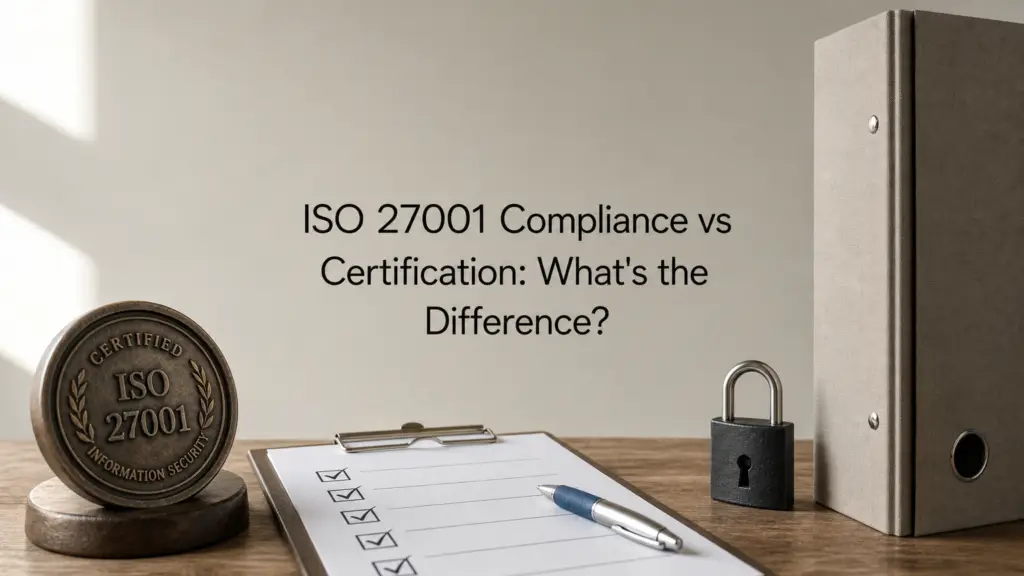
You’ve probably heard “ISO 27001 compliant” and “ISO 27001 certified” used as if they mean the same thing. They don’t, and the difference matters when a client, insurer, or tender board asks you to prove it. Understanding iso 27001 compliance vs certification is the first step to picking the right path for your organisation, rather than spending months on the wrong one.
Compliance means you’ve built your practices around the standard’s requirements. Certification means an accredited body has independently audited you and confirmed it. One is a self-assessed claim; the other is a formal, verifiable credential that carries weight with customers, regulators, and insurers. Many businesses also compare SOC 2 and ISO 27001 side by side, since both prove security maturity but suit different markets and audit styles.
This article breaks down what each status involves, where SOC 2 compliance and ISO 27001 diverge in scope and reporting, and how to judge which route fits your resources and risk profile. We work with organisations on this decision every day, from initial gap assessments through full ISO 27001 consultancy and certification support, so we built this guide around the questions clients ask us most often.
Why the compliance vs certification distinction matters
Most of the confusion starts with language. Businesses say “we’re ISO 27001 compliant” when they mean they’ve read the standard, written some policies, and believe they’re doing the right things. That’s a reasonable starting point, but it’s an internal claim with no external verification. Compliance is a state you declare, and nobody outside your organisation has checked whether the declaration holds up under pressure. That gap becomes a real problem the moment a customer, insurer, or regulator asks for proof rather than a promise.
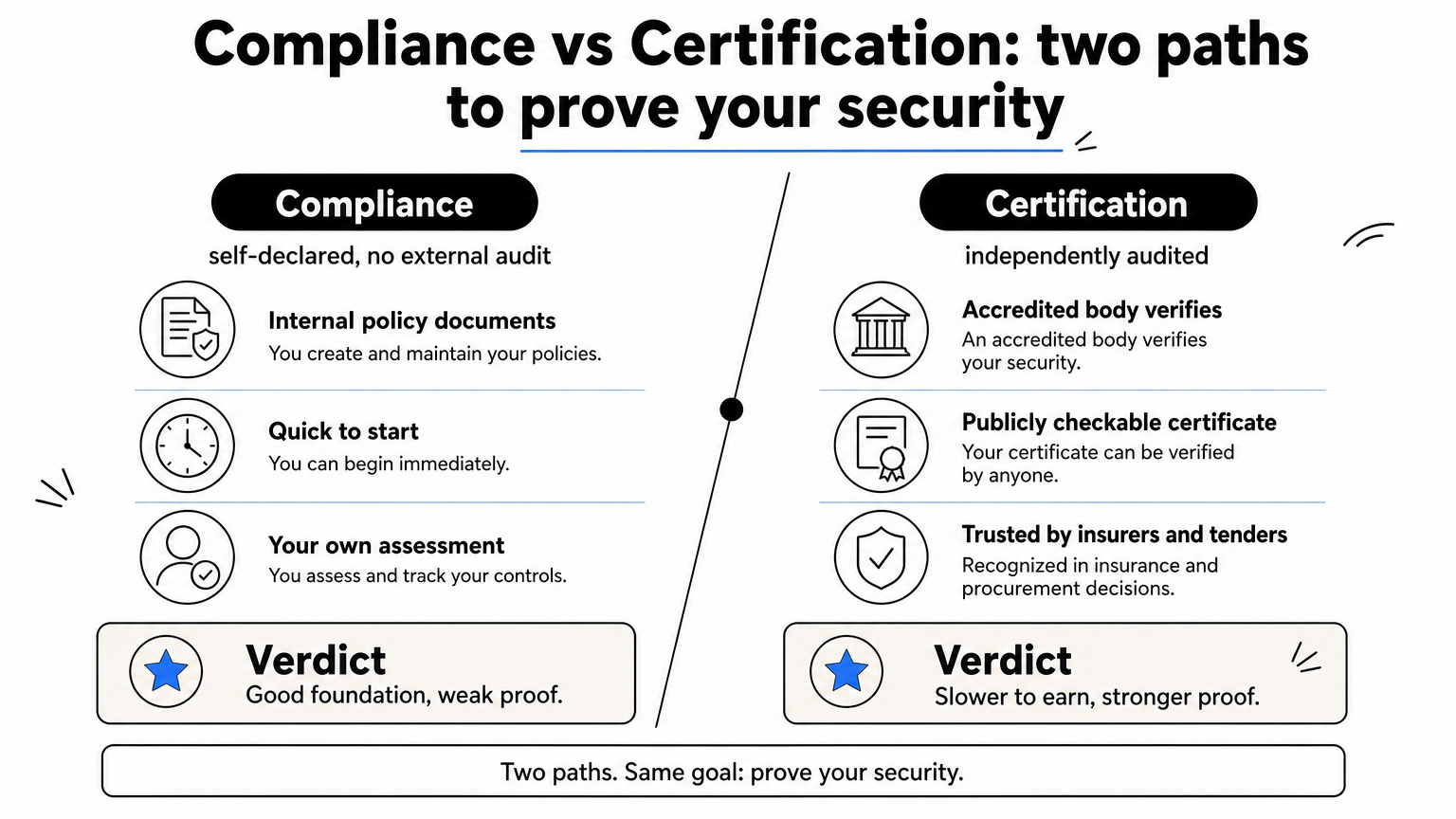
Self-declared compliance rarely survives scrutiny
Procurement teams and cyber insurers have learned to ask pointed follow-up questions. If you tell a prospective client you’re compliant, the next question is usually “can we see your certificate?” or “who audited you?” Without a third-party audit trail, you’re left explaining a process rather than presenting evidence. This isn’t a technicality. Insurers increasingly use ISO 27001 status as a factor in underwriting cyber cover, alongside the security controls cyber insurers expect, and enterprise clients running vendor risk assessments will often filter out suppliers who can’t produce a certificate, regardless of how secure their environment is.
Compliance tells people what you believe about your security. Certification tells them what an independent auditor found.
Certification as a verifiable credential
Certification changes the conversation entirely. An accredited certification body examines your information security management system (ISMS), tests it against the standard’s clauses and Annex A controls, and issues a certificate that’s logged with a recognised accreditation scheme. That certificate is checked annually through surveillance audits and renewed every three years, so it stays current rather than becoming a one-off badge. The UK Accreditation Service (UKAS), and equivalent bodies internationally, maintain public registers of accredited certification bodies, which gives buyers a way to verify your certifier is legitimate, not just your certificate.
| Aspect | Compliance | Certification |
|---|---|---|
| Verification | Self-assessed, internal | Independent, third-party audited |
| Proof for clients/insurers | Statement or policy documents | Formal certificate, publicly verifiable |
| Ongoing checks | None mandated | Annual surveillance audits, 3-year recertification |
| Typical use case | Early-stage security programmes | Tenders, contracts, insurance requirements |
| Credibility with regulators | Limited | Recognised industry standard |
Where the confusion causes real damage
Getting this wrong costs businesses more than embarrassment. We’ve seen organisations lose contract bids after telling a procurement panel they were “ISO compliant,” only to be asked for a certificate number they couldn’t provide. We’ve also seen the reverse: businesses that assumed compliance alone would satisfy a cyber insurance renewal, only to find their premium jumped or cover was declined outright because the insurer specifically required certified status. Neither outcome is rare, and both are avoidable once you understand which credential a given situation actually demands.
Think about who’s asking and why before you decide which route to pursue:
- A tender or contract clause naming “ISO 27001 certified” as a requirement means compliance alone won’t qualify you, no matter how strong your controls are.
- An insurer’s proposal form may accept compliance as a starting signal, but certification usually secures better terms.
- A customer’s vendor questionnaire might accept evidence of an active ISMS without a full certificate, particularly for smaller suppliers.
- Your own risk appetite matters too. Even without external pressure, working towards certification forces a rigour that informal compliance rarely achieves on its own.
The distinction, in short, isn’t academic. It determines whether the work you’re doing translates into something you can actually put in front of a client, an insurer, or an auditor when it counts.
How to decide between compliance and certification
Deciding between compliance and certification starts with asking who needs proof of your security posture, and how soon. If you’re chasing enterprise contracts, government tenders, or better cyber insurance terms, certification is usually non-negotiable within twelve to eighteen months. If you’re an early-stage business building your information security management system from scratch, working towards compliance first often makes more sense financially and operationally, giving you a foundation before you pay for an external audit.

Weigh the cost and time trade-off
Budget realistically before committing to either path. Compliance work is mostly internal labour, policy writing, risk assessments, and staff training, so the main cost is time rather than fees. Certification adds external audit costs, a certification body’s day rates, and often consultancy support to prepare for stage one and stage two audits. Most organisations we work with spend six to twelve months preparing before the first audit, depending on how mature their existing controls already are.
- Small teams with limited security history: budget closer to twelve months, expect meaningful process changes (not just documentation), and see what certification looks like for a small business.
- Organisations with an existing ISMS or ISO 9001 background: certification readiness can often be reached in six to nine months.
- Businesses under contractual deadline pressure: a gap assessment early on tells you exactly how far you are from audit-ready, so you’re not guessing.
If a client, insurer, or regulator will eventually ask for proof, plan for certification from day one rather than retrofitting it later.
Consider your growth trajectory and market
Growth plans should shape the decision as much as current pressure does. A business planning to sell into larger enterprises, government frameworks, or regulated sectors within the next two years should treat certification as inevitable rather than optional and start the groundwork now, while no deadline forces rushed decisions. Smaller suppliers serving a stable, undemanding customer base might reasonably stay at the compliance stage longer, revisiting the question each time a new contract or partnership raises the bar.
Ultimately, the right answer depends on evidence, not instinct. Run a proper gap analysis against the standard’s clauses and Annex A controls before committing budget either way. It tells you precisely where your current practices sit relative to certification requirements, which turns a vague strategic question into a concrete, costed project plan.
ISO 27001 vs SOC 2: which route suits your organisation

American and SaaS-heavy markets tend to ask for SOC 2 rather than ISO 27001, and the two standards aren’t interchangeable even though they cover similar ground. SOC 2 is an American Institute of CPAs (AICPA) framework built around five “trust services criteria”: security, availability, processing integrity, confidentiality, and privacy. Rather than a certificate, you get a detailed audit report written by a licensed CPA firm, describing your controls and whether they operated effectively over a defined period. ISO 27001, by contrast, results in a certificate backed by an accredited body and a documented ISMS that covers the whole organisation, not just one product or service line.

Choose ISO 27001 for international, regulator-facing credibility; choose SOC 2 when your buyers are US-based SaaS customers expecting a detailed audit report.
Comparing scope, audience, and output
Getting this decision right means comparing them on the dimensions that actually affect your buyers, not just the acronym they recognise.
| Aspect | ISO 27001 | SOC 2 |
|---|---|---|
| Governing body | Accredited certification bodies (via UKAS or equivalent) | Licensed CPA firms (AICPA framework) |
| Output | Certificate, valid for 3 years with annual surveillance | Detailed report, typically renewed annually |
| Primary audience | International clients, regulators, insurers | US enterprise and SaaS buyers |
| Scope | Whole-organisation ISMS | Specific systems or services |
| Type I vs Type II | N/A | Type I (point-in-time) or Type II (over a period) |
Deciding which credential your buyers actually want
Questions about SOC 2 and ISO 27001 compliance usually come from businesses selling into both UK and US markets, and the honest answer is that you may eventually need both. If your pipeline is dominated by European or UK public sector contracts, ISO 27001 certification is the safer default because procurement teams there recognise it instinctively. If you’re selling SaaS into American enterprise accounts, a SOC 2 Type II report often closes deals faster than an ISO certificate, because their security teams are trained to request it.
Neither standard makes the other redundant, and running both isn’t wasted effort. Many controls overlap enough that achieving ISO 27001 certification first makes a subsequent SOC 2 report considerably faster to prepare, since your risk assessments, policies, and evidence trail are already in place.
Practical steps to achieve ISO 27001 certification
Getting certified follows a fairly predictable sequence, regardless of your industry or size. Skipping stages rarely saves time; it just moves the delay to a failed audit instead of a planning meeting. Below is the route we walk clients through to get ISO 27001 certified, from the first scoping conversation to certificate in hand.
Scope, assess, and build the ISMS
Start by defining the scope of your ISMS, which locations, systems, and services it covers, since a narrow scope is easier to certify quickly but may not satisfy every client asking for proof. Follow that with a gap analysis against Annex A’s controls and the standard’s core clauses, which tells you exactly which policies, risk treatments, and technical controls are missing. From there, build out the ISMS itself: risk assessment methodology, a risk treatment plan, an information security policy suite, and evidence that staff actually follow them, not just documents sitting in a folder.
- Define scope: agree which business units, sites, and systems the ISMS covers.
- Run a gap analysis: map current controls against Annex A and the standard’s clauses.
- Build the ISMS: write policies, complete risk assessments, and implement technical controls, following a step-by-step implementation plan.
- Train staff: ISO 27001 security awareness training requirements mean awareness needs to be demonstrable, not assumed.
- Run internal audits: test the system yourself before an external auditor does.
Choose an accredited body and prepare for audit
Selecting an accredited certification body matters more than businesses expect. Check it’s accredited by UKAS or an equivalent recognised national accreditation scheme, because an unaccredited certificate carries far less weight with insurers and procurement teams, sometimes none at all. Once appointed, you’ll go through the stage one and stage two audit process: a documentation review checking your ISMS is designed correctly, followed by an audit where the auditor tests whether controls actually operate as described. Any nonconformities raised get a corrective action deadline before certification is issued.
Certification is earned in the stage two audit, not the paperwork that precedes it, so build evidence of real practice, not just policy.
Maintain it after the certificate arrives
Certification isn’t a one-off achievement, so it pays to understand how to maintain ISO 27001 certification. Surveillance audits happen annually to confirm the ISMS is still operating, and full recertification is due every three years. Ongoing maintenance means keeping risk assessments current, running internal audits regularly, and updating controls as your business, suppliers, and threat landscape change. Organisations that treat certification as a finish line rather than an ongoing programme are the ones that struggle at surveillance audits, so build the review cycle into your calendar from the start, not as an afterthought once the certificate is framed on the wall.
Making the right choice for your organisation
Weighing iso 27001 compliance vs certification always comes back to one question: who needs proof, and what will they accept as evidence? Compliance builds the foundation and suits early-stage security programmes with no immediate external pressure. Certification proves it independently, and that’s what tenders, insurers, and enterprise buyers increasingly demand before they’ll sign anything. Whether you’re weighing SOC 2 compliance vs ISO 27001, or trying to work out if you need both, the answer depends on your market, your buyers, and how much rigour your current controls can actually withstand under audit.
Guessing at this decision wastes months and budget you won’t get back. A proper gap assessment turns the question into a costed, realistic plan rather than an open-ended debate. If you want that clarity before committing resources either way, talk to TrustedIA about an ISO 27001 gap analysis and remediation roadmap and get a route mapped out that actually fits your organisation.