Ask five IT managers to define these two terms and you’ll likely get five different answers, half of which use the words interchangeably. That confusion causes real problems. Teams patch a handful of visible flaws and assume they’re covered, while attackers walk in through gaps nobody scanned for. Understanding vulnerability management vs patch management matters because each addresses a different part of your risk exposure, and mixing them up leaves holes in your defences.
In short, patch management is the operational task of applying vendor updates to fix known software issues. Vulnerability management is the broader, continuous process of identifying, assessing, and prioritising security weaknesses across your entire environment, the discipline often called threat and vulnerability management, of which patching is just one response. One fixes what’s already been found; the other keeps finding what needs fixing.
This article breaks down how each process actually works day to day, where they overlap, and why relying on patching alone leaves you exposed to configuration errors, unsupported systems, and zero-day risks. We’ll also look at how the two fit together within a proper cyber security strategy, and what that means practically for businesses working towards standards like ISO 27001.
Why the difference matters for your cybersecurity strategy
Treating patch management as your whole security programme is one of the most common mistakes we see in cyber audits. Patching fixes what a vendor has already flagged, but it says nothing about misconfigured firewalls, weak access controls, unsupported legacy systems, or the zero-day flaws that haven’t made it into a patch cycle yet. A business that patches diligently every month can still be sitting on a dozen unaddressed weaknesses that no update will ever touch. This is exactly why the vulnerability management vs patch management distinction isn’t academic. It shapes whether your business is actually reducing risk or just ticking a box.

Patching closes known doors. Vulnerability management checks the whole building for windows left open.
What patch management alone misses
Here’s a practical list of gaps that patching never covers, regardless of how quickly your team rolls out updates:
- Configuration errors: an open port, a default password, or an overly permissive firewall rule that no patch will ever fix.
- Unsupported or end-of-life systems: vendors stop releasing patches, but the software often stays in production for years.
- Zero-day vulnerabilities: flaws exploited before a fix exists, which only proper monitoring and layered defences catch.
- Third-party and supply chain risk: weaknesses in software you rely on but don’t control directly.
- Human and process weaknesses: phishing susceptibility, weak credential policies, or unmanaged shadow IT.
Each of these needs a continuous risk assessment process, not a patch schedule. Vulnerability management exists precisely to surface these blind spots before they turn into incidents.
The compliance angle: ISO 27001 and risk-based thinking
Organisations working towards ISO 27001 compliance, and looking closely at the scope and controls ISO 27001 covers, quickly discover that auditors expect evidence of ongoing risk identification, not just a patching log. ISO 27001’s Annex A control set requires a documented approach to technical vulnerability management, including scanning frequency, remediation timelines, and prioritisation criteria based on business impact. A company that can only show patch deployment records, with no record of vulnerability scans, asset inventories, or risk scoring, will struggle to satisfy that requirement. Bodies like the UK’s National Cyber Security Centre also stress that vulnerability management should be a structured, risk-based process rather than a reactive one, and their guidance on vulnerability management underlines why prioritisation matters as much as speed.
Getting this right also changes how you allocate resources. Not every vulnerability deserves the same urgency. A critical flaw on an internet-facing server handling customer data warrants same-day attention. A medium-severity issue on an isolated internal test machine can wait for the next maintenance window. Patch management, taken in isolation, doesn’t build in that judgement. It’s built for compliance with vendor release schedules, not for weighing business risk. Vulnerability management supplies the context that turns patching from a checklist exercise into a genuinely risk-reducing activity.
What happens when the two get conflated
Conflating the two processes tends to produce a false sense of security. Teams report high patch compliance percentages to leadership and assume the job is done, while the actual attack surface, unpatched applications no one tracked, cloud misconfigurations, exposed APIs, remains invisible. Several major breaches over the past decade trace back not to missing patches but to unmanaged vulnerabilities that sat outside the patch cycle entirely: an exposed database, a forgotten test server, an overly broad access permission granted years earlier and never revisited.
Small and medium-sized businesses feel this gap most acutely because they typically lack the in-house resources to run both processes properly at the same time. IT teams stretched across help desk tickets, infrastructure projects, and security often default to whichever task feels most concrete, and patching wins because it has a clear, measurable output. Vulnerability management, by contrast, requires ongoing scanning, analysis, and prioritisation, work that’s easy to defer when nothing looks broken yet. That’s precisely the gap our vulnerability assessment and penetration testing services are built to close, giving businesses a continuous view of their exposure rather than a snapshot taken once a year during an audit.
How to build an integrated vulnerability and patch management process
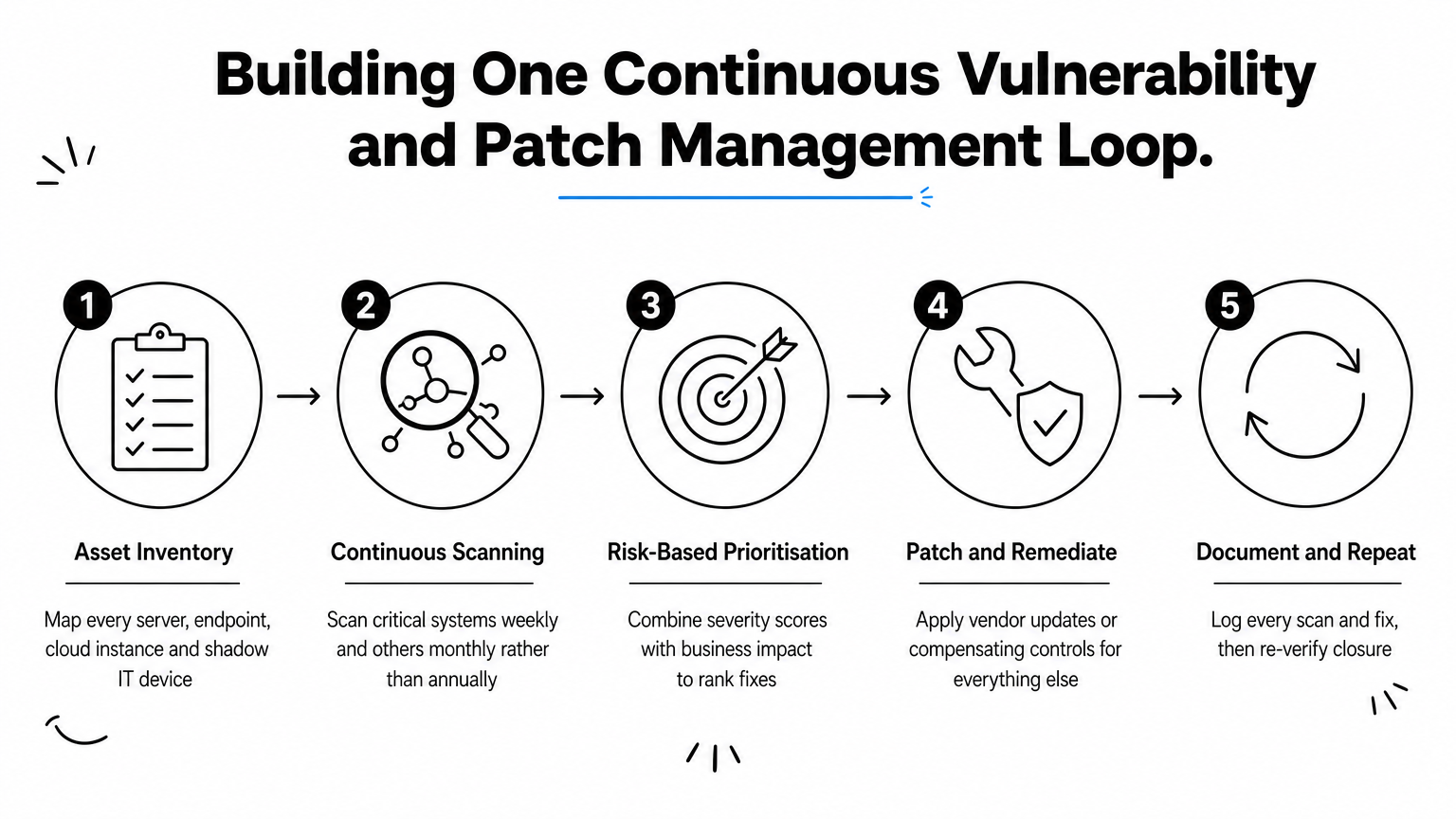
Building a workable process starts with accepting that vulnerability management and patch management aren’t competing systems, they’re sequential stages of the same workflow. Vulnerability management finds and ranks the risks; patch management (alongside other remediation actions) closes them. Businesses that treat this as one continuous loop, rather than two separate departments, cut their exposure window dramatically and stop wasting effort on low-priority fixes while critical gaps sit untouched.
Vulnerability management without patching is just a report nobody actioned. Patching without vulnerability management is guesswork dressed up as diligence.
Start with a complete asset inventory
Anything you don’t know exists can’t be scanned, patched, or protected. Before any tooling gets deployed, map every server, endpoint, cloud instance, and third-party application in your environment, including the shadow IT that IT teams often discover only during an audit. This inventory becomes the baseline against which every future scan is measured, and it’s usually the single biggest gap we find during a network infrastructure audit.
Run continuous scanning, not periodic checks
Once your inventory is solid, schedule automated scanning from inside and outside the perimeter rather than relying on annual reviews. Attackers exploit new vulnerabilities within days of public disclosure, so scanning quarterly leaves months of blind exposure. A practical cadence looks like this:
- Critical, internet-facing systems: weekly or continuous scanning
- Internal servers and infrastructure: monthly scanning
- Endpoints and workstations: monthly, tied to patch cycles
- Third-party and cloud services: quarterly, plus vendor security bulletins
Prioritise using business risk, not just severity scores
A CVSS score tells you how severe a flaw is in theory. It doesn’t tell you whether that flaw sits on a customer-facing payment system or an isolated test box nobody touches. Combine the technical severity score with asset context, exposure, and business impact to build a prioritisation matrix, much as a NIST-aligned prioritisation approach does. This step is where vulnerability management vs patch management stops being a semantic debate and becomes an operational decision: which fixes go out today, and which wait for the scheduled maintenance window.
Patch, remediate, and verify
With priorities set, patch management takes over for anything a vendor update resolves. For everything else, misconfigurations, unsupported systems, weak access controls, remediation means changing settings, isolating systems, or applying compensating controls. Verification matters just as much as the fix itself. Re-scan after every patch cycle to confirm the vulnerability is actually closed, not just that an update was installed. We’ve seen patches deploy successfully while the underlying flaw remained exploitable due to a configuration conflict.
Document, report, and repeat
Finally, log every scan, decision, and remediation action. This documentation does double duty: it satisfies the records ISO 27001 expects you to keep, and it gives your team a historical record to spot recurring weak points. Organisations without in-house resources to run this loop consistently often lean on an outsourced security operations centre to keep scanning, prioritisation, and reporting moving without gaps, which is exactly the continuous coverage a mature process demands rather than a once-a-year fire drill.
Vulnerability management vs patch management: a side-by-side comparison
Sometimes the clearest way to settle the patch management vs vulnerability management debate is to line the two up feature by feature. Once you see them side by side, the differences stop feeling abstract and start explaining why one process can’t substitute for the other.

The comparison table
The table below breaks down the two processes across the areas that matter most when you’re building or auditing a security programme.
| Aspect | Vulnerability Management | Patch Management |
|---|---|---|
| Scope | Entire attack surface: software, configurations, access controls, third-party services | Known software flaws with an available vendor fix |
| Frequency | Continuous scanning and reassessment | Scheduled cycles, typically monthly or on vendor release |
| Primary output | Prioritised risk register with remediation actions | Deployed updates confirming systems are current |
| Handles zero-days? | Yes, through detection and compensating controls | No, by definition there’s no patch yet |
| Handles misconfigurations? | Yes | No |
| Owned by | Security or risk team, often supported by external audits | IT operations or infrastructure team |
| Compliance role | Satisfies risk assessment requirements under ISO 27001 Annex A | Provides evidence of technical control implementation |
| Failure mode if done alone | Risks identified but never closed | Systems updated but blind to unmanaged risk |
Reading the table in practice
Notice how narrow the patch management column looks once you set it against the full scope of vulnerability management. That’s not a criticism of patching, it’s simply what the task was designed to do. Patch management is a subset activity, a tool inside a bigger toolbox, not a replacement for the toolbox itself. Where vulnerability management asks "what’s exposed and how bad is it", patch management answers "has the fix shipped and did it install".
A patch report tells you what’s been updated. A vulnerability report tells you what’s still at risk.
Ownership is another row worth pausing on, because who owns each stage of vulnerability management needs defining explicitly. In smaller businesses, the same person often runs both processes, which makes the distinction feel unnecessary until an audit or incident exposes the gap. Larger organisations tend to split ownership between IT operations, who chase patch deployment metrics, and a security or risk function, who track the broader vulnerability register. Neither model is wrong, but whichever you use, someone needs to own the connection between the two, otherwise vulnerabilities get identified and then sit unassigned.
Where the columns meet
Remediation timelines are the clearest overlap point. A vulnerability scan surfaces a missing patch, that finding feeds into the patch management queue, and the patch deployment closes the loop back in the vulnerability register once verified. Treat these as connected columns in the same spreadsheet, not two separate reports living in different systems, and you avoid the common failure mode where a critical finding gets logged, acknowledged, and then quietly forgotten because no patch ticket was ever raised against it.
Common mistakes that weaken both processes
Even businesses that understand the theory behind vulnerability management vs patch management still trip over the same operational mistakes. These errors rarely show up until an audit or an incident forces a closer look, by which point the gap has usually existed for months.
Chasing patch compliance percentages instead of risk reduction
Boards and IT managers love a clean number, so "98% patch compliance" becomes the headline metric in monthly reports. That figure says nothing about the 2% left unpatched, which is often where the highest-risk systems sit. A missed patch on an internet-facing server matters far more than a missed patch on an isolated printer, yet both count equally in a simple percentage. Judging success by coverage alone, rather than by which risks actually got closed, is one of the fastest ways to build false confidence.
A high patch compliance score can hide the one unpatched system that gets you breached.
Treating vulnerability scans as a compliance checkbox
Running a scan once a year purely to satisfy an auditor defeats the purpose of continuous vulnerability management. Threats evolve daily, and a scan taken in January tells you nothing about what’s exposed by June. Businesses working towards ISO 27001 in particular need to show ongoing scanning cadence, not a single annual snapshot, otherwise the evidence trail looks thin the moment an assessor asks follow-up questions.
Letting findings and fixes live in separate systems
When the vulnerability register sits in one spreadsheet and the patch queue sits in a different ticketing tool, findings fall through the cracks. Nobody owns the handoff, so critical issues get logged, acknowledged, and quietly forgotten. The fix is procedural, not technical: every vulnerability finding needs a corresponding remediation ticket, tracked to closure and re-verified.
Ignoring assets outside the core network
Shadow IT, forgotten test servers, and cloud instances spun up for a single project rarely make it into either scanning schedules or patch cycles. They sit unmanaged until someone finds them the hard way, which is why mapping and monitoring your external attack surface has to be continuous. A few recurring blind spots worth checking today:
- Cloud storage buckets left with default or overly permissive access settings
- Decommissioned staging environments still running production data
- Third-party vendor portals with credentials nobody has rotated in years
- Personal or BYOD devices connecting to company resources outside standard patch management
Underinvesting in remediation capacity
Finally, many businesses invest heavily in detection tools but underfund the team actually fixing what gets found. Scanning software is only as useful as the hours available to act on its output. When remediation lags behind detection, the vulnerability backlog grows faster than anyone can clear it, and prioritisation collapses into whoever shouts loudest. Businesses without dedicated in-house capacity often turn to services like TrustedIA’s incident response and recovery support, working through the steps needed to prepare for and recover from an incident, to close that gap when a vulnerability turns into an active incident rather than discovering the shortfall mid-breach.
Bringing vulnerability and patch management together
Getting vulnerability management vs patch management right isn’t about picking one over the other. Patching closes known gaps quickly and efficiently, but it only ever answers questions someone already asked. Vulnerability management keeps asking new ones, surfacing misconfigurations, unsupported systems, and risks patching was never designed to catch. Run them as one connected process, with shared ownership and a single tracking system, and you stop findings from sitting unassigned while attackers exploit exactly those blind spots.
Businesses that treat this as a continuous loop, rather than a once-a-year audit exercise, build genuine resilience instead of a compliance illusion. That distinction matters whether you’re chasing ISO 27001 certification or simply trying to sleep easier at night. If you’d rather have that loop managed properly than pieced together internally, talk to us about managed security services with 24/7 monitoring and we’ll show you what continuous coverage actually looks like.