Staring at a blank document while your compliance deadline creeps closer is not how you want to spend a Tuesday afternoon. Most IT managers and business owners searching for business continuity management plan examples aren’t after a theory lesson, they want to see what a working plan actually looks like before they write their own.
This article gives you exactly that. We’ve pulled together eight real-world formats covering different business sizes, sectors and risk profiles, so you can see how organisations structure their recovery priorities, communication trees, and resource lists without starting from zero. Each example highlights the sections that auditors and insurers actually check, which matters if ISO 22301 or ISO/IEC 27001 certification is on your radar.
We’ve spent over 30 years helping businesses build continuity plans that hold up under real incidents, not just on paper. Below, you’ll find practical templates you can adapt, along with a business continuity plan template to work from, plus notes on where each example succeeds and where it falls short, so your plan doesn’t repeat the same gaps we see time and again during cyber incident response work.
1. Cyber attack and data breach continuity plan
This is the plan most businesses need first, because ransomware incident response and data breach recovery now cause more operational downtime than fire or flood combined. A cyber attack continuity plan documents exactly what happens in the minutes after you spot suspicious activity, not the days after, when the damage is already spreading through your network.
Scenario and key risks
Picture this: your finance team can’t access the accounting system, several files carry a ransom note, and nobody knows if customer data left the building. The key risks in this example of a business continuity plan include encrypted or stolen data, compromised backups (a mistake we see constantly), regulatory reporting deadlines under UK GDPR, and reputational fallout if customers hear about the breach before you tell them yourself.
Recovery strategy
The recovery strategy in this template runs on a strict sequence, not a checklist you tackle in any order:
- Isolate affected systems within the first hour to stop lateral movement.
- Verify backup integrity before any restoration begins.
- Engage forensic support to establish the entry point and scope.
- Notify the ICO within 72 hours if personal data is involved, following the standard data breach notification steps.
- Restore from clean backups in priority order, starting with revenue-generating systems.
- Communicate to staff, customers and insurers using pre-approved templates.
A cyber continuity plan only works if it assumes your first backup attempt will fail.
That assumption changes everything about how the plan is written. Good examples build in a secondary recovery path and name the exact tool or service, such as endpoint detection and a dedicated security operations centre, that triggers the isolation step automatically rather than relying on someone noticing in time.
Roles and responsibilities
Given the speed these incidents move at, this example assigns a named incident commander with authority to take systems offline without waiting for sign-off, alongside a communications lead, a technical lead who liaises with external responders, and a legal or compliance contact who manages regulatory notifications. Without that pre-agreed authority, decisions stall exactly when speed matters most.
Who this example suits
However, this format suits businesses that hold sensitive customer data, process payments, or operate systems that would halt trading if taken offline, which in practice means most SMBs and enterprises today. Organisations working towards ISO 27001 certification will recognise this structure closely, since auditors specifically look for evidence of tested recovery paths and named responders rather than a generic policy statement. If you’re building this section from scratch, our rapid containment and recovery specialists work from a similar structure with insurers and loss adjusters daily, so it’s a solid reference point for what a plan needs to survive contact with a real attack rather than just an audit.
2. Small business continuity plan example
Most small businesses don’t need a 40-page document, they need something that fits on a few sides of paper and actually gets read before an incident, not filed away after one, which is the whole point of continuity planning at a small business scale. This example of a business continuity plan strips out the corporate layers and focuses on what a five to fifty person business genuinely needs to keep trading through a disruption.
Scenario and key risks
Think of a local accountancy firm or independent retailer that loses its only office to a burst pipe, or whose sole server fails with no IT department to call. The key risks here are single points of failure, thin cash reserves that can’t absorb weeks of lost trading, and owner-dependency, where one person holds all the passwords, supplier contacts and client knowledge in their head rather than on paper.
Recovery strategy
Recovery in this format relies on simplicity over sophistication. Owners typically list three things: where staff work from if the office is unusable, how quickly a replacement laptop or server can be sourced, and which three or four suppliers or clients get contacted first. Cloud-based accounting and email systems make this far easier than it was a decade ago, since data doesn’t live on one physical machine.
A small business continuity plan fails the moment it depends on one person who isn’t available.
Roles and responsibilities
Structure matters even at this scale. Rather than a full incident team, this example usually names a single backup decision-maker, often a deputy or trusted employee, who can access supplier lists, insurance documents and the emergency fund without waiting on the owner. A short contact sheet, updated quarterly, replaces the elaborate communication trees larger organisations rely on.
Who this example suits
Sole traders, family businesses, and companies under 50 staff without a dedicated IT or compliance function suit this format best. It won’t satisfy an ISO 27001 auditor on its own, but it gives owners something workable to build from before scaling up the detail as the business grows, and our guide to ISO 27001 for small businesses covers what that scaling involves.
3. IT and software company continuity plan example
Software vendors and managed IT providers face a different problem to most businesses: their product is uptime itself, so a continuity plan here reads more like a technical runbook than a policy document. This IT continuity plan example focuses on service level agreements, redundant infrastructure and the contractual penalties that kick in the moment a platform goes dark.
Scenario and key risks
Imagine a SaaS provider whose primary data centre suffers a power failure during peak trading hours, or a codebase that gets corrupted mid-deployment with no rollback tested. Key risks include breached SLAs with enterprise clients, cascading failures across dependent third-party APIs, and developers who assume someone else owns the disaster recovery runbook until an incident proves otherwise.
Recovery strategy
Recovery here depends on infrastructure that fails over automatically rather than manually, often built on an image-based backup and recovery platform, so the plan typically documents:
- Multi-region hosting with automated failover thresholds
- A tested rollback procedure for every deployment
- Status page updates published within minutes, not hours
- Client-facing SLA credits triggered automatically once downtime is confirmed
A software company’s continuity plan is only as good as its last untested failover.
Untested failover is the gap we find most often during network audits, and it’s usually the one clients discover during a live incident rather than a drill, long after their RTO and RPO targets were agreed on paper.
Roles and responsibilities
Given the technical nature of these incidents, responsibility sits with an on-call engineering lead, a client communications owner separate from engineering, and a product manager who decides when to invoke degraded-mode operation. Escalation paths must name individuals, not just teams, because a shared inbox rarely gets checked at 3am.
Who this example suits
SaaS businesses, managed service providers and any company selling uptime as part of its contract will recognise this structure immediately. If your clients ask about your own resilience during procurement, pairing this plan with regular vulnerability assessments gives them evidence, not just assurances.
4. Manufacturing continuity plan example
Manufacturers lose money the moment a production line stops, so this business continuity plan example focuses on physical assets and supply chains rather than data alone. Unlike a software business, downtime here is measured in units not shipped, not just customer complaints, which changes what the plan needs to prioritise first.

Scenario and key risks
Suppose a key supplier goes into administration overnight, or a critical piece of machinery fails with a six-week lead time on replacement parts. Key risks in this example of a business continuity plan include single-supplier dependency, machinery with no maintenance contract or spare parts on site, and health and safety exposure if a disruption forces staff to work around damaged equipment under pressure to keep output moving.
Recovery strategy
Recovery strategy here centres on alternatives identified before they’re needed, not scrambled together during the crisis itself:
- Pre-qualified secondary suppliers for critical raw materials
- Service contracts guaranteeing parts and engineer callout within 48 hours
- Manual workarounds documented for any process that relies on a single automated system
- Stock buffers sized against realistic worst-case lead times, not average ones
A manufacturing continuity plan is only credible if the backup supplier has actually been tested with a real order.
That testing step gets skipped constantly, and it’s usually the reason a “qualified” secondary supplier turns out to be unable to deliver at the volume or quality needed when it actually matters, which is why knowing how to test a continuity plan counts for more than writing one.
Roles and responsibilities
Responsibility typically sits with an operations manager who holds authority to activate secondary suppliers without board sign-off, a health and safety lead who assesses whether the site remains safe to operate, and a logistics coordinator who manages customer delivery commitments during the disruption. Named deputies matter here too, since shift patterns mean the usual decision-maker isn’t always on site.
Who this example suits
This format suits manufacturers, engineering firms and any business where physical output depends on machinery, suppliers or a specific site. If your continuity plan hasn’t been stress-tested against a supplier failure in the last year, our network auditing service is a practical place to check where the real gaps sit.
5. Retail and hospitality continuity plan example
Retail and hospitality businesses live or die by footfall and transaction volume, so this continuity business plan example focuses on keeping tills running and doors open rather than data recovery alone. A pub, restaurant or shop that can’t take payment for even an hour on a Saturday loses revenue it never gets back, which makes speed the priority over documentation depth.
Scenario and key risks
Picture a card payment system going down during a busy weekend service, or a fire alarm forcing an evacuation mid-trade at a shopping centre location. Key risks in this example include card payment outages, perishable stock loss during extended closures, seasonal staff who’ve never seen the continuity plan, and multi-site businesses where head office loses visibility of what’s actually happening on the ground.
Recovery strategy
Recovery here relies on manual fallbacks that staff can execute without waiting for instructions:
- A backup payment method, such as a mobile card reader on a separate network
- A printed contact list for utility providers and landlords, since staff can’t always access a laptop mid-crisis
- Stock write-off procedures agreed with insurers in advance
- Clear guidance on when to close a site versus trade through the disruption
A hospitality continuity plan only earns its place if a shift supervisor can run it without calling head office first.
That last point separates plans that work from ones that look good on paper, because the person on shift during an incident is rarely the person who wrote the document, and it’s one of the continuity planning practices UK SMEs get wrong most often.
Roles and responsibilities
Site managers typically hold day-to-day authority, backed by a regional or area manager who can approve stock write-offs and staff reassignment across locations. A single point of contact handles supplier and landlord communication, keeping messaging consistent across multiple sites.
Who this example suits
Retailers, restaurants, pubs and hotel groups with multiple trading locations suit this format best. If your business handles card payments across several sites, pairing this plan with regular vulnerability assessments helps confirm your payment infrastructure holds up under the same pressure your continuity plan assumes it will.
6. Healthcare organisation continuity plan example
Healthcare providers carry a duty of care that most other sectors don’t, so this business continuity management plan example puts patient safety above every other consideration, including financial loss. GPs, dental practices, care homes and clinics all rely on systems that hold sensitive medical records, which makes this one of the more heavily scrutinised plans an auditor will ask to see, and anyone contracting with the health service should also read our guide to the NHS business continuity plan.
Scenario and key risks
Suppose a patient records system goes offline during clinic hours, or a ransomware attack locks appointment scheduling and prescription histories at once. Key risks in this example of a business continuity plan include loss of access to patient data, missed medication or treatment windows, safeguarding information becoming unreachable, and regulatory exposure under both UK GDPR and Care Quality Commission requirements if records can’t be produced on request.
Recovery strategy
Recovery strategy here prioritises continuity of care over system restoration speed alone:
- Paper-based fallback processes for appointments and prescriptions, rehearsed rather than just written down
- Offline access to critical patient information for emergencies
- Clear triage rules for which appointments proceed and which get postponed
- Escalation to NHS or partner organisations when a site can’t safely continue operating
A healthcare continuity plan succeeds only if staff can still treat patients safely with the system switched off.
That single test, whether care can continue without the software, separates plans built for auditors from plans built for patients.
Roles and responsibilities
A clinical lead typically decides whether patient safety allows the site to keep operating, while a data protection officer manages regulatory notification and an IT contact coordinates recovery of the underlying systems. Reception and admin staff need clear, rehearsed instructions too, since they’re usually first to notice something’s wrong.
Who this example suits
GP surgeries, dental practices, care homes and private clinics handling patient data suit this format closely. Given the sensitivity involved, pairing this plan with 24/7 monitoring and expert protection gives smaller practices the detection and response capability they rarely have in-house.
7. Financial services continuity plan example
Financial firms answer to regulators before anyone else, so this business continuity plan example treats regulatory reporting and client fund protection as non-negotiable rather than aspirational goals. Banks, insurers, brokers and wealth managers all operate under FCA SYSC 4.1 and 13.8 continuity obligations that demand documented resilience, which means this plan gets tested by regulators, not just internal auditors.
Scenario and key risks
Imagine a trading platform going offline during market hours, or a core banking system failing while client withdrawals are mid-process. Key risks in this example of a business continuity plan include transaction processing failures, breach of FCA operational resilience rules, loss of client fund segregation records, and reputational damage that spreads fast when money movement stops without explanation.
Recovery strategy
Recovery here runs on strict impact tolerances agreed in advance, not decided during the incident itself:
- Defined maximum tolerable downtime for each critical business service
- Real-time transaction logging that survives a full system failure
- Alternative trading or processing venues pre-agreed with counterparties
- FCA notification procedures triggered automatically once impact tolerance is breached
A financial services continuity plan only holds up if impact tolerances were tested, not just written down.
That testing requirement comes straight from the FCA’s operational resilience rules, which expect firms to prove they can stay within tolerance during a severe but plausible disruption, not simply claim they can.
Roles and responsibilities
Responsibility typically sits with a board-level operational resilience owner, a compliance lead who manages regulatory reporting, and a treasury or operations lead who protects client funds during the disruption. Named deputies matter more here than almost anywhere else, since regulatory deadlines don’t pause for annual leave.
Who this example suits
Banks, insurers, brokers, payment firms and wealth managers regulated by the FCA suit this format directly. If you’re preparing for an operational resilience review, our smarter cyber assurance audit service maps your current posture against what regulators actually expect to see, rather than what looks reassuring on paper.
8. Remote and hybrid workforce continuity plan example
Hybrid working has quietly become a continuity risk in its own right, since a plan written for an office-based team often assumes everyone can gather in one building when disruption hits. This business continuity plan example addresses what happens when your workforce is already scattered across home offices, co-working spaces and client sites, and the usual fallback of “work from home instead” isn’t actually an option.

Scenario and key risks
Picture a home broadband outage affecting several staff during a critical deadline, or a laptop stolen from a car boot with unencrypted client files on it. Key risks in this example of a business continuity plan include unmanaged home networks, personal devices used without proper endpoint controls, staff who can’t reach a colleague because contact details live in a system that’s currently down, and inconsistent VPN or cloud access that leaves some people locked out while others carry on unaffected.
Recovery strategy
Recovery here depends on infrastructure that doesn’t care where staff are sitting:
- Cloud-based file storage and communication tools with no single physical dependency
- Mandatory VPN or zero-trust access for anyone connecting from outside the office
- A secondary internet connection method, such as mobile tethering, agreed per employee
- Endpoint detection, AV and endpoint backup for laptops on every device, personal or company-issued
A hybrid workforce continuity plan is only as strong as the weakest home network connecting to it.
That weak link rarely gets tested until someone’s router fails mid-project, which is exactly why the plan needs a documented fallback rather than an assumption that broadband just works.
Roles and responsibilities
An IT lead typically owns device and access security, while a people manager checks in on staff wellbeing and workload redistribution during extended disruption. A communications lead keeps a status update flowing through a channel that doesn’t depend on the system that’s down, since email outages happen too, and it’s worth mapping these recovery plan roles and responsibilities before anything breaks.
Who this example suits
This format suits consultancies, professional services firms and any business running hybrid or fully remote teams across multiple locations. Given how much of this risk sits on endpoints you don’t physically control, our endpoint detection and AV service gives dispersed teams the same protection an office network would normally provide.
From example to your own plan
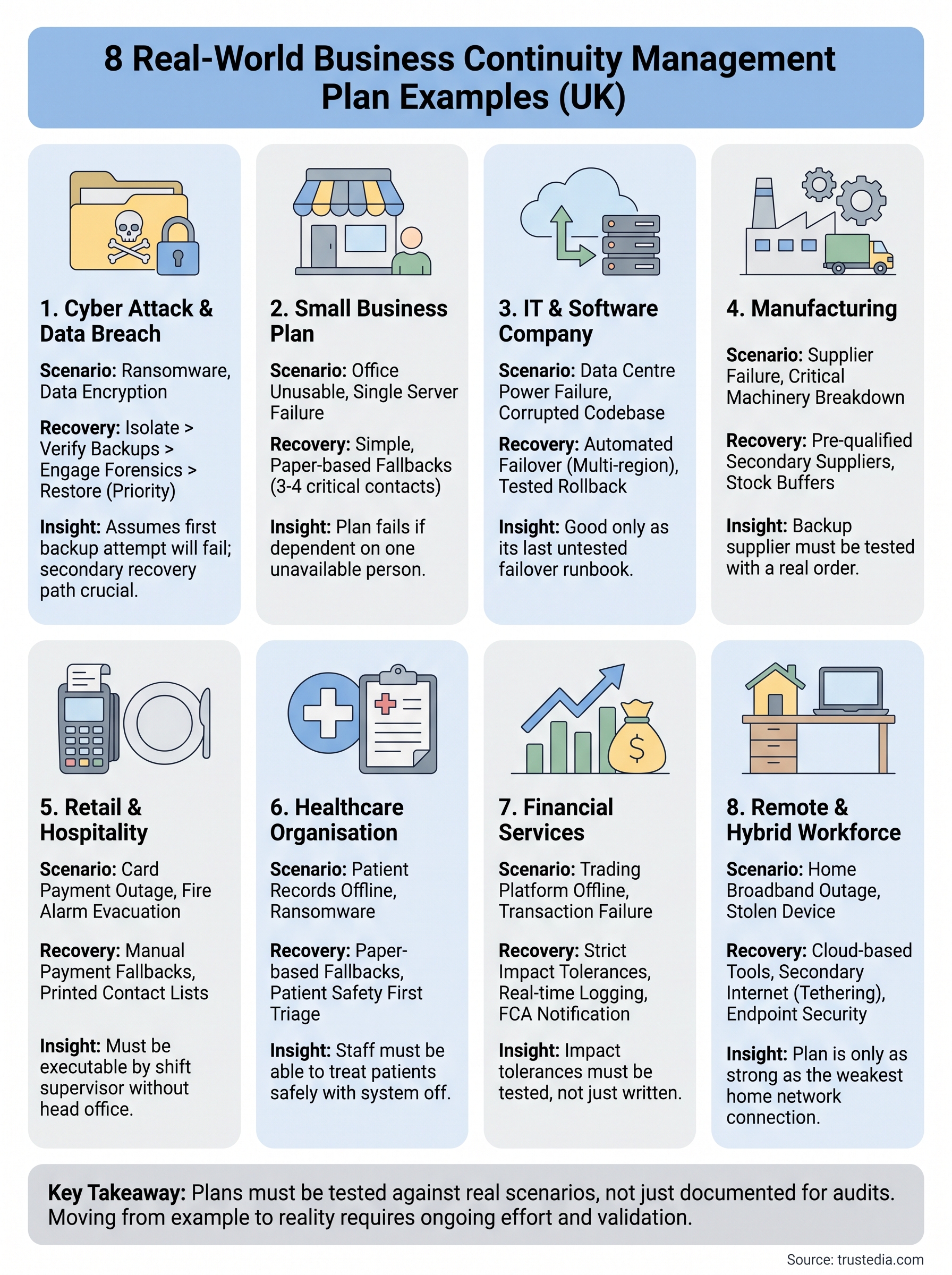
Every example above shares the same bones: named decision-makers, tested recovery paths, and a communication plan that doesn’t rely on the system that’s just gone down. The details change with your sector, but the discipline behind them doesn’t. Business continuity management plan examples are only useful as a starting point, not a finished document you can lift wholesale and file away unread.
Writing the plan is the easy part. Testing it against a real scenario, keeping it current as your systems and staff change, and proving to an auditor or insurer that it actually works under pressure takes ongoing effort most internal teams don’t have time for. That’s where a second set of eyes pays off, particularly if ISO 27001 certification or an operational resilience review is on your horizon.
If you’d rather build your plan alongside people who respond to real incidents every week, talk to TrustedIA about business continuity managed services that turn these examples into something that holds up when it matters.