When a server goes down, ransomware locks your files, or a flood takes out your data centre, the technical fix is only half the battle. The other half is knowing exactly who does what. A disaster recovery plan roles and responsibilities framework fails more often from confused ownership than from missing technology. If nobody knows whether IT, the CEO, or a third-party provider should be sending the first customer notification, you lose the hours that matter most.
This article breaks down the team structure you need for disaster recovery to actually work under pressure, not just look good in a document nobody reads. We cover the core roles, from the recovery manager coordinating the response to the communications lead managing stakeholders and customers, and explain what each person should own before, during, and after an incident.
We draw on what we see working with businesses through our own CyberSOS incident response service, where clear accountability consistently separates a fast recovery from a prolonged, costly one. Whether you’re building a plan from scratch or reviewing gaps in an existing one, you’ll leave with a practical structure you can assign to real people in your organisation, not a generic template.
Why defined roles matter in disaster recovery planning
What happens when roles aren’t defined
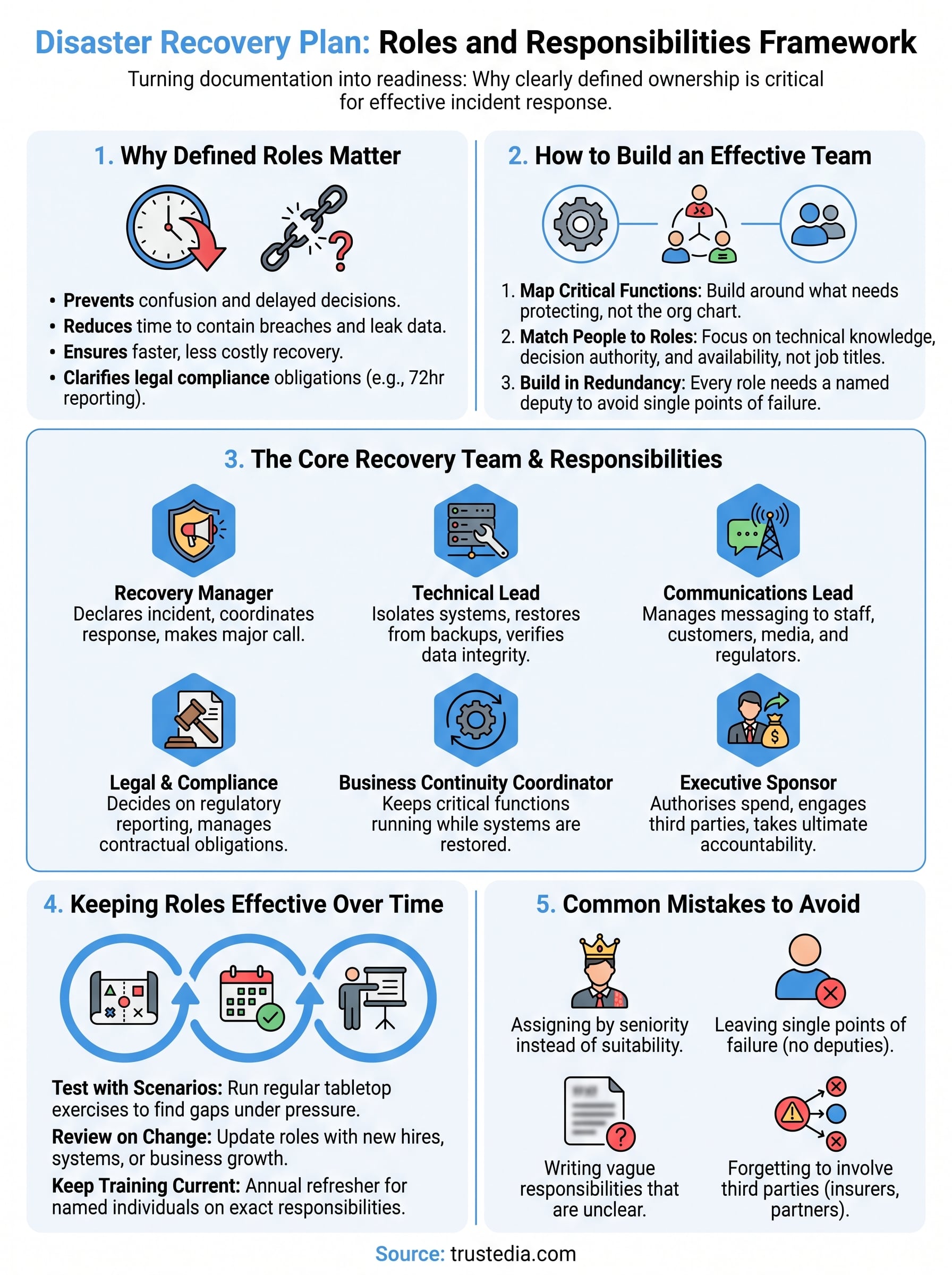
Picture ransomware hitting your file server at 2am on a Saturday. The IT manager gets the alert but isn’t sure if she should isolate the network herself or wait for sign-off from the operations director. Meanwhile, a customer starts asking questions on social media, and nobody has been told they’re allowed to respond publicly. This is what happens when a disaster recovery plan exists on paper but the roles and responsibilities inside it were never assigned to named individuals. The technology might be sound and the backups current, but the response stalls because everyone is waiting for someone else to make the call.
Confusion at this stage costs more than embarrassment. Every hour spent working out who’s in charge is an hour ransomware keeps spreading, data keeps leaking, or customers lose confidence in your business. Businesses without a formal, rehearsed incident response process consistently take longer to identify and contain breaches, a pattern reflected in the UK government’s Cyber Security Breaches Survey. Time is the one resource you can’t recover once it’s gone, whatever your backup strategy looks like.
A disaster recovery plan without named owners is just a wish list, not a plan.
The business case for clear ownership
Insurers and loss adjusters, who see the aftermath of hundreds of incidents a year, will tell you the same thing: organisations with clearly assigned disaster recovery roles recover faster and spend less money doing it. When accountability is built into the plan itself, decisions happen in minutes rather than hours, because the person authorised to shut down a system, contact a regulator, or approve a conversation with legal counsel already knows it’s their job. This is exactly the pattern we see through our own CyberSOS engagements: organisations that arrive with a role structure already defined recover measurably faster than those piecing together a response team mid-incident.
Ownership also protects you legally. Under UK data protection rules, certain breaches must be reported to the Information Commissioner’s Office within 72 hours of discovery. If nobody has been assigned responsibility for that reporting decision, the clock keeps running while people argue over who should be making it. Defined team structure turns a legal deadline into a manageable checklist rather than a scramble against the clock.
Roles versus responsibilities: why the distinction matters
Naming a disaster recovery team isn’t the same as defining what each person on it actually does. A role gives you a title, a responsibility gives you an action, and a working plan needs both. Skipping this distinction is one of the most common reasons disaster recovery documentation looks thorough on paper but falls apart under real pressure.
Typical gaps we see include:
- A recovery manager named on paper, but no clarity on their authority to declare a formal incident
- A communications lead identified, but no pre-approved messaging templates or channels assigned to them
- IT staff responsible for restoring systems, but no one owns validating that the restored data is actually clean
- Senior leadership expected to be involved, but no defined trigger for when they get looped in
Closing these gaps is what separates a document that satisfies an audit checklist from one your team can actually execute when it matters. The next section walks through how to build that structure properly, starting with who belongs on the team in the first place.
How to build an effective disaster recovery team
Building a disaster recovery team starts before you assign a single name to a role. You need to work out what actually needs protecting and in what order, because that determines who needs to be in the room when disaster strikes. Skip this step and you end up with a team built around your existing org chart rather than around the risks your business actually faces.
Map your critical functions first
Start by identifying which systems, processes, and data would cause the most damage if they went down for a day, a week, or a month. A manufacturing firm might prioritise its production line control systems, while a professional services firm might prioritise its client database and email. This mapping exercise tells you which departments need representation on your disaster recovery team and which can be looped in later. Our own CRAFT assessments start exactly here, because a team built around guesswork instead of business impact tends to overstaff the wrong areas and leave genuine gaps elsewhere.
Build the team around what needs protecting, not around who already has a senior title.
Match people to roles, not job titles
Seniority doesn’t automatically make someone the right fit for a disaster recovery role. The best recovery manager might be a systems administrator who stays calm under pressure and knows the infrastructure inside out, not necessarily the head of IT. When you’re assigning disaster recovery responsibilities, look at three things:
- Technical knowledge: does this person understand the systems well enough to make fast, informed decisions?
- Decision-making authority: can they authorise actions like isolating a network or contacting a regulator without waiting for approval?
- Availability: will they realistically be reachable during an incident, including nights, weekends, and holidays?
Build in redundancy for every seat
Every role on your team needs a named deputy, because incidents don’t wait for annual leave to end. If your communications lead is unreachable during a genuine crisis, someone else needs the authority and the pre-approved templates to step in immediately. This is one of the most overlooked parts of team structure planning: organisations name a primary owner for each function but forget that person might be on a plane, in hospital, or simply on holiday when the incident happens. Document a deputy for every seat with the same clarity as the primary, and make sure both have actually seen the plan, not just been listed in it.
Key disaster recovery roles and their responsibilities
Every disaster recovery plan needs a core set of roles, though the exact titles will flex depending on the size of your business. What matters is that each function below has a named owner, a named deputy, and a clear scope of authority written into the plan itself.
The core recovery team
Six roles cover most of what happens during an incident, from the first alert through to the final report. Smaller businesses often combine two or three of these into one person’s remit, but the responsibilities themselves shouldn’t disappear just because headcount is tight.
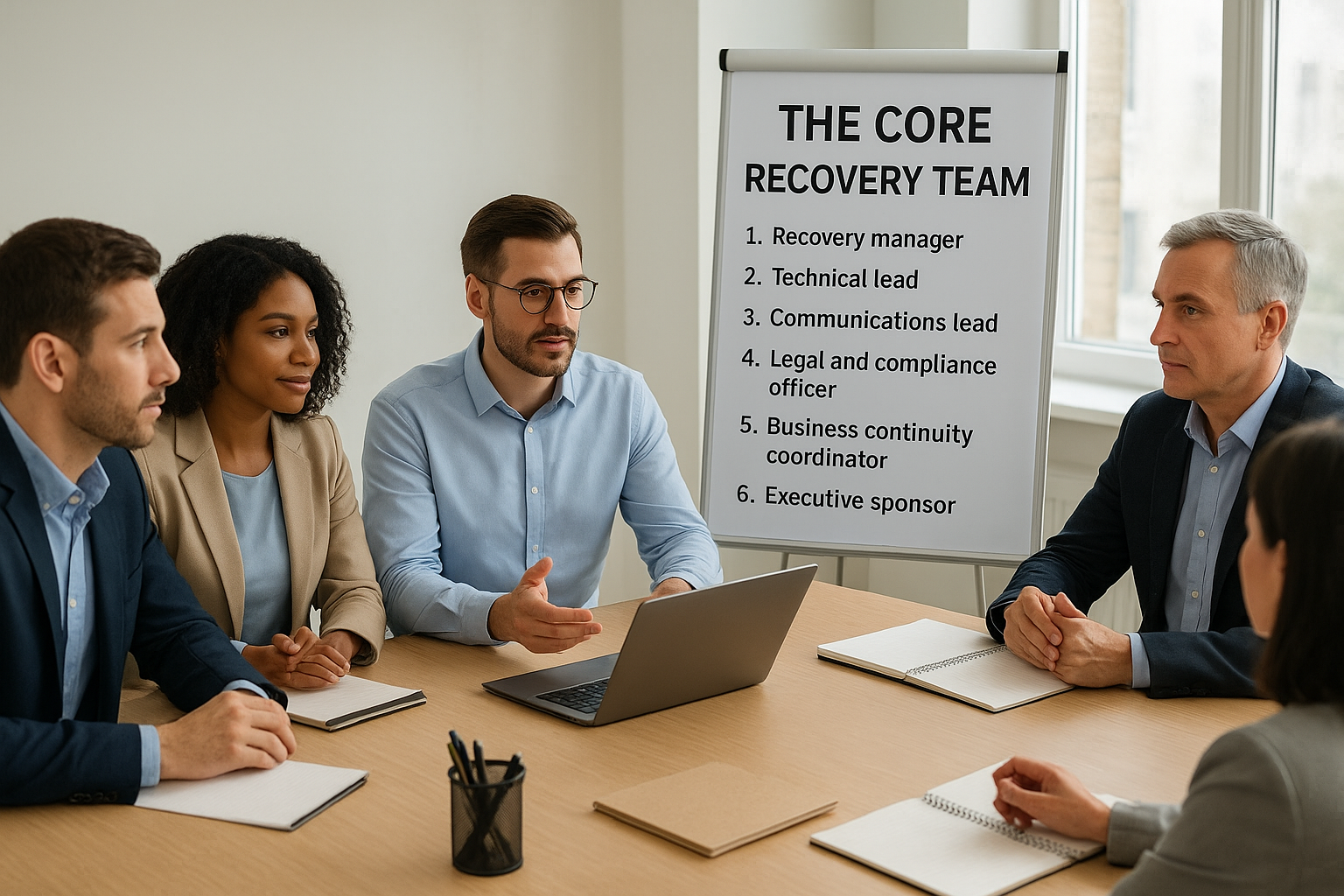
| Role | Core responsibility | Typically owned by |
|---|---|---|
| Recovery manager | Declares the incident, coordinates the response, and makes the call on major decisions | Senior IT or operations lead |
| Technical lead | Isolates affected systems, runs restoration from backups, verifies data integrity | Systems administrator or IT manager |
| Communications lead | Manages messaging to staff, customers, media, and regulators using pre-approved templates | Marketing, PR, or a senior manager |
| Legal and compliance officer | Decides on regulatory reporting, including ICO breach notifications, and manages contractual obligations | Legal counsel or compliance manager |
| Business continuity coordinator | Keeps critical business functions running while systems are restored | Operations manager |
| Executive sponsor | Authorises spend, engages third parties like insurers, and takes ultimate accountability | Business owner or director |
Every role on this list needs a name attached to it, not just a job title.
Roles that extend beyond IT
Disaster recovery isn’t purely a technical exercise, which is why the communications lead and legal and compliance officer matter as much as anyone touching a keyboard. A ransomware attack that’s contained within four hours technically but mishandled publicly can still cost you customers and reputation for months afterwards. Getting the right message to staff, clients, and regulators, at the right time, is as much a recovery task as restoring a server.
Executives sometimes assume their job during a crisis is simply to stay informed, but the executive sponsor role carries real weight. This person authorises emergency spend, decides whether to engage outside specialists such as a CyberSOS response team, and signs off on decisions the recovery manager isn’t empowered to make alone. Without that sponsor actively engaged from the start, decisions that need budget or external authority stall exactly when speed matters most.
How to keep disaster recovery roles effective over time
A disaster recovery plan is never finished. Roles that made sense last year can quietly become outdated as staff leave, systems change, or the business grows into new markets. Treating the plan as a living document, rather than a compliance exercise you file away after certification, is what keeps disaster recovery roles genuinely usable when an incident actually happens.
Test the plan with real scenarios
Running a tabletop exercise twice a year exposes gaps that a written plan can hide. Walk your team through a realistic scenario, a ransomware attack on a Friday evening or a supplier data breach, and watch whether people actually know their role without checking the document. Vulnerability assessments and penetration testing can tell you where your technical weaknesses sit, but only a live exercise tells you whether your disaster recovery team can actually execute the plan under time pressure. Note every hesitation, every unclear handoff, and every moment someone asks "is this my call to make?" Those are the gaps you fix before a real incident finds them for you.

A plan that’s never been tested is a plan you’re hoping works, not one you know works.
Review roles whenever the business changes
Every significant change to your organisation should trigger a review of your disaster recovery plan roles and responsibilities. New hires, departures, a merger, a new office, or a shift to a new IT provider all change who has the knowledge and authority to act. Build this review into your existing change management process rather than relying on someone remembering to update it. A simple trigger list works well:
- Someone named in the plan leaves the business or changes role
- A new critical system or supplier is introduced
- The business enters a new regulatory jurisdiction
- An incident or exercise reveals a gap in ownership
Keep training current
Documented responsibilities mean nothing if the people holding them have forgotten what they signed up for. Refresh training annually at minimum, and sooner for anyone new to a role. Phishing simulation and cyber awareness training keep the wider workforce alert, but the named individuals in your recovery structure need something more specific: a walkthrough of their exact responsibilities, their authority limits, and who their deputy is. Set a recurring calendar reminder for this rather than leaving it to chance, because in our experience with CyberSOS clients, the businesses that skip refresher training are the ones whose named leads hesitate most when a real incident starts.
Common mistakes when assigning disaster recovery roles
Even organisations that take disaster recovery seriously fall into predictable traps when they get to the assigning stage. These mistakes rarely show up until an actual incident, which is exactly why they’re worth catching now, while you’re still reviewing the plan rather than living through the consequences of it.
Assigning roles by seniority instead of suitability
Giving the CEO the technical lead role because they’re the most senior person in the building is a mistake we see often. Seniority and suitability aren’t the same thing, and a disaster recovery plan built around org-chart hierarchy rather than actual capability tends to stall the moment a decision requires hands-on system knowledge. The person best placed to isolate a compromised server is whoever understands that server, regardless of their title.
Assign roles based on who can act fastest and most accurately, not who sits highest on the org chart.
Leaving single points of failure
A role with no named deputy is a single point of failure waiting to happen. If your only trained recovery manager is unreachable when ransomware hits on a bank holiday weekend, the rest of the team is left improvising. This is one of the most common gaps in disaster recovery plan roles and responsibilities documentation: every seat has a name attached, but only one.
Writing responsibilities too vaguely to act on
A line that reads "IT will manage the technical response" tells nobody what to actually do at 3am. Vague responsibilities force people to interpret their remit mid-crisis, which wastes exactly the time you can’t afford to lose. Specific, actionable wording beats broad statements every time.
Forgetting to involve third parties in the structure
Insurers, loss adjusters, managed service providers, and incident response partners like a CyberSOS team often have a defined part to play, yet plans regularly omit them entirely. Common oversights include:
- No agreed point of contact for external responders
- No clarity on when to escalate to an insurer or legal counsel
- No pre-approved process for bringing in outside specialists quickly
Leaving these gaps means valuable external expertise arrives late, precisely when speed determines how much the incident ends up costing you.
Turning roles into recovery readiness
Getting disaster recovery plan roles and responsibilities right isn’t about producing a longer document. It’s about making sure a named person knows exactly what to do the moment something goes wrong, without waiting for permission or guessing at authority. Every role covered here, from the recovery manager to the executive sponsor, only works if it’s assigned to a real individual, tested against a real scenario, and reviewed as your business changes.
Building this structure yourself takes time most businesses don’t have spare, especially alongside day-to-day operations. That’s precisely the gap our CyberSOS incident response service exists to close, giving you a team that already knows how to slot into your recovery plan the moment it’s needed, rather than working it out mid-incident. If your current plan still has gaps in ownership, don’t wait for an incident to expose them. Get in touch with TrustedIA to build a disaster recovery structure your team can actually execute.