When a ransomware attack or a flooded server room takes your systems down, the businesses that recover fastest are the ones that planned for it months earlier. Business continuity planning best practices aren’t theoretical exercises for large corporations with dedicated risk teams. They’re practical steps any UK SME can put in place, often without a huge budget or a resident cyber security expert.
This article gives you exactly what you’re searching for: a clear, workable set of guidelines for building a plan that actually holds up under pressure. We won’t bury you in theory. Instead, you’ll get the six practices that separate businesses which bounce back within hours from those that spend weeks firefighting, losing customers and revenue along the way.
We’ve drawn these recommendations from what we see working across the SMEs we support at TrustedIA, from risk assessments and recovery time objectives through to testing your plan before you ever need it. By the end, you’ll know precisely where your current continuity arrangements fall short and what to prioritise first.
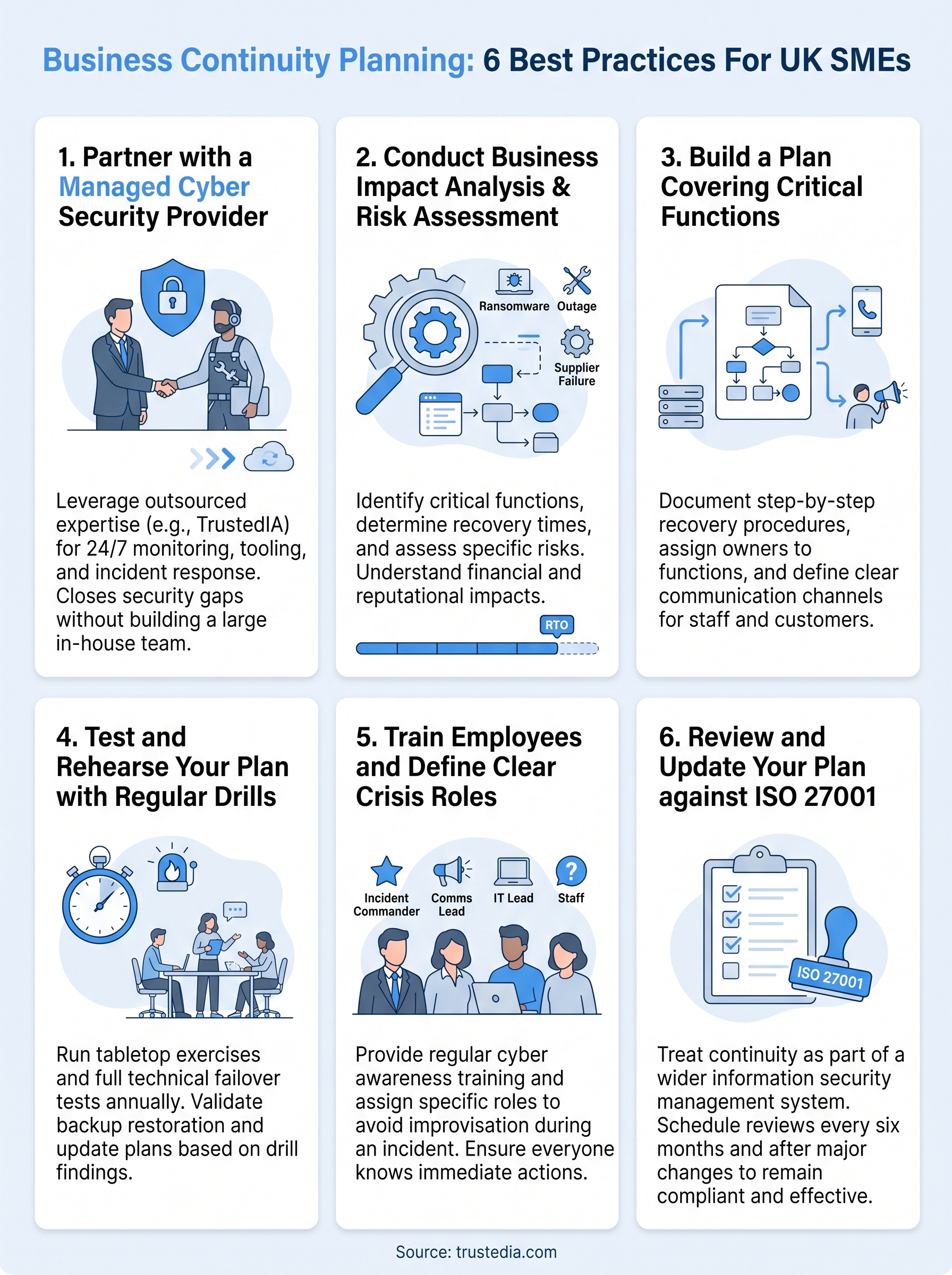
1. Partner with a managed cyber security provider like TrustedIA
Most SMEs don’t have a security operations centre sitting idle, waiting for an incident. That’s exactly why outsourced expertise tends to outperform in-house efforts when it comes to continuity planning. A managed provider brings the tooling, the trained analysts, and the incident response playbooks that would otherwise take years and a six-figure budget to build internally.
What it involves
Working with a provider like TrustedIA means handing over the technical heavy lifting: endpoint monitoring, dark web surveillance, vulnerability assessments, and a dedicated incident response service such as CyberSOS when something does go wrong. Rather than buying a single product, you get a solution-agnostic partner who recommends whatever technology actually fits your risk profile, not whatever a vendor is pushing that quarter.
Why it matters for UK SMEs
Smaller businesses rarely have a CISO on staff, let alone a rota of analysts watching threat feeds around the clock. That gap is exactly where attackers find their opening, and it’s why the National Cyber Security Centre treats basic protective monitoring as a baseline expectation for organisations of any size. A managed partner closes that gap without you needing to recruit, train, and retain a specialist team.
A continuity plan is only as strong as the expertise behind it, and most SMEs can’t afford to build that expertise in-house alone.
How to put it into practice
Start by mapping what you currently have against what a managed service actually covers, then decide where the gaps sit:
- Audit your existing tools – list every security product you already pay for and check for overlap or blind spots.
- Request a network audit – ask a provider like TrustedIA for a Smarter Cyber Assurance review before signing anything.
- Define response expectations – agree recovery time objectives and escalation paths in writing, not verbally.
- Confirm insurer alignment – check your cyber insurance policy references an approved incident response partner, since this speeds up claims after a breach.
Getting this partnership right early makes every other practice on this list considerably easier to execute.
2. Conduct a business impact analysis and risk assessment
Before you write a single procedure, you need to know what you’re actually protecting. A business impact analysis identifies which systems, suppliers, and processes your revenue depends on, and a risk assessment tells you what’s most likely to knock them over.
What it involves
You score each business function by two things: how much disruption costs you per hour, and how quickly you need it restored. This gives you a recovery time objective for every critical system, from your invoicing platform to your customer database. Pair that with a risk assessment covering ransomware, supplier failure, power outages, and staff absence, and you get a realistic picture of where your exposure actually sits, rather than where you assume it does.
Why it matters for UK SMEs
Many SMEs skip this step and jump straight to buying backup software, which often protects the wrong things. The ICO expects businesses handling personal data to demonstrate they understand their risks, and a documented impact analysis gives you that evidence if a regulator ever asks.
You can’t protect what you haven’t measured, and guessing at your risks is how continuity plans fail on day one.
How to put it into practice
- Interview department heads about their daily dependencies
- Rank functions by financial and reputational impact
- Set a recovery time objective for each critical system
- Revisit the assessment annually or after major changes
3. Build a plan that covers your critical business functions
Once you know what matters most, you need a document that actually tells people what to do about it. A written continuity plan turns your impact analysis into concrete instructions, covering everything from IT failover to who calls your key suppliers when the office is unreachable.
What it involves
Your plan should map each critical function to a specific recovery procedure, a named owner, and the resources needed to restart it, whether that’s a backup site, cloud failover, or a manual workaround. Cover communications too: how you notify staff, customers, and regulators within the first hour of an incident.
Why it matters for UK SMEs
SMEs often have continuity documents that exist on paper but say nothing useful once a real incident starts. A plan that only lists contact numbers isn’t a plan, it’s a phone book. The Gov.uk business continuity guidance makes clear that effective plans specify actions, not just intentions.
A continuity plan that doesn’t name who does what, by when, isn’t a plan at all.
How to put it into practice
- Assign a named owner to every critical function
- Document step-by-step recovery procedures, not summaries
- Include alternative suppliers and backup communication channels
- Store the plan somewhere accessible even if your main systems are down
4. Test and rehearse your plan with regular drills
A plan that’s never been tested is a guess dressed up as a procedure. Regular drills expose the gaps between what’s written down and what actually happens when systems go dark, and they’re the only way to know your recovery time objectives are realistic rather than aspirational.

What it involves
Run scheduled exercises that simulate specific scenarios: a ransomware lockout, a supplier failure, a building evacuation. Tabletop walkthroughs work for testing decision-making, while full technical failover tests confirm your backups and infrastructure actually recover within the timeframes you’ve set.
Why it matters for UK SMEs
Most SMEs write a continuity plan once and file it away, only discovering its flaws mid-incident when it’s too late to fix them. The NCSC specifically recommends testing backup restoration rather than assuming it works, because failed restores are one of the most common reasons recovery drags on far longer than businesses expect.
An untested continuity plan is just a theory, and theories fail under real pressure.
How to put it into practice
- Schedule at least one full drill annually, plus shorter tabletop exercises quarterly
- Test actual data restoration, not just backup completion logs
- Rotate who leads the drill so the plan isn’t dependent on one person
- Document what broke and update the plan within two weeks of every test
5. Train employees and define clear crisis roles
Your continuity plan can be perfect on paper and still collapse if staff don’t know their part in it. Employee training turns a document into muscle memory, and clear crisis roles stop people from freezing or duplicating work when an incident actually hits.
What it involves
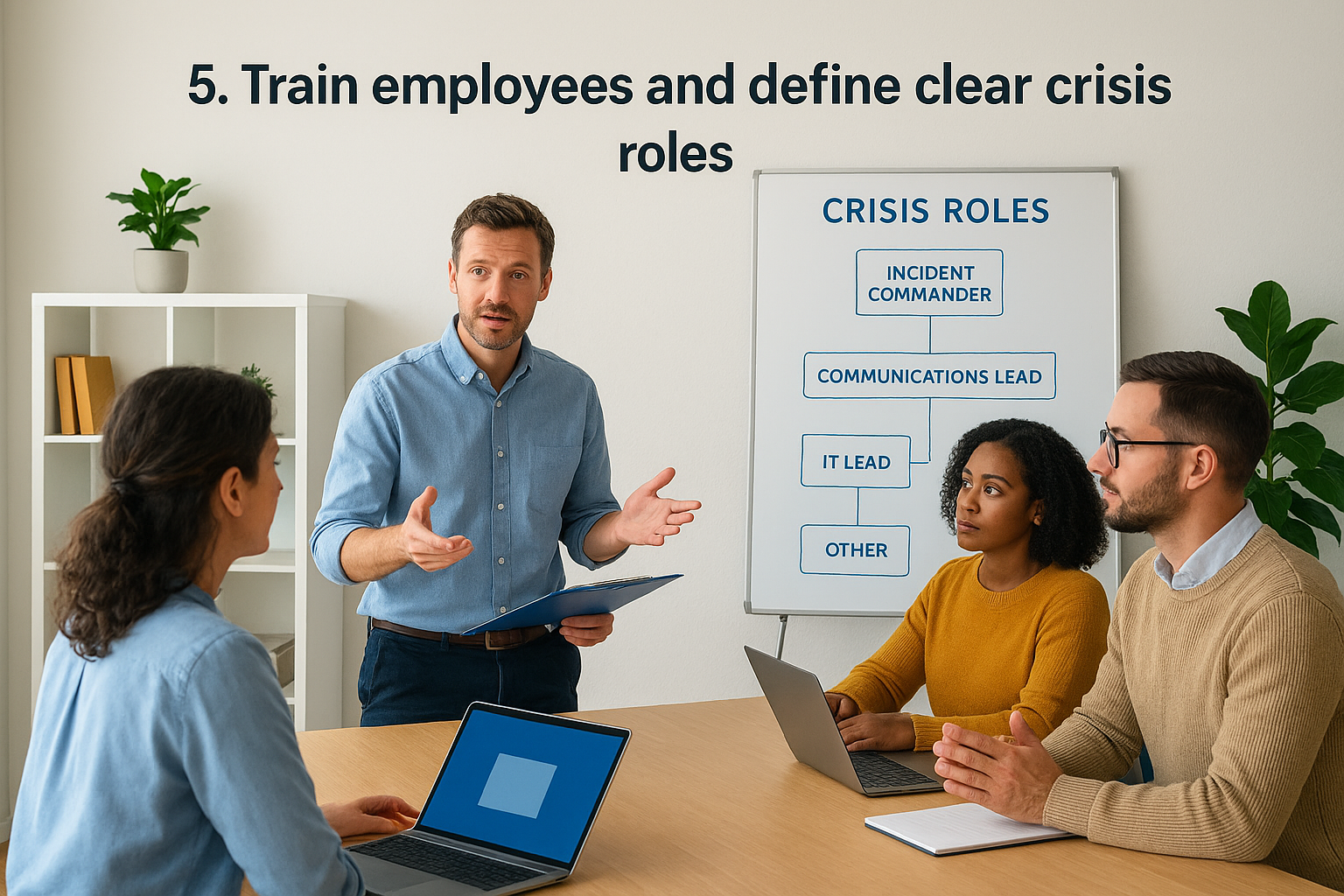
Every employee needs to know two things: what to do in the first ten minutes of an incident, and who to escalate to if their normal manager is unreachable. Beyond that, run regular cyber awareness training covering phishing, password hygiene, and reporting suspicious activity, since human error still triggers most breaches. Assign named crisis roles, incident commander, communications lead, IT lead, so nobody’s improvising during a live event.
Why it matters for UK SMEs
Smaller teams often assume everyone "just knows" what to do, but that assumption falls apart under pressure. Phishing simulation exercises consistently show that untrained staff click malicious links at far higher rates than teams who’ve been through structured training. A named role removes hesitation exactly when speed matters most.
A plan without trained people behind it is just a document waiting to be ignored.
How to put it into practice
- Run phishing simulations quarterly and share results with the team
- Publish a one-page role chart naming who does what during an incident
- Train backup role-holders in case the primary contact is unavailable
- Refresh training after every drill or real incident, not just annually
6. Review and update your plan against ISO 27001
A continuity plan drafted three years ago is already out of date. ISO 27001 gives you a recognised framework for reviewing your plan on a schedule, rather than only after something breaks or a new system gets bolted on without anyone updating the documentation.
What it involves
The standard requires you to treat continuity as part of your wider information security management system, not a standalone document. That means scheduled management reviews, documented evidence of testing, and a clear audit trail showing your plan reflects your current suppliers, systems, and staff structure.
Why it matters for UK SMEs
Many SMEs pursue ISO 27001 certification to win contracts or satisfy insurer requirements, then let the continuity section stagnate between audits. Certification bodies specifically check whether your plan matches reality, and a stale document is one of the fastest ways to fail an assessment. The ISO 27001 standard exists precisely to stop plans from becoming shelfware.
A certified continuity plan that nobody’s updated in a year isn’t compliant, it’s a liability waiting to be found.
How to put it into practice
- Schedule a formal review every six months, not just at certification renewal
- Update the plan immediately after any major system, supplier, or staffing change
- Bring in an ISO 27001 subject matter expert if certification is new to you
- Keep dated version records so auditors can see the plan’s history, not just its current state
Turning best practices into everyday resilience
None of these six practices work in isolation. A business impact analysis without testing is just paperwork, and a trained team without a written plan is improvising with confidence. Together, they build the kind of resilience that turns a ransomware attack or a flooded server room into a bad afternoon rather than a bad quarter. That’s the real point of business continuity planning best practices: not ticking a compliance box, but knowing your business will still be standing after the incident everyone hopes never happens.
Start wherever your biggest gap sits, whether that’s an untested backup or a plan nobody’s reviewed since it was written. Momentum matters more than perfection on day one. If you’d rather not build this alone, talk to TrustedIA about a network audit and see exactly where your current arrangements would hold, and where they’d fail.