
Every organisation that handles personal data belonging to individuals in the UK or EU needs to understand what is GDPR compliance, and more importantly, what it actually takes to achieve it. The General Data Protection Regulation sets out strict rules for how businesses collect, store, process, and share personal data. Getting it wrong carries real consequences: fines of up to €20 million or 4% of annual global turnover, whichever is higher, along with the reputational damage that follows a breach.
Yet many businesses still treat GDPR as a box-ticking exercise rather than an ongoing commitment to protecting the people behind the data. Compliance isn’t a one-off project. It demands clear policies, robust technical controls, staff awareness, and regular assessment of your data handling practices, areas where gaps often go unnoticed until something goes wrong.
At TrustedIA, we help organisations build and maintain strong cybersecurity postures through managed security services, audits, and compliance support, including ISO 27001 implementation, which shares significant overlap with GDPR requirements. This guide breaks down the core principles of GDPR, the specific obligations your organisation must meet, and the practical steps to move from understanding to action.
Why GDPR compliance matters for UK organisations
Understanding what is GDPR compliance goes beyond knowing the rules on paper. For UK organisations, compliance directly affects your financial exposure, your reputation, and your day-to-day ability to operate. Since the UK retained and adapted the EU regulation into domestic law post-Brexit as the UK GDPR, the obligations remain substantive and are enforced by the Information Commissioner’s Office (ICO), which holds real power to investigate, audit, and penalise organisations that fall short.
The financial cost of non-compliance
The ICO can issue fines at two tiers. Lower-tier infringements, such as failing to maintain adequate records or appointing a Data Protection Officer when required, carry penalties of up to £8.7 million or 2% of annual global turnover, whichever is higher. Upper-tier violations, such as breaching the core data protection principles or ignoring individuals’ rights, can reach up to £17.5 million or 4% of annual global turnover. These figures are not hypothetical: the ICO has fined organisations across sectors ranging from healthcare and retail to financial services and local government.
A single significant data breach can cost a UK organisation far more than the regulatory fine itself once you factor in incident response, legal fees, system remediation, and mandatory customer notification.
Beyond ICO penalties, regulatory investigations consume internal resources and senior leadership time that your business cannot afford to lose. You may also face civil compensation claims from individuals whose data was mishandled, adding further financial pressure on top of any regulatory action. For smaller businesses especially, that combined exposure can be existential.
Reputational and operational impact
When a breach or ICO investigation becomes public, the damage to your brand moves fast. Customers lose confidence quickly, and rebuilding that trust takes months or years of consistent effort. News of a data incident can deter prospective clients, unsettle existing relationships, and create friction in commercial negotiations where data security now features as a qualifying criterion rather than a nice-to-have.
Operationally, non-compliance usually signals deeper weaknesses in your data governance and IT infrastructure. Organisations that have not addressed GDPR properly tend to have unclear data inventories, inconsistent access controls, and staff who are uncertain about their responsibilities when something goes wrong. Those gaps create vulnerabilities that attackers actively exploit, making poor compliance a direct cybersecurity risk, not just a legal one.
Trust as a competitive advantage
Compliance done properly becomes an asset rather than a burden. When you can demonstrate transparent data practices to customers, partners, and suppliers, you signal that your organisation handles information with care. This matters more every year as procurement processes and supplier due diligence increasingly include formal data protection assessments as a standard requirement before contracts are signed.
For organisations also working towards ISO 27001 certification, strong GDPR compliance creates meaningful overlap in documented controls, risk assessments, and staff training requirements. The effort you invest in one framework directly strengthens your overall security posture across both, reducing duplicated work and producing clearer evidence that your organisation treats information security as a genuine priority.
Your customers share personal data with you because they trust you to handle it responsibly. Consistently meeting that expectation is what compliance ultimately comes down to: not a legal formality, but a standard of care that runs through how your organisation collects, uses, stores, and protects information at every level.
When GDPR applies to you
Knowing whether GDPR applies to your organisation is the logical starting point before you can address what is GDPR compliance in practical terms. The regulation applies more broadly than many businesses expect, catching organisations that have no physical presence in the UK or EU but still handle personal data belonging to individuals located there. If you collect, process, or store any personal data about people in the UK or EU, you almost certainly fall within scope.
The territorial scope
GDPR follows the data subject, not the data controller’s location. This means a company based in the United States that sells goods or services to UK residents, or monitors their behaviour online, must comply with UK GDPR regardless of where it operates from. The ICO takes this extraterritorial reach seriously, and organisations outside the UK that handle UK residents’ data without appointing a UK representative can face enforcement action.

If your website collects email addresses, tracks visitor behaviour, or accepts payments from individuals in the UK or EU, the regulation applies to you whether or not you have a UK office.
Who counts as a controller or processor
GDPR distinguishes between two key roles, and your obligations under the regulation differ depending on which one applies to your organisation. A data controller decides why and how personal data is processed. A data processor handles data on behalf of a controller, such as a cloud hosting provider or payroll bureau. Both roles carry distinct legal responsibilities, and a single organisation can act as a controller for some activities and a processor for others simultaneously.
- Data controller: sets the purpose and means of processing
- Data processor: processes data strictly on the controller’s instructions
- Joint controllers: two or more organisations that jointly determine how data is used
What counts as personal data
Personal data covers any information that identifies or can identify a living individual, either directly or indirectly. Names, email addresses, phone numbers, and national insurance numbers are obvious examples. Less obvious ones include IP addresses, cookie identifiers, and location data, all of which fall within scope if they can be linked back to a specific person.
Special category data, such as health records, biometric data, or information about religious beliefs, carries additional protections and stricter processing conditions. Understanding where your organisation holds both standard and special category data is essential before you can accurately map your compliance obligations.
Key GDPR terms you need to know
When you research what is GDPR compliance, you quickly encounter a specific vocabulary that shapes how the regulation is interpreted and applied. Getting to grips with these terms is not just useful background knowledge; it directly affects how you identify your obligations, draft your policies, and respond correctly when something goes wrong.
Personal data and special category data
Personal data covers any information that relates to an identifiable living person. This includes obvious identifiers like names and email addresses, but also IP addresses, device identifiers, and cookie data when they can be linked back to a specific individual. Special category data, which includes health records, biometric data, racial or ethnic origin, and religious beliefs, carries additional legal protections and stricter processing conditions that sit on top of the standard requirements.
If your organisation processes any special category data, you must identify a specific legal condition that permits this before you begin, separate from your standard lawful basis.
Controllers, processors, and the DPO
A data controller is the organisation that determines the purpose and means of processing personal data. A data processor handles data strictly on the controller’s instructions, such as a cloud hosting provider or payroll bureau. Written contracts between controllers and processors must reflect these roles clearly, and many organisations act as both simultaneously depending on the activity involved.
The Data Protection Officer (DPO) is a formally appointed individual responsible for overseeing compliance with the regulation. Appointing one is mandatory if you carry out large-scale systematic monitoring or large-scale processing of special category data. Even where it is not strictly required, having a designated person with clear data protection responsibility significantly reduces the chance of compliance gaps forming undetected.
Lawful basis for processing
Every time you process personal data, you need a documented lawful basis to justify it. The regulation provides six options:
- Consent: the individual has given clear, specific agreement
- Contract: processing is necessary to fulfil or prepare a contract
- Legal obligation: you must process to comply with the law
- Vital interests: processing is necessary to protect someone’s life
- Public task: you are carrying out an official function
- Legitimate interests: your interests are balanced against individual rights
Legitimate interests is the most flexible basis available, but it requires a documented balancing test demonstrating that your interests do not override the rights of the individual before you can rely on it.
The 7 principles that underpin GDPR compliance
When you work through what is GDPR compliance in detail, Article 5 of the UK GDPR is the foundation everything else builds on. It sets out seven core principles that govern how personal data must be handled at every stage of its lifecycle. Every policy you write, every data process you run, and every system you configure needs to align with these principles. They are not optional guidelines; they are enforceable legal obligations that the ICO will examine directly when assessing whether your organisation has met its responsibilities.

The first four principles
Lawfulness, fairness and transparency requires you to hold a valid legal basis for processing, handle data in ways people would reasonably expect, and be open about what you do with it. Purpose limitation means you collect data for a specific, clearly stated reason and do not reuse it for anything incompatible with that original purpose.
- Data minimisation: collect only what you genuinely need for the stated purpose, nothing more
- Accuracy: keep personal data correct and up to date, with clear processes to rectify errors promptly
Collecting more data than you need does not make your operations more flexible; it increases your exposure significantly if a breach occurs.
These four principles shape your data collection and processing activities from the outset. If your intake processes gather excessive information or your systems hold data without a documented purpose, you are already in breach before anything else goes wrong. Reviewing your data flows against these four principles is one of the most practical early actions you can take.
The final three principles
The remaining three principles govern how long you keep data, how you protect it, and who carries ultimate responsibility for getting it right.
- Storage limitation: retain personal data only for as long as necessary, supported by a documented retention schedule
- Integrity and confidentiality: protect data against unauthorised access, loss, or destruction using appropriate technical and organisational measures
- Accountability: demonstrate actively that your organisation complies through records, policies, training, and documented decisions
Accountability is the principle that ties everything together. It shifts the burden onto your organisation to prove compliance rather than simply assert it. Maintaining records of processing activities (RoPA), conducting data protection impact assessments, and keeping documented evidence of your decisions gives you the audit trail you need if the ICO ever asks you to justify your practices.
Lawful bases and consent rules in practice
One of the most common mistakes organisations make when working out what is GDPR compliance is treating consent as the default lawful basis for every processing activity they run. The regulation gives you six lawful bases to choose from, and selecting the wrong one, or failing to document your choice, creates direct compliance risk that an ICO audit will surface quickly.
Choosing the right basis before you start
You must identify and record your lawful basis before processing begins, not retrospectively once a question is raised. Each processing activity across your organisation needs its own documented basis, because the basis you choose directly determines what rights individuals hold in relation to that data. For example, individuals can object to processing carried out under legitimate interests, but they cannot withdraw consent after the fact and expect you to delete data held under a contract basis.
| Lawful Basis | When it applies |
|---|---|
| Consent | Individual freely agrees to specific processing |
| Contract | Processing is necessary to deliver a service |
| Legal obligation | A law requires you to process the data |
| Vital interests | Necessary to protect someone’s life |
| Public task | Carrying out an official or public function |
| Legitimate interests | Your interests outweigh the individual’s rights |
What valid consent actually requires
Consent under UK GDPR carries specific conditions that many organisations fail to meet. It must be freely given, specific to a clearly stated purpose, informed, and unambiguous through a clear affirmative action. Pre-ticked boxes, consent bundled into terms and conditions, and implied agreement through continued website use do not meet the standard. If individuals cannot reasonably refuse without suffering a consequence, the consent is not freely given and therefore not valid.
Consent you cannot clearly demonstrate is treated as no consent at all by the ICO, meaning any processing that relied on it becomes unlawful.
Withdrawing consent must be as straightforward as giving it, and you must act on withdrawal promptly. Keeping a clear record of when, how, and what each individual consented to provides essential evidence if a complaint is raised.
Using legitimate interests without creating risk
Legitimate interests gives you flexibility, but it requires a documented Legitimate Interests Assessment (LIA) that weighs your purpose against the rights and expectations of the individuals involved. Run a three-part test: confirm the purpose is genuine, verify the processing is necessary to achieve it, and balance your interests against those of the individual. Keep the completed assessment on file, because showing your documented reasoning to the ICO is far stronger than simply asserting the basis applies.
Data subject rights and how to handle requests
When people ask what is GDPR compliance, the conversation often focuses on data collection and processing rules, but the rights individuals hold over their own data are equally central to your obligations. The UK GDPR grants eight distinct rights to data subjects, and your organisation must have clear, documented procedures to honour each one. Failing to respond correctly is a direct breach of the regulation, not simply an administrative oversight.
The eight rights individuals hold
Each right creates a specific obligation on your organisation to act within defined parameters. You cannot ignore a request simply because it is inconvenient or technically complex. Understanding the scope of each right helps you build processes that respond consistently and accurately.
| Right | What it means in practice |
|---|---|
| Access | Individuals can request a copy of their personal data |
| Rectification | You must correct inaccurate or incomplete data |
| Erasure | Individuals can ask you to delete their data in certain circumstances |
| Restriction | Processing can be paused while a dispute is resolved |
| Portability | Data provided by consent or contract must be transferable in a machine-readable format |
| Objection | Individuals can object to processing based on legitimate interests or direct marketing |
| Automated decision-making | Individuals can request human review of decisions made solely by algorithms |
| Withdraw consent | Individuals can withdraw previously given consent at any time |
Responding within the one-month deadline
The standard deadline for responding to a data subject request is one calendar month from the date you receive it. You can extend this by a further two months for complex or numerous requests, but you must inform the individual within the first month that you are extending the deadline and explain why. Missing both the response and the notification is the most common failure point organisations face.
If you receive a high volume of requests, or your data is spread across multiple systems, the one-month deadline becomes extremely difficult to meet without documented workflows and designated ownership.
Your organisation also needs a clear process for verifying the identity of the person making a request before you release any data. Disclosing personal information to the wrong individual creates a separate breach. Keep a log of every request received, the steps you took, and the date you responded. That record is your evidence if the ICO ever investigates whether you handled a request appropriately.
Security, breach response and 72-hour rule
Security sits at the heart of what is GDPR compliance in operational terms. The regulation requires you to implement appropriate technical and organisational measures to protect personal data against unauthorised access, accidental loss, destruction, or disclosure. What counts as appropriate depends on the nature of the data you hold, the volume you process, and the realistic risks your systems face.
Technical and organisational security measures
The UK GDPR does not prescribe a specific list of security controls, but it does expect your measures to reflect the current state of available technology and the sensitivity of the data involved. In practice, this means your organisation needs to address both the technical layer and the human layer of security together, not as separate concerns.
- Encryption: protect personal data in transit and at rest using current encryption standards
- Access controls: limit who can view or process personal data to those who genuinely need it
- Pseudonymisation: where practical, replace identifying information with artificial identifiers to reduce exposure
- Regular testing: conduct ongoing assessments of your systems, including vulnerability scanning and penetration testing
- Staff training: ensure everyone who handles personal data understands their responsibilities and your internal procedures
Documenting your security decisions matters as much as the controls themselves. The accountability principle requires you to show how you arrived at your current measures and why you consider them appropriate for the risks your organisation faces.
What counts as a reportable breach
A personal data breach is any accidental or unlawful destruction, loss, alteration, unauthorised disclosure, or access to personal data. This includes incidents where data is accidentally sent to the wrong recipient, a laptop containing unencrypted data is stolen, or a ransomware attack locks you out of systems holding personal records.
Not every breach must be reported to the ICO, but you must document all of them internally, including those that do not meet the reporting threshold.
You only need to report a breach to the ICO when it is likely to result in a risk to the rights and freedoms of the individuals affected. Where the risk is high, you must also notify those individuals directly without undue delay.
Meeting the 72-hour reporting deadline
Once you become aware of a reportable breach, the 72-hour clock starts immediately. Reporting to the ICO must happen within that window, and any delay beyond it requires a clear documented explanation of why notification was late. Building an internal escalation process with defined responsibilities before a breach occurs is the only realistic way to meet this deadline consistently.

Practical steps to become GDPR compliant
Knowing what is GDPR compliance in theory only gets you so far. Turning that knowledge into practice requires a structured sequence of actions, each one building on the last. Organisations that treat this as a single project with a fixed end point consistently find themselves exposed. Compliance is a cycle, not a destination, and the steps below give you a repeatable framework to follow.
Map your data before anything else
Your first task is to understand exactly what personal data your organisation holds, where it came from, where it is stored, who can access it, and how long you keep it. This data mapping exercise produces your Record of Processing Activities (RoPA), which Article 30 of the UK GDPR requires most organisations to maintain. Without an accurate data map, every other compliance action you take rests on incomplete foundations.

Your data map is a living document. Every time you introduce a new system, supplier, or process that touches personal data, it needs to be updated immediately.
Work through each department systematically. Ask staff what data they collect, what systems they use, and whether they share data with any third parties. Document every data flow, including transfers to processors and any data leaving the UK.
Build your documentation foundation
Once you know what data you hold, you need to assign a lawful basis to each processing activity and record it clearly. Draft or update your privacy notices so they accurately reflect current practices, and ensure your internal policies cover subject access requests, data breach response, and retention periods. Gap analysis at this stage often reveals inconsistencies between what your privacy notice states and what your systems actually do.
Review your contracts with any third-party suppliers who process personal data on your behalf. Data Processing Agreements (DPAs) must be in place before any processing begins, and many organisations discover they are missing these entirely for cloud services or HR platforms they have used for years.
Test, train, and review regularly
Policies and documentation only protect you if your staff understand them and your systems hold up under realistic attack conditions. Run phishing simulations and mandatory data protection training for all staff, not just your IT team, at regular intervals. Conduct vulnerability assessments and penetration tests to confirm your technical controls are functioning as intended.
Schedule a formal compliance review at least annually, or whenever you make significant changes to your systems or data processing activities. Consistent review cycles are what separate organisations that maintain genuine compliance from those that drift back into risk over time.
UK GDPR vs EU GDPR and cross-border data
When people research what is GDPR compliance in the UK context, one question that comes up consistently is whether UK GDPR and EU GDPR are the same thing. They are closely aligned but not identical, and organisations that operate across both jurisdictions, or transfer data between them, need to understand where the differences sit and what they mean for your compliance obligations.
How UK GDPR differs from the EU version
The UK retained the substance of the EU GDPR into domestic law after Brexit, incorporating it as the UK GDPR alongside the Data Protection Act 2018. The core principles, data subject rights, lawful bases, and breach reporting obligations remain virtually the same. The most significant practical difference is that the ICO enforces UK GDPR, while EU data protection authorities regulate the EU version within their respective member states.
The two frameworks have begun to diverge incrementally since separation. The UK government has introduced its own adequacy decisions for international data transfers, and future amendments to either framework may increase the gap between them over time. If you operate in both the UK and EU simultaneously, you may need to appoint a separate representative in the EU under Article 27 of the EU GDPR, as your UK presence no longer satisfies that requirement.
If your business serves customers in both the UK and EU, you are subject to both frameworks and need documented compliance measures that satisfy each independently.
Transferring data outside the UK
Sending personal data to countries outside the UK is only permitted when an adequate level of data protection is in place at the destination. The ICO maintains its own list of countries it considers adequate, covering most EU and EEA member states following the UK-EU adequacy decision. For transfers to other destinations, you need to rely on an approved transfer mechanism to keep the transfer lawful.
The primary mechanisms available to UK organisations include:
- UK International Data Transfer Agreements (IDTAs): the UK-specific replacement for EU Standard Contractual Clauses
- Addendum to EU Standard Contractual Clauses: allows existing EU SCCs to satisfy UK transfer requirements with a standard addendum
- Binding Corporate Rules: used by multinational groups transferring data internally across borders
Before you make any international transfer, carry out a Transfer Risk Assessment (TRA) to confirm the destination country’s legal environment does not undermine the protections your contract provides. Documenting that assessment is part of your accountability obligations under UK GDPR.
A simple way to stay on track
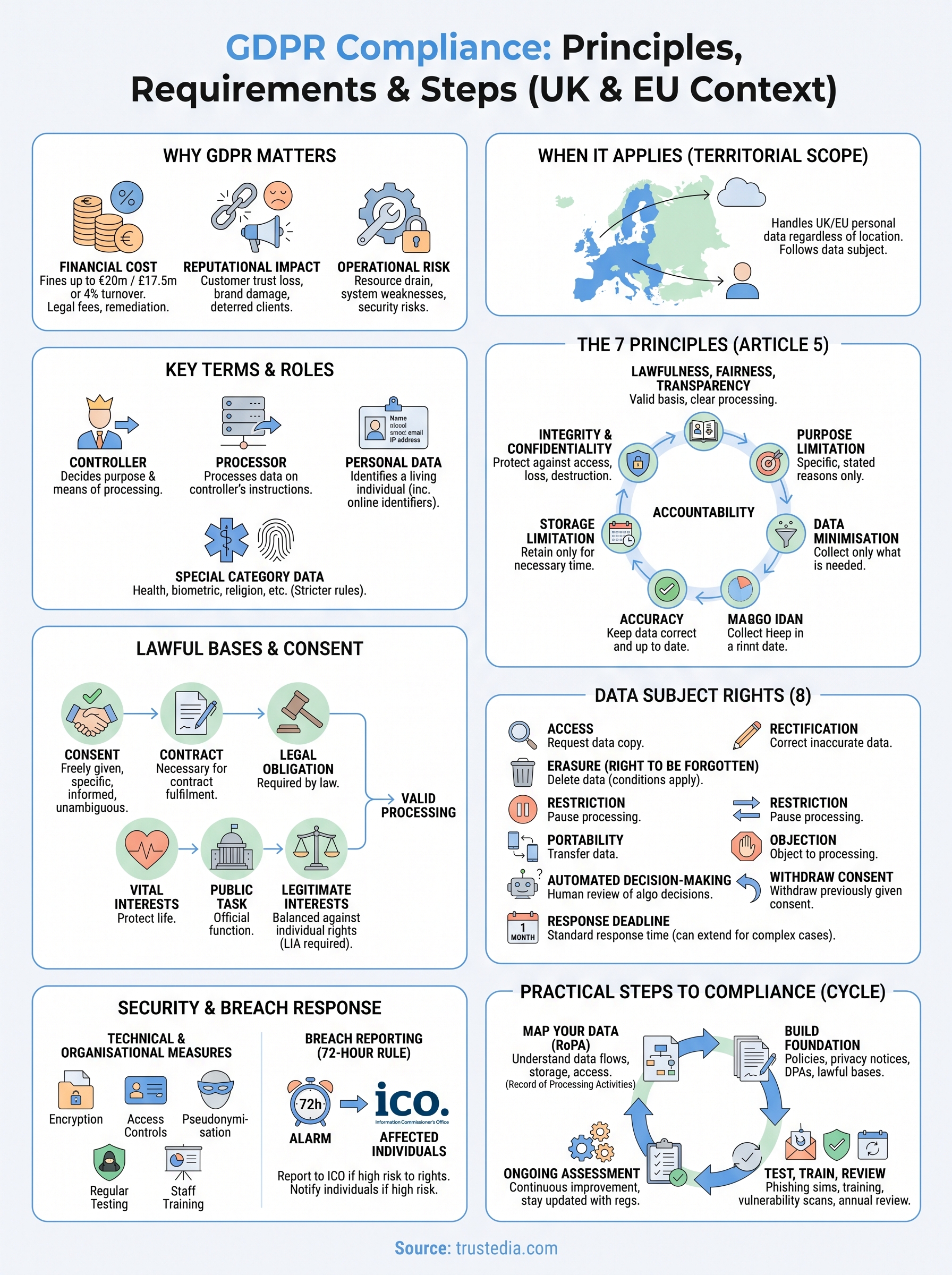
Understanding what is GDPR compliance is one thing; maintaining it consistently across your organisation is another challenge entirely. Data protection obligations do not stay static, and neither do the threats your systems face. Regulations shift, new suppliers get added, staff change roles, and your data processing activities evolve. Without a structured approach to reviewing your controls, gaps accumulate quietly until a breach or an ICO enquiry forces them into view.
Working with a specialist gives you the ongoing oversight that internal teams often cannot sustain alone. TrustedIA works with organisations across the UK to build and maintain the security and compliance foundations that keep personal data genuinely protected. From vulnerability assessments and penetration testing to managed security services and dedicated audit support, the team helps you close gaps before they become serious incidents. Every action you take now reduces your exposure and demonstrates to the ICO that your organisation treats data protection as a genuine priority.
Talk to TrustedIA about your compliance needs and get expert support that keeps you covered.



