
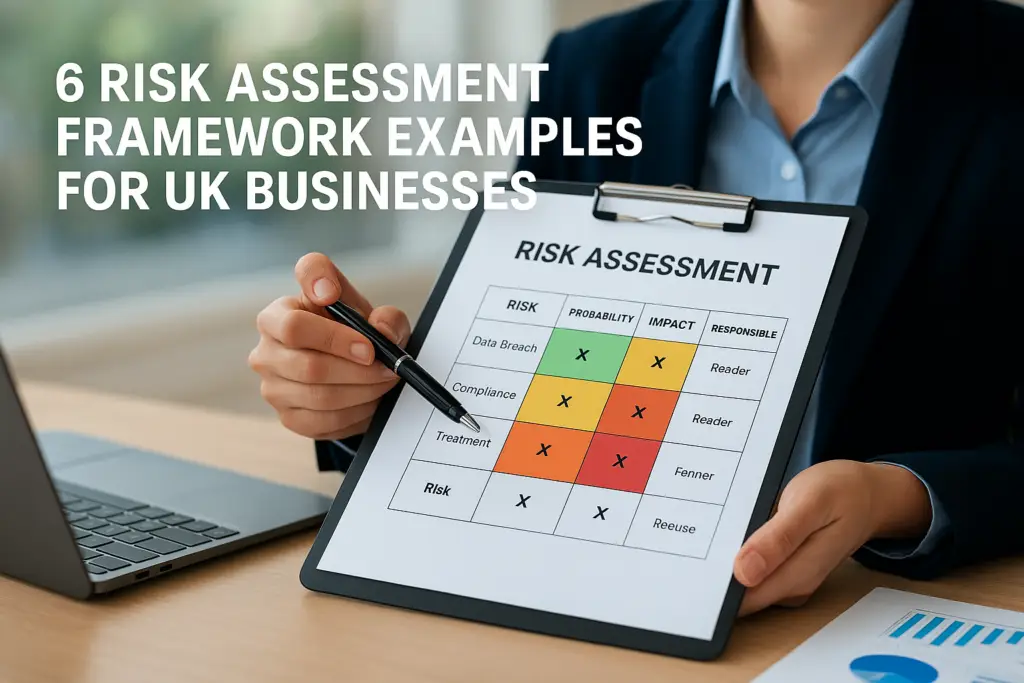
Choosing the right risk assessment framework can feel overwhelming when there are dozens of standards, models, and templates competing for your attention. Most UK businesses know they need a structured approach to identifying and managing risk, especially cyber risk, but figuring out where to start is the hard part. That’s exactly why we’ve put together these risk assessment framework examples: to give you a clear, practical comparison so you can pick the one that actually fits your organisation.
At TrustedIA, we help businesses across the UK build and maintain strong cyber security postures, including ISO 27001 implementation and certification. Risk assessment sits at the heart of everything we do, from audits and vulnerability assessments to incident response planning. We’ve seen first-hand how the right framework transforms risk from a vague worry into something measurable and manageable.
Below, you’ll find six proven frameworks used by UK businesses right now, each broken down with its strengths, ideal use cases, and practical guidance. Whether you’re an IT manager scoping out options or a business owner trying to meet compliance requirements, this guide will help you move forward with confidence.
1. TrustedIA ISO 27001-aligned cyber risk assessment
TrustedIA’s framework sits at the top of these risk assessment framework examples because it’s built specifically for UK businesses pursuing or maintaining ISO 27001 certification. It combines the standard’s formal requirements with over 30 years of practical IT and managed security experience, which means the output works in the real world, not just on paper.
What this framework covers
This framework maps information security risks across your entire organisation, identifying threats, vulnerabilities, and potential business impacts against the assets that matter most. It follows ISO/IEC 27001:2022 clause 6.1, covering both risk identification and treatment planning within a clearly defined scope.
How TrustedIA structures the assessment
TrustedIA starts by building out your information asset register and confirming the assessment scope before assigning likelihood and impact ratings to each identified risk. The process uses CRAFT, TrustedIA’s internally developed security posture tooling, to produce a measurable baseline rather than relying on assumptions or self-reported data.
A measured baseline turns the risk assessment from a one-off compliance exercise into something you can track and improve each year.
What outputs you produce
At the end of the process, you hold three core documents:
- Risk register listing all identified risks with ratings and ownership
- Risk treatment plan detailing the controls or actions applied to each risk
- Statement of Applicability (SoA) mapping selected controls to identified risks
These documents meet the requirements most UK certification bodies expect to review during a formal ISO 27001 audit.
Where it fits best for UK organisations
This approach suits SMBs and mid-sized enterprises pursuing first-time ISO 27001 certification or working through a recertification cycle. Organisations handling sensitive client data in regulated sectors such as finance, healthcare, or legal services will find it particularly well-matched to their compliance obligations.
Strengths, limits, and common pitfalls
The key strength is that every output aligns directly with ISO 27001 audit requirements, which significantly reduces rework before certification. The main limit is focus: this framework addresses information security risks only and does not extend to broader operational or financial risk categories. The most common pitfall is scoping too widely at the start, which produces a risk register too large to act on effectively.
2. ISO 31000 risk management framework
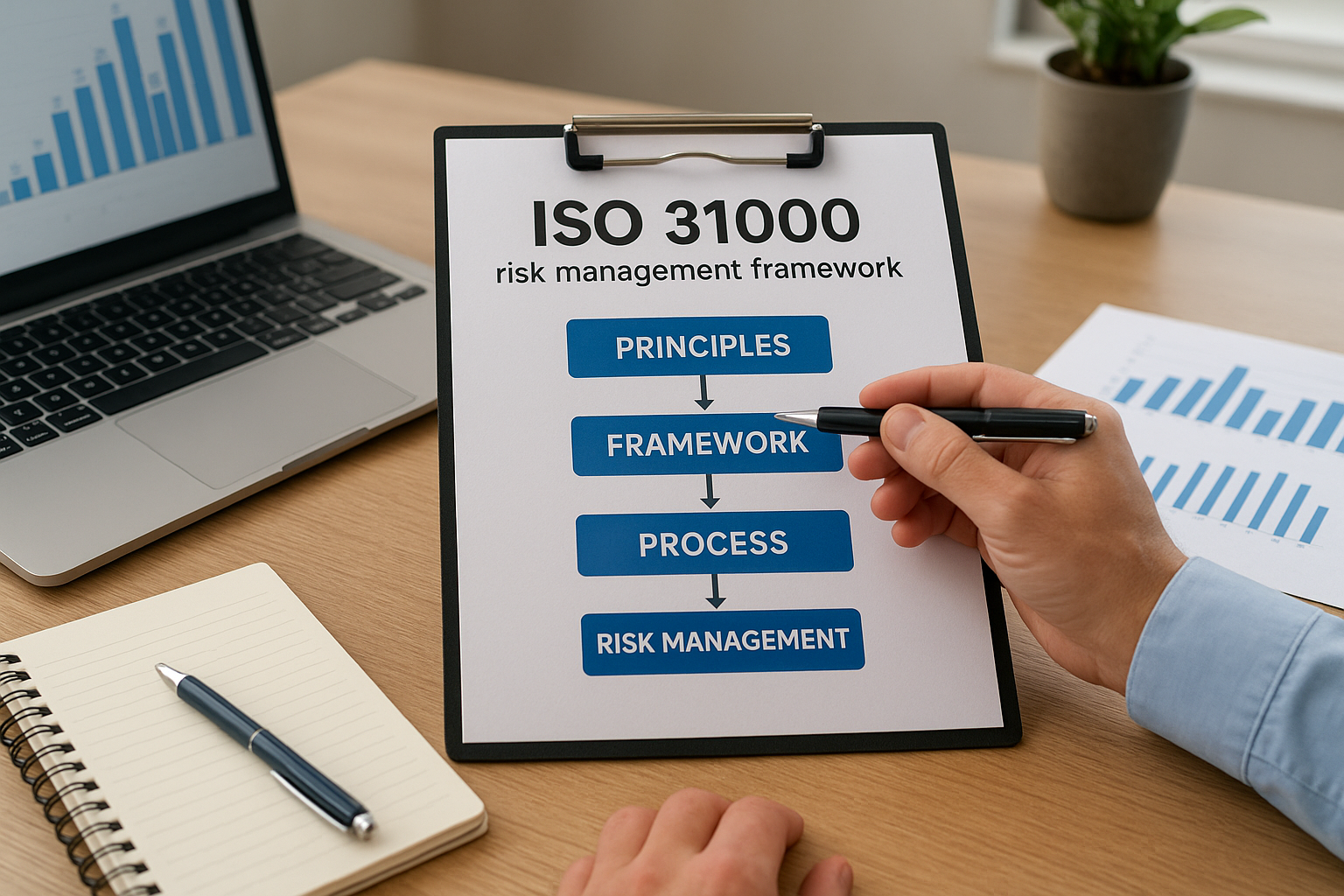
ISO 31000 is one of the most widely referenced risk assessment framework examples in enterprise risk management globally. Published by the International Organization for Standardization, it applies to any organisation type or industry, making it a common starting point when building a broad risk management programme.
What this framework covers
ISO 31000 defines principles, a framework, and a process for managing risk across all categories, including operational, strategic, financial, and reputational risks. It does not specify a single methodology, giving you flexibility to adapt it to your organisational context.
How the process works in practice
The process follows eight key steps: establishing context, identifying risks, analysing risks, evaluating risks, treating risks, communicating, monitoring, and reviewing. You work through each step in sequence, but the standard expects you to revisit and update the cycle as your organisation’s risk environment changes.
Treating ISO 31000 as a living process rather than a one-time exercise is what separates organisations that manage risk well from those that simply document it.
What outputs you produce
You produce a risk register and a risk treatment plan, along with documented communication and monitoring procedures to keep the process active over time.
Where it fits best for UK organisations
ISO 31000 suits organisations wanting a flexible, enterprise-wide framework that is not tied to a specific regulation or certification requirement.
Strengths, limits, and common pitfalls
The main strength is its broad applicability across functions and sectors, but without sector-specific guidance, it can lack the practical detail some teams need. The common pitfall is treating it as a one-time compliance exercise rather than an ongoing management discipline.
3. ISO IEC 27005 information security risk management
ISO/IEC 27005 provides dedicated guidance on information security risk management, sitting directly alongside ISO 27001 as a companion standard. Unlike ISO 31000, it focuses entirely on information security risks rather than enterprise risk broadly.
What this framework covers
ISO/IEC 27005 covers the full information security risk lifecycle: establishing context, identifying and analysing risks, evaluating them against defined criteria, and planning treatment. It is one of the most detailed risk assessment framework examples available for cyber security focused teams.
How the process works in practice
You define your risk acceptance criteria first, then work through asset identification, threat and vulnerability analysis, and impact estimation. The standard supports both qualitative and quantitative approaches, so you can match the method to your organisation’s maturity.
Pairing ISO/IEC 27005 with ISO 27001 removes much of the ambiguity around what a compliant risk assessment should look like in practice.
What outputs you produce
Your key outputs are a risk assessment report and a risk treatment plan, both of which feed directly into your ISO 27001 compliance evidence during a formal audit.
Where it fits best for UK organisations
This framework suits organisations already working within the ISO 27001 ecosystem who need more methodological detail than the parent standard provides on its own.
Strengths, limits, and common pitfalls
The main strength is its tight alignment with ISO 27001, which reduces interpretation effort. The limit is its narrow focus on information security only. The most common pitfall is starting the assessment before defining clear risk acceptance criteria.
4. NIST SP 800-30 risk assessment approach
NIST SP 800-30, published by the US National Institute of Standards and Technology, is one of the most detailed risk assessment framework examples available for information system risk. While it originates from a US federal context, UK technology teams and government suppliers reference it regularly because of its structured, evidence-based methodology.
What this framework covers
NIST SP 800-30 focuses on information system risks, walking you through threat source identification, vulnerability analysis, likelihood determination, and impact analysis. It is designed to feed into a broader risk management hierarchy covering organisational, mission, and system-level decisions.
How the process works in practice
You work through three tiers: organisation, mission or business processes, and information systems. At each tier, you identify threat events, assess their likelihood, and estimate potential impact before producing a risk score that guides treatment decisions.
Applying NIST SP 800-30 across all three tiers gives you a genuinely connected risk picture, rather than isolated system-level snapshots.
What outputs you produce
Your primary output is a risk assessment report documenting threat sources, vulnerabilities, likelihood ratings, impact ratings, and recommended controls for each identified risk.
Where it fits best for UK organisations
This framework suits technology-heavy organisations or those supplying into US government supply chains where NIST alignment is a contractual expectation.
Strengths, limits, and common pitfalls
The main strength is its methodological rigour, but the US-centric terminology can create friction for UK teams. The common pitfall is applying it at the system level only and missing the broader organisational context it was designed to capture.
5. FAIR quantitative cyber risk model
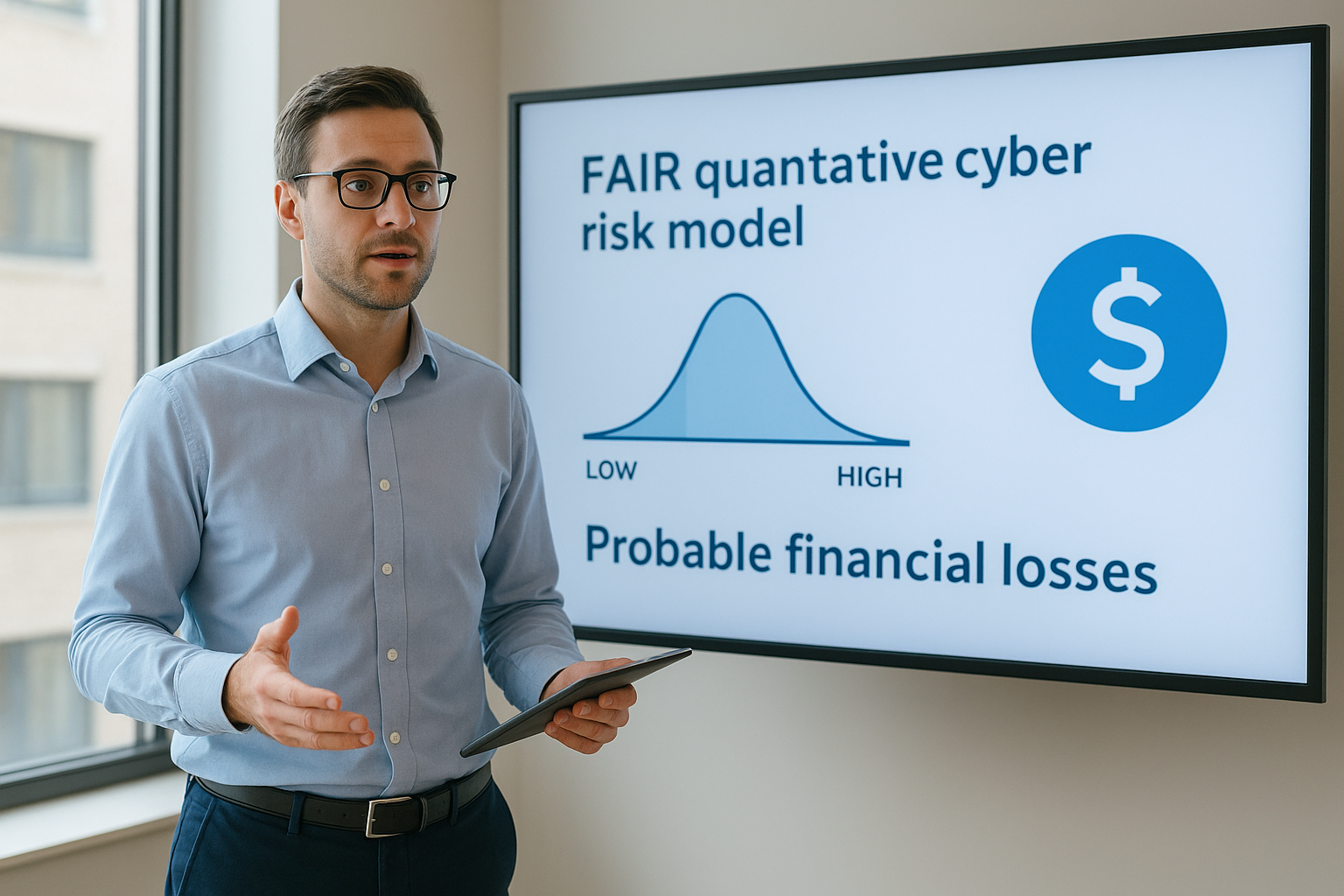
FAIR (Factor Analysis of Information Risk) takes a different approach from the other risk assessment framework examples in this list. Instead of qualitative ratings like "high, medium, low," it uses probabilistic modelling to express risk in financial terms, giving decision-makers a concrete monetary figure to work with rather than a colour-coded matrix.
What this framework covers
FAIR breaks cyber risk into two core components: loss event frequency and probable loss magnitude. It decomposes each component into measurable sub-factors such as threat capability, control strength, and asset value, so every element of the calculation is traceable.
How the process works in practice
You identify a specific risk scenario, gather data on threat frequency and vulnerability, then run a Monte Carlo simulation to produce a range of probable financial losses. This gives you a defensible estimate grounded in data rather than gut feeling.
Expressing cyber risk in financial terms makes it far easier to secure budget from senior leadership.
What outputs you produce
Your primary output is a quantified risk report showing probable annual loss in monetary values. You use this directly to justify security investment decisions or compare the cost of different treatment options side by side.
Where it fits best for UK organisations
FAIR suits mature security teams that already have qualitative processes in place and want to communicate risk impact to board-level stakeholders in straightforward business terms.
Strengths, limits, and common pitfalls
The main strength is its financial clarity, but FAIR demands good quality threat data to produce reliable outputs. The most common pitfall is running the model without sufficient historical data, which generates loss ranges too wide to act on.
6. HSE five-step workplace risk assessment method
The Health and Safety Executive (HSE) five-step method is the most widely used physical workplace risk framework in the UK. Unlike the other risk assessment framework examples in this list, it addresses occupational hazards rather than cyber or financial risk.
What this framework covers
This framework covers physical and occupational hazards such as manual handling, chemical exposure, fire risks, and equipment safety. It helps you meet your legal duties under the Management of Health and Safety at Work Regulations 1999.
How the process works in practice
You work through five steps: identify hazards, decide who might be harmed and how, evaluate risks and agree on precautions, record your findings, and review regularly. Each step is clear enough for non-specialist managers to complete without outside support.
Scheduling a review date when you first complete the assessment turns it from a one-off document into an active safety management tool.
What outputs you produce
Your output is a written risk assessment document recording each hazard, who is affected, existing controls, and further actions needed. UK law requires written documentation if you employ five or more people.
Where it fits best for UK organisations
This framework suits any UK employer with physical workplace risks, particularly those in manufacturing, construction, or retail who need to demonstrate compliance with health and safety legislation.
Strengths, limits, and common pitfalls
The main strength is its simplicity, making it usable without a dedicated safety team. It does not cover cyber or financial risks. The most common pitfall is completing the assessment once and never returning to update it as working conditions change.
Next steps
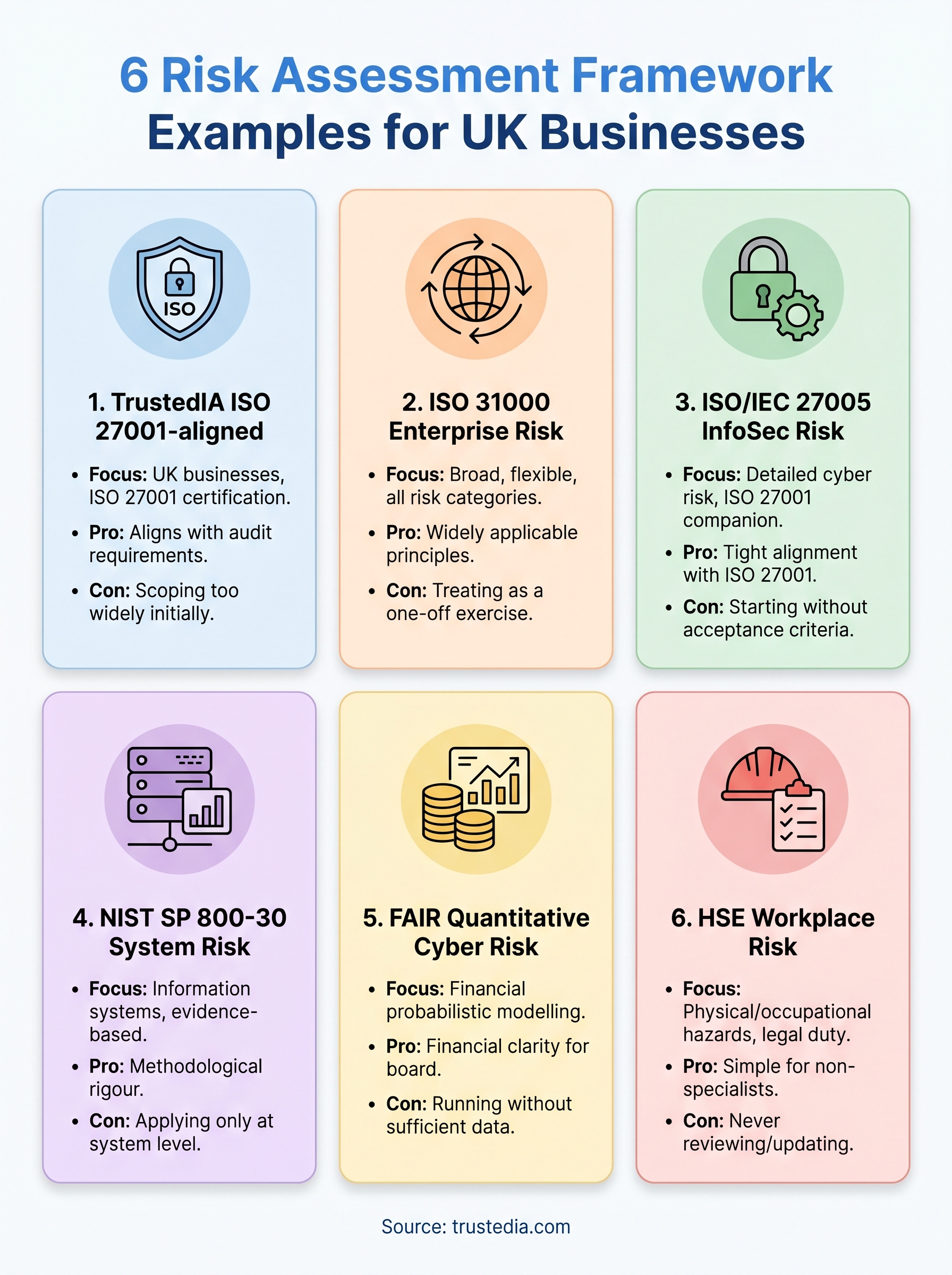
These six risk assessment framework examples give you a practical map of what is available and where each approach fits best. The right choice depends on your industry, the type of risks you are managing, and whether you need to meet a specific compliance requirement such as ISO 27001 certification or UK health and safety legislation.
Your next move is to match your situation to the frameworks above and identify which one addresses your most pressing risks first. If you are a UK business working to improve your cyber security posture or preparing for an ISO 27001 audit, starting with a structured, expert-led assessment will save you significant time and help you avoid the pitfalls that trip up most first attempts.
TrustedIA works with UK businesses at every stage of the risk assessment and compliance process. To find out how we can support your organisation, explore our cyber security services.



