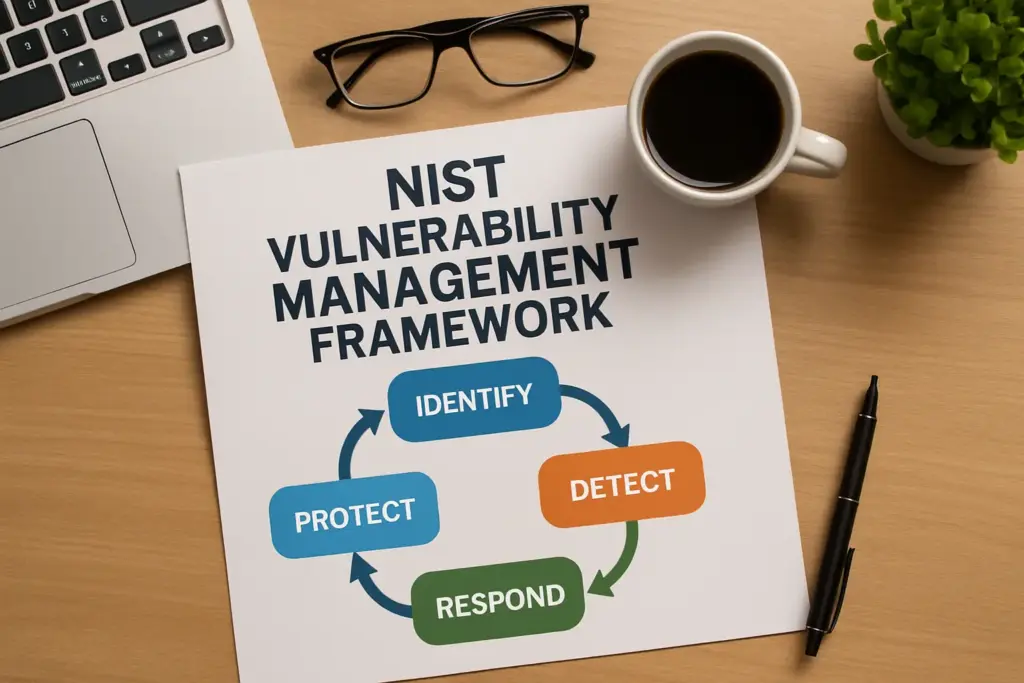
Most organisations know they need to manage vulnerabilities. Fewer know how to do it in a structured, repeatable way that actually holds up under scrutiny. That’s where the NIST vulnerability management framework comes in: a set of guidelines and publications from the National Institute of Standards and Technology that provides a clear methodology for identifying, prioritising, and remediating security weaknesses before they become incidents.
Whether you’re building a vulnerability management programme from scratch or trying to align an existing one with recognised standards, NIST provides the structure to do it properly. Its guidance, drawn primarily from the Cybersecurity Framework and Special Publications such as SP 800-40, helps organisations move beyond ad hoc patching to something measurable and defensible. For businesses working towards or maintaining ISO 27001 certification, these controls map closely to what auditors expect to see.
At TrustedIA, we help organisations implement frameworks like this through vulnerability assessments, penetration testing, and managed security services. With over 30 years of experience in IT services and a solution-agnostic approach, we focus on what actually works for your environment, not what a single vendor wants to sell you.
This article breaks down what the NIST vulnerability management framework covers, how its key components fit together, and why it matters for your organisation’s security posture.
What the NIST vulnerability management framework is
The NIST vulnerability management framework is not a single document, but rather a collection of complementary publications that together define how organisations should identify, classify, prioritise, and remediate security vulnerabilities. NIST, the National Institute of Standards and Technology, is a US federal agency, but its guidance has become the de facto international standard for structured security programmes. Organisations across the UK and Europe use it because it is thorough, publicly available, and widely recognised by auditors and regulators alike.
NIST guidance is not a checkbox exercise. It describes a continuous cycle of discovery, assessment, and remediation that keeps your security posture aligned with actual risk.
The core documents behind the framework
Three NIST publications form the backbone of a structured vulnerability management approach. SP 800-40 (Guide to Enterprise Patch Management) focuses specifically on patching cycles, prioritisation logic, and handling unsupported software. SP 800-53 provides a comprehensive catalogue of security controls, including those covering vulnerability scanning, risk assessment, and system maintenance. The NIST Cybersecurity Framework (CSF), now in version 2.0, sits above both and offers a high-level structure built around five functions: Identify, Protect, Detect, Respond, and Recover. Together, these documents give you both the strategic overview and the operational detail you need.
What it actually tells you to do
Within those documents, the framework breaks vulnerability management into four repeating phases that mirror how real-world security teams work:
- Identify weaknesses through scanning, asset inventory, and threat intelligence
- Prioritise findings based on exploitability, business impact, and environmental context
- Remediate through patching, configuration changes, or compensating controls
- Verify that fixes have been applied correctly and that no new exposures have been introduced
Each phase has specific control references in SP 800-53, which means you can map your activities directly to numbered requirements. That mapping matters particularly if you are working towards ISO 27001, since many of the controls overlap and supporting evidence gathered for one standard will often satisfy the other.
Why NIST-aligned vulnerability management matters
Running a vulnerability management programme without a recognised framework means you’re making decisions based on gut feel rather than structured risk prioritisation. The NIST vulnerability management framework gives your programme a defensible basis, one that auditors, insurers, and board members can understand and verify. Without that structure, even a technically competent security team will struggle to show that its work is systematic and risk-informed.
It supports compliance across multiple standards.
NIST controls map directly to requirements in ISO 27001, SOC 2, and Cyber Essentials Plus, which means the evidence you gather for a NIST-aligned programme works across multiple frameworks without duplicating effort. Auditors expect to see documented scan cycles, prioritisation logic, and remediation timelines, and NIST provides the language and structure to produce exactly that.
Alignment with a recognised framework reduces the time and cost of achieving and maintaining certification, not just the audit stress.
It reduces actual business risk
Beyond compliance, the real reason to align with NIST is that it works. Organisations that follow a structured identify-prioritise-remediate cycle close critical vulnerabilities before attackers can exploit them. Studies consistently show that most successful breaches exploit known, unpatched vulnerabilities, meaning a disciplined programme grounded in NIST guidance directly reduces your real-world exposure.
Pairing that structure with regular penetration testing and vulnerability assessments gives you the verification layer that turns documented processes into proven results.
How NIST CSF, SP 800-40 and SP 800-53 fit together
The three documents in the NIST vulnerability management framework work as a layered system rather than standalone references. Each one operates at a different level of detail, and understanding how they connect helps you use them without duplication or gaps in coverage.
The CSF is your strategic layer
The NIST Cybersecurity Framework provides a high-level structure for your entire security programme. Its five functions define the outcomes you need to achieve across your vulnerability management cycle:
- Identify: catalogue assets and discover vulnerabilities through scanning
- Protect: apply controls and patches to reduce exposure
- Detect: monitor continuously for new weaknesses or active exploitation
- Respond: contain and remediate confirmed issues quickly
- Recover: restore affected systems and document lessons learned
These functions tell you what your programme needs to do. The supporting publications tell you how to do it in practice.
SP 800-40 and SP 800-53 as your operational layer
SP 800-40 fills in the patching-specific detail: scan frequency, remediation timelines tiered by severity, and guidance for software that vendors no longer support. SP 800-53 provides a broader control catalogue covering vulnerability scanning, risk assessment, and system maintenance, with each control numbered for direct reference in your documentation. Together, they give your team specific, auditable actions under each CSF function, turning strategic outcomes into a repeatable process your auditors can verify.
Using all three documents together means your vulnerability management programme has both strategic direction and the operational discipline to back it up.
How to implement a NIST-aligned vulnerability programme
Implementing the NIST vulnerability management framework starts before you run a single scan. You need to define your scope and assign ownership across your asset base so that every finding has someone accountable for acting on it. Without that groundwork, even well-structured scan results pile up unresolved.
Start with asset discovery and baseline scanning
Your first step is to build a complete asset inventory that covers every endpoint, server, application, and cloud resource in scope. You cannot manage vulnerabilities in systems you have not found. Once your inventory is ready, run an authenticated baseline scan and document the results formally so you have a clear reference point for measuring progress over time.
A useful baseline inventory should capture at a minimum:
- Device type and operating system version
- Software versions and current patch levels
- Assigned owner or responsible team
Define remediation tiers and assign clear ownership
SP 800-40 recommends tiering remediation by severity and exploitability rather than treating all findings equally. Set timelines by CVSS score bands: critical findings within 24 to 48 hours, high within 14 days, and medium within 30 days.
Documented timelines and named owners are exactly what auditors look for when assessing whether your vulnerability programme operates as described.
Assign named ownership for each tier and track progress in a remediation register your security function reviews on a fixed schedule. That register becomes your primary evidence artefact when auditors ask whether your programme runs as documented.
How to measure, govern and improve over time
A vulnerability programme that runs without measurement and governance is one that drifts. The NIST vulnerability management framework expects you to track performance over time and adjust your approach when the data shows gaps. Defining the right metrics from the start turns your programme from a technical exercise into something your leadership team can act on.
Track metrics that reflect actual risk reduction
Your metrics should tell you whether vulnerabilities are being closed faster than they are being introduced, not just how many scans you have run. Measure mean time to remediate by severity tier, the percentage of critical findings resolved within your defined window, and the volume of repeat findings across consecutive scans.
Metrics tied directly to remediation timelines are the clearest evidence that your programme operates as documented when auditors come calling.
Useful metrics to track regularly include:
- Mean time to remediate (MTTR) by severity tier
- Percentage of critical and high findings closed within agreed-upon windows
- Repeat findings rate across consecutive scan cycles
- Asset coverage as a percentage of your total known inventory
Build a governance cycle into your programme
Reviewing metrics only matters if someone has the authority to act on them. Assign a named governance owner, whether that is your CISO, IT manager, or a managed security partner, and schedule quarterly programme reviews to assess trends, adjust remediation timelines, and update your asset inventory as your environment changes. That review cycle is also the right time to feed lessons from any incidents or near-misses back into your scanning scope and prioritisation logic.
Where to go from here
The NIST vulnerability management framework gives you a structured, auditable approach to reducing real security risk, not just producing scan reports. By combining the Cybersecurity Framework’s strategic functions with the operational detail in SP 800-40 and SP 800-53, you get a programme that satisfies auditors, supports ISO 27001 compliance, and actually closes vulnerabilities before attackers reach them.
Putting this into practice requires the right expertise alongside the right framework. Defining asset scope, setting remediation timelines, and maintaining a governance cycle are all achievable, but they take time and consistent effort to embed properly, especially if your team is already stretched. Working with a specialist partner means you get both the technical capability and the documented evidence trail that regulators and insurers expect to see.
If you want to build a vulnerability programme that holds up under scrutiny, speak to the TrustedIA team about how we can help.