
When a critical system goes offline, two questions immediately follow: how quickly can we restore service, and how much data have we lost? The answers depend entirely on whether your organisation has invested in high availability vs disaster recovery, two strategies that are often confused, sometimes conflated, but serve fundamentally different purposes. Understanding the distinction between them isn’t academic; it directly shapes your infrastructure decisions, your budget, and your ability to keep operating when something breaks.
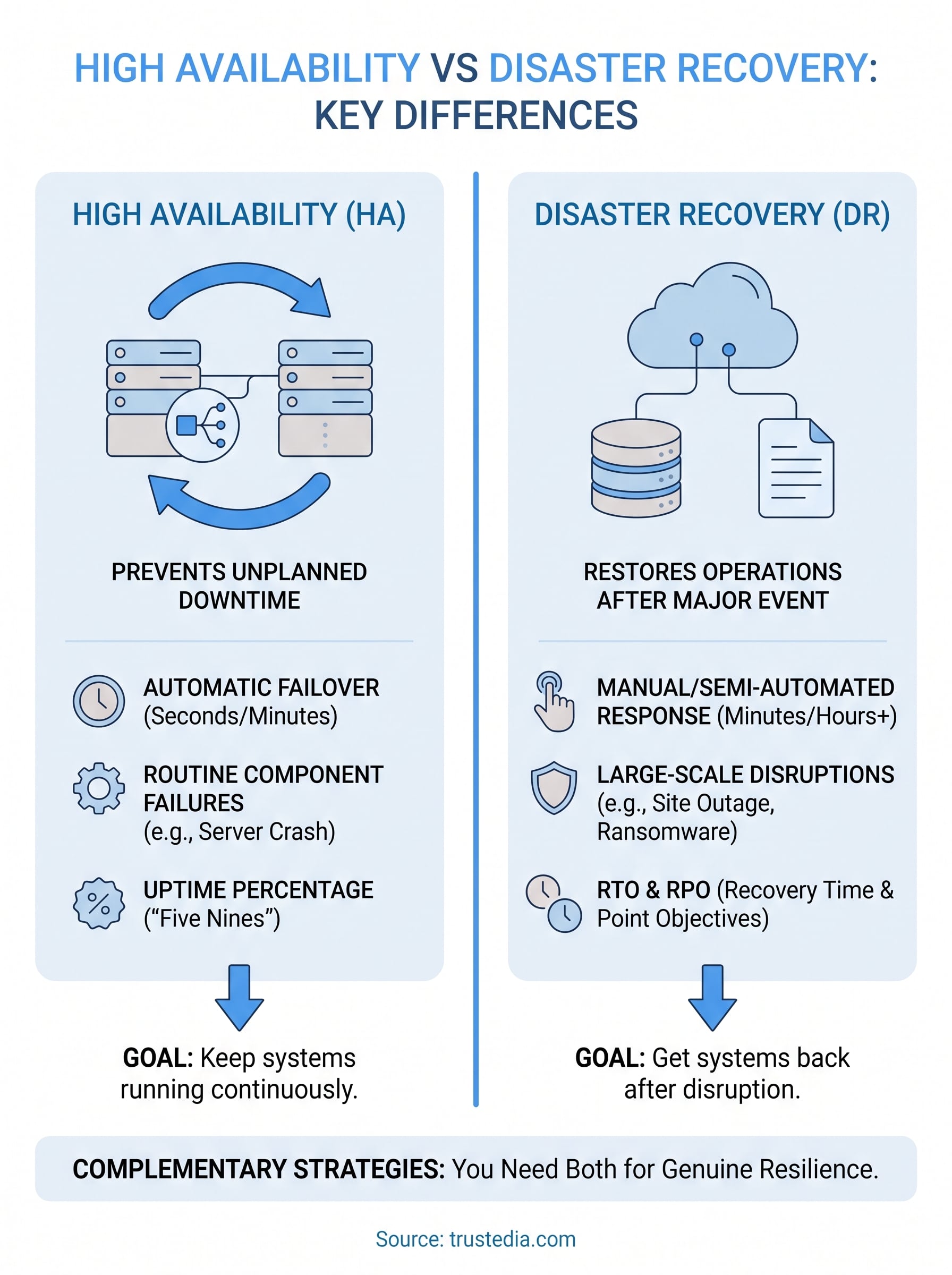
High availability focuses on eliminating single points of failure so that systems stay running with minimal interruption. Disaster recovery focuses on getting systems back after a significant event, a ransomware attack, a data centre fire, a catastrophic hardware failure. Both are essential, but they protect against different types of risk, and one cannot replace the other.
At TrustedIA, we help businesses design and implement business continuity and disaster recovery strategies that actually hold up under pressure. With over 30 years of experience in managed IT services and cybersecurity, including incident response through our CyberSOS service, we’ve seen first-hand what happens when organisations treat these concepts as interchangeable. This article breaks down the key differences between high availability and disaster recovery, explains how they complement each other, and helps you determine what your organisation actually needs.
Why high availability and disaster recovery matter
Businesses run on data and systems. When either becomes unavailable, the impact spreads quickly across operations, revenue, and reputation. The question isn’t whether your organisation will experience system disruption at some point; it’s whether you have the right measures in place to limit the damage when it happens. Understanding where high availability vs disaster recovery fits into your infrastructure strategy is the starting point for building genuine resilience.
The cost of unplanned downtime
Downtime is expensive, and the numbers are significant. Research consistently shows that the average cost of IT downtime can exceed £5,000 per minute for larger organisations, with SMBs facing proportionally severe impacts when critical systems go offline. Those figures don’t capture the full picture either. Customer trust, regulatory penalties, and operational disruption add layers of cost that are harder to quantify but very real.
Downtime doesn’t just cost money in the moment; it erodes customer confidence in ways that can take months to rebuild.
Every unplanned outage carries a direct financial impact alongside an indirect one. Staff cannot process orders, customer-facing services go dark, and leadership spends time managing a crisis instead of running the business. For organisations that handle sensitive data, there is also the risk of data loss or corruption during an outage, which compounds the recovery challenge significantly. Both problems require investment in prevention and recovery, not just one or the other.
Cyber threats have changed what resilience looks like
The threat landscape has shifted. Ransomware attacks, supply chain compromises, and targeted intrusions have made cybersecurity incidents one of the leading causes of severe and prolonged downtime. A hardware failure in 2005 might have taken a server offline for a few hours. A ransomware attack today can encrypt your entire environment and leave you attempting recovery for days or weeks, sometimes longer if backups have also been compromised.
Your organisation can no longer treat resilience as a straightforward infrastructure problem. Your business continuity strategy needs to account for scenarios where the disruption isn’t accidental but deliberate, where an attacker has specifically targeted your backups, your recovery systems, and your failover capabilities. Both high availability and disaster recovery need to be designed with an adversarial mindset, not just a hardware failure mindset. That shift in thinking changes both the architecture decisions you make and the budgets you need to justify them.
Why neither strategy works in isolation
High availability keeps systems running through redundancy and automatic failover. Disaster recovery restores systems after a significant event that redundancy alone cannot absorb. Neither strategy is complete on its own. A highly available system with no disaster recovery plan leaves you exposed to large-scale failures such as a ransomware attack or a site-wide outage. A disaster recovery plan without high availability means you accept far more routine downtime than most businesses can sustain.
Organisations that handle disruption best are those that have built both layers into their infrastructure and tested them regularly. They know their recovery time objectives (RTOs) and recovery point objectives (RPOs), they have mapped out which systems are genuinely business-critical, and they have invested in the right blend of redundancy, replication, and documented recovery procedures. Treating high availability and disaster recovery as separate budget lines rather than complementary components of the same strategy is one of the most common and costly mistakes we see.
What high availability means in practice
High availability (HA) is an approach to infrastructure design that minimises unplanned downtime by removing single points of failure. The goal is to keep systems running continuously, or as close to continuously as possible, even when individual components fail. In practical terms, this means building systems where redundancy is built in at every critical layer, from servers and storage to networking and power. If one component fails, another takes over automatically, often without any action required from your team.
The metric most commonly used to describe high availability is uptime percentage. "Five nines" availability, meaning 99.999% uptime, translates to fewer than six minutes of downtime per year. That level of resilience requires careful architecture, not simply buying more hardware. When organisations weigh high availability vs disaster recovery, HA sits firmly in the camp of preventing disruption rather than recovering from it.
The components that make a system highly available
Achieving genuine high availability depends on specific technical patterns applied consistently across your infrastructure. The core principle is eliminating every single point of failure so that no isolated component failure can bring down an entire service.

The most common components include:
- Load balancers that distribute traffic across multiple servers, so a single server failure does not affect users
- Clustered databases with automatic replication, ensuring data remains readable from a healthy node
- Redundant network paths that reroute traffic if a link or switch fails
- Uninterruptible power supplies (UPS) and generator backup, which protect against power failures at the physical layer
- Health monitoring and automated failover, which detects failures and shifts workloads without manual intervention
Building redundancy into your infrastructure is not enough on its own; those redundant systems must be able to detect failure and respond to it automatically.
How HA handles failure automatically
When a component in a highly available system fails, the process of detecting the failure and routing traffic or workloads to a healthy component is called failover. In well-designed HA environments, this happens in seconds rather than minutes, and users often experience nothing more than a brief delay. The key is that your systems are monitoring one another continuously, and the logic for switching over is defined and tested well in advance.
Automated failover depends on accurate health checks and clearly defined thresholds for what constitutes a failed node. If your monitoring cannot reliably detect that a component is unhealthy, it cannot trigger failover at the right moment. This is where the operational discipline behind high availability matters just as much as the underlying architecture.
What disaster recovery means in practice
Disaster recovery (DR) is the process of restoring systems, data, and operations after a significant disruption that your day-to-day redundancy cannot absorb. Where high availability focuses on preventing interruption, disaster recovery accepts that some events will cause a full or partial outage and plans specifically for how you get back. In the high availability vs disaster recovery comparison, DR is your response capability, the structured set of procedures, technologies, and responsibilities that determines how quickly and completely your organisation recovers.
The key metrics: RTO and RPO
Two metrics define the practical shape of any disaster recovery strategy: Recovery Time Objective (RTO) and Recovery Point Objective (RPO). RTO is the maximum acceptable time between an outage and full system restoration. RPO is the maximum acceptable amount of data loss, measured in time. If your RPO is four hours, your backups must run at least every four hours, otherwise a failure leaves you losing more data than your organisation can tolerate.

Your RTO and RPO targets should be driven by business impact, not by what your current infrastructure happens to support.
These targets vary significantly by system. A customer-facing payment platform may require an RTO of minutes and an RPO close to zero. An internal reporting tool might tolerate several hours of downtime and data loss measured in days. Identifying which systems sit in which category is one of the most important steps in building a disaster recovery plan that allocates budget and effort appropriately.
What a disaster recovery plan actually contains
A disaster recovery plan is a documented, tested set of procedures that your team follows when a significant incident occurs. It does not exist as a single document alone; it requires the supporting infrastructure to make those procedures executable. The core elements of a working plan include:
- Defined roles and responsibilities: clear ownership so that every critical action has an assigned person
- Offsite or cloud-based backups: data copies stored separately from primary systems to survive a site-level failure
- Tested recovery procedures: step-by-step runbooks that staff can follow under pressure without guessing
- Communication plans: internal and external notification procedures for stakeholders, customers, and regulators
- A declared recovery environment: a target infrastructure, whether cloud-based or a secondary site, where systems can be restored
Without a tested, documented plan, your recovery capability exists only in theory. The organisations that recover fastest from serious incidents are those that have rehearsed their procedures before the incident occurs, not those that figure it out in the moment.
High availability vs disaster recovery: key differences
The core distinction in the high availability vs disaster recovery debate comes down to intent. High availability is a design philosophy aimed at preventing disruption, while disaster recovery is a response capability designed to restore operations after disruption has already occurred. Both strategies protect your organisation, but they address entirely different failure scenarios and operate on different timescales. Conflating them leads to gaps that become visible only when something goes seriously wrong.
Different problems, different solutions
High availability addresses routine and localised failures, such as a server crashing, a network link dropping, or a storage node becoming unresponsive. Your HA infrastructure is built to absorb these events automatically, with no human action required. Disaster recovery, by contrast, addresses large-scale, high-impact events that your redundancy cannot absorb, including ransomware encrypting your primary environment, a data centre losing power for an extended period, or a critical database being corrupted. DR requires documented procedures, trained staff, and a recovery environment that sits separate from your primary systems.

High availability keeps the lights on during everyday failures; disaster recovery turns the lights back on after a major event.
The table below shows how the two strategies differ across the dimensions that matter most when you are designing or reviewing your infrastructure:
| Dimension | High availability | Disaster recovery |
|---|---|---|
| Primary goal | Prevent unplanned downtime | Restore operations after a major event |
| Failure scope | Component or system level | Site or organisation level |
| Activation | Automatic, within seconds | Manual or semi-automated, following a plan |
| Recovery time | Seconds to minutes | Minutes to hours or longer |
| Key technologies | Load balancers, clustering, failover | Offsite backups, replication, runbooks |
| Ongoing cost | Higher infrastructure investment | Lower ongoing cost, higher recovery-time cost |
How each strategy handles failure
When a highly available system detects a failed component, automated failover logic redirects traffic or workloads to a healthy instance without your team needing to intervene. Speed is built into the architecture. Disaster recovery works differently. When a significant event hits, your team executes a documented recovery plan, spinning up a secondary environment, restoring data from offsite backups, and following predefined runbooks to bring services back in a controlled sequence.
Neither approach is inherently superior. Your organisation needs both layers because automated redundancy cannot protect you from events large enough to take down an entire environment, and a disaster recovery plan alone cannot prevent the cumulative downtime caused by frequent, smaller component failures. Recognising where one ends and the other begins is what allows you to invest in each appropriately.
How to design for RTO and RPO targets
Setting RTO and RPO targets is not a technical exercise; it is a business decision grounded in the real cost of disruption. Many organisations make the mistake of letting their existing infrastructure dictate their targets rather than the other way around. In the context of high availability vs disaster recovery, your RTO and RPO values determine which strategy you apply to each system, how much you invest in redundancy and replication, and what trade-offs are acceptable when failure occurs.
Start with a business impact analysis
Before you assign a single number to any system, you need to understand what each system is actually worth to your operations. A business impact analysis (BIA) identifies your critical processes, maps them to the underlying systems they depend on, and quantifies the cost of losing access to those systems over time. This gives you a defensible, evidence-based foundation for your targets rather than inherited assumptions or guesswork.
Your RTO and RPO targets should reflect what your organisation can genuinely tolerate, not what sounds reasonable in a planning meeting.
Not all systems are equally critical, and your BIA output should make that visible. A customer-facing payment platform that processes transactions in real time may need an RTO under fifteen minutes and an RPO near zero. An internal HR portal might tolerate several hours of downtime and a day’s worth of data loss without meaningful business impact. Mapping these differences clearly lets you allocate budget and technical effort where the risk is highest rather than spreading resources too thinly.
Translate targets into technical requirements
Once you have defined your RTO and RPO for each system, you can work backwards to select the right architecture. A tight RTO requires automated failover, pre-provisioned recovery infrastructure, and tested runbooks your team can execute under pressure without improvising. A tight RPO requires continuous or near-continuous data replication, which carries both cost and complexity implications you need to account for upfront.
Synchronous replication is typically necessary for systems requiring an RPO close to zero, meaning data is written to a secondary location at the same time it is written to the primary. Systems that can tolerate an RPO measured in hours may be adequately protected by scheduled backups to an offsite or cloud location, which reduces cost considerably.
Matching your technical solution to your actual business requirements prevents both over-spending on unnecessary resilience and under-investing in systems where failure would genuinely damage your operations.
Common architectures and patterns for HA and DR
When you understand the distinction in high availability vs disaster recovery, the next step is choosing the right architecture to support each. The pattern you select directly affects your RTO and RPO targets, your infrastructure costs, and the level of automation your team can rely on during a failure. Several well-established architectures have emerged to address different failure scenarios, and knowing which one suits your organisation requires understanding both their trade-offs and their limitations.
Active-passive and active-active clustering
Clustering is one of the most common patterns used to achieve high availability at the application and database layer. In an active-passive cluster, one node handles all traffic while a standby node remains ready to take over if the primary fails. Failover is automatic, but it introduces a brief period during which the passive node must accept responsibility for workloads. In an active-active cluster, multiple nodes share the load simultaneously, meaning no single node carries the full burden, and failure of one node redistributes traffic across the remaining healthy nodes with minimal disruption.
Active-active setups typically offer lower recovery times and better use of your hardware investment, but they are more complex to configure and require your application to support distributed workloads. Active-passive setups are simpler to implement and are often the right choice when application architecture does not allow for concurrent processing across multiple instances.
Warm standby and pilot light for DR
For disaster recovery, two widely used patterns are warm standby and pilot light. A pilot light approach keeps a minimal version of your environment running in a secondary location, typically just the core database layer, while the remaining infrastructure is provisioned only when recovery is triggered. This keeps ongoing costs low but increases recovery time because you need to scale up infrastructure during an incident.

A warm standby environment costs more to maintain than a pilot light, but it significantly reduces the time required to restore full service after a major disruption.
A warm standby keeps a scaled-down but functional replica of your full environment running continuously, ready to be scaled up quickly when needed. This approach sits between a pilot light and a full active-active multi-site deployment, offering a practical middle ground for organisations that need a reasonable RTO without the cost of running duplicate infrastructure at full capacity. Microsoft’s Azure Site Recovery documentation provides useful reference for implementing these patterns in cloud environments.
Testing, monitoring and operational readiness
Both high availability and disaster recovery require ongoing validation to remain effective. Designing resilient infrastructure is the starting point, but it only tells you what should happen during a failure. Regular testing and monitoring tell you what actually happens, and the gap between the two is where most organisations discover their weaknesses. Neither strategy delivers value if your team only reviews it after a real incident forces the issue.
Test your failover before you need it
Failover testing is the only reliable way to confirm that your HA architecture behaves as designed when a component fails. Many organisations assume their automated failover works because they configured it correctly, but assumptions break under pressure. Scheduling planned failover tests on a regular cadence, at minimum annually and ideally quarterly for critical systems, exposes configuration drift, dependency issues, and gaps in your runbooks before an actual failure does.
A disaster recovery plan that has never been tested is not a plan; it is a set of untested assumptions written down on paper.
Disaster recovery exercises should go beyond document reviews. A full tabletop exercise walks your team through a realistic failure scenario so that roles, responsibilities, and decision points are clear before anyone is under pressure. A more demanding test, sometimes called a live failover or simulation test, actually switches workloads to your recovery environment and measures whether your RTO and RPO targets are achievable in practice. Both formats build the organisational muscle memory your team needs when recovery is not optional.
Monitor what matters, not just availability
In the context of high availability vs disaster recovery, effective monitoring means watching the indicators that signal a system is approaching failure, not just confirming that it is currently online. Proactive monitoring tracks metrics such as replication lag, storage capacity, CPU saturation, and backup job completion rates. Each of these can indicate a growing problem before it becomes an outage.
Your monitoring setup should include clear alert thresholds and defined escalation paths so that when something crosses a threshold, the right person receives a notification and knows what action to take. Without that structure, alerts generate noise rather than action. Configuring your monitoring platform to feed into a centralised dashboard gives your team a single view of system health across your primary and recovery environments. Tools like Azure Monitor provide a practical starting point for organisations running cloud-based workloads. Reviewing your monitoring coverage regularly ensures it keeps pace with changes to your infrastructure rather than lagging behind them.
Compliance and risk: aligning with ISO 27001
If your organisation is pursuing or maintaining ISO 27001 certification, your approach to availability and recovery is not just a technical concern but a compliance requirement. ISO 27001 requires you to systematically identify risks to information availability and put proportionate controls in place to manage them. The decisions you make in the high availability vs disaster recovery space directly feed into your information security management system (ISMS), and auditors will expect documented evidence that those decisions are grounded in a formal risk assessment.
ISO 27001 and business continuity controls
ISO 27001 Annex A includes specific controls covering information availability and business continuity. Control 8.14 addresses redundancy of information processing facilities, which maps directly to your high availability architecture. Control 5.30 covers ICT readiness for business continuity, which encompasses your disaster recovery planning, testing, and documented recovery objectives. Together, these controls require you to demonstrate that you have assessed the likelihood and impact of disruption, implemented appropriate technical measures, and tested that those measures work.
ISO 27001 does not prescribe specific technologies; it requires evidence that your controls are proportionate to the risks your organisation has identified.
Meeting these controls in practice means maintaining documented RTO and RPO targets that are derived from a business impact analysis, not inherited assumptions. Your certification auditor will look for traceability between your risk register, your control selection, and your test results. If your documented RTO is four hours but your last DR test took sixteen hours to complete, that gap becomes a nonconformity you need to address.
Mapping HA and DR to your risk register
Your ISO 27001 risk register should include scenarios that your high availability and disaster recovery controls are specifically designed to address. Common entries include prolonged system outage, ransomware infection affecting primary infrastructure, third-party service provider failure, and physical site loss. For each scenario, you assign a risk rating based on likelihood and impact, then select controls and record how those controls reduce the residual risk to an acceptable level.
High availability controls typically address frequency of minor disruptions and reduce the likelihood that small failures escalate into larger outages. Disaster recovery controls reduce the impact of major events by ensuring you can restore operations within an agreed timeframe. Documenting the relationship between your risk scenarios and your chosen controls gives your ISMS the internal logic that auditors look for, and it gives your leadership team a clear picture of where residual risk remains. TrustedIA’s ISO 27001 subject matter experts work with organisations at every stage of this process, from initial risk assessment through to certification support.
Key takeaways and next steps
High availability and disaster recovery solve different problems. High availability removes single points of failure so your systems keep running through routine component failures. Disaster recovery gives your organisation a structured path back to normal operations after a major event that redundancy alone cannot handle. Both strategies are necessary, and neither substitutes for the other.
Your RTO and RPO targets should drive every architectural decision, from clustering patterns to backup frequency. Testing both your failover mechanisms and your recovery procedures on a regular schedule is the only reliable way to confirm they work under real conditions. Compliance frameworks like ISO 27001 require documented evidence that your controls are proportionate to the risks you have identified.
If you want expert guidance on building a resilience strategy that addresses the full high availability vs disaster recovery picture, speak to TrustedIA’s cybersecurity team to discuss your specific requirements.