
When a ransomware attack encrypts your files or a server failure takes your operations offline, the clock starts ticking. Every minute of downtime costs money, erodes customer trust, and puts your business at genuine risk. Having disaster recovery explained clearly, and, more importantly, planned properly, is what separates organisations that bounce back from those that don’t. Yet many businesses still treat it as a problem for tomorrow, leaving critical systems without a tested recovery strategy.
This article breaks down what disaster recovery actually involves, from the core concepts of Recovery Time Objective (RTO) and Recovery Point Objective (RPO) to the practical steps needed to build a plan that works under pressure. You’ll learn the key methods available, how they fit into a broader business continuity strategy, and what to prioritise based on your organisation’s size and risk profile.
At TrustedIA, disaster recovery is central to the managed security services we deliver. With over 30 years of experience helping businesses prepare for and recover from cyber incidents, including through our dedicated CyberSOS Incident Response service, we’ve seen first-hand what good planning looks like and what happens without it. This guide reflects that hands-on experience, built to give you a practical foundation you can act on.
What disaster recovery is and what it is not
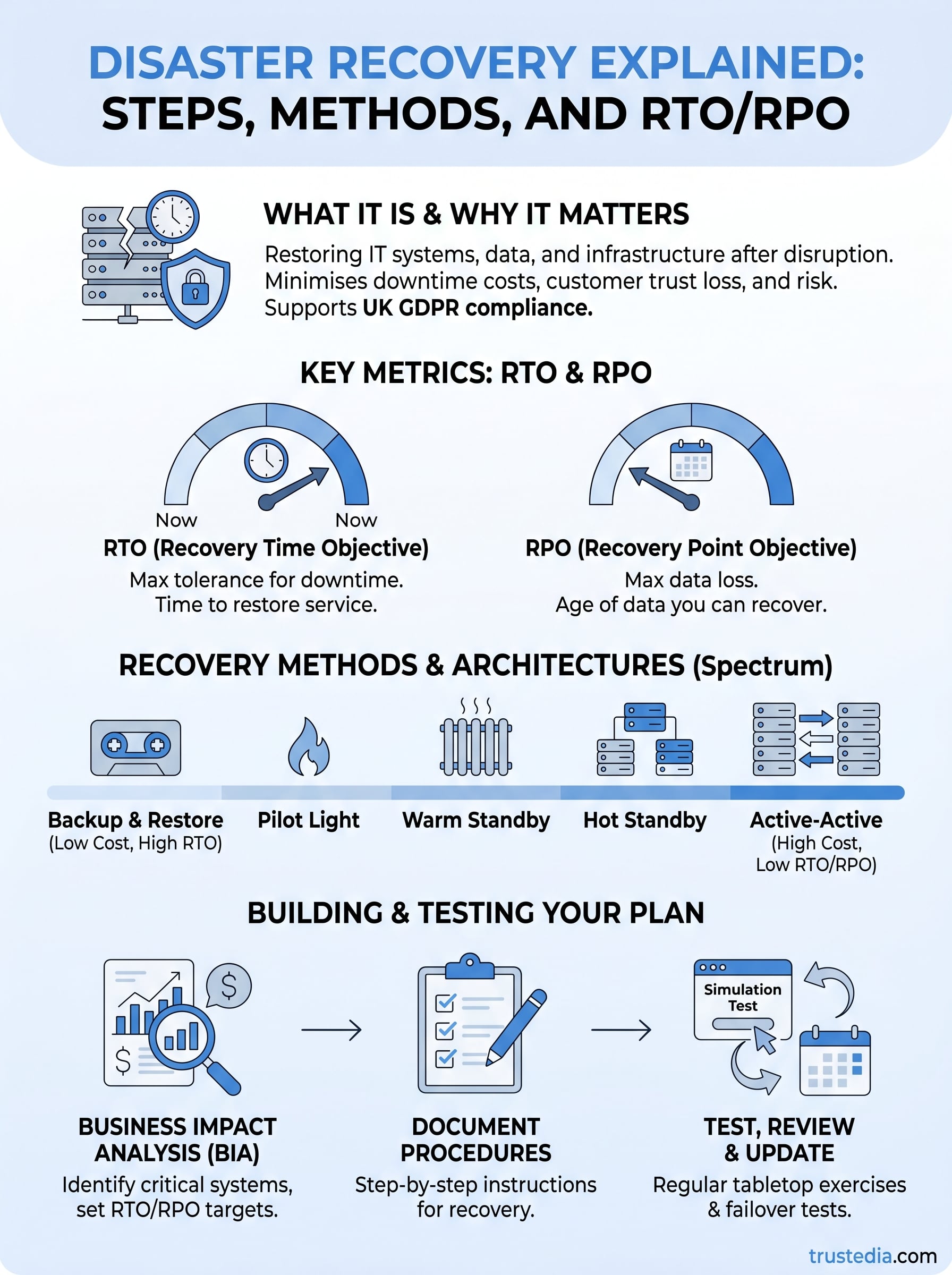
Disaster recovery (DR) refers to the set of policies, tools, and procedures your organisation uses to restore access to IT systems, data, and infrastructure after a disruptive event. That event could be a ransomware attack, hardware failure, power outage, accidental deletion, or a natural disaster affecting your physical premises. At its core, disaster recovery is about restoring normal operations as quickly and completely as possible, minimising the damage that downtime inflicts on your business and its customers.
The core definition
To get disaster recovery explained accurately, it helps to understand what it actually covers. A disaster recovery plan (DRP) defines your recovery priorities, responsible personnel, and specific technical steps needed to bring systems back online after an incident. It answers three fundamental questions: what do you need to recover, in what order, and how fast? Good DR documentation does not sit in a drawer; it gets tested, updated, and understood by the people who need to execute it under pressure.
Disaster recovery operates at the infrastructure level, meaning it focuses on your servers, networks, storage, cloud environments, and the data running through them. When a major incident strikes, your DR plan dictates exactly which systems come back first and in what state. Without that clarity, recovery efforts become reactive and disorganised, and the time it takes to restore services stretches far beyond what it should.
A disaster recovery plan is only as useful as the last time it was tested. An untested plan is little more than a document.
What disaster recovery is not
Disaster recovery is not the same as backup. Backups are a critical component of DR, but having a copy of your data stored somewhere does not mean you have a recovery plan. A backup tells you where your data is; a DR plan tells you how, when, and in what sequence you restore it across your full environment. Many organisations discover this distinction the hard way when they attempt to recover from an incident and find that their backups are incomplete, untested, or take far longer to restore than anyone anticipated.
Business continuity planning (BCP) is another concept that often gets conflated with DR, but the two are distinct. Business continuity takes a broader organisational view, covering how your business keeps operating during a disruption, including people, processes, communications, and supply chains, not just IT systems. DR sits within the business continuity framework as the technical recovery component. You need both, but treating them as the same thing creates gaps in your planning that only surface during an actual incident.
Finally, disaster recovery is not a one-time project you complete and file away. Your IT environment changes constantly, and new systems, new cloud services, and new threat vectors all affect your recovery capabilities. Treating DR as an ongoing discipline rather than a box you tick once is what keeps your organisation genuinely protected when something goes wrong.
Why disaster recovery matters for UK businesses
UK organisations face a growing volume of cyber threats, and the consequences of inadequate preparation are measurable. Ransomware, phishing attacks, and infrastructure failures have affected businesses across every sector in recent years. Whether you run a ten-person SMB or a mid-sized enterprise, the question is not whether a disruptive incident could happen, but how well prepared you are when it does. Getting disaster recovery explained and properly embedded in your operations gives you a structured path back to normal, rather than an improvised scramble.
The financial and operational impact of downtime
Unplanned downtime carries direct costs that accumulate quickly: lost revenue, idle staff, emergency IT spend, and damage to customer relationships that takes far longer to repair than the systems themselves. For smaller businesses, even a few hours offline can represent a significant share of monthly revenue. The indirect costs are often harder to quantify but equally serious, including reputational damage, lost contracts, and the operational disruption of rebuilding processes from scratch.
For many SMBs, a single major incident without a tested recovery plan is enough to threaten the long-term viability of the business.
Recovery without a plan rarely goes smoothly. Teams end up making decisions under pressure without clear priorities, which extends downtime and increases the risk of data loss. A tested disaster recovery plan changes that by giving everyone defined roles, documented procedures, and pre-agreed recovery priorities that hold up under stress.
Regulatory obligations under UK GDPR
UK GDPR, enforced by the Information Commissioner’s Office (ICO), requires organisations to implement appropriate technical and organisational measures to protect personal data and ensure its availability. If a cyber incident results in data loss or prolonged unavailability, you may face a mandatory breach notification obligation to the ICO within 72 hours. Penalties for non-compliance can reach £17.5 million or 4% of annual global turnover, whichever is higher.
A well-structured disaster recovery plan directly supports your GDPR obligations by demonstrating that you have treated data resilience as a genuine operational control, not just a paper exercise. Organisations that can show documented, tested recovery procedures are in a far stronger position with regulators than those that cannot.
Key metrics: RTO, RPO, and service tiers
Two numbers sit at the heart of every disaster recovery explained properly: Recovery Time Objective (RTO) and Recovery Point Objective (RPO). These metrics define your acceptable limits for downtime and data loss and drive every architectural and budgetary decision in your DR programme. Without setting them deliberately, you end up falling back on an arbitrary standard that may not reflect what your business actually needs.
Recovery Time Objective (RTO)
RTO is the maximum amount of time your organisation can tolerate being without a system or service before the impact becomes unacceptable. If your RTO for a core application is four hours, your recovery architecture must be capable of restoring that system within that window. Setting your RTO requires honest input from business stakeholders, not just IT, because the people running operations understand the real cost of downtime better than anyone measuring server uptime.
An RTO of zero is effectively continuous availability, which requires active-active infrastructure and carries significant cost implications.
Recovery Point Objective (RPO)
RPO defines the maximum age of the data you can recover without causing unacceptable data loss. If your RPO is 1 hour, you need backup or replication mechanisms that capture changes at least hourly. A longer RPO means more data may be lost during recovery, which may be acceptable for some systems but completely unworkable for others, such as financial transaction platforms or patient records.
Mapping metrics to service tiers
Your RTO and RPO targets will differ across your systems, and grouping them into tiers by criticality makes this manageable. Tier 1 systems, such as your core business applications, carry the tightest objectives and require the most resilient architecture. Tier 2 and Tier 3 systems can tolerate longer recovery windows, which lets you allocate budget proportionally rather than treating every server as mission-critical.

Using a tiered model forces you to make deliberate prioritisation decisions before an incident happens, which is exactly where disaster recovery planning should begin.
Disaster recovery methods and architectures
The method you choose shapes everything from your RTO and RPO targets to your budget and operational complexity. Getting disaster recovery explained at the architectural level helps you match the right approach to your actual recovery requirements, rather than defaulting to whatever your current backup vendor offers. Each method sits on a spectrum, trading off cost against recovery speed, and the right answer depends entirely on the criticality of the systems involved.
Backup and restore
Backup and restore is the most straightforward DR method, where data is copied to a secondary location on a scheduled basis, and systems are rebuilt from scratch during a recovery event. This approach incurs the lowest infrastructure cost but typically results in the longest RTO, since restoring full environments from backup takes time. It suits non-critical systems where a recovery window of several hours or more is acceptable.
Backup and restore is a valid DR method for low-criticality systems, but applying it to mission-critical infrastructure will almost certainly breach your RTO targets.
Pilot light and warm standby
Pilot light keeps a minimal version of your environment running in a secondary location, with core components such as databases replicating continuously, but application servers switched off until needed. Warm standby goes a step further by maintaining a scaled-down yet fully functional environment that you can quickly scale up when recovery is required. Both approaches reduce RTO significantly compared to basic backup and restore, while keeping ongoing costs lower than a full hot standby.
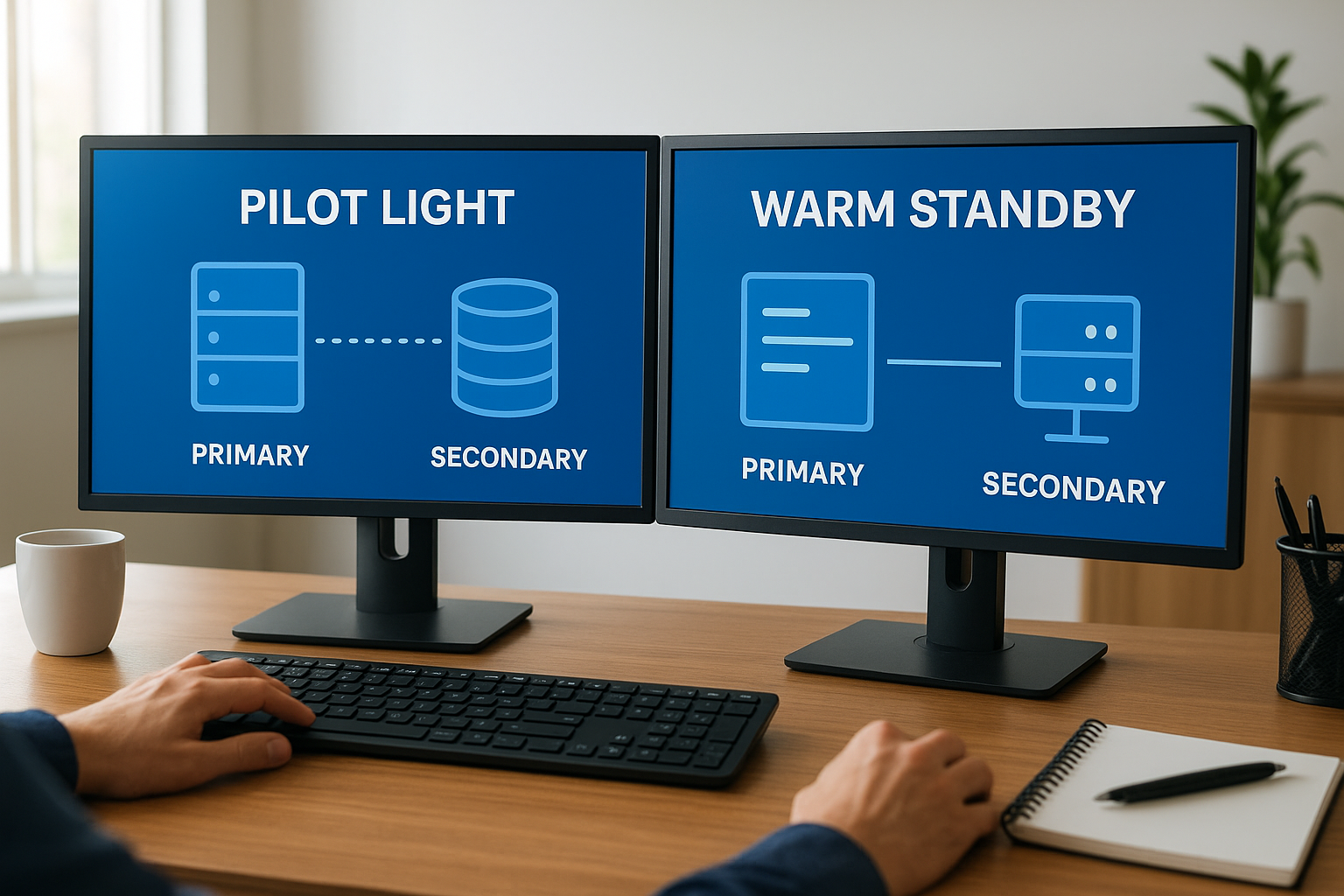
Your choice between the two comes down to how fast you need to be fully operational. Pilot light introduces a lag for spinning up additional infrastructure; warm standby removes most of that lag, at a proportionally higher running cost.
Hot standby and active-active
Hot standby maintains a complete, fully operational environment in a secondary location with near-real-time data replication. Active-active takes this further by running both environments simultaneously and distributing workloads between them, delivering near-zero RTO and RPO. Both architectures suit Tier 1 systems where even brief downtime carries serious business impact, but they require proportionally higher investment in infrastructure, networking, and ongoing management.
How to build and test a disaster recovery plan
Building a disaster recovery plan starts before you touch any technology. Your first task is to understand which systems and processes your business depends on most, and what the real cost of losing them would be. Once you have that foundation, every technical decision that follows, from architecture to replication frequency, maps back to a documented business need rather than guesswork.
Start with a business impact analysis.
A business impact analysis (BIA) identifies your critical systems, maps dependencies between them, and quantifies the effect of downtime on your operations. This is where you set your RTO and RPO targets for each system tier. Involve department heads and operational stakeholders directly, not just IT, because they hold the practical knowledge about which processes can tolerate delays and which cannot. The output of a BIA forms the foundation of your entire DR plan.
Document your recovery procedures step by step
Each critical system needs a documented recovery procedure that a competent person could follow under pressure without improvising. Include specific steps, responsible owners, contact details, and escalation paths. Vague instructions fail when people are stressed, and the clock is running, so treat this documentation as operational tooling rather than compliance paperwork. Store copies both online and offline, because a recovery document locked inside the system you are trying to restore is useless.
With disaster recovery explained and documented at the procedural level, your team spends recovery time executing rather than deciding.
Test, review, and keep it current
An untested plan gives you false confidence. Run tabletop exercises at least annually to walk your team through recovery scenarios, identify gaps, and validate that your RTO and RPO targets are genuinely achievable. Full failover testing, where you actually cut over to your recovery environment, is more disruptive to schedule but far more revealing than a theoretical walkthrough. After every significant infrastructure change, revisit the plan and update it before the details are forgotten.
Next steps
This guide has covered disaster recovery explained from the ground up, including what it is, why it matters, the metrics that define your recovery targets, the architectural options available, and how to build and test a plan that holds up under real pressure. Every element connects back to one practical goal: getting your business back online quickly, with minimal data loss, when something goes wrong.
The next step is an honest assessment of where your organisation stands today. Do your critical systems have documented recovery procedures? Have those procedures been tested against your actual RTO and RPO targets? If the answers are unclear, that is where to start.
TrustedIA helps businesses across the UK build and manage recovery capabilities that work when it counts, backed by over 30 years of hands-on experience in managed security and incident response. To find out how we can support your organisation, speak to our disaster recovery team.