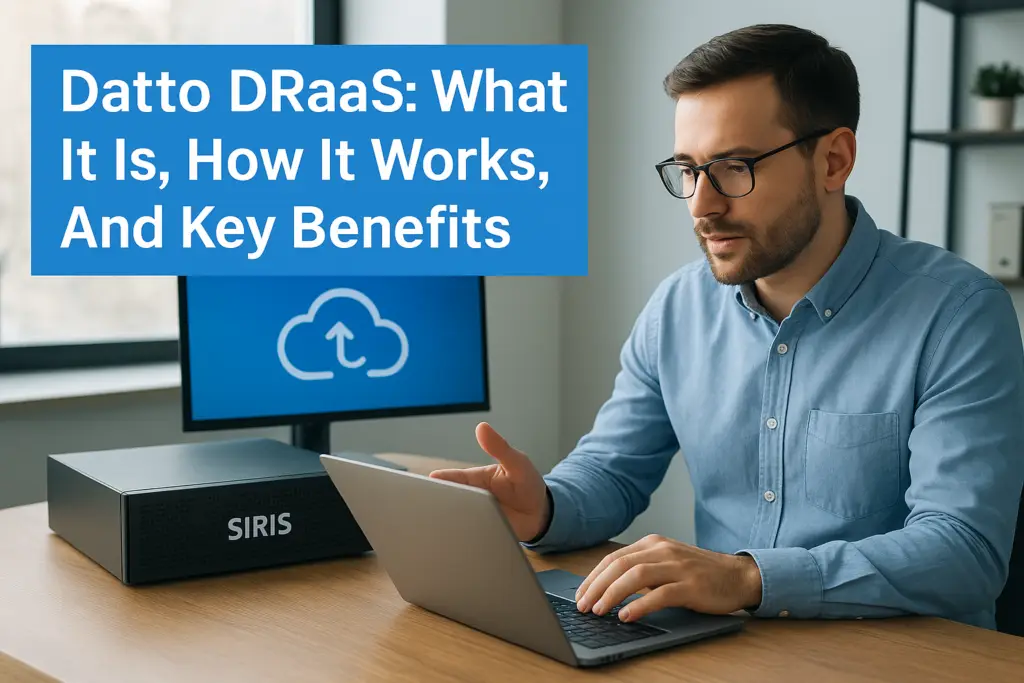
When a server goes down or ransomware locks your files, the difference between a minor disruption and a full-blown crisis comes down to one thing: how quickly you can recover. That’s exactly the problem Datto DRaaS (Disaster Recovery as a Service) is built to solve. It gives Managed Service Providers and the businesses they support a reliable path to rapid recovery, combining local backup appliances with cloud-based failover to keep operations running when things go wrong.
At TrustedIA, disaster recovery and business continuity sit at the core of what we do. With over 30 years of experience delivering managed security services, we help organisations build resilience against cyber threats and operational failures alike. Our solution-agnostic approach means we recommend tools based on what best fits your environment, and Datto’s DRaaS platform is one we see frequently in the MSP space.
This article breaks down what Datto DRaaS is, how its technology works under the hood, and the specific benefits it offers to MSPs and their clients. Whether you’re evaluating it for the first time or comparing it against alternatives, you’ll walk away with a clear, practical understanding of where it fits in a modern recovery strategy.
What Datto DRaaS is and where it fits
Datto DRaaS is a managed disaster recovery solution built specifically for MSPs and the businesses they support. It combines on-site backup appliances with cloud-based infrastructure so that when a server fails, gets encrypted by ransomware, or stops responding, you can spin up a virtual copy of your environment within minutes. Unlike traditional backup tools that only protect data, Datto DRaaS restores entire systems, including operating systems, applications, and configurations, so your staff can keep working without waiting days for hardware replacements to arrive.
The platform sits within Datto’s broader business continuity portfolio, which covers everything from file-level recovery to full virtualisation in the cloud. When people search for Datto DRaaS, they’re typically trying to understand how the disaster recovery layer specifically works, how it differs from basic backup, and whether it justifies the investment. The practical distinction is straightforward: backup confirms the data exists; DRaaS confirms the business can keep running.
If your recovery plan relies solely on backup without a tested failover mechanism, you’re measuring recovery in days rather than hours.
How Datto DRaaS is delivered
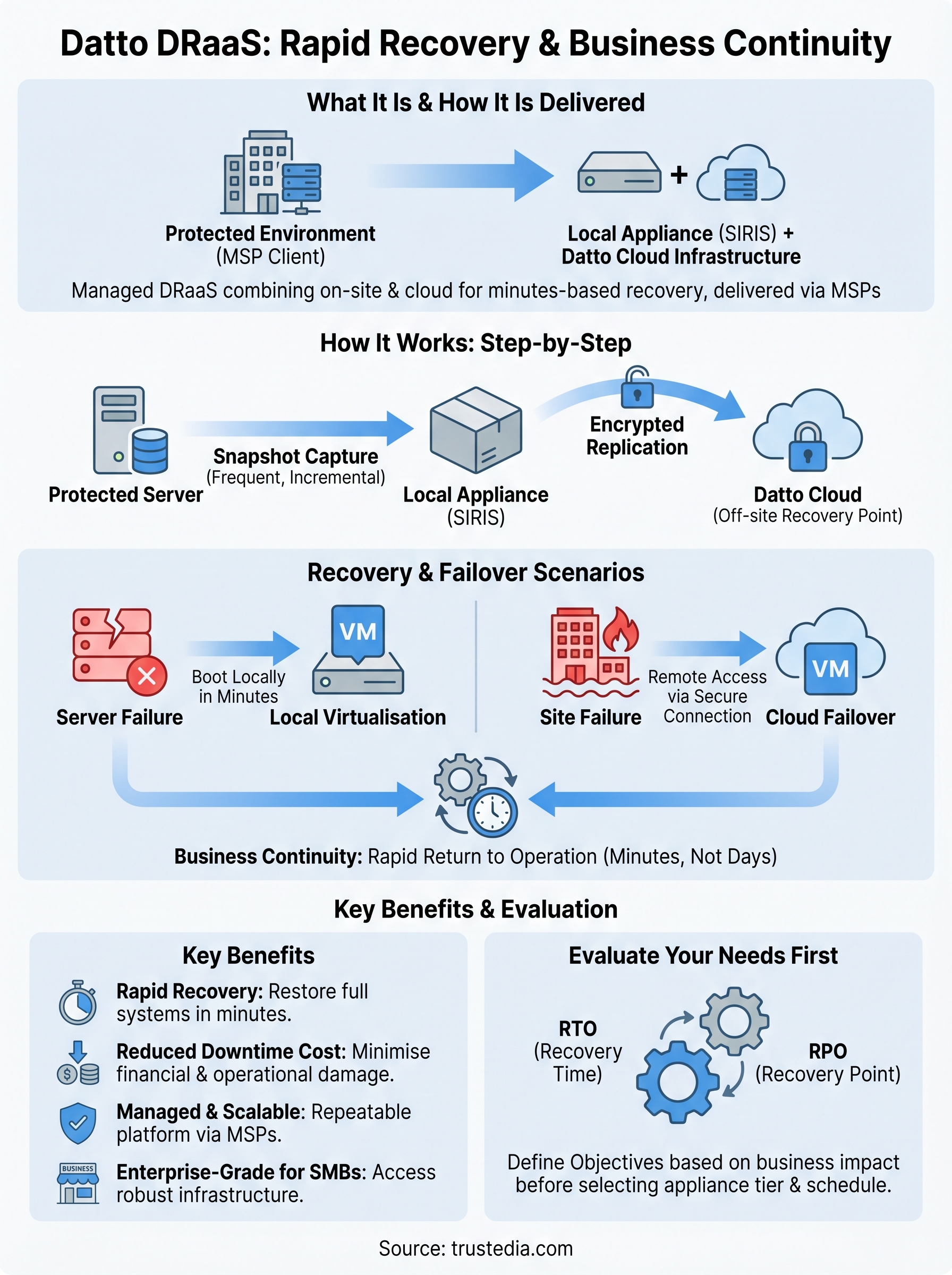
Datto delivers its DRaaS solution through MSPs rather than directly to end users. That model matters because it means the configuration, monitoring, and testing responsibilities sit with a partner who knows your environment, rather than with an in-house team that may lack the capacity or specialist knowledge to manage it properly. The primary hardware component is the Datto SIRIS appliance, an on-premises device that captures frequent incremental snapshots of your systems throughout the working day. Those snapshots then replicate automatically to Datto’s cloud infrastructure, providing you with a secondary, entirely off-site recovery point.
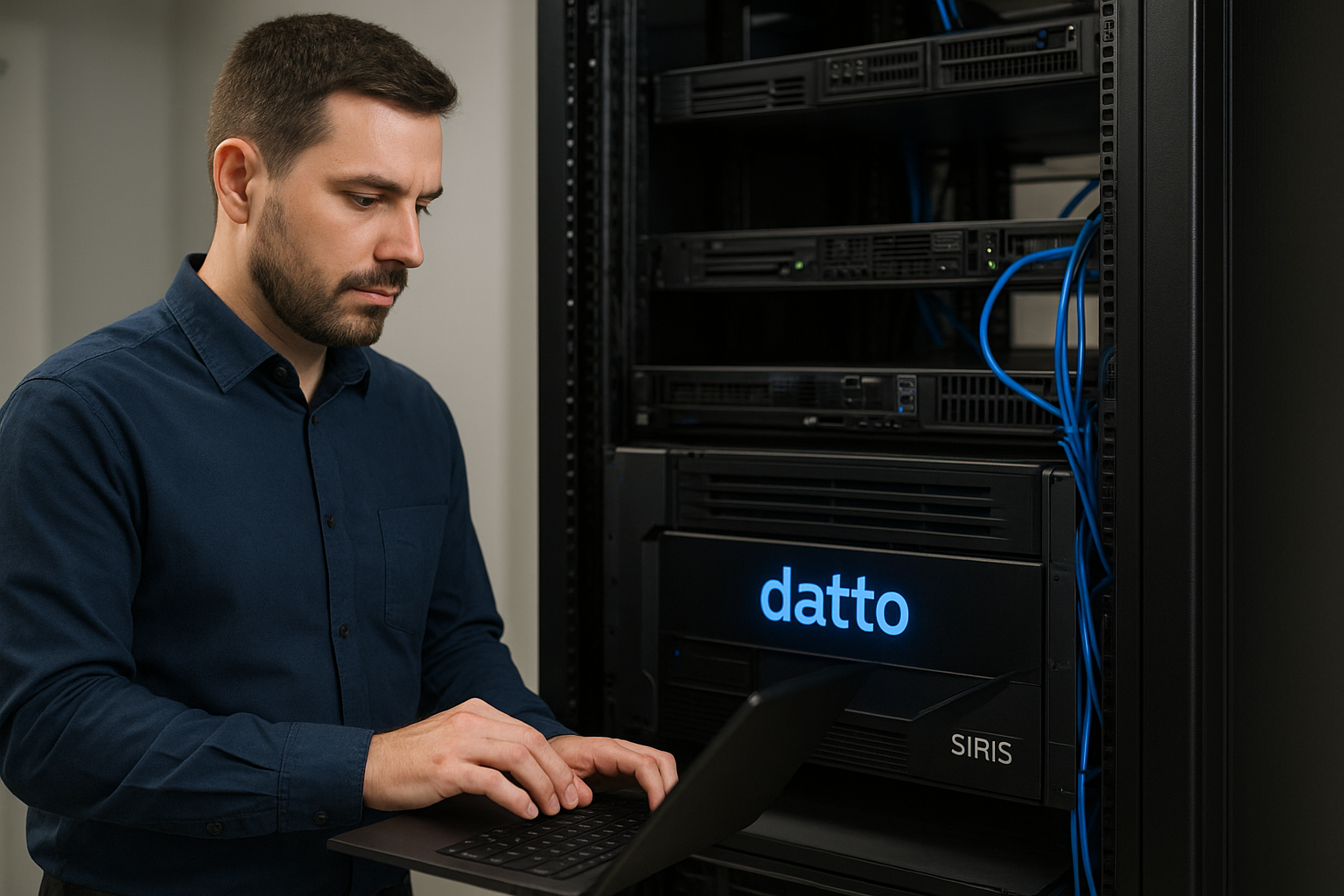
The SIRIS appliance can also run a virtualised version of your protected server locally, which means if a machine fails, you do not have to wait for a cloud-based restore to complete. Your MSP can boot the virtual instance directly from the appliance within minutes. This dual-location approach, combining local and cloud-based recovery, is what sets Datto’s model apart from simpler cloud-only backup services that leave you dependent on download speeds during a crisis.
Where Datto DRaaS fits in a wider security framework
Disaster recovery does not exist in isolation. It works alongside endpoint protection, network monitoring, and incident response to form a complete resilience strategy. Datto DRaaS specifically handles the recovery phase of that framework: once a threat has materialised, once data has been compromised or systems have gone offline, restoring operational capability becomes the immediate priority rather than prevention.
For organisations that need to meet ISO 27001 requirements or satisfy cyber insurance conditions, having a tested and documented DRaaS process directly supports those obligations. The standard’s business continuity controls require demonstrable recovery capabilities, and a platform like Datto DRaaS provides both the technical infrastructure and the audit trail to demonstrate compliance when insurers or assessors request proof. Your MSP plays a central role here, running scheduled recovery tests and producing the documentation your auditors will expect to review.
Why MSPs and SMBs use Datto DRaaS
MSPs adopt Datto DRaaS because it provides a repeatable, scalable recovery platform they can deploy across multiple clients without having to rebuild the process from scratch each time. Instead of managing different tools for different customers, MSPs run a single, standardised workflow backed by Datto’s centralised management portal. That consistency reduces the risk of human error during a recovery event, when mistakes are most costly.
Why MSPs prioritise it
If you run an MSP, offering reliable disaster recovery services strengthens your client relationships and significantly reduces churn. When a business knows you can restore their systems within minutes rather than days, that becomes a core reason to stay with your service. Datto’s platform also generates automated recovery testing reports, which you can use to demonstrate value to clients without scheduling lengthy manual checks. That reporting capability alone saves considerable time across a managed portfolio.
- Centralised management of multiple client environments from one portal
- Automated screenshot verification to confirm each backup is bootable
- Instant local virtualisation for fast on-site recovery
- Cloud failover for resilience when the physical appliance is also affected
What SMBs actually gain
Small and medium-sized businesses benefit from access to enterprise-grade recovery infrastructure without the overhead of running it themselves. A typical SMB does not have the staff or budget to build a secondary data centre, but through their MSP, they effectively get one. This is precisely where Datto DRaaS delivers its clearest value: businesses that could not previously afford dedicated disaster recovery capabilities now have them as part of a managed service contract.
The ability to restore a full server environment within minutes rather than days is the difference between a recoverable incident and a business-threatening one.
Downtime carries a direct financial cost. Every hour a critical system remains offline results in lost productivity, missed revenue, and potential reputational damage. Research from Microsoft and other enterprise technology providers consistently highlights downtime costs as a primary driver of business continuity investment. For SMBs operating on tight margins, Datto DRaaS through a trusted MSP converts what was once an unaffordable risk into a manageable, predictable operational expense.
How Datto DRaaS works step by step
Understanding the mechanics behind Datto DRaaS helps you make a more informed decision about whether it fits your recovery requirements. The process runs continuously in the background, capturing system states, replicating them off-site, and providing your MSP with a set of verified restore points to work from the moment you declare an incident. Rather than relying on a single nightly backup window, the platform builds a rolling timeline of recovery points throughout the working day.
Snapshot capture and replication
The process starts with the Datto SIRIS appliance installed on your premises. It takes incremental, image-based snapshots of your protected servers at regular intervals, as often as every 5 minutes, depending on how your MSP configures the schedule. Each snapshot captures the entire system state, not just changed files, so every restore point is an independent, bootable image of your full environment.
Once a snapshot is created, the appliance compresses and deduplicates it before replicating it to the Datto Cloud over an encrypted connection. This happens automatically without manual intervention, which removes one of the most common failure points in traditional backup strategies: the human step of initiating and verifying transfers. Your MSP receives alerts if replication falls behind or fails, so problems surface before you need to rely on the backup.
Frequent, automated replication means your worst-case data loss is measured in minutes, not hours or an entire working day.
Recovery and failover
When a failure occurs, your MSP has two immediate options depending on the nature of the incident. If the server hardware fails but the SIRIS appliance remains functional, your MSP can virtualise the affected server directly on the appliance within minutes. Your staff connect to the virtual machine and continue working while the underlying issue is resolved.

If the failure affects the physical site itself, such as a fire, flood, or power outage, your MSP triggers cloud failover. The protected systems spin up in Datto’s cloud infrastructure, and users access them remotely via a secure connection. Both paths give you a rapid return to operation without waiting for hardware procurement or lengthy manual restores.
Datto DRaaS capabilities and options
The Datto DRaaS platform is not a single fixed product. Datto offers a range of appliances and deployment models so your MSP can match the solution to your environment’s size, criticality, and budget. Understanding the available options helps you have a more informed conversation with your provider about what you actually need, rather than defaulting to whatever is easiest to deploy.
SIRIS appliance tiers
Datto’s SIRIS line is the core hardware component of its DRaaS offering, and it comes in multiple configurations to suit different workloads. Smaller appliances handle lower data volumes for SMBs with modest infrastructure, while larger units support higher-capacity environments that require simultaneous protection for multiple servers. Your MSP selects the appropriate tier based on the total amount of data you need to protect and the recovery time objectives you want to meet.
- SIRIS: Designed for small to mid-sized environments with standard workloads
- SIRIS Business: Scales for businesses with larger data sets and more demanding recovery requirements
- SIRIS Enterprise: Built for high-availability environments where downtime tolerance is minimal
Each tier supports both local virtualisation and cloud replication, so the core recovery capabilities remain consistent regardless of which appliance your MSP installs.
Cloud and software-defined options
Not every organisation needs a physical appliance on site. Datto also offers ALTO, a smaller, cloud-connected device suited to micro-businesses, and Datto Cloud Continuity, a software-only solution for businesses running primarily on physical PCs rather than servers. These options extend the recovery capability to environments where installing a full SIRIS appliance is either cost-prohibitive or logistically impractical.
Matching the right product tier to your actual recovery requirements prevents both overspending on capacity you do not use and underinvesting in protection you genuinely need.
Your MSP plays a critical role in guiding that selection, reviewing your existing infrastructure, acceptable data loss thresholds, and compliance requirements before recommending a specific configuration. The right choice is always specific to your environment, not a generic default.
How to evaluate Datto DRaaS for your org
Deciding whether Datto DRaaS is the right fit for your organisation starts with an honest assessment of your current recovery position. Before comparing pricing or appliance specs, you need to understand two core metrics: your Recovery Time Objective (RTO) and your Recovery Point Objective (RPO). RTO defines how long you can tolerate being offline; RPO defines how much data loss your business can absorb. Those two numbers will shape every other decision you make.
If you cannot answer what your acceptable RTO and RPO are, your disaster recovery evaluation has not started yet.
Define your recovery objectives first.
Your RTO and RPO are not guesses; they come directly from understanding your business operations and the real cost of disruption. A business processing financial transactions every hour has a very different RPO from one that updates records daily. Work through each critical system and assign realistic figures before speaking to any provider. Your MSP can then map those requirements against specific Datto appliance tiers and snapshot schedules to identify which configuration genuinely meets your needs.
- List your critical systems and rank them by operational priority
- Assign a maximum acceptable downtime to each
- Identify your tolerance for data loss in hours or minutes
- Check whether any regulatory or compliance requirements impose specific recovery benchmarks
Questions to ask your MSP
Once your objectives are clear, your conversations with your MSP become far more productive. Ask them how frequently snapshots are scheduled for your environment and whether that frequency meets your RPO. Confirm that recovery testing happens on a regular, documented schedule, and ask to see the results of previous tests rather than accepting verbal assurances.
You should also ask your MSP how they handle a simultaneous site failure, where both the physical appliance and your premises are affected at the same time. Understanding the cloud failover process, including how users access their systems remotely and how long the switchover takes, helps you determine whether the solution holds up under the most serious recovery scenario your business could realistically face.
Key takeaways
Datto DRaaS gives MSPs and their clients a recovery platform that goes well beyond standard backup. By combining local virtualisation with cloud failover, downtime is reduced from days to minutes, directly limiting the financial and operational damage caused by a cyber incident or hardware failure.
Matching the right Datto DRaaS configuration to your environment depends on understanding your RTO and RPO before selecting any appliance tier or snapshot schedule. Those numbers drive every meaningful decision in the evaluation process, so define them first.
Your MSP’s role is not just technical deployment. It includes regular recovery testing, documented results, and honest guidance on whether the solution you have actually meets the objectives you have set. If you lack that confidence in your current recovery setup, that gap is worth addressing sooner rather than later.
For expert guidance on building a resilient, tested recovery strategy, speak to the TrustedIA team about how we support businesses across the UK.