A penetration test is only as good as the process behind it. Skip a phase, rush the scoping, or treat reporting as an afterthought, and you end up with a tick-box exercise that tells you very little about your actual risk. Understanding the penetration testing steps involved, from the initial planning conversations right through to the final report, helps you evaluate what you’re paying for and hold your testing provider to a higher standard.
Every pen test follows a structured sequence of phases, each building on the one before it. Reconnaissance feeds into vulnerability analysis. Vulnerability analysis shapes exploitation. Exploitation provides the evidence that makes the report actionable. When any of these stages is cut short, gaps appear in the findings, and those gaps can leave real weaknesses undetected.
At TrustedIA, penetration testing is one of our core managed security services. With over 30 years of experience in IT services and cybersecurity, we run tests that follow a rigorous, methodical process, because our clients need results they can act on, not a generic PDF gathering dust in a shared drive. This guide walks you through each phase of a professional penetration test, explaining what happens, why it matters, and what you should expect to see from your provider at every stage.
Why penetration testing matters for UK businesses
UK businesses face a threat landscape that has grown considerably more hostile over the past decade. The National Cyber Security Centre (NCSC) handles thousands of reported cyber incidents each year, and the organisations affected are not limited to large enterprises. Small and medium-sized businesses are increasingly targeted precisely because they hold valuable data but often lack the security investment that larger organisations can afford. Attackers are opportunistic, and an untested network is an open invitation.
The regulatory and compliance landscape
The legal environment in the UK creates clear, enforceable obligations around data protection and security. The UK GDPR, enforced by the Information Commissioner’s Office (ICO), requires organisations to implement appropriate technical and organisational measures to protect personal data. If you experience a breach and cannot demonstrate that you actively tested your defences, regulators are unlikely to accept your other security measures as sufficient mitigation. Fines under UK GDPR can reach £17.5 million or 4% of global annual turnover, whichever figure is higher, and the ICO has shown it is willing to use those powers.
If you cannot show that you have tested your security controls, regulators and insurers are unlikely to take your other protective measures at face value.
Organisations pursuing or maintaining ISO 27001 certification face an additional expectation. Annex A of the standard addresses technical vulnerability management directly, and auditors expect documented evidence that penetration testing has been carried out and that identified weaknesses have been remediated. Without that evidence, your certification is at risk, and with it, the trust of clients and partners who rely on that accreditation as proof of your security posture.
The real cost of an undetected vulnerability
When a vulnerability goes undetected, the financial consequences extend well beyond the immediate incident. Businesses face recovery costs, regulatory penalties, legal liability, and lost revenue from downtime, often simultaneously and without warning. IBM’s 2024 Cost of a Data Breach Report put the global average cost of a breach at 4.88 million USD, and UK organisations feature consistently in those figures. Cyber insurance premiums have also risen sharply, and insurers increasingly require evidence of active security testing before they will offer favourable terms.
Businesses that fare best in the aftermath of an incident are those that identified and addressed their weaknesses on their own terms, before an attacker could exploit them. Following the complete set of penetration testing steps, from initial scoping right through to post-test remediation, is what separates a test that genuinely reduces your risk from a report that gives your board a false sense of security. You need findings that are specific, evidenced, and prioritised by severity, not a theoretical list of vulnerabilities with no clear path to resolution.
Before the test: scope, rules and access
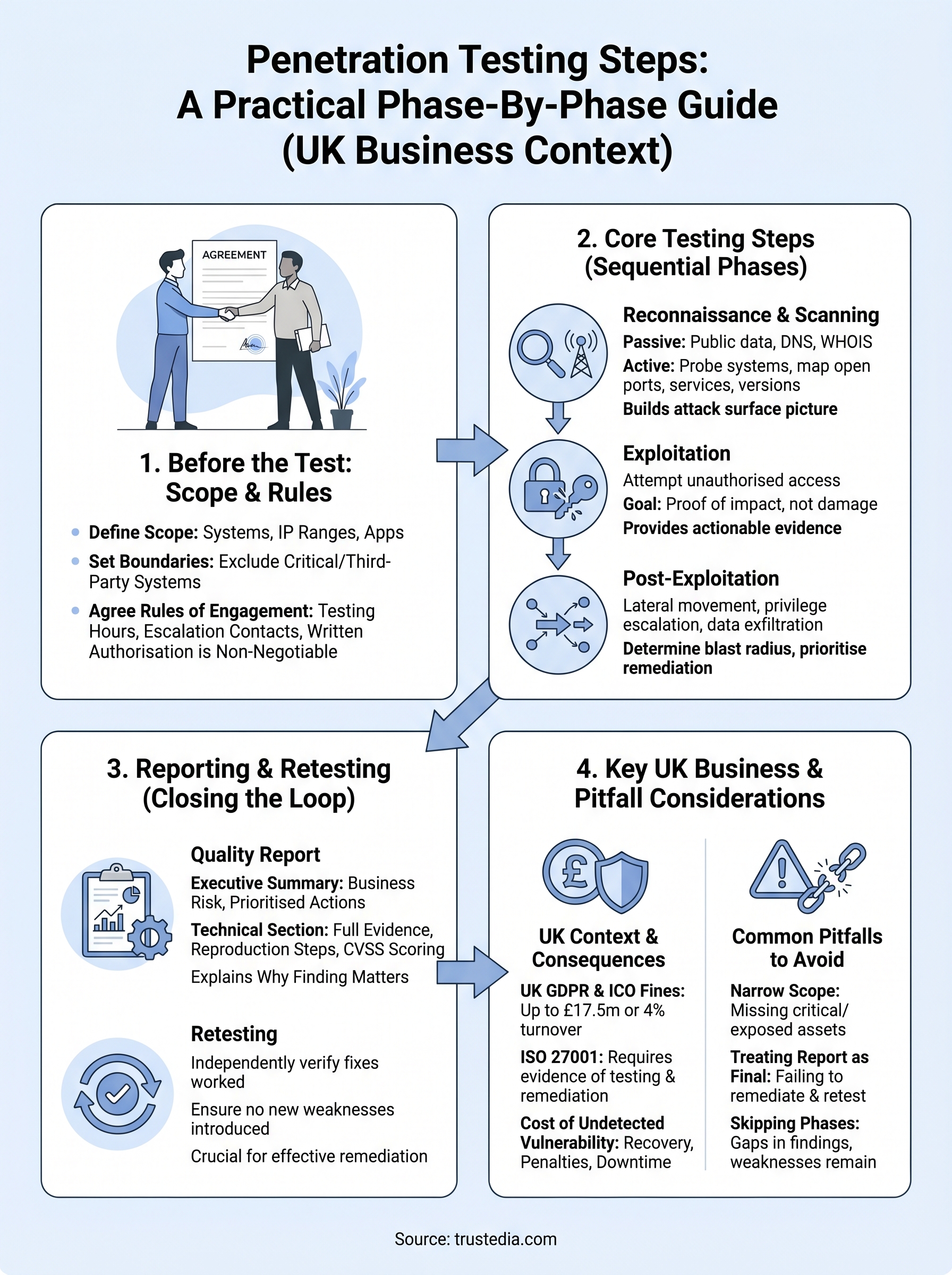
Before any of the penetration testing steps begin, you and your provider need to agree on exactly what is being tested and what is explicitly out of bounds. This pre-test phase is not a formality. The decisions you make here shape every stage that follows, from reconnaissance right through to the final report, and they directly affect how useful your findings will be.
Defining the scope
Scope sets the boundaries of the entire test, covering which systems, IP ranges, applications, and user accounts the tester is authorised to access. A vague scope leads to one of two problems: the tester either misses your most sensitive assets, or inadvertently disrupts live systems that were never meant to be included. Both outcomes reduce the value of the exercise significantly.
Before testing begins, you should agree on:
- Which IP ranges, domains, and web applications are included
- Any systems that must stay out of scope, such as third-party infrastructure you do not control
- Whether the test covers production systems, staging environments, or both
- Any testing restrictions, such as time windows that avoid peak business hours
A clearly defined scope is what separates a focused, evidenced test from one that leaves your most critical assets untouched.
Rules of engagement and legal authorisation
Written authorisation is a non-negotiable requirement before any testing activity starts. Without it, what your provider is doing is legally indistinguishable from an unauthorised intrusion, regardless of their intent.
Your rules of engagement document should specify testing hours, escalation contacts, and the steps the tester must follow if they discover a critical vulnerability mid-engagement. These rules protect both parties and ensure any disruption is controlled rather than unexpected. Make sure your provider has a formally documented agreement in place before you share any credentials or network details.
Step-by-step phases of a pen test
Once scope and rules of engagement are locked down, the penetration testing steps begin in a defined sequence. Each phase produces outputs that feed directly into the next, which is why skipping or compressing any stage weakens the overall findings.
Reconnaissance and scanning
Reconnaissance is where the tester builds a picture of your environment before touching a single system. In passive reconnaissance, they gather information from publicly available sources such as DNS records, WHOIS data, job postings, and LinkedIn profiles, all without sending a single packet to your network. Active reconnaissance follows, where the tester begins probing your systems directly to map open ports, running services, and software versions. Both stages matter because they reveal the attack surface an adversary would realistically exploit.

Reconnaissance done properly tells the tester exactly where to focus during exploitation, making the entire engagement sharper and more efficient.
Scanning and enumeration build on reconnaissance findings by identifying specific vulnerabilities in the services and configurations discovered. Your tester will use this phase to prioritise which weaknesses are most likely to yield a foothold, rather than chasing every low-severity finding equally.
Exploitation and post-exploitation
Exploitation is where the tester attempts to use confirmed vulnerabilities to gain unauthorised access. The goal is not damage but proof of impact, demonstrating that a vulnerability is genuinely exploitable in your environment rather than theoretical. Evidence gathered here forms the backbone of your final report.
Post-exploitation examines what an attacker could realistically do once inside. This includes privilege escalation, lateral movement across your network, and data exfiltration, giving you a clear picture of the potential blast radius. Understanding this stage is what turns a list of vulnerabilities into a meaningful, prioritised remediation roadmap.
What good reporting and retesting look like
The final report is where the penetration testing steps produce their lasting value. A well-structured report does not just list what the tester found; it explains why each finding matters, how it was exploited, and what remediation looks like in practical terms. If you receive a report that reads like a vulnerability scanner printout with no context or prioritisation, you have not received a complete service.
What a quality report contains
A strong pen test report is divided into two distinct audiences: an executive summary for business leaders, and a technical section for your IT and security teams. The executive summary explains risk in business terms, covering potential impact and a prioritised list of actions. The technical section provides full evidence of exploitation, including screenshots, payloads used, and step-by-step reproduction steps so your team can verify and remediate each finding with confidence.

Findings should be rated using a recognised severity framework, such as CVSS (Common Vulnerability Scoring System), so you can triage remediation by risk rather than working through issues in the order they appear on the page. A good report tells you what to fix first, not just what is broken.
Retesting and closing the loop
Retesting is what confirms your remediation actually worked. Once your team has addressed the findings, your provider should retest each vulnerability directly to verify that the fix holds and has not introduced new weaknesses in the process. Without this step, you are trusting your own judgment on technical fixes rather than independent verification.
A report without a retesting commitment is an incomplete service; remediation only counts when it has been independently confirmed.
Your engagement agreement should include retesting from the outset, not treat it as a paid add-on after the initial report lands. Make this a firm requirement before you sign anything.
Common pitfalls and how to avoid them
Even when businesses commit to running a formal test, certain mistakes reduce its value significantly. Understanding where engagements typically go wrong helps you ask the right questions before you sign a contract and ensures the penetration testing steps your provider follows produce findings you can genuinely act on rather than a report that flatters your existing assumptions.
Choosing scope that is too narrow
One of the most common mistakes is scoping the test around systems you already feel confident about, rather than your most critical and exposed assets. Testers can only find what they are authorised to look at. If your customer database, cloud infrastructure, or remote access systems sit outside the agreed scope, any vulnerabilities there remain invisible until an attacker finds them first.
Scope your test around your highest-risk assets, not the systems you feel most comfortable exposing to scrutiny.
When defining scope, involve your IT and security leads together, not just the person managing the vendor relationship. They know where your sensitive data lives and which systems would cause the most operational damage if compromised.
Treating the report as the final deliverable
Many organisations receive their pen test report, file it away, and move on without completing structured remediation or retesting. A report with no follow-through leaves attackers with exactly the same opportunities they had before the test started. Acting on every finding is where the real value of the engagement lies, not the document itself.
Assign ownership of each finding to a specific team member with a clear deadline, and track remediation progress in a documented log. Your provider should retest confirmed fixes before the engagement is formally closed, giving you independent verification rather than your own team assessing its own work without external scrutiny.
Next steps
A penetration test only delivers value when you run it as a structured, end-to-end process rather than a one-off scan. The penetration testing steps covered in this guide, from scoping and reconnaissance through to exploitation, reporting, and retesting, represent the minimum standard you should expect from any credible provider. Cutting corners at any stage leaves real weaknesses in place and gives you false confidence instead of a clear picture of your risk.
Your first practical step is to review your current security testing programme honestly. If your last test had no formal scoping document, no retesting commitment, or a report that lacked evidence of exploitation, those are gaps worth addressing now rather than after an incident forces your hand.
To speak with a team that runs rigorous, evidence-based penetration tests, contact TrustedIA’s cybersecurity specialists and find out how we can help you understand and reduce your real exposure.