
A general data protection regulation breach happens the moment personal data is lost, altered, disclosed, or accessed without authorisation, whether that’s an email sent to the wrong recipient, a stolen laptop, or a ransomware attack on your servers. If you’re reading this because something has already gone wrong, you don’t have much time to think. The ICO expects notification within 72 hours of becoming aware of a breach, and getting that wrong can turn a bad day into a regulatory investigation.
This article answers the question properly: what actually counts as a breach under UK GDPR and the Data Protection Act, how the reporting process works, and what happens if you miss the deadline or fail to act. We cover data protection act breaches involving both accidental and malicious incidents, because the ICO treats a misdirected letter and a hacked database under the same legal framework, even though the response looks very different.
You’ll also get a clear picture of the consequences, from fines that can reach into the millions to compensation claims from affected individuals, and the reputational damage that often outlasts the financial penalty. We wrote this from years spent handling incidents for businesses just like yours, so expect practical detail, not just legal theory.
Why a GDPR breach matters for your business
Ignoring the risk isn’t an option once your business handles personal data, and almost every UK company does, whether that’s payroll records, customer emails, or supplier contact details. A breach data protection act incident doesn’t need a headline-grabbing hack to trigger legal obligations. Losing a USB stick, misconfiguring a cloud storage bucket, or a staff member falling for a phishing email all count. Understanding why this matters isn’t academic. It shapes how quickly you detect problems, how you respond, and whether your business survives the fallout with its reputation and finances intact.
The legal duty you can’t sidestep
Under UK GDPR and the Data Protection Act 2018, you have a legal duty to protect personal data and to tell the Information Commissioner’s Office when things go wrong. This isn’t guidance you can quietly skip if the breach seems minor. The ICO’s role and enforcement powers include statutory authority to investigate, demand evidence of your security measures, and issue enforcement notices that force changes to how you operate. Directors and compliance officers who assume a breach is purely an IT problem often discover too late that it’s a governance failure with their name attached.
A GDPR breach stops being an IT incident and becomes a legal liability the moment personal data is exposed.
The financial and operational fallout
Beyond the headline fine, a breach drags your business through costs that rarely appear in the initial incident report. You’ll pay for forensic investigation, legal advice, credit monitoring for affected individuals, and the staff hours spent on remediation instead of revenue-generating work. Operational disruption compounds the problem, particularly if systems need to be taken offline while you contain the incident.
| Cost category | What it typically covers |
|---|---|
| Regulatory fines | ICO penalties for non-compliance or failure to report |
| Legal and forensic fees | Investigation, evidence gathering, legal counsel |
| Remediation | Patching systems, replacing hardware, rebuilding trust in affected processes |
| Compensation | Payouts to individuals who suffered damage or distress |
| Business interruption | Lost revenue during downtime or recovery |
Smaller businesses feel this hardest because they rarely have the cash reserves or spare staff capacity that larger enterprises use to absorb the shock. A single serious incident can consume months of profit, which is why many of the businesses we support at TrustedIA come to us only after a near-miss has shown them how exposed they actually were.
Trust is harder to rebuild than systems
Rebuilding a firewall takes days. Rebuilding customer trust takes years, if it happens at all. Clients, suppliers, and insurers all pay attention to how you handle a breach, not just whether one occurred. A poorly managed response, vague communication, or repeated incidents signal that your business doesn’t take data protection seriously, and that perception follows you into contract renewals, tender applications, and insurance premium negotiations.
Insurers in particular have sharpened their scrutiny of cyber posture before offering cover, and a documented history of breaches without evidence of improved controls can push premiums up or see cover withdrawn entirely. Working with a partner who runs regular vulnerability assessments and penetration testing gives you the evidence base to show insurers, auditors, and clients that you’ve actually addressed the weaknesses a breach exposed, rather than just patched the immediate hole and moved on.
How to report a GDPR breach to the ICO

Reporting a personal data breach to the ICO isn’t optional once you’ve assessed that a breach poses a risk to individuals, and the clock starts the moment you become aware of it, not when you finish investigating. Many businesses waste precious hours trying to fully understand what happened before telling anyone, but the ICO expects notification of a general data protection regulation breach within 72 hours even if your investigation is still ongoing. You can and should submit follow-up information as it becomes available, so don’t delay the initial report waiting for perfect answers.
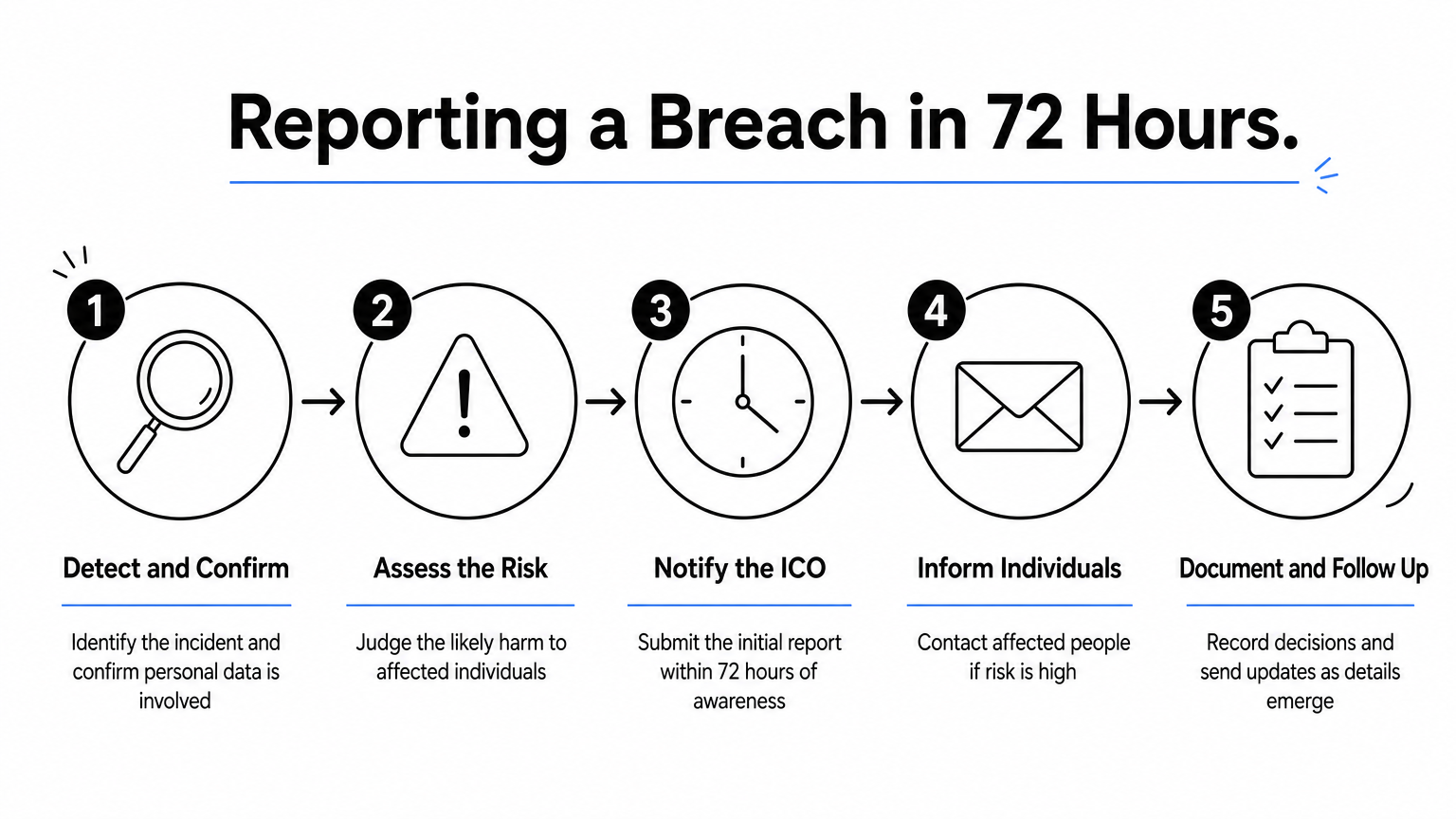
The 72-hour countdown starts immediately
Once someone in your organisation reasonably suspects a breach involving personal data, the deadline begins. Waiting for board approval or a full forensic report before notifying the ICO is a common mistake that turns a manageable incident into a compliance failure in its own right.
The 72-hour deadline starts the moment you become aware, not the moment you understand.
What you need to include in your report
The ICO’s breach reporting form asks for specific details, and having these ready before an incident happens saves valuable time. Prepare your team to gather:
- Nature of the breach: what happened, how it was discovered, and the systems or data involved
- Categories and approximate numbers of individuals and records affected
- Likely consequences for the people whose data was exposed
- Measures taken or proposed to address the breach and mitigate harm
- Contact details of your data protection officer or another point of contact
Organising this information in advance, even as a template your incident response team can fill in quickly, turns a stressful scramble into a structured process.
Telling the people affected
Beyond notifying the regulator, you may also need to tell the individuals whose data was compromised, particularly where the breach creates a high risk to their rights and freedoms. This applies to genuine data protection act breaches involving sensitive categories of data, financial information, or details that could lead to identity theft. Delaying this step because it feels uncomfortable only increases your legal exposure and damages trust further when the truth eventually surfaces.
Document every decision you make during this process, including why you judged the risk level as you did. The ICO reviews your reasoning, not just your outcome, when deciding whether enforcement action is warranted. Businesses that can show a clear, timely, and well-evidenced response consistently fare better than those that acted correctly but left no paper trail proving it.
Common examples of GDPR and Data Protection Act breaches
Most businesses picture a general data protection regulation breach as a dramatic hack, but the ICO’s own enforcement casework tells a different story. The majority of reported incidents come from ordinary mistakes made by ordinary staff, not sophisticated criminal groups. Knowing the common data security threats helps you spot risk in your own processes before an incident forces you to.
Human error incidents
Sending an email to the wrong recipient remains one of the most reported categories the ICO deals with, especially when it includes attachments containing customer records or health information. Printing documents and leaving them on a shared printer, posting letters to outdated addresses, and cc-ing a distribution list instead of bcc-ing it all fall into this bucket. None of these require malicious intent to count as breach data protection act incidents, and none of them require a hacker.
Most data protection breaches start with a mistake, not a hacker.
Technical and system failures
Misconfigured cloud storage buckets, databases left accessible without authentication, and software updates that accidentally expose customer records are increasingly common as businesses move more infrastructure online, which is why securing data held in the cloud deserves its own attention. Lost or stolen devices, particularly laptops and phones without encryption, also sit firmly in this category. Regular network auditing catches many of these before they become reportable incidents, which is exactly why we push clients toward scheduled reviews rather than one-off checks.
Malicious and criminal breaches
Responding to a ransomware attack, phishing campaigns that trick staff into handing over credentials, and deliberate insider theft of data represent the more serious end of the spectrum. These data protection act breaches typically involve larger volumes of data, greater financial motive, and a higher likelihood of regulatory scrutiny because the harm to individuals is more severe.

| Breach type | Typical cause | Common example |
|---|---|---|
| Human error | Staff mistake | Email sent to wrong recipient |
| Technical failure | Misconfiguration | Cloud storage left publicly accessible |
| Device loss | Poor physical security | Unencrypted laptop stolen from a car |
| Malicious attack | Criminal intent | Ransomware encrypting customer records |
| Insider threat | Deliberate misuse | Employee exporting client data before leaving |
Understanding which category your business is most exposed to shapes where you invest your prevention budget, whether that’s staff training, technical controls, or both.
Fines, compensation and other consequences of a breach
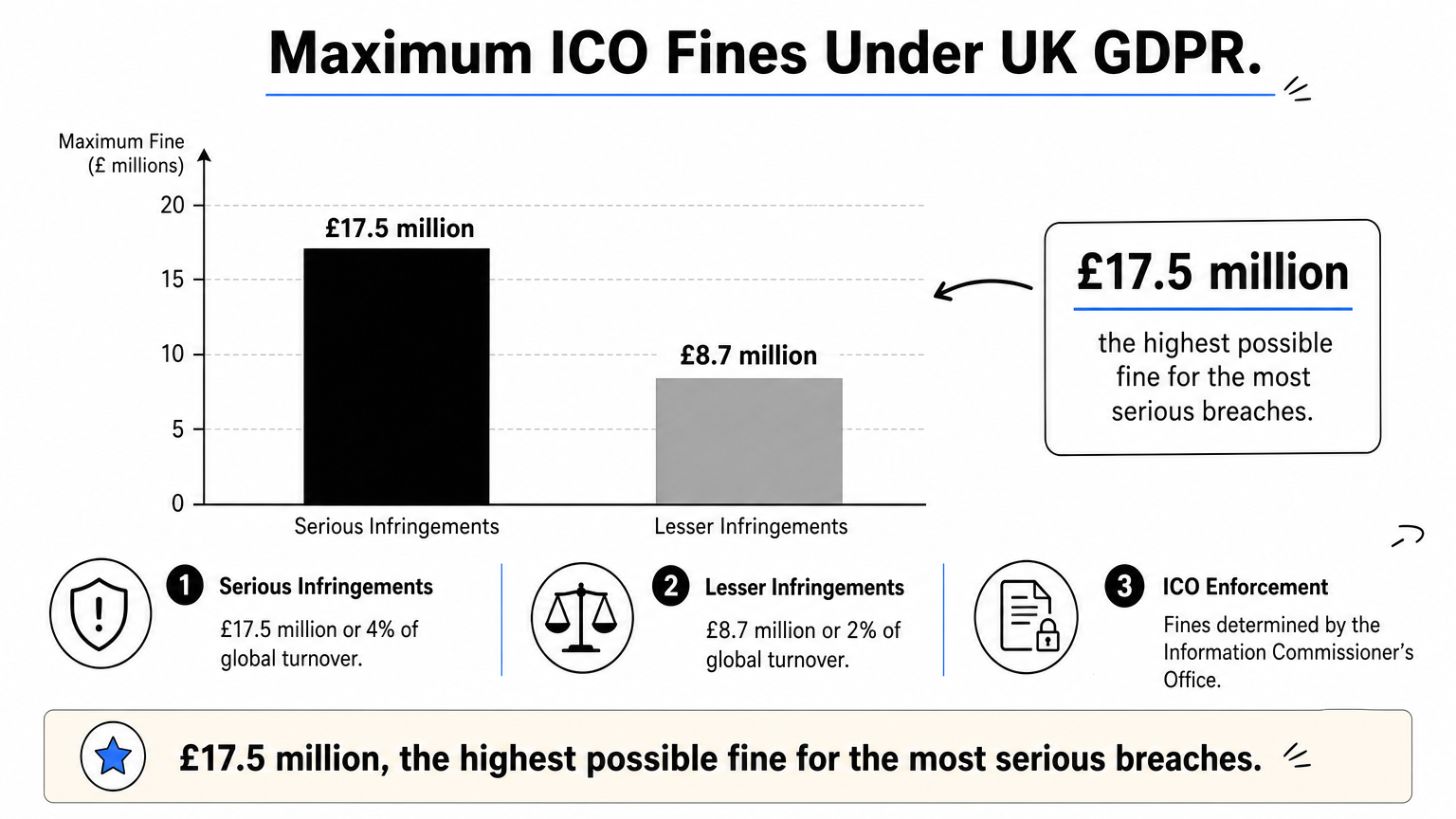
Money is usually the first thing people ask about after a breach, and the penalties for breaching the Data Protection Act can be brutal. Under UK GDPR, the ICO can issue fines up to £17.5 million or 4% of annual global turnover, whichever is higher, for the most serious infringements. Lesser breaches still carry penalties of up to £8.7 million or 2% of turnover. Few businesses ever hit the maximum, but even a mid-range fine can wipe out a year’s profit for a smaller organisation.
How the ICO tiers its penalties
The ICO doesn’t apply fines uniformly. It weighs the nature, severity, and duration of the breach, the number of people affected, whether you notified promptly, and how cooperative you were during the investigation.
| Factor considered | Effect on fine |
|---|---|
| Late or missing notification | Increases severity, treated as a separate failure |
| Number of records exposed | Larger volumes typically increase the penalty |
| Prior history of breaches | Repeat offenders face harsher treatment |
| Evidence of proactive security | Can reduce the fine significantly |
| Cooperation with investigators | Genuine engagement often softens outcomes |
A fine is only the visible part of the cost. The invisible part, lost contracts and lost trust, often runs higher.
Compensation claims from affected individuals
Beyond regulatory penalties, individuals whose data was compromised can pursue compensation claims through the courts, even where they haven’t suffered direct financial loss. Distress alone can be grounds for a claim under UK GDPR, and group litigation has become increasingly common where large numbers of people are affected by the same incident. Legal costs defending these claims, win or lose, add another layer of expense on top of any ICO penalty.
Enforcement notices and ongoing scrutiny
Fines aren’t the only tool the ICO uses. It can issue enforcement notices demanding specific changes to how you process data, and it can restrict or ban certain processing activities entirely until you demonstrate compliance. Organisations under an enforcement notice also face closer scrutiny for years afterwards, which slows down future audits, insurance renewals, and client due diligence checks. Having a documented incident response plan, tested through round-the-clock breach containment support like CyberSOS, gives you the evidence trail that regulators and insurers want to see when assessing whether your business has genuinely improved.
How to prevent future data protection breaches
Prevention beats remediation every time, and most of the controls that stop a breach cost far less than the cleanup after one. Getting ahead of a general data protection regulation breach means building layered defences across people, technology, and process, rather than relying on a single firewall or policy document gathering dust in a shared drive. None of this is exotic. It’s disciplined, consistent practice applied over time.
Build security into everyday habits
Strong access controls, encrypted devices, and regular software patching close off the most common routes attackers and accidents both exploit. Simple measures make the biggest difference here: enforce multi-factor authentication, restrict admin rights to those who genuinely need them, and remove access the moment someone leaves the business. Consistently running vulnerability assessments properly catches the gaps before they become headlines, which is why we run them as a standing service rather than a one-off box-tick for clients.
Prevention isn’t a project you finish. It’s a habit you maintain.
Test your defences before criminals do
Regular testing shows you exactly where a real attacker would get in, and understanding what a pen test involves makes clear why it’s far cheaper to fix a weakness on paper than after it’s been exploited. Combine this with ongoing dark web surveillance so you know immediately if your credentials or customer data surface somewhere they shouldn’t. Businesses that treat testing as an annual formality rather than an ongoing discipline consistently miss the vulnerabilities that emerge between checks.
- Schedule penetration testing at least annually, more often for high-risk systems
- Run phishing simulations quarterly to measure staff resilience
- Review third-party and supplier access regularly
- Monitor endpoints continuously rather than relying on periodic scans
- Keep an incident response plan current and tested, following proven breach response steps for UK SMEs
Train people, not just systems
Technology stops some threats, but your staff make the daily decisions that either protect or expose personal data. Ongoing cyber security awareness training for staff turns employees into your first line of defence rather than your weakest link, teaching them to spot phishing attempts, handle data correctly, and report suspicious activity without fear of blame. Genuine improvement comes from repetition, not a single onboarding session two years ago that nobody remembers.
Combining technical controls, tested defences, and trained people gives you a far stronger position than any single measure alone. Data protection act breaches rarely happen because a business had no security at all. They happen because one layer failed and nothing behind it caught the fall.
Staying prepared for the next incident
A general data protection regulation breach rarely announces itself in advance, which is exactly why preparation matters more than reaction. You now know what counts as a breach, how the 72-hour reporting clock works, and what fines, compensation claims, and reputational damage look like when things go wrong. None of that knowledge helps unless it’s built into daily practice: layered controls, tested defences, and staff who know what to do the moment something looks wrong.
Getting there alone is hard, especially if you’re already stretched thin managing everything else the business needs. That’s where a partner with real incident response experience makes the difference between a contained problem and a headline. If you want a straight assessment of where your business stands right now, talk to TrustedIA about a cyber security posture assessment and find out what needs fixing before an attacker or a regulator finds it first.



