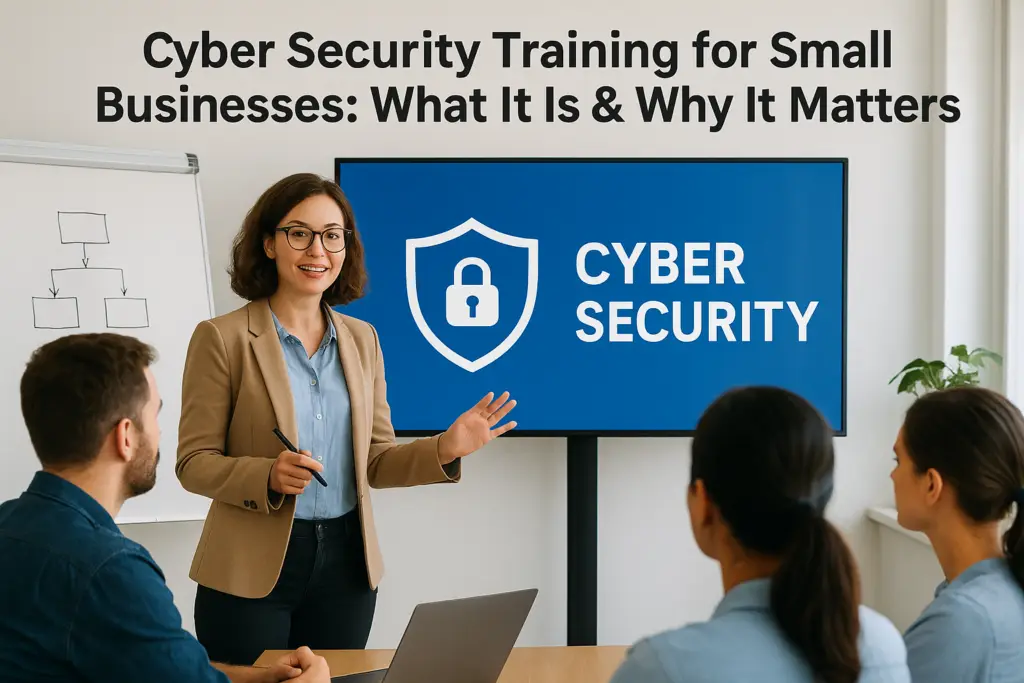
One phishing email is all it takes. Your accounts team clicks a fake invoice link, and suddenly you’re dealing with stolen credentials or worse. This is exactly why cybersecurity training for small businesses has moved from nice-to-have to essential. Most SMBs don’t have a dedicated IT security team, which means every employee is effectively your first line of defence, whether they know it or not.
So what does this training actually involve? At its core, it’s structured education that teaches your staff to spot phishing attempts, use strong passwords, handle sensitive data correctly, and know exactly what to do when something looks wrong. It’s not a one-off session either. The best programmes include ongoing simulations and refreshers, because attackers constantly change their tactics and staff forget what they learned six months ago.
In this article, we’ll break down what proper cyber security training covers, why small businesses are prime targets despite their size, and how training fits alongside other protections like phishing simulation and endpoint monitoring. We’ll also look at practical options, so you can build awareness across your team without needing a huge budget or an in-house expert.
Why cyber security training matters for small businesses
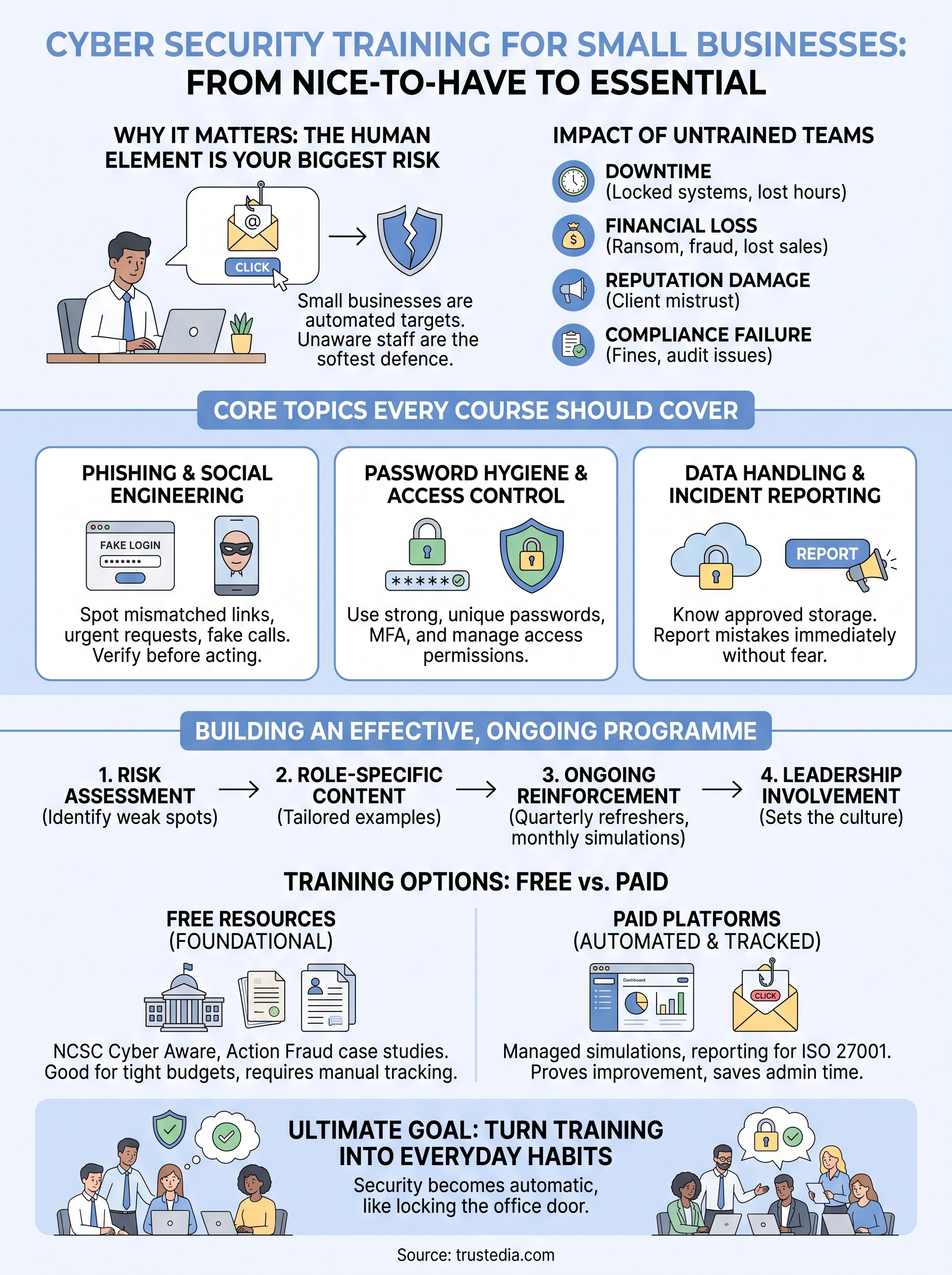
Many owners assume criminals only chase big corporations with deep pockets, but that’s backwards. Small businesses get targeted precisely because they’re easier prey. Attackers automate their scans and phishing campaigns, so it costs them nothing extra to hit thousands of small firms alongside a handful of enterprises. Without dedicated cyber security training for small businesses, your staff become the softest target in that automated sweep.
The human element is your biggest risk
Firewalls and antivirus software matter, but they can’t stop someone from typing their password into a convincing fake login page. Verizon’s Data Breach Investigations Report consistently finds that the human element features in the majority of breaches, whether through stolen credentials, misdirected emails, or someone simply clicking the wrong link. Untrained staff open attachments they shouldn’t, reuse passwords across work and personal accounts, and hand over sensitive details to callers pretending to be from IT.

A firewall can’t stop an employee who doesn’t recognise a scam.
What an untrained team costs you
Recovering from an incident is far more expensive than preventing one, and small firms often lack the cash reserves to absorb the hit. Consider the typical fallout:
| Impact area | What happens without training |
|---|---|
| Downtime | Systems locked or wiped, staff unable to work for days |
| Financial loss | Ransom demands, fraud payments, lost sales |
| Reputation | Clients lose confidence, contracts get reviewed |
| Compliance | Regulatory fines, failed ISO 27001 audits |
Organisations that experience a phishing attack lose productivity almost immediately, and many never fully recover their client base afterwards.
Training closes the gap other tools can’t
Penetration tests and vulnerability assessments reveal technical weaknesses, but they say nothing about whether your receptionist would question a suspicious phone call. Regular training, paired with phishing simulations, builds the instinct to pause and verify before acting. Quarterly refreshers work better than annual box-ticking sessions, because attackers update their scripts constantly and staff need current examples, not stale slideshows from three years ago. Investing here also strengthens your case during ISO 27001 assessments, where evidence of staff awareness is a standard requirement rather than an optional extra.
How to build an effective training programme
Building a programme that actually changes behaviour takes more than buying an off-the-shelf course and ticking a box once a year. You need a structure that matches your risk level, involves every department, and gets reinforced often enough that lessons stick. Small businesses rarely have a training manager, so the plan needs to be simple enough for an office manager or HR lead to run without specialist knowledge.
Start with a risk assessment
Before choosing content, work out where your weak spots actually sit. A firm handling client payments needs different priorities than one storing patient records. Run a quick internal audit, or bring in a cyber audit service, to identify which departments handle sensitive data, who has admin access, and where past incidents (even near misses) happened.
Make it role-specific and ongoing
Generic slideshows bore people and teach nothing memorable. Tailor examples to each team; finance staff need invoice fraud scenarios, while customer service needs social engineering examples over the phone.
Training that ignores your actual risks is just a compliance exercise, not protection.
Ongoing reinforcement matters more than the initial session. Build your programme around this cadence:
- Onboarding session for every new hire within their first week
- Quarterly refreshers covering current phishing trends
- Monthly simulated phishing emails to test retention
- Annual policy review tied to your ISO 27001 documentation
Leadership involvement also signals that this isn’t optional. When owners and managers complete the same training as junior staff, uptake improves noticeably, and nobody assumes cyber security is someone else’s job.
Key topics every training course should cover
A good course covers more ground than “don’t click suspicious links.” Small businesses need training that maps to the real threats they face daily, not a generic checklist borrowed from a corporate template. The core topics below give staff practical skills they can apply the same afternoon, rather than abstract theory they forget by Friday.
Phishing and social engineering
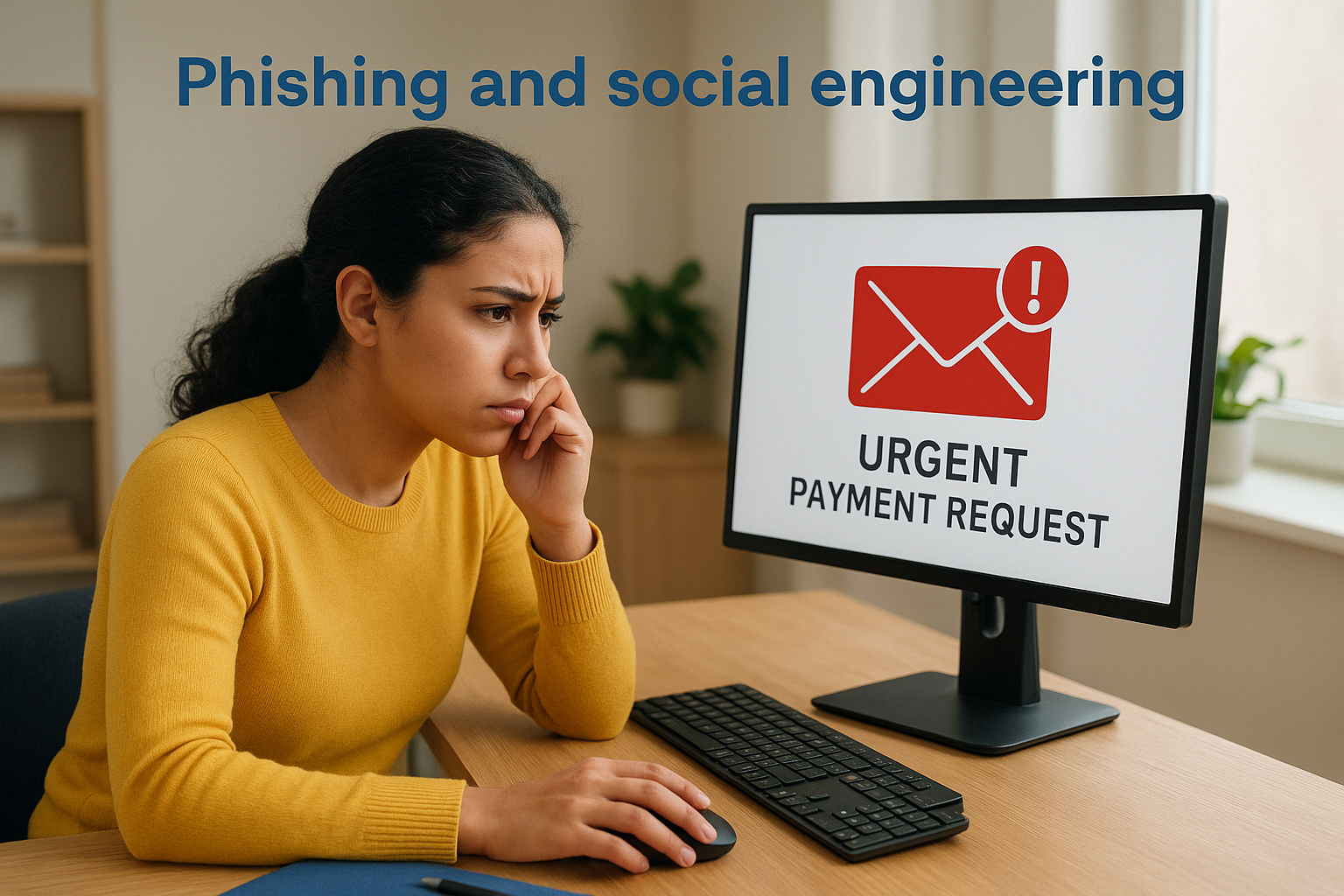
Phishing remains the entry point for most breaches, so your team needs to spot the tell-tale signs: mismatched sender domains, urgent payment requests, and links that don’t match the displayed text. Cover social engineering tactics too: fake IT calls, impersonated suppliers, and pretexting over the phone, since attackers often skip email entirely when a confident voice works just as well.
Password hygiene and access control
Weak or reused passwords hand attackers an easy route into multiple accounts at once. Teach staff to use a password manager, enable multi-factor authentication everywhere it’s offered, and understand why sharing logins between colleagues breaks accountability during an investigation.
Data handling and incident reporting
Staff need clear rules on where client data can live, whether that’s approved cloud storage or a locked filing cabinet, and how to report a mistake without fear of blame.
The fastest breaches to contain are the ones staff report within minutes, not days.
The National Cyber Security Centre publishes free guidance covering these exact fundamentals, and it’s worth building your internal materials around its recommendations: https://www.ncsc.gov.uk/section/advice-guidance/all-topics
Free and paid training options for UK businesses
Budget worries stop many owners from starting cyber security training for small businesses at all, but plenty of solid options cost nothing beyond staff time. Government-backed resources give you a credible foundation, while paid platforms add tracking, simulated phishing, and reporting that satisfies an auditor. Choosing between them depends on how much hands-on management your team can spare, not just the price tag.
Free resources worth using
Government schemes remain the strongest starting point because they’re free, current, and built specifically for smaller organisations. The NCSC’s Cyber Aware campaign offers straightforward advice sheets and videos your staff can work through in an afternoon, and Action Fraud publishes real case studies you can turn into discussion points during team meetings. These resources won’t track completion rates or send simulated phishing tests, so you’ll need a spreadsheet and some discipline to keep records for compliance purposes.
Paid platforms and managed training
Paid providers earn their fee through automation: scheduled campaigns, dashboards showing who’s falling for simulations, and content that updates as new scams emerge.
Free guidance teaches the basics; managed platforms prove you’re actually improving.
| Option | Cost | Best for |
|---|---|---|
| NCSC Cyber Aware | Free | Foundational awareness, tight budgets |
| Action Fraud case studies | Free | Discussion-based sessions |
| Managed phishing simulation | Paid | Ongoing testing with reporting for ISO 27001 |
| Full cyber training programme | Paid | Structured, role-specific courses with certification |
Combining both tiers, free fundamentals plus a paid simulation layer, usually delivers the best value without stretching a small firm’s budget.
Turning training into everyday habits
Knowledge fades fast unless it becomes routine. Cybersecurity training for small businesses only pays off when spotting a phishing email feels as automatic as locking the office door at night. Build small checkpoints into the working week: a two-minute security tip in your Monday meeting, a quick discussion when a simulated phishing test catches someone out, a shared channel where staff flag suspicious messages without embarrassment.
Leadership sets the tone here. When managers ask about security the same way they ask about deadlines, staff stop treating it as an annual chore and start treating it as part of the job. Pair that culture with the quarterly refreshers and role-specific content covered above, and you’ve got a workforce that actually notices when something’s off.
If you’d rather have specialists design and run that programme for you, get in touch with TrustedIA, and we’ll build training that fits your team, your risk profile, and your ISO 27001 requirements.