Searching for an iso 27001 compliance checklist xls usually means one thing: you’ve been handed the job of getting your organisation certified, and you need a way to track hundreds of requirements without losing your mind in email threads and sticky notes. A spreadsheet still beats most fancy GRC tools for this stage, as long as it’s built properly and covers the right ground.
That’s what this article gives you. Rather than just pointing you towards a download link, we break down exactly what a working iso 27001 requirements checklist xls needs to contain: the clauses from the main standard, all 93 Annex A controls, status columns, evidence links, owner assignments, and review dates. Skip any of these and your checklist becomes a liability during audit, not an asset.
We’ve built ISO 27001 programmes for organisations across dozens of sectors, so this list reflects what auditors actually ask to see, not a generic template copied from a compliance blog. Whether you’re working from the 2013 revision or preparing for the newer control set, you’ll know precisely what belongs in your spreadsheet before you open Excel.
1. Scope and context of your ISMS
Getting your ISO 27001 scope definition right is where most ISO 27001 projects either gain momentum or grind to a halt in month one. Clause 4 asks you to define the boundaries of your information security management system (ISMS), work out which internal and external issues affect it, and identify who has a stake in the outcome. Get this wrong and everything downstream, from risk assessment to the Statement of Applicability, ends up built on shaky foundations.

What it covers
This section of your iso 27001 2013 compliance checklist xls should map directly to clauses 4.1 through 4.4: understanding the organisation and its context, understanding the needs and expectations of interested parties, determining the scope of the ISMS, and establishing the ISMS itself. In practice, that means listing your business locations, departments, systems, and third-party dependencies, then deciding which of these sit inside your certification boundary and which don’t. A retailer might scope in its e-commerce platform and payment processing but scope out a legacy warehouse system slated for decommission. Whatever you decide, you need a documented rationale.
Why it matters for certification
Auditors spend a disproportionate amount of time on scope because a poorly defined boundary undermines the credibility of everything else. If your scope statement claims coverage of "all IT operations" but your risk register only mentions three systems, that mismatch gets flagged immediately. Certification bodies also check that exclusions are justified, not just convenient.
A vague scope statement is the fastest way to fail an ISO 27001 audit before the assessor even opens your risk register.
We’ve seen organisations lose weeks re-scoping after an initial audit because nobody had mapped interested party requirements, things like customer contracts demanding specific security clauses, or regulatory obligations tied to particular data types. Bringing in outside eyes, such as our network auditing services, often catches these gaps before an external auditor does.
What to record in your spreadsheet
Build a dedicated tab for scope and context with these columns:
| Column | Purpose |
|---|---|
| Interested party | Customer, regulator, employee, supplier |
| Requirement | What they need from your ISMS |
| In/out of scope | Whether the related asset or process is included |
| Justification | Why it’s included or excluded |
| Owner | Who confirmed the entry |
| Last reviewed | Date the scope was last validated |
Keep this tab short but precise. Vague entries like "IT systems" won’t survive scrutiny; auditors want named systems, named locations, and named contractual obligations.
2. Leadership, policy and objectives
Clause 5 puts responsibility for the ISMS squarely on top management, not the IT team alone. This trips up a lot of organisations building their first iso 27001 compliance checklist excel sheet, because they treat the policy as a document to write once and forget, rather than a living commitment that senior leaders actively demonstrate.
What it covers
Leadership commitment, an approved information security policy, and measurable security objectives all sit here. Auditors want to see that management has assigned roles and authorities, communicated the policy across the business, and set objectives that connect to the actual risks facing the organisation, not generic statements like "we take security seriously". Objectives should be specific: reduce phishing click-through rates by a defined percentage, or achieve patch compliance within a set number of days.
Why it matters for certification
Without visible leadership buy-in, an ISO 27001 certificate becomes a paper exercise that collapses under real audit questions.
Certification bodies interview management during the audit, often separately from the compliance team. If leadership can’t explain the policy or the reasoning behind current objectives, that’s a nonconformity. We’ve watched otherwise well-prepared organisations stumble here because the policy sat in a folder nobody above operations level had actually read.
What to record in your spreadsheet
Use a leadership tab with the following fields:
- Policy name and version number
- Approval date and approving executive
- Communication method (intranet, induction training, all-staff email)
- Security objective and target metric
- Review frequency and next review date
- Evidence link (board minutes, sign-off email, training log)
Assign one senior owner per objective, not a department. When an auditor asks who owns the objective to cut incident response time, you want a name, not a shrug.
Revisit this tab whenever objectives change, and treat stale entries as a red flag rather than a formality to tidy up later.
3. Risk assessment and treatment plan
Risk assessment sits at the heart of ISO 27001, and it’s the section where a poorly built spreadsheet causes the most pain later. Clause 6.1.2 and 6.1.3 require you to identify risks to confidentiality, integrity and availability, evaluate them against consistent criteria, and decide how you’ll treat each one. Skip the consistency and you’ll end up with a register where one risk scores 4 and an equally serious one scores 12, purely because different people filled in the fields.
What it covers
Your iso 27001:2013 compliance checklist xls needs a risk identification method, a scoring methodology covering likelihood and impact (where worked examples of risk assessment frameworks help), and a treatment decision for every entry: accept, avoid, transfer, or reduce. This links directly to asset registers, threat sources, and existing vulnerabilities, so don’t treat it as a standalone exercise disconnected from the rest of your ISMS.
Why it matters for certification
Auditors trace individual risks through to specific Annex A controls and check that treatment decisions actually reduce the score to an acceptable level. A risk marked "treated" with no corresponding control reference is an easy nonconformity to raise.
Every risk in your register needs a clear line to the control that treats it, or the assessment is just a list, not a plan.
Organisations that lean on our independent vulnerability assessments tend to build far more defensible risk scores, because the data behind each entry comes from testing rather than guesswork.
What to record in your spreadsheet
Build columns for: risk description, asset affected, threat and vulnerability, likelihood score, impact score, inherent risk rating, treatment decision, control reference, residual risk rating, owner, and target closure date. Sort by residual risk descending so the highest exposures sit at the top, not buried on row 200.
4. Statement of Applicability and Annex A controls
The Statement of Applicability (SoA) is the document every certification auditor asks for first, and it’s where your iso 27001 requirements checklist xls proves its worth. It lists all 93 Annex A controls, states whether each one applies to your organisation, and justifies any exclusion by reference to your risk assessment. Get this tab wrong and the auditor has grounds to question the entire ISMS, not just this section.
What it covers
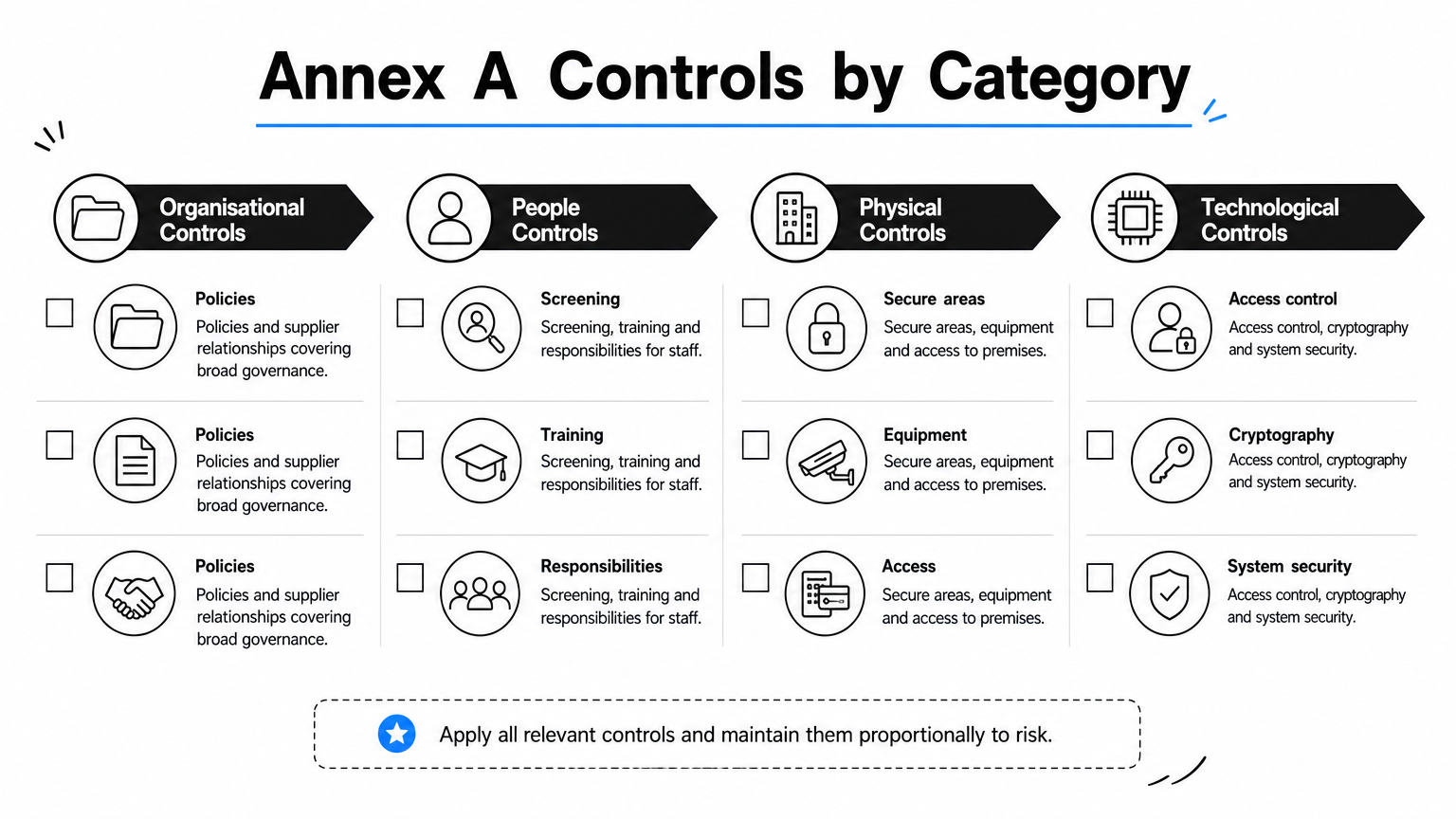
Each control needs four things: an applicability decision, a justification, an implementation status, and a link back to the risk it addresses. Controls span organisational, people, physical, and technological categories, covering everything from access control and cryptography to supplier relationships and incident management.
Why it matters for certification
Auditors cross-reference the SoA against your risk treatment plan and your actual environment, checking that "applicable" controls have real evidence behind them, not just a tick in a box.
A control marked applicable with no evidence attached is worse than admitting it isn’t implemented yet.
We run penetration testing against technical controls specifically so clients have hard evidence, not assumptions, sitting behind each SoA entry.
What to record in your spreadsheet
Structure this tab with one row per Annex A control:
| Column | Purpose |
|---|---|
| Control reference | e.g. A.5.1, A.8.2 |
| Applicable (Y/N) | Applicability decision |
| Justification | Reason for inclusion or exclusion |
| Implementation status | Not started, in progress, implemented |
| Evidence link | Policy, screenshot, test report |
| Linked risk(s) | Cross-reference to the risk register |
Review every exclusion annually. Controls excluded two years ago on the basis of an old system architecture rarely still hold up once infrastructure changes.
5. Documentation, competence and awareness records
Clause 7 covers the resources, skills and paperwork that hold your ISMS together, and it’s often the section people rush through when building an iso 27001 compliance checklist xls. That’s a mistake, because auditors treat missing competence records as a symptom of a wider management failure, not a minor paperwork gap.
What it covers
This clause spans documented information (policies, procedures, records), competence requirements for anyone with security responsibilities, and awareness training for the whole workforce. Support also includes communication, both internal and external, and the resources needed to run the ISMS properly, whether that’s staff time, budget, or tooling. A security awareness programme that meets ISO 27001 without a record of who attended and when doesn’t count as evidence.
Why it matters for certification
Certification bodies check that people in security-critical roles, IT admins, developers, HR staff handling personal data, actually have the skills their job descriptions imply. A job title alone isn’t proof of competence.
Untrained staff with system access represent the same risk as an unpatched server, and auditors treat them that way.
We deliver role-specific cyber security training precisely because generic e-learning modules rarely satisfy an auditor asking for evidence of role-specific competence.
What to record in your spreadsheet
Use a training and competence tab with these fields:
- Employee name and role
- Required competence for that role
- Training completed and date
- Evidence link (certificate, attendance log, quiz score)
- Awareness campaign name and completion rate
- Document reference and current version number
- Next review or refresher date
Link each document reference back to a master document register so version control doesn’t fall apart when policies get updated mid-cycle.
6. Internal audits and management review
Clause 9 asks you to check your own work before an external auditor does it for you. Internal audits and management review meetings form the feedback loop that keeps an ISMS alive between certification cycles, and they’re often the weakest section of a homemade iso 27001 compliance checklist xls because teams treat them as a formality rather than a genuine health check.

What it covers
This clause covers planning and running internal audits against a defined programme, reporting findings honestly, and holding management review meetings at planned intervals to assess whether the ISMS still fits the business. Reviews need to look at audit results, risk changes, nonconformities, and whether objectives from clause 5 are still being met. A review that just rubber-stamps last quarter’s minutes won’t satisfy an assessor.
Why it matters for certification
Auditors ask for your internal audit schedule, the actual reports, and evidence that findings led to real action, much as they do at each stage of the ISO 27001 audit. A programme that skips departments or repeats the same scope every year signals a box-ticking exercise rather than genuine oversight.
An internal audit that never finds a problem probably isn’t looking hard enough.
Organisations running our security operations centre monitoring alongside their audit programme tend to surface issues earlier, which gives management review something substantive to discuss rather than a blank agenda.
What to record in your spreadsheet
Build an audit and review tab with:
- Audit scope, date, and auditor name (internal or independent)
- Findings and nonconformity references
- Management review date and attendees
- Decisions made and actions assigned
- Owner and target closure date for each action
- Status: open, in progress, closed
Cross-reference every finding to the corrective action log so nothing raised in a review quietly disappears before the next audit cycle.
7. Corrective actions and continual improvement
Clause 10 closes the loop on everything else in your ISMS: what happens once you actually find a problem. Corrective actions turn nonconformities from internal audits, management reviews, incidents, or day-to-day operations into tracked, closed-out fixes. Continual improvement asks whether the ISMS as a whole is getting better year on year, not just staying static because nobody wants to touch it, and that is exactly what keeping your certificate through surveillance audits depends on. A lot of homemade ISO 27001 checklists list this clause almost as an afterthought, then wonder why the same nonconformity reappears at the next surveillance audit.
What it covers
This section covers root cause analysis for every nonconformity, the corrective action taken, and verification that the action actually worked rather than just being marked complete. It also covers broader improvement initiatives that aren’t tied to a specific failure, things like upgrading a control after a near-miss, or tightening a process because a risk score crept upward. Root cause analysis matters more than the fix itself; patch the symptom without it and the same issue resurfaces within a year.
Why it matters for certification
Surveillance auditors specifically check whether corrective actions from the last cycle actually closed, and whether the root cause was addressed rather than just the immediate symptom.
A corrective action that doesn’t stop the problem recurring isn’t corrective, it’s cosmetic.
We see this repeatedly during our cyber incident response engagements: organisations that treat every incident as a one-off rarely build the pattern recognition that prevents the next one.
What to record in your spreadsheet
Track these fields per entry:
- Nonconformity or improvement trigger
- Root cause identified
- Corrective action taken
- Verification method and date
- Effectiveness check (did it actually work)
- Owner and closure date
Link each row back to the audit finding or risk entry that raised it, so nothing gets closed without evidence it stuck.
8. Progress tracking, ownership and version control
Beyond the individual clauses, your iso 27001 compliance checklist xls needs an overarching layer that tells you, at a glance, how the whole certification project is progressing. This is the tab senior stakeholders actually look at, so it needs to summarise status without forcing anyone to trawl through eight other sheets first.
What it covers
This final piece pulls together a master status view across every clause and control, showing overall completion percentage, outstanding actions, and who’s accountable for each open item. It also covers version control for the checklist itself: who last edited it, when, and what changed. Without this, spreadsheets drift into conflicting copies emailed between departments, and nobody knows which version reflects reality.
Why it matters for certification
Auditors rarely ask for this tab directly, but a project that can’t demonstrate clear ownership and a controlled document history raises doubts about how seriously the ISMS is managed day to day. If three people hold three different versions of the same checklist, that inconsistency tends to surface elsewhere in the audit too.
A checklist nobody can prove is current isn’t evidence, it’s just a spreadsheet.
We build this tracking discipline into every ISO 27001 professional services engagement we run, because certification projects that lose momentum almost always trace back to unclear ownership rather than technical gaps.
What to record in your spreadsheet
Use a master tracker with:
- Clause or control reference
- Status (not started, in progress, complete)
- Percentage complete
- Owner
- Blocking issues
- Document version and last edited by
- Change log summary
Update this weekly during active certification pushes. A tracker refreshed monthly looks tidy but rarely reflects what’s actually happening on the ground.
Next steps after the checklist
Building an iso 27001 compliance checklist xls gets you organised, but a spreadsheet alone won’t carry you through certification. Every tab covered here, scope, leadership, risk, Annex A, competence, audits, corrective action, and tracking, needs consistent input from people who understand what auditors actually look for. That’s where most in-house projects stall: not from lack of effort, but from lack of experience spotting gaps before an assessor does.
Once your checklist is populated, get a second set of eyes on it. A gap analysis from someone who’s sat through dozens of certification audits will catch weak justifications, missing evidence, and inconsistent risk scoring far faster than another internal review round. That’s exactly the kind of support we provide clients working towards certification or maintaining it year on year.
If you’d rather not leave certification to a spreadsheet and guesswork, talk to TrustedIA about an ISO 27001 gap analysis with a practical remediation roadmap and get your ISMS audit-ready properly.