
If you’ve been asked whether your business needs a data protection officer, you’re not alone. UK GDPR and the Data Protection Act (DPA): what it is and why it matters use specific language to define who must appoint one, and the rules trip up plenty of well-run organisations. Get it wrong and you’re either paying for a role you don’t need or leaving yourself exposed to an ICO enforcement action.
This article answers the question directly: what a DPO actually does day to day, and whether your organisation falls into the category that’s legally required to appoint one. We’ll walk through the statutory criteria, the difference between a mandatory appointment and a voluntary best-practice hire, and what happens if you get the assessment wrong.
We work with businesses across sectors on ISO 27001 compliance and data protection posture, so we see this confusion regularly, often at the worst possible moment, mid-audit or after an incident. By the end, you’ll know exactly where you stand and what practical steps to take next, whether that means appointing someone internally, outsourcing the function, or documenting why you don’t need one at all.
Why appointing a data protection officer matters
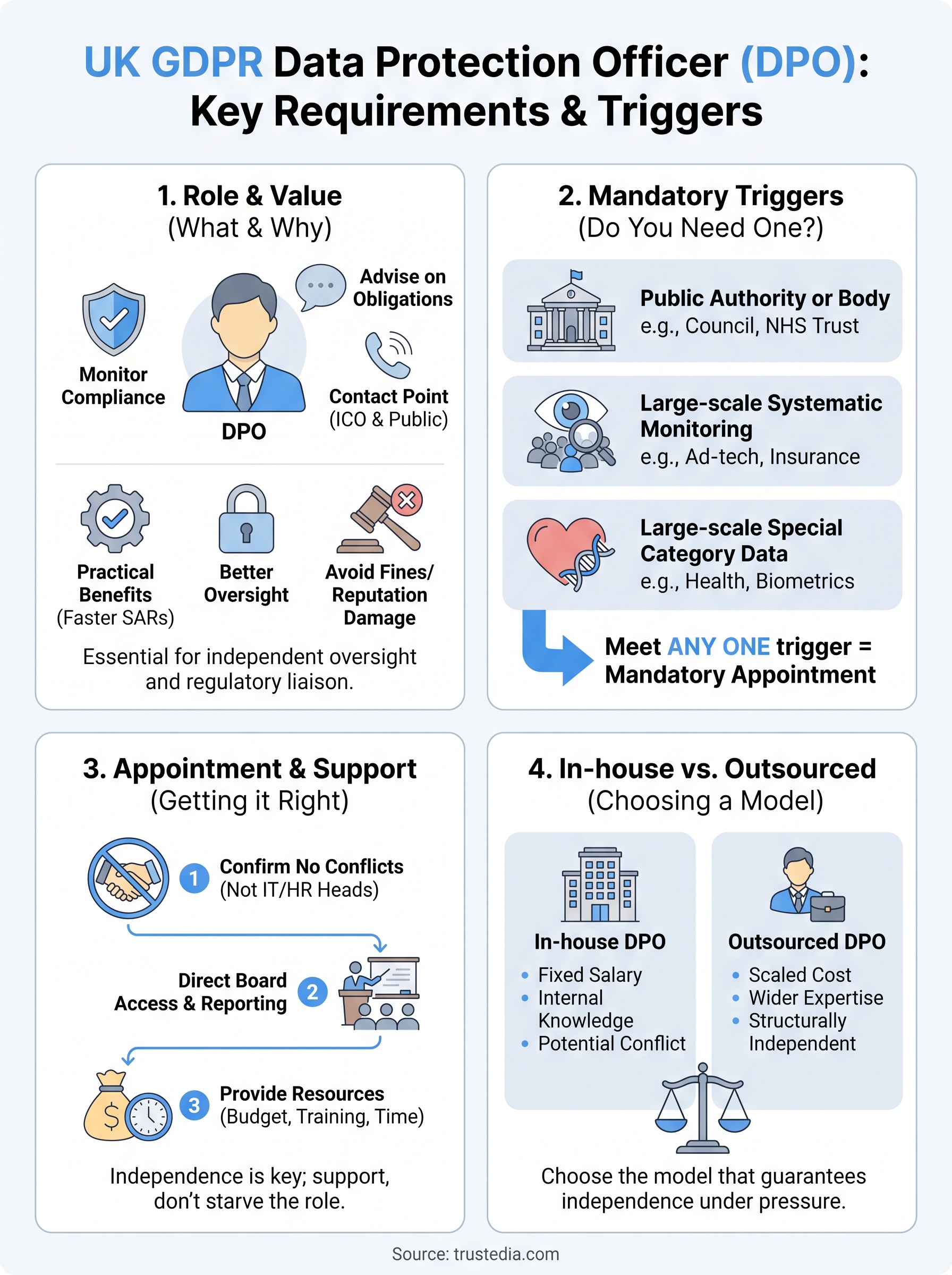
A data protection officer is the named individual responsible for monitoring your organisation’s compliance with UK GDPR, advising on data protection obligations, and acting as the contact point for both the ICO’s role in data protection and the people whose data you hold. Article 39 of UK GDPR sets out the job description directly: monitor compliance, advise on data protection impact assessments, train staff, and cooperate with regulators. It’s not a title you hand to whoever’s free on a Tuesday.
The legal weight behind the role
Getting this wrong carries real consequences. Organisations that should have appointed a DPO but didn’t can face enforcement action from the ICO, and that’s before you factor in the reputational damage of a breach handled without proper oversight, including the timelines and thresholds for reporting a breach. We’ve seen businesses discover the requirement only after a subject access request lands on the wrong desk, with nobody clearly accountable for the response.
A DPO isn’t paperwork for its own sake, it’s the person who catches a data protection failure before it becomes a regulatory one.
What good oversight actually looks like
Beyond the legal minimum, a properly resourced DPO gives you something most businesses lack: independent, informed oversight of how data actually moves through your organisation. Think of the practical benefits:
- Faster, more consistent responses to subject access requests
- A single point of contact for regulators and data subjects
- Early warning on projects that need a data protection impact assessment
- Staff who know who to ask when something looks wrong
Supporting this properly matters just as much as appointing the role. The DPO needs direct access to senior management, enough independence to challenge decisions without fear of being overruled, and sufficient resource to actually do the job rather than hold the title. Many businesses appoint a DPO on paper but starve the role of time and authority, which leaves them just as exposed as having no DPO at all. That’s the gap we see most often during an independent data protection audit, and it’s usually an easy one to close once it’s identified.
Do you need to appoint a DPO?
Article 37 of UK GDPR sets out three specific triggers, and you only need to meet one to fall under the mandatory DPO appointment rule. The first is being a public authority or body, which covers most councils, NHS trusts, and government-adjacent organisations regardless of size. The second is carrying out large-scale, regular, and systematic monitoring of individuals, think ad-tech platforms, insurers, or any business tracking behaviour at scale. The third is processing special category data (health records, biometric data, criminal convictions) on a large scale as a core activity.
| Trigger | Typical example |
|---|---|
| Public authority or body | Local council, NHS trust |
| Large-scale systematic monitoring | Ad-tech, telecoms, insurance |
| Large-scale special category data | Private healthcare provider, biometric security firm |
If none of these three triggers apply to you, appointing a DPO is a choice, not a legal obligation.
Size alone doesn’t decide this. A ten-person clinic handling patient records at scale can meet the threshold, while a five-hundred-person manufacturer processing ordinary customer data might not. Recognising which category you fall into requires an honest look at what you actually process, not just how many people you employ. Where the answer is genuinely no, document that assessment anyway. The ICO’s official GDPR guidance expects you to show your reasoning, and a written data protection officer requirements review protects you if that judgement is ever questioned later.
How to appoint and support a data protection officer
Once you’ve confirmed you meet the criteria, the appointment itself needs care. Appointing a data protection officer isn’t just picking a name and updating an org chart, you need to check for conflicts of interest, confirm relevant expertise, and formalise reporting lines before anyone touches a live data breach.
Getting the appointment right
Follow a structured process rather than a rushed decision:
- Confirm the candidate has no operational role that conflicts with independent oversight (avoid IT directors or HR heads holding the title)
- Check they understand what GDPR compliance requires, sector-specific rules, and your data flows
- Register the appointment with the ICO where required
- Publish contact details so data subjects and regulators can reach them directly
- Document the reporting line to senior management in writing
A DPO who reports to the person they’re meant to be checking on isn’t independent, they’re compromised before they start.
Supporting the role after appointment
Supporting a DPO appointment properly means budget, training time, and direct access to the board, not just a job description. Underfunded DPOs get overruled on genuine data protection concerns because they lack the standing to push back, which defeats the purpose of appointing one at all.
Successful organisations build in annual training refreshers, protected time for data protection impact assessments, and a clear escalation path when the DPO flags a risk that operational teams want to ignore. Without that backing, the appointment is symbolic rather than functional, and it won’t hold up if the ICO ever asks how the role actually operates in practice.
In-house vs outsourced DPO: which suits your business?
Deciding between an in-house DPO and an outsourced DPO service comes down to volume, expertise, and cost. Larger organisations processing special category data daily often justify a full-time hire who lives inside the business and knows every system by heart. Smaller and mid-sized organisations rarely generate enough DPO-specific work to fill a salaried role, yet still need the same statutory competence the moment a breach or subject access request lands.
Weighing the practical trade-offs
Outsourcing solves the independence problem too. An external data protection officer has no line-management ties to the teams they’re overseeing, so there’s no awkward conflict when they need to challenge a project or flag a risky rollout.
| Factor | In-house DPO | Outsourced DPO |
|---|---|---|
| Cost | Fixed salary, benefits, training | Scaled to actual need |
| Independence | Can be compromised by internal politics | Structurally separate |
| Expertise breadth | Limited to one person’s experience | Access to a wider team’s case knowledge |
| Continuity | Vulnerable to sickness or turnover | Covered by the provider |
The right DPO model isn’t the cheapest or the most senior, it’s the one that stays independent under pressure.
Questioning which fits your business usually comes down to whether you can genuinely resource independence internally. If you can’t, TrustedIA’s professional services team provides outsourced DPO support built around ISO 27001 practice, giving you the expertise without carrying a full-time headcount.
Getting your next step right
Whether you need a data protection officer comes down to a clear-eyed look at your triggers under Article 37, not a guess based on headcount or gut feeling. Get that assessment right, document it properly, and you’ve already removed the biggest risk most organisations carry into an ICO enquiry or a breach investigation.
Once you know where you stand, the next decision is practical: appoint internally with real independence and budget, or bring in outsourced expertise that carries the same statutory weight without the full-time cost. Neither route works if the role sits on paper only, so treat the resourcing question as seriously as the appointment itself.
Getting this right protects your organisation and the people whose data you hold. If you’d rather have specialists handle the assessment, appointment, and ongoing support, talk to TrustedIA about accelerating UK GDPR and DPA 2018 compliance with a data protection function that actually holds up under scrutiny.



