
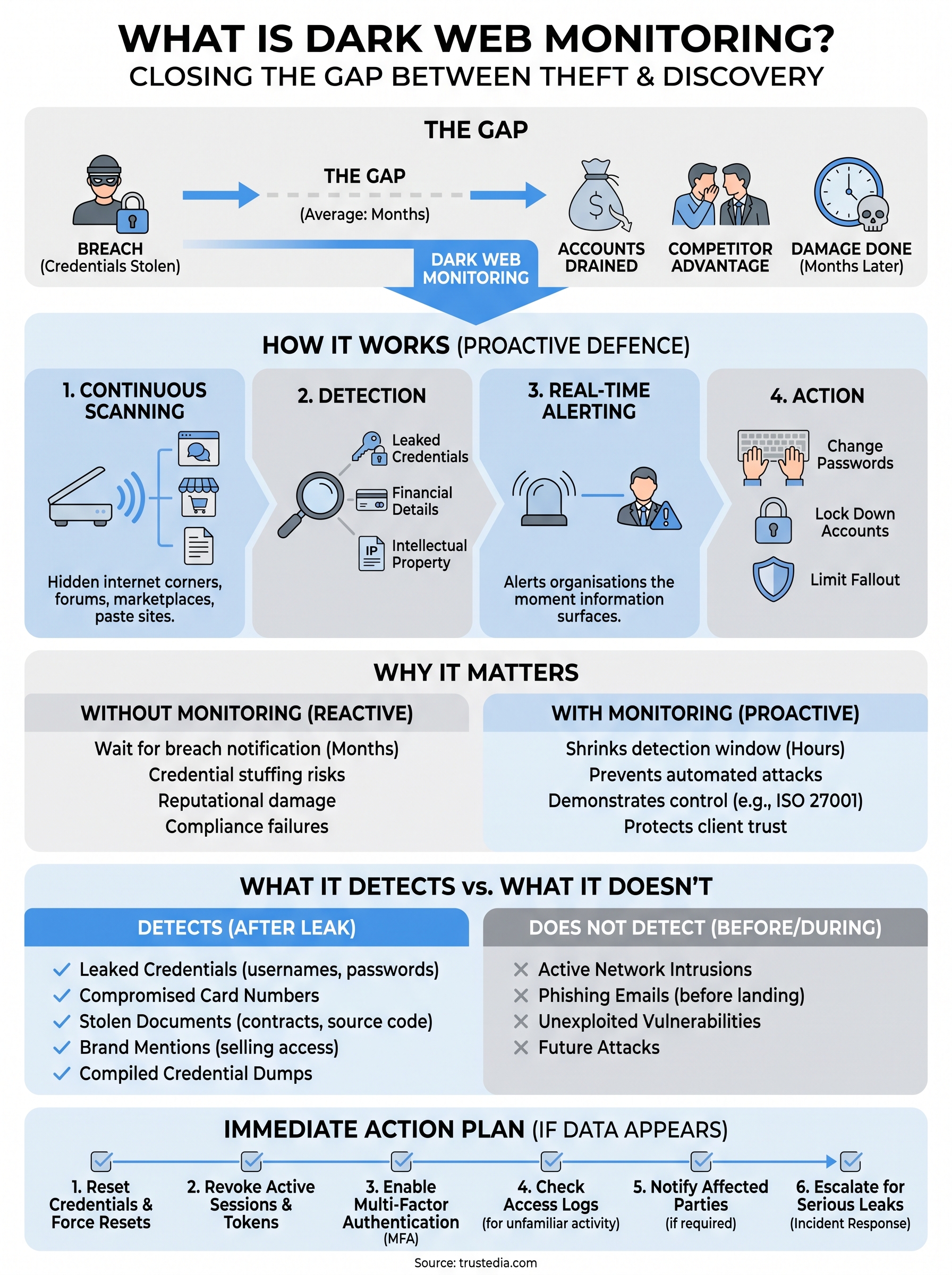
If your company’s credentials ever get stolen in a breach, you probably won’t find out from the attacker. You’ll find out when your bank accounts get drained, or when a competitor suddenly knows your pricing strategy, or worse, you won’t find out until months later when the damage is already done. That’s the gap what is dark web monitoring exists to close.
In short, dark web monitoring is a security service that scans hidden corners of the internet, forums, marketplaces, and paste sites where stolen data gets traded, looking for your organisation’s leaked usernames, passwords, financial details, or intellectual property. It works by continuously searching these sources and alerting you the moment your information turns up, giving you a chance to change passwords, lock down accounts, and limit the fallout before criminals act on what they’ve found.
In this article, we’ll walk through exactly how dark web monitoring works, what tools and techniques are used to search these hidden networks, and why it’s become a core part of proactive cyber defence for businesses that can’t afford to wait for a breach notification to find out something’s gone wrong.
Why dark web monitoring matters for your business
Most businesses assume they’d know if their data had been stolen. In reality, the average organisation takes months to discover a breach, and by the time they do, criminals have already sold the data on multiple dark web marketplaces. The UK’s National Cyber Security Centre has repeatedly flagged credential theft as one of the most common entry points for ransomware and business email compromise, precisely because stolen logins sit unnoticed on hidden forums for weeks before anyone acts on them. That silent gap between theft and discovery is where the real damage happens.
The question isn’t whether your data will ever appear on the dark web. It’s whether you’ll find out before someone else uses it against you.
Once credentials leak, they don’t just sit there. Criminal buyers use automated tools to test stolen usernames and passwords against dozens of other services, a technique called credential stuffing. If an employee reuses a password across their work email and a personal shopping account that got breached, your company’s network is exposed the moment that shopping site’s database hits a paste site. This is why dark web surveillance has shifted from a nice-to-have for large enterprises to a baseline expectation for SMBs too, since attackers don’t discriminate by company size when they’re running automated scripts.
What typically shows up for sale
Stolen data doesn’t come in one flavour. Depending on how a breach happened, you might see any combination of the following circulating on underground markets:

- Employee and customer credentials (usernames, passwords, session cookies)
- Financial details such as card numbers, bank account information, or invoicing data
- Intellectual property, including source code, product designs, or pricing sheets
- Personally identifiable information (PII) like National Insurance numbers, addresses, and dates of birth
- Corporate email archives that reveal internal communications and vendor relationships
Seeing your organisation’s name attached to any of these categories is a direct signal that action is overdue, not optional.
The compliance and reputational angle
Beyond the immediate security risk, there’s a regulatory dimension that businesses working towards ISO 27001 certification can’t ignore. The standard requires organisations to demonstrate ongoing risk monitoring and incident detection capability, and dark web monitoring is one of the more concrete ways to prove that control is actually functioning rather than sitting in a policy document. Auditors increasingly expect to see evidence of proactive threat intelligence gathering, not just firewalls and antivirus software.
Reputational damage compounds the problem further. Customers and partners who discover their data was exposed, and that you only found out because they told you, lose confidence fast. Insurers assessing your cyber liability cover often ask directly whether you run any form of leaked data monitoring, and a yes answer can materially affect your premium. Data breaches aren’t just an IT problem anymore; they touch legal exposure, client trust, and your ability to win new business from security-conscious customers who now ask vendors about their monitoring practices before signing contracts. Given all this, treating dark web monitoring as background insurance rather than a core defence layer is a mistake most businesses only realise once it’s too late.
How to implement dark web monitoring effectively
Getting dark web monitoring right isn’t about switching on a tool and forgetting it exists. You need a defined scope covering every domain, email pattern, and brand name your business operates under, plus a clear escalation path for when an alert actually fires. Skip the planning stage and you’ll end up with a flood of low-value notifications that your team learns to ignore, which defeats the entire point.
A monitoring tool nobody responds to is just an expensive way of confirming a breach after it’s already too late.
Choosing between DIY tools and a managed service
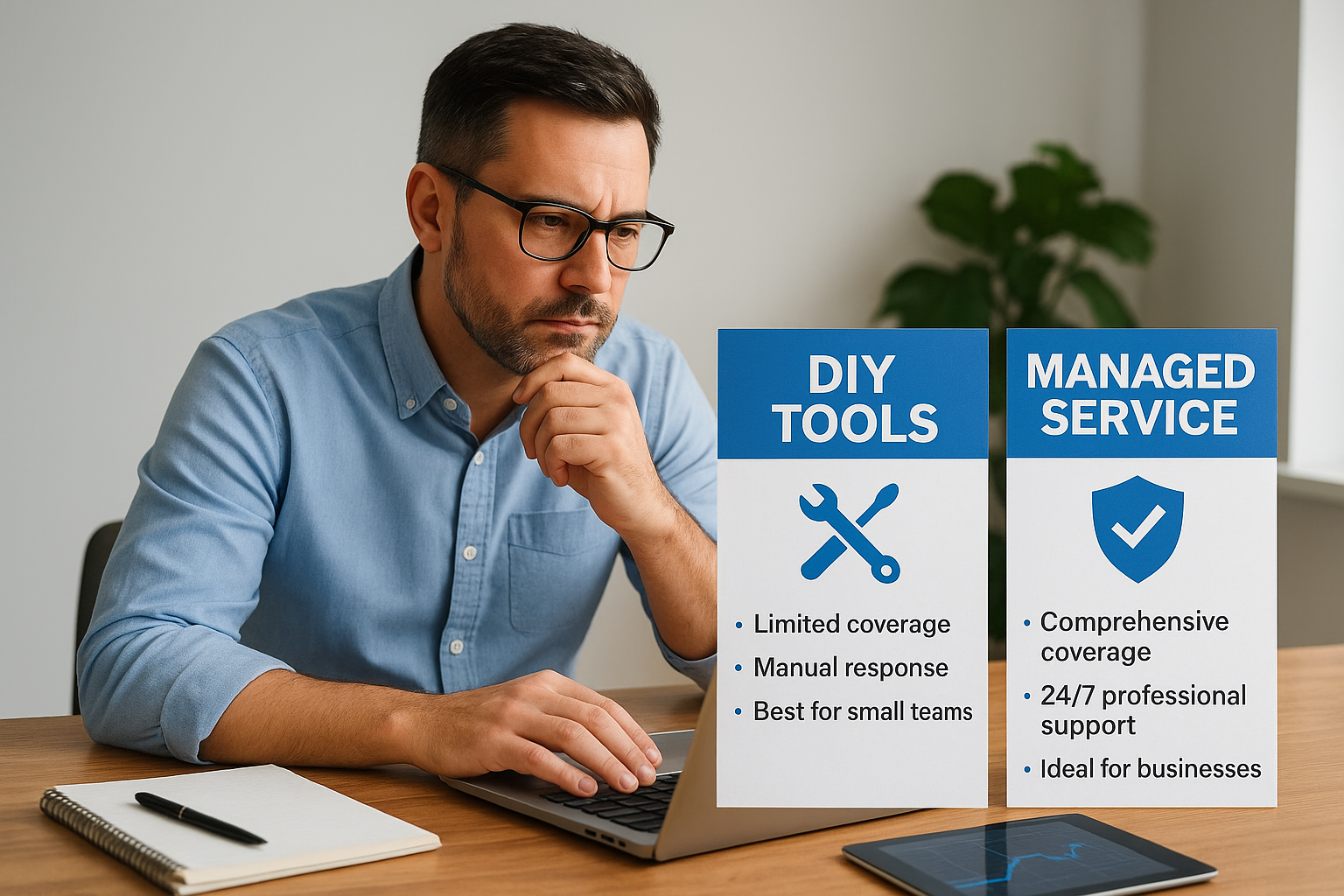
Smaller businesses often start with free or low-cost scanning tools, but these typically check a narrow slice of known breach databases and miss the closed forums where fresher, more damaging data circulates, which is worth bearing in mind when you compare the best dark web monitoring services for UK businesses. A managed security service run by analysts with genuine access to underground marketplaces catches far more, and someone else carries the burden of sorting noise from real threats.
| Approach | Coverage | Response speed | Best suited to |
|---|---|---|---|
| Free/DIY scanners | Public breach databases only | Manual, delayed | Very small teams testing the concept |
| Managed dark web surveillance | Forums, marketplaces, paste sites, closed channels | Continuous, analyst-verified | SMBs and enterprises needing real assurance |
Building the alerting and response workflow
Once you’ve picked an approach, map out exactly who gets notified and what they do next. A workable setup looks like this:
- Identify assets to monitor: domains, executive email addresses, VPN credentials, customer databases
- Set alert thresholds so genuine leaks aren’t buried under duplicate or low-risk mentions
- Assign ownership to a named person or team, not a shared inbox nobody checks daily
- Pre-write your response playbook covering password resets, account lockdowns, and stakeholder notification
- Review findings monthly, even when nothing’s flagged, to confirm the service is still active
Running this alongside a wider managed Security Operations Centre means alerts don’t sit in isolation. They feed straight into the same team already watching your network, so a leaked credential can be cross-checked against live login attempts within minutes rather than days.
What dark web monitoring can and cannot detect
Understanding the limits of this service matters as much as understanding what it offers. Dark web monitoring is a detection tool, not a prevention one, and setting the wrong expectations leads to false confidence. It tells you when something has already leaked, not whether an attacker is currently inside your network or planning a future attack you haven’t seen signs of yet.
What it reliably catches
Genuinely useful monitoring picks up specific, identifiable data tied to your organisation once it surfaces on the sources analysts actually watch:
- Leaked credentials matching your company’s email domains or known account patterns
- Compromised card numbers or banking details linked to your business
- Stolen documents such as contracts, source code, or internal spreadsheets posted on paste sites
- Mentions of your brand name on forums where access to your systems is being sold or discussed
- Compiled credential dumps from third-party breaches that happen to include your staff’s reused passwords
These hits give you a genuine head start, often the only warning you’ll get before that data gets used against you.
Where the blind spots are
Coverage always depends on which forums, marketplaces, and channels the provider actually has access to, and no single service sees everything. Truly private, invite-only criminal networks stay closed to outsiders, including most monitoring vendors, so some of the most damaging trades never surface at all. Encrypted messaging groups on platforms like Telegram present a similar problem, since data traded there rarely gets indexed anywhere a scanner can reach.
Dark web monitoring tells you what’s already been stolen. It can’t tell you what’s about to be.
Nor does it detect an active intrusion sitting quietly on your network, a phishing email about to land in an employee’s inbox, or a vulnerability waiting to be exploited. It also can’t stop data appearing in the first place; by definition, the leak has already happened by the time an alert fires. That’s precisely why it needs to sit alongside vulnerability assessments, endpoint detection, and phishing simulation rather than standing in as a substitute for them. Treat it as one signal among several, and it earns its place. Treat it as your only line of defence, and you’ll be blindsided by exactly the threats it was never built to see.
What to do if your data appears on the dark web
Getting an alert is only useful if you act on it fast. An exposed credential left unchanged for even a few hours can be enough for an attacker to log in, move laterally, and lock you out of your own systems. Panic isn’t the answer, but hesitation is just as damaging, so the priority is working through a clear sequence rather than scrambling to figure out what matters first.
The value of a dark web alert disappears the moment you sit on it.
Immediate containment steps
Before anything else, treat the exposure as live until proven otherwise, following the same discipline you would use to respond to a data breach. Work through these in order:
- Reset the affected credentials immediately, and force a reset on any account sharing that password
- Revoke active sessions and tokens tied to the compromised login, not just the password itself
- Enable multi-factor authentication on the account if it wasn’t already switched on
- Check access logs for unfamiliar login locations, times, or devices around the exposure date
- Notify affected employees or customers if personal or financial data was involved, in line with your data protection obligations
Quick action here closes the window attackers rely on, and it’s the difference between a contained incident and a full-blown breach.
Escalating beyond a password reset
Sometimes a reset isn’t enough, particularly when the leak includes financial data, source code, or evidence that an attacker already used the credentials to access your network. That’s when you need proper 24/7 cyber incident response, not just remediation steps ticked off a checklist. Trustedia’s CyberSOS service exists for exactly this scenario, giving you access to specialists who can confirm whether the exposure led to actual unauthorised access, contain any ongoing compromise, and guide you through notification requirements under UK data protection law.
Reporting matters too, so it pays to know the ICO data breach reporting thresholds before an alert lands. Serious exposures involving personal data may trigger obligations under UK GDPR, and the Information Commissioner’s Office expects organisations to report qualifying breaches within 72 hours of becoming aware of them. Document what you found, when you found it, and every step you took in response. That record protects you legally and gives your team a working template for the next alert, because there will be one.
Where dark web monitoring fits in your defences
Dark web monitoring won’t stop a breach from happening, but it shrinks the window between theft and discovery from months to hours, and that window is where most of the damage gets done. Businesses that treat it as one layer among several, alongside vulnerability assessments, endpoint detection, and a properly staffed response plan, get real value from it. Those that bolt it on and walk away get a false sense of security instead.
Getting the coverage, alerting, and response workflow right takes more than a free scanner and good intentions. If you want that layer built properly, backed by analysts who can act the moment your data surfaces and a team ready to run incident response when it counts, talk to TrustedIA about adding managed dark web monitoring to your defences. Waiting for the breach notification is the expensive way to learn this lesson.



