

If someone has asked you to prove your organisation is on the data protection act register, or you’ve just realised you might need to be on it, you’re not alone. Every year the ICO chases businesses that assumed registration was optional, only to find themselves facing a penalty notice instead. It’s a small administrative step that gets overlooked far too often, usually because nobody assigned ownership of it.
This register is the ICO’s public record of organisations that process personal data and pay the data protection fee, and checking or completing your data protection act registration takes minutes once you know where to look. We’ll show you exactly how to search the register, who actually needs to register, and how to work out which fee tier applies to your business.
Beyond the mechanics, we’ll cover what happens if you skip registration, how it fits into wider UK GDPR compliance, and where it sits alongside broader obligations like ISO 27001. Whether you’re checking a supplier’s status or sorting out your own listing, you’ll leave with a clear answer and a clear next step.
Why the data protection act register matters for your business
Most people assume that once they’ve adopted UK GDPR practices internally, like drafting a privacy policy and training staff, they’ve covered their obligations. That’s a common misunderstanding. The Data Protection Act 2018 and its accompanying regulations require most organisations that process personal data to pay the data protection fee and appear on the ICO’s public register, separately from any GDPR compliance work you’ve already done. Skipping this step leaves a gap that’s easy for regulators, and increasingly for customers and partners, to spot.
It’s a legal requirement backed by real penalties
Registration isn’t a courtesy the ICO extends to businesses, it’s a statutory duty under the Data Protection (Charges and Information) Regulations 2018. Organisations that process personal data and don’t have a specific exemption must register and keep their details current. Fail to do so and the ICO can issue a civil monetary penalty of up to £4,350, on top of the fee you owed anyway. That’s a costly way to learn about an obligation you could have handled in ten minutes.
Registering with the ICO is a legal duty, not an optional extra, and ignoring it can cost you far more than the fee itself.
It signals trust to clients, insurers, and auditors
Beyond the legal angle, your entry on the register has become a practical trust signal. Procurement teams, insurers, and auditors increasingly check the register before signing contracts or underwriting cyber policies, treating it as a baseline indicator that you take data handling seriously. If a supplier can’t produce a valid registration number, that’s often enough to stall a deal or trigger deeper due diligence questions you’d rather avoid.
It supports wider compliance work like ISO 27001
Additionally, registration slots into a much bigger compliance picture. If your organisation is working towards ISO 27001 certification or responding to a client’s security questionnaire, auditors will often ask to see evidence of your data protection fee status alongside your information security management system. Having it sorted removes one easy tick-box question from what can already be a lengthy audit process, and it demonstrates that your governance extends beyond technical controls into the legal and administrative side of data handling.
Ultimately, treating registration as an afterthought creates exposure that’s disproportionate to the effort required to fix it. You can read the ICO’s own explanation of who needs to pay the data protection fee on its official guidance page, which sets out the exemptions and thresholds in full.
…I’How to register with the ICO step by step section: Actually just write content.
How much you’ll pay and which fee tier applies
Deciding what you owe comes down to your organisation’s size, turnover, and sector, not the volume of personal data you handle. The ICO splits fees into three tiers, and most small businesses land in Tier 1 or Tier 2 without realising it. Getting the tier wrong is one of the most common mistakes people make when completing their data protection act registration, so it’s worth checking the criteria properly rather than guessing.
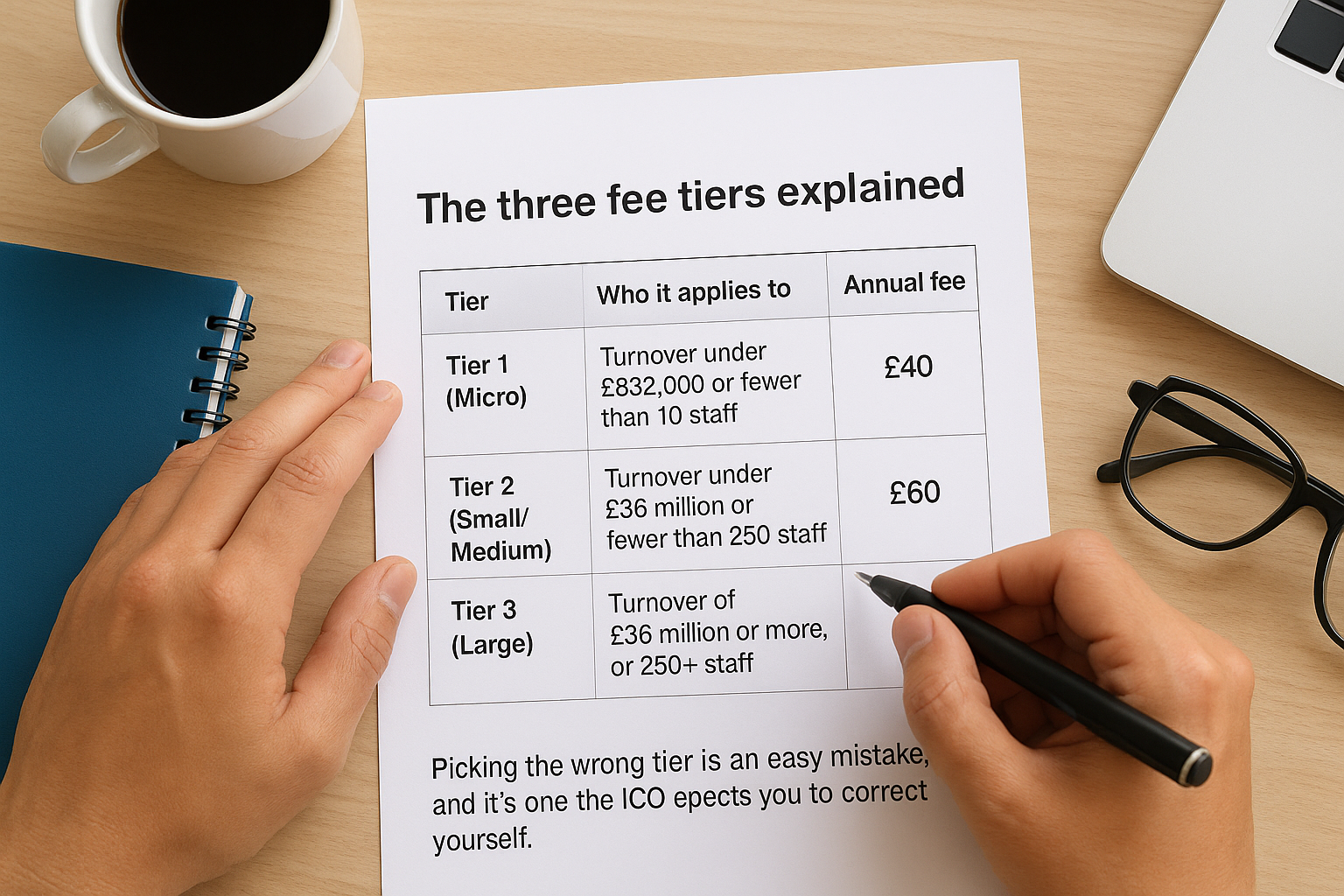
The three fee tiers explained
Each tier reflects turnover and staff numbers, with charities and small non-profits benefiting from a reduced rate regardless of size. Here’s how the current structure breaks down:
| Tier | Who it applies to | Annual fee |
|---|---|---|
| Tier 1 (Micro) | Turnover under £632,000 or fewer than 10 staff | £40 |
| Tier 2 (Small/Medium) | Turnover under £36 million or fewer than 250 staff | £60 |
| Tier 3 (Large) | Turnover of £36 million or more, or 250+ staff | £2,900 |
Charities pay a flat £40 regardless of size, and public authorities are assessed separately.
Picking the wrong tier is an easy mistake, and it’s one the ICO expects you to correct yourself, not one it forgives quietly.
Why the tier matters more than people expect
Furthermore, self-assessing incorrectly isn’t a paperwork slip you can shrug off. If the ICO finds you’ve underpaid, whether through an honest miscalculation or overlooking a group company’s turnover, you’ll be asked to pay the difference and could face a penalty on top. Groups with several subsidiaries often trip up here, because turnover calculations sometimes need to include the parent company’s figures.
Paying and renewing your fee
Once you’ve settled on the right tier, payment is handled directly through the ICO’s online portal, and renewal happens automatically each year unless your circumstances change. Reviewing your tier annually, particularly after growth, acquisitions, or restructuring, keeps your data protection fee accurate and avoids an awkward correction further down the line.
How to search the register and check a registration
Checking whether an organisation is on the data protection act register takes less time than making a coffee. The ICO hosts a free, public search tool that lets anyone look up a company by name, registration number, or postcode, and it returns results instantly without needing an account or login. This is the same tool procurement teams and insurers use when they ask you to "prove" your registration, so it’s worth knowing exactly what it shows before someone else checks it for you.
Finding a company on the register
Searching is straightforward if you follow a few simple steps:
- Go to the ICO’s official Data Protection Register search page.
- Enter the organisation’s name exactly as it’s registered, or use its registration number if you have it.
- Scroll through results if multiple entries share a similar name, since group companies often register separately.
- Confirm the entry matches the correct trading name and address before relying on it.
A quick search on the ICO’s register can confirm in seconds what a lengthy email chain with a supplier might take weeks to establish.
What the results tell you
Once you’ve found the right entry, the register displays the organisation’s registration number, the date the registration was granted, and its expiry date, which falls exactly one year after payment unless renewed. Details like the registered address and the name of the data controller are also shown, giving you enough to verify authenticity without contacting the company directly. Missing entries, expired dates, or mismatched details are red flags worth raising before you sign a contract or share data with that organisation, particularly if data protection compliance forms part of your due diligence process.
Staying compliant after you’ve registered
Getting your entry on the data protection act register isn’t a one-off task you can file away and forget. The ICO expects your details to stay accurate for as long as you’re processing personal data, and letting them drift out of date is one of the quickest ways to undo the effort you put into registering correctly in the first place.
Keep your details current
Notify the ICO whenever something material changes, not just at renewal time. That includes:
- A change of registered address or trading name
- A new data protection officer or main contact
- A shift in turnover or staff numbers that moves you into a different fee tier
- Significant changes to how you process personal data
Organisations that grow through acquisitions often forget this step entirely, leaving an outdated entry that no longer reflects reality.
Renew on time, every time
Quietly, your registration lapses exactly one year after payment unless you renew it, and the ICO doesn’t send endless reminders chasing you down. Set a calendar reminder well ahead of the expiry date, because a lapsed registration puts you back in the same exposed position as never registering at all.
Staying on the register isn’t about registering once, it’s about treating it as a recurring obligation like any other compliance deadline.
Fold registration into your wider security programme
Rather than managing your data protection act registration as an isolated admin task, build it into your broader compliance calendar alongside vulnerability assessments, staff training, and any ISO 27001 review cycles you run. Teams that already partner with a managed security provider for their managed security services tend to find this far easier, since renewal dates and compliance reviews sit within the same governance rhythm rather than depending on one person remembering a deadline.
Getting your registration right from the start
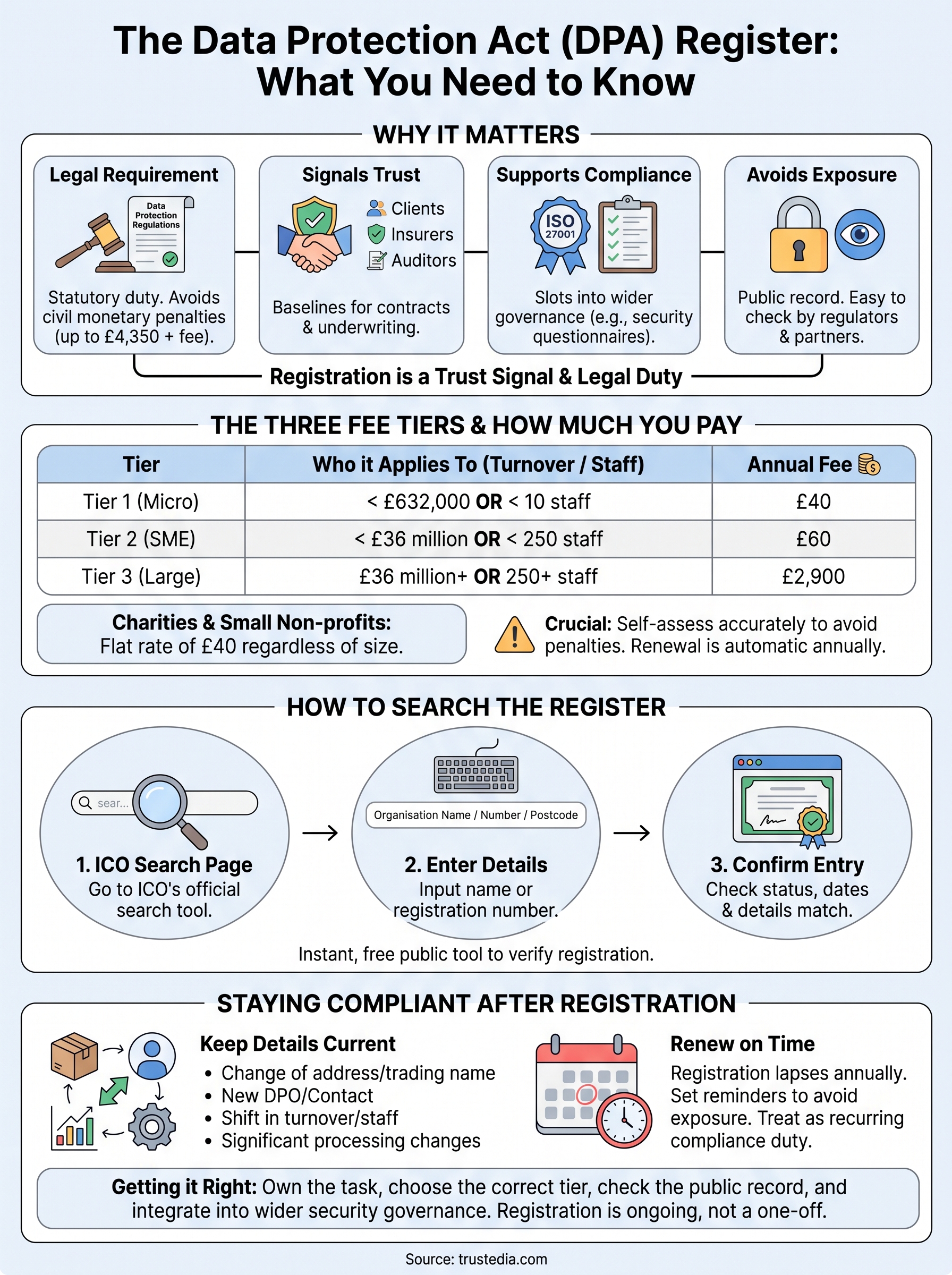
Registering with the ICO isn’t complicated, but it’s easy to get wrong if nobody owns the task. Confirm whether your organisation needs to be on the data protection act register, pick the correct fee tier, and check the public search tool before a client or insurer does it for you. From there, treat renewal and detail updates as a recurring compliance job rather than a one-time box to tick.
Getting data protection act registration right protects you from penalties, but it also signals to partners and auditors that your data handling practices hold up to scrutiny. That’s worth more than the £40 or £60 it costs most small businesses.
If you’d rather fold registration reviews into a wider security and compliance programme instead of tracking deadlines manually, TrustedIA’s managed security services can handle that alongside vulnerability assessments, staff training, and your ISO 27001 obligations, all under one governance rhythm.



