
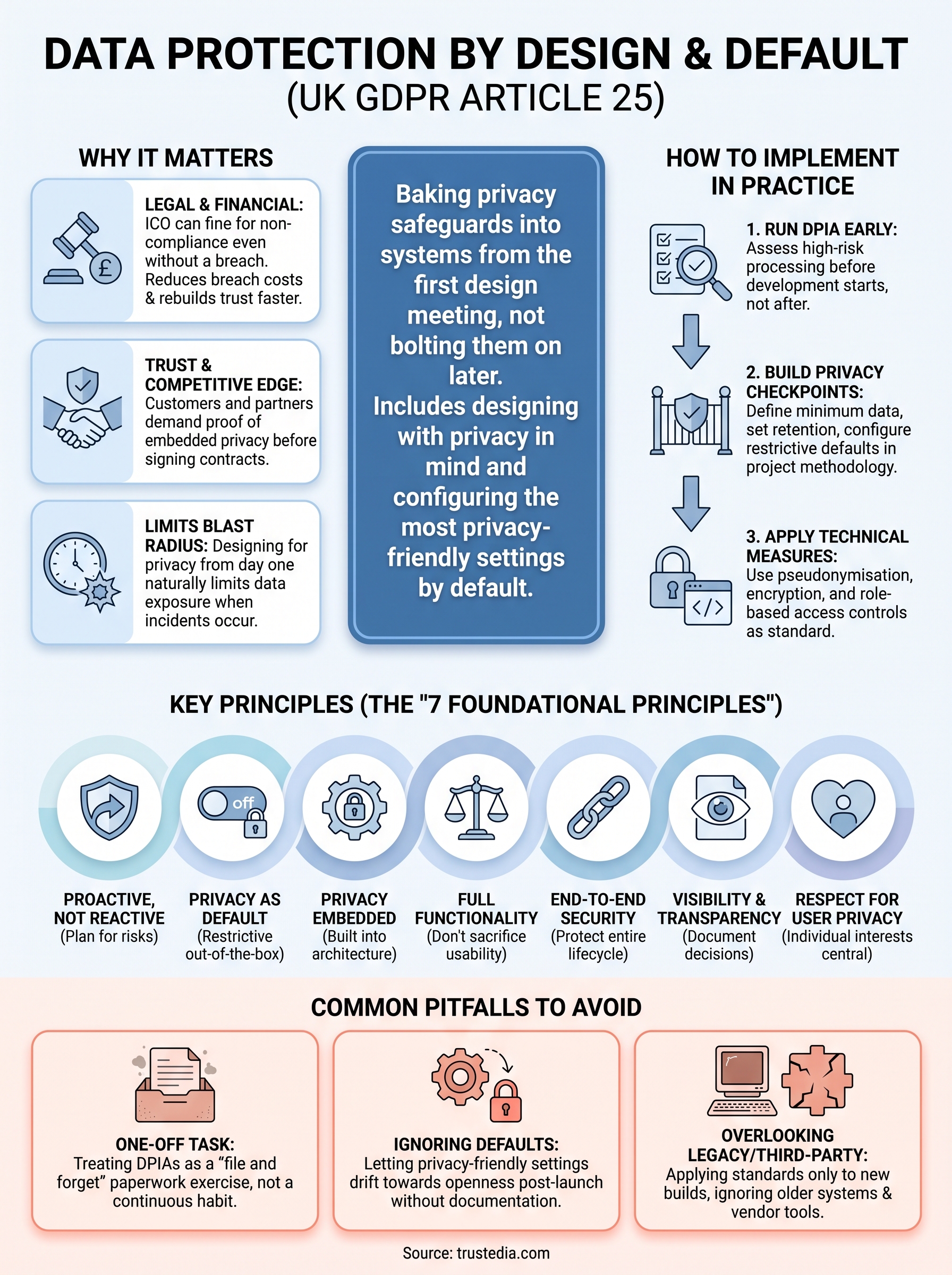
If you’re building a new system, launching a product, or rolling out a process that touches personal data, you’ve probably hit this question: what is data protection by design, and does GDPR actually require it? The short answer is yes. Article 25 of the UK GDPR makes it a legal obligation, not a best practice you can quietly skip. It means baking privacy safeguards into your systems from the first design meeting, rather than bolting them on after a regulator or a breach forces your hand.
In practice, this covers two linked concepts: designing systems with privacy protections built in from the start, and configuring them so that the most privacy-friendly settings apply by default. Together they form one of the most misunderstood parts of data protection law, largely because guidance rarely explains what implementation looks like day to day.
This article breaks down both principles in plain terms, explains what the ICO expects from compliant organisations, and walks through practical steps for embedding them into your existing processes. We work with businesses on exactly this kind of ISO 27001 aligned compliance every day, so we’ve kept the advice grounded in what actually holds up under scrutiny.
Why data protection by design matters for your business
Regulators don’t treat data protection by design as optional guidance. The ICO can investigate and fine organisations that fail to demonstrate they considered privacy at the design stage, even if no breach has occurred yet. Article 25 sits alongside the accountability principle, which means you need to show your working, not just claim you’ve thought about privacy. If your systems collect more data than necessary, retain it longer than needed, or default to sharing settings that expose personal information, you’re already exposed to enforcement action regardless of whether anything has gone wrong yet.

Data protection by design isn’t a paperwork exercise, it’s the difference between a breach costing you a bad week and a breach costing you your business.
Beyond the regulatory angle, the financial exposure is real. Breach costs escalate fast when personal data wasn’t properly minimised or protected at the point of collection, because you end up notifying more people, facing larger potential fines, and rebuilding trust from a much deeper hole. A system designed with privacy in mind from day one naturally limits the blast radius when something does go wrong, simply because there’s less sensitive data sitting around to be stolen in the first place.
Trust matters just as much as the legal and financial angles. Customers, partners, and insurers increasingly ask pointed questions about how you handle personal data before they’ll sign a contract. Showing that privacy is embedded in your processes, rather than retrofitted after a scare, gives you a genuine edge in procurement conversations and cyber insurance renewals alike.
Consider how the consequences stack up depending on when privacy gets addressed:
| Approach | Typical outcome |
|---|---|
| Privacy considered at design stage | Lower breach impact, fewer records exposed, easier ICO conversations |
| Privacy bolted on after launch | Costly rework, inconsistent controls, gaps regulators notice quickly |
| Privacy ignored until a breach | Regulatory investigation, reputational damage, potential enforcement fines |
Organisations that treat privacy by default as a project requirement rather than an afterthought tend to spend less time firefighting and more time building. That’s not a coincidence. Building it in from the start forces you to ask the right questions early, like what data you actually need and who should be able to see it, questions that are far cheaper to answer before launch than after a regulator asks them for you.
How to implement data protection by design in practice
Getting data protection by design implementation right starts with a simple shift: privacy questions belong in your project kickoff, not your pre-launch checklist. Treat every new system, feature, or supplier contract as an opportunity to ask what data you genuinely need before anyone writes a line of code or signs a form.
Run a Data Protection Impact Assessment early
Whenever a project involves higher-risk processing, a Data Protection Impact Assessment (DPIA) should happen before development starts, not after. The ICO’s guidance on DPIAs sets out when they’re mandatory, but running one earlier than required rarely hurts. It forces you to map data flows, identify who accesses what, and flag risks while changes are still cheap to make.
The cheapest privacy fix is the one you make before anything gets built.
Build privacy checkpoints into project delivery
Embedding these checks into your existing project methodology stops privacy becoming a one-off exercise. A practical checklist for most teams looks like this:
- Define the minimum data needed before designing the collection form or field
- Set retention periods at the design stage, not after storage costs pile up
- Configure default settings so sharing and visibility start restrictive, not open
- Document decisions so accountability requirements are met upon request
- Review third-party tools and integrations for the same standards before onboarding
Specific technical measures reinforce these checkpoints: pseudonymisation, encryption at rest and in transit, and role-based access controls all reduce exposure without slowing teams down once they’re standard practice. Treating them as defaults, rather than optional add-ons, is what separates organisations that pass ICO scrutiny from those that scramble to explain gaps after the fact.
Key principles to build into every project
Seven principles, originally set out by Ann Cavoukian and now embedded in the UK GDPR, should shape every design decision you make. Treat them as a checklist rather than abstract values, because that’s how the ICO assesses accountability during an investigation. Below is how each one translates into a practical build decision.

| Principle | Practical translation |
|---|---|
| Proactive, not reactive | Address privacy risks in planning, not after launch |
| Privacy as the default setting | Restrictive sharing and visibility settings out of the box |
| Privacy embedded into design | Build controls into architecture, not bolt-on add-ons |
| Full functionality | Don’t sacrifice usability to achieve compliance |
| End-to-end security | Protect data across its entire lifecycle, not just storage |
| Visibility and transparency | Document decisions so they’re auditable on request |
| Respect for user privacy | Keep the individual’s interests central to every choice |
Data minimisation and purpose limitation
Every field you collect should have a clear justification tied to a specific purpose. Data minimisation means asking whether you actually need a date of birth or a full address before adding it to a form, not collecting it because it might be useful someday. Purpose limitation then stops that data being repurposed later without fresh consent, which is where many organisations quietly slip out of compliance.
If you can’t explain why you’re collecting a piece of data, you shouldn’t be collecting it.
Security and accountability by default
Security controls need to sit at the architecture level, not as a separate workstream bolted on before go-live. Combine that with clear documentation, because accountability under GDPR means proving your reasoning, not just having good intentions on record.
Common pitfalls that undermine privacy by design
Even organisations with good intentions get this wrong in predictable ways. Most failures don’t come from ignorance of the law but from treating privacy by design principles as a box-ticking exercise rather than a genuine design constraint. Spotting these patterns early saves you from repeating them on your next project.
Treating it as a one-off compliance task
Many teams complete a DPIA, file it away, and never revisit it as the project evolves. Requirements change, new features get bolted on, and suddenly the original privacy assessment no longer reflects what the system actually does. Data protection by design only works as a continuous discipline, not a document you produce once to satisfy an auditor.
Privacy by design fails the moment it becomes a document instead of a habit.
Ignoring default settings after launch
Systems often ship with restrictive defaults, then drift towards openness as teams chase convenience or user complaints. Sharing permissions get widened, retention periods get quietly extended, and nobody documents why. Six months later, the privacy by default settings you designed no longer exist in practice, and nobody can explain when or why they changed.
Overlooking third-party and legacy systems
Organisations frequently apply strict standards to new builds while ignoring the older systems and vendor tools already handling personal data. This creates obvious gaps:
- Legacy databases with no retention policy applied
- Third-party plugins collecting more fields than the contract specifies
- Integrations that bypass access controls built into the main system
Auditing these regularly closes the gaps that regulators tend to find first.
Making privacy part of everyday practice
Getting data protection by design right isn’t about a single policy document or a one-off DPIA. It’s a habit that shows up in how you scope projects, configure defaults, and question every new field on a form before it gets built. The businesses that handle this well treat privacy as a design constraint from day one, not a compliance step bolted on before launch.
Holding that standard consistently, across new builds, legacy systems, and third-party tools, takes more than good intentions. It takes structured processes, documented decisions, and someone checking your assumptions against what the ICO actually expects. That’s where ISO 27001 aligned expertise earns its keep, turning privacy by design from a risk you manage reactively into a discipline built into everything you ship.
If you want help embedding these principles properly rather than guessing at what regulators expect, talk to TrustedIA about your compliance approach.