A ransomware attack, a server room flood, a botched software update. Any one of these can stop your business trading within hours, and most SMBs discover their recovery plan has gaps only after the damage is done. If you’re researching business continuity managed services, you’re probably already aware that internal IT teams rarely have the time or specialist skills to build resilience properly, let alone test it.
Business continuity managed services combine disaster recovery planning, incident response, and ongoing risk assessment into a single outsourced service, so your organisation can keep operating, or recover fast, when something goes wrong. Rather than a static document sitting in a drawer, it’s an active partnership that gets tested, updated, and ready to act the moment an incident occurs.
In this article, we’ll break down exactly what these services include, how they differ from basic backup solutions, and why operational resilience has become a compliance expectation rather than a nice-to-have. We’ll also cover what to look for when choosing a provider, drawing on what genuinely works when businesses face real incidents.
Why business continuity managed services matter
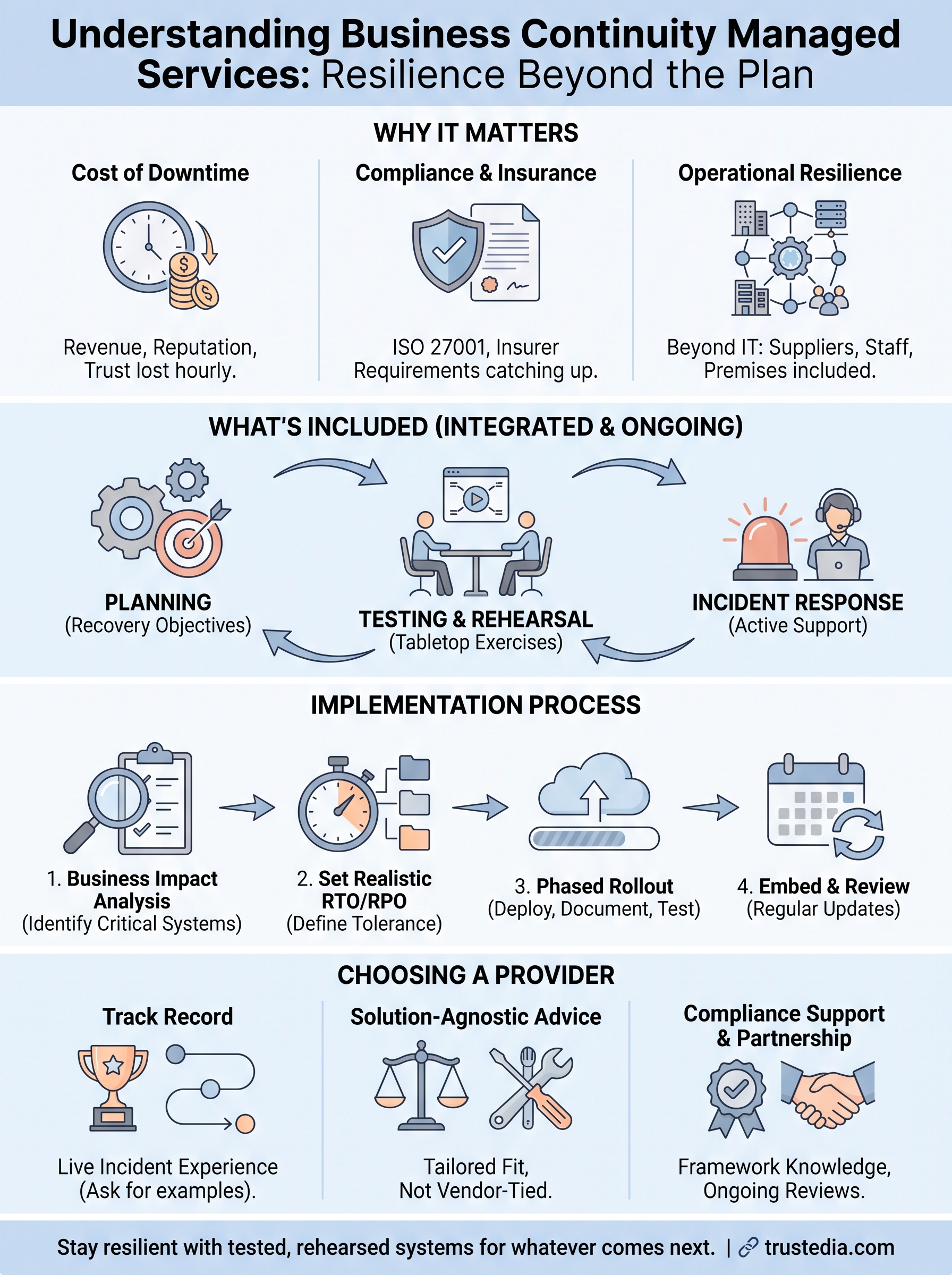
Every hour your systems are down costs you customers, revenue, and trust. Business continuity managed services exist because most organisations underestimate how quickly a single operational disruption cascades into lost contracts, regulatory scrutiny, and reputational damage that outlasts the original technical fault. Understanding why this matters starts with looking at what’s genuinely at stake when things go wrong.
The real cost of downtime
Figures from the UK government’s Cyber Security Breaches Survey show a substantial share of UK businesses experience a breach or attack every year, and the financial damage climbs the longer systems stay offline. Downtime costs aren’t limited to lost sales either, you’re also paying staff who can’t work, absorbing contractual penalties, and often paying for emergency IT support at premium rates once an incident hits. A managed disaster recovery arrangement shifts this from reactive firefighting to a rehearsed process with clear recovery time objectives agreed in advance.
A business that hasn’t tested its recovery plan doesn’t actually have one, it has a theory.
Compliance and insurance are catching up
Cyber insurers now routinely ask for evidence of tested continuity arrangements before they’ll pay out on a claim, and frameworks like ISO/IEC 27001 build business continuity planning into their core requirements rather than treating it as optional. Falling short here doesn’t just slow your recovery, it can void cover entirely or block the certification you need to win contracts with larger clients. Meeting these expectations is increasingly a condition of doing business, not a competitive advantage you can choose to skip.
Resilience is bigger than IT
Many businesses still treat continuity as a technology problem, when in reality it touches suppliers, staff, communications, and physical premises. Losing a key supplier’s system, for instance, can be just as damaging as losing your own servers, which is why genuine operational resilience looks across the whole business rather than just the server room. Managed continuity providers typically cover:

- Data and system recovery timeframes
- Alternative working arrangements for staff
- Supplier and third-party dependency mapping
- Customer and stakeholder communication plans
- Financial and legal exposure during an incident
Taken together, rather than as isolated documents, these elements are what separate real resilience from a folder of policies nobody reads. Small and medium-sized businesses feel this gap hardest because they rarely have a dedicated continuity function in-house, which is exactly the space managed services are built to fill.
What’s included in a business continuity managed service
Opening a services brochure won’t tell you much, because the real value sits in how the pieces fit together. A properly built business continuity managed services package blends technical safeguards with planning and people, so nothing depends on one person remembering what to do during a crisis. Look for a provider who treats this as an ongoing service rather than a one-off project.
Core components you should expect
Providers vary, but a genuine business continuity offering typically covers the following ground:
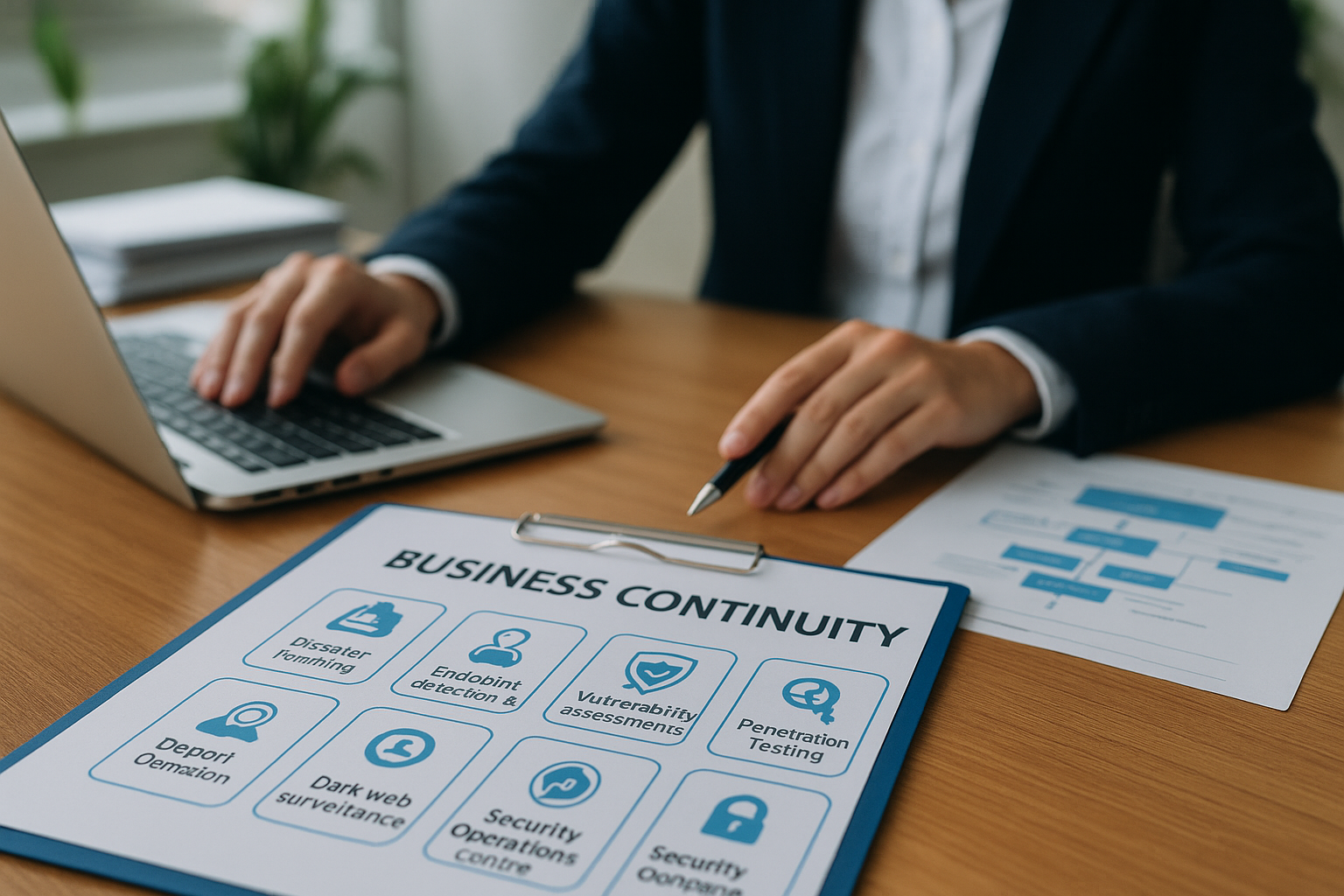
| Component | What it does |
|---|---|
| Disaster recovery planning | Defines recovery time and point objectives for critical systems |
| Endpoint detection & AV | Spots and contains threats before they spread |
| Vulnerability assessments | Identifies weaknesses before attackers find them |
| Penetration testing | Tests defences the way a real attacker would |
| Dark web surveillance | Flags stolen credentials tied to your organisation |
| Security Operations Centre (SOC) | Provides round-the-clock monitoring and alerting |
| Phishing simulation | Builds staff resistance to the most common attack route |
Testing, not just planning
Documents age quickly, and a plan nobody has rehearsed usually fails at the worst possible moment. Reputable providers schedule regular tabletop exercises and simulated failovers, checking that backups actually restore and that staff know their roles when systems go down.
A recovery plan only proves itself the day you’re forced to use it, so test it long before that day arrives.
Incident response baked in
Beyond planning and testing, a mature service includes dedicated incident response support, sometimes offered as a standalone arm like TrustedIA’s CyberSOS, which insurers and loss adjusters rely on for fast recovery after a breach. Together, these elements turn continuity from a static policy into a working system that’s ready the moment something breaks.
How to implement business continuity managed services
Getting started doesn’t mean signing a contract and hoping for the best. Implementing business continuity properly means working through a structured process before any provider touches your systems, so the service you buy actually matches what your business needs to survive an incident.
Start with a business impact analysis
Before anyone can build a recovery plan, you need a clear picture of what actually matters most. A business impact analysis identifies your critical systems, the maximum tolerable downtime for each, and the knock-on effects across departments if they fail. Skipping this step is the most common reason continuity plans fall apart, because providers end up protecting the wrong things at the wrong priority.
You can’t protect what you haven’t mapped, and you can’t prioritise what you haven’t measured.
Set realistic recovery objectives
Once priorities are clear, translate them into recovery time objectives (RTOs) and recovery point objectives (RPOs) for each system. These numbers should reflect actual business tolerance, not aspiration, because unrealistic targets are expensive to build and rarely met when it counts.
Roll out in stages
A phased approach keeps the process manageable and lets you adjust before committing fully:
- Map critical systems, suppliers, and dependencies
- Agree recovery objectives with each department
- Deploy technical safeguards, backups, monitoring, and endpoint protection
- Document staff roles and communication plans
- Run a tabletop exercise within the first quarter
- Schedule ongoing reviews as the business changes
Embed it, don’t shelve it
Finally, treat the plan as a living arrangement rather than a compliance exercise ticked off once a year. Circumstances change fast: new suppliers, new software, new staff, and each shift can quietly invalidate assumptions baked into your disaster recovery planning. Regular reviews with your managed provider keep the plan aligned with how the business actually operates today, not how it operated when the contract was signed.
Choosing the right business continuity managed service provider
Not every provider selling business continuity managed services actually delivers resilience, some simply sell backup software with a support contract attached. Picking the right partner means looking past the sales pitch and checking whether they’ve actually handled a live incident, not just planned for a hypothetical one.
Ask about track record, not just tools
Experience matters more than the brand of software on the invoice. A provider worth hiring should be able to describe real incidents they’ve recovered clients from, the recovery times achieved, and how their approach adapted afterwards. Questions worth asking during any procurement conversation include:
- How many live incidents have you managed in the past 12 months?
- What are your typical recovery time objectives for a business our size?
- Do you test failovers with us, or only internally?
- Are you solution agnostic, or tied to specific vendor products?
- Can you support us through ISO 27001 certification requirements?
Ask what happens on day one of an incident, not just what’s promised in the brochure.
Look for solution-agnostic advice
Beware of providers pushing one vendor’s stack regardless of fit. A genuinely useful managed disaster recovery partner recommends the right tool for your specific risk profile, even if that means combining products from several vendors. This matters because your infrastructure, supplier relationships, and compliance obligations are rarely identical to the next client’s, so a one-size-fits-all package usually leaves gaps.
Check compliance and certification support
Providers working towards frameworks such as ISO/IEC 27001 should understand the standard from the inside, not just reference it in marketing material. This becomes especially important if your business needs to demonstrate compliance to insurers, regulators, or larger clients as a condition of doing business.
Confirm ongoing support, not a one-off project
Question whether the relationship ends once systems are configured or continues with scheduled reviews, tabletop exercises, and updates as your business changes. Continuity that isn’t maintained decays quietly, often without anyone noticing until the moment it’s tested for real.
Staying resilient for whatever comes next
Downtime doesn’t wait for a convenient moment, and neither should your recovery plan. Business continuity managed services turn a folder of good intentions into a tested, rehearsed system that holds up when a real incident hits, whether that’s ransomware, a supplier failure, or a flooded server room. Getting there means mapping what matters, setting honest recovery objectives, and choosing a provider who’s actually managed live incidents rather than one selling backup software with a support contract attached.
Resilience isn’t a box you tick once for an audit. It’s an ongoing relationship that adapts as your systems, suppliers, and staff change, which is exactly why operational resilience needs a partner rather than a project. If you’re ready to move past theoretical plans and build something that works under pressure, talk to TrustedIA about business continuity managed services and find out where your current arrangements would actually hold up, and where they wouldn’t.