A data breach rarely announces itself with sirens. It usually starts with a strange login alert, a supplier asking why they’ve been emailed twice, or an employee reporting a phishing email they’d already clicked. Within hours you’re deciding what to tell customers, whether to call the ICO, and how much time you actually have. Data breach response best practices exist precisely because those first 72 hours decide whether your business recovers quickly or spends months rebuilding trust and paying fines.
This guide gives you the step-by-step actions UK SMEs need, from the moment a breach is suspected through to containment, investigation, and regulatory notification under UK GDPR. We’ve written it for businesses without a dedicated security team, because that’s who tends to get caught out when a breach hits and nobody knows who’s supposed to do what.
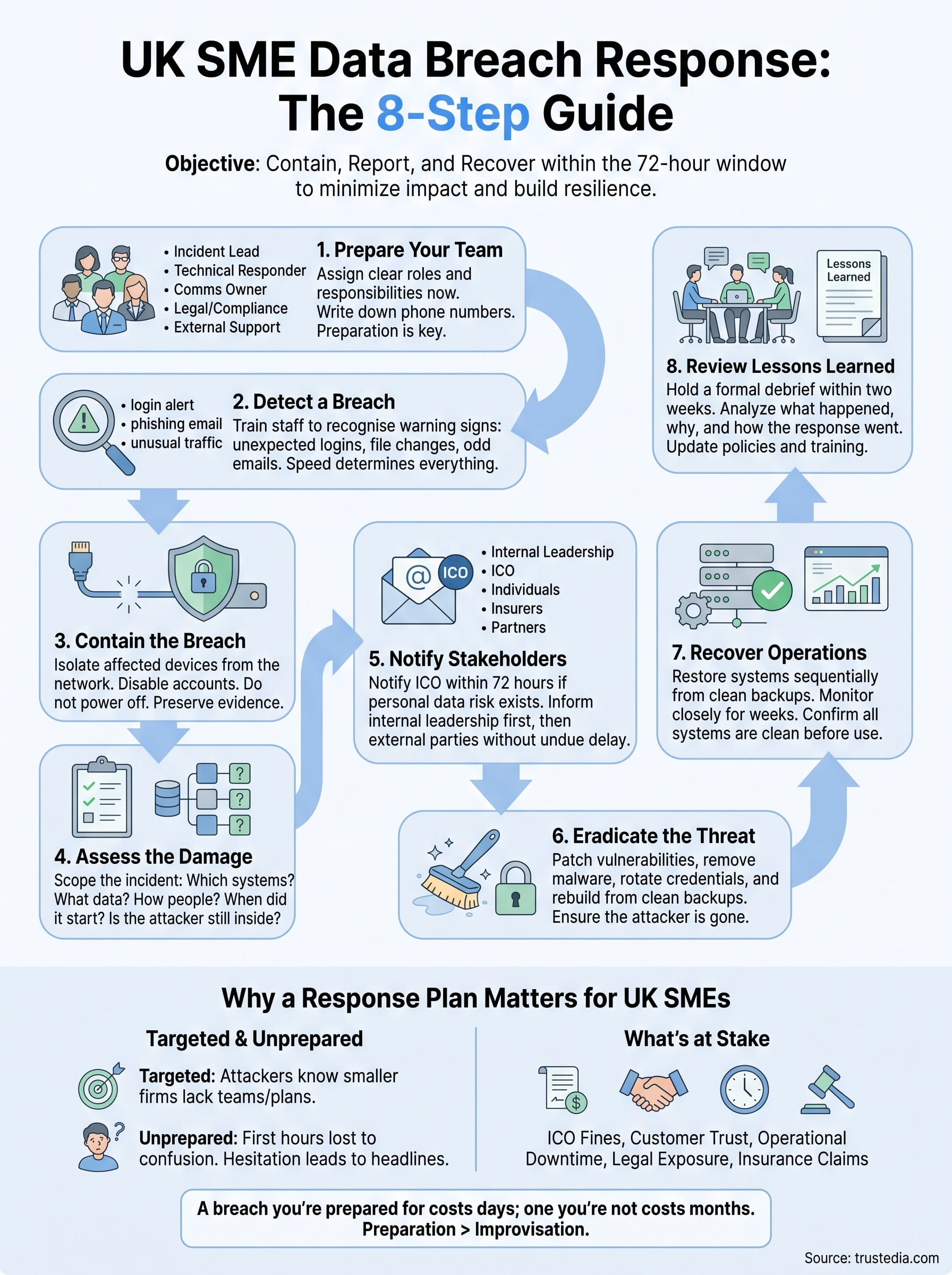
We’ll walk through eight practical steps, covering incident detection, isolating affected systems, working out what data and people are affected, notifying the ICO and customers within the legal timeframe, and closing the loop with lessons learned. Having supported organisations through real incidents via our CyberSOS response service, we’ve built this guide around what actually works under pressure, not just theory.
Why a clear response plan matters for UK SMEs
Most small and medium-sized businesses assume a data breach is something that happens to bigger companies with more valuable data. That assumption is wrong, and it’s expensive. UK SMEs are targeted precisely because attackers know smaller firms often lack a dedicated security team, formal escalation process, or the confidence to act fast when something goes wrong. Without a plan, the first few hours of an incident get eaten up by confusion: who do we tell first, do we need a lawyer, is this even reportable? That hesitation is exactly what turns a contained incident into a headline.
The regulatory clock starts immediately
Under UK GDPR, you have a legal duty to report certain personal data breaches to the Information Commissioner’s Office within 72 hours of becoming aware of them, not 72 hours from when you’ve finished investigating. If your business can’t say with confidence what data was affected, how many people are impacted, or when the breach actually started, you’ll struggle to make that deadline. Missing it, or submitting a rushed and inaccurate report, can draw more regulatory scrutiny than the breach itself.
A breach you’re prepared for costs you days of disruption; a breach you’re not prepared for costs you months of recovery and regulatory attention.
What’s actually at stake
The financial and reputational fallout from a poorly handled breach tends to land in a few predictable places:
| Impact area | What happens without a plan |
|---|---|
| Regulatory fines | ICO penalties for late or incomplete notification |
| Customer trust | Public disclosure delays make it look like you tried to hide the breach |
| Operational downtime | Systems stay compromised longer because nobody owns containment |
| Insurance claims | Cyber insurers often require evidence of a documented response process |
| Legal exposure | Affected individuals or partners pursue claims over delayed notification |
Why documentation beats improvisation
Having a written, tested plan changes the dynamic completely. Your team knows their role before the pressure hits, rather than working it out in a group chat while customer data is still exposed. It also gives you something concrete to hand to insurers, auditors, and the ICO showing you took reasonable steps, which matters both legally and reputationally. Businesses working towards or holding ISO 27001 certification already have much of this groundwork laid, since incident response planning is a core requirement of the standard, not an optional extra.
The eight steps that follow give you that structure. They won’t stop every attack, nothing does, but they’ll stop a bad day from becoming a bad year.
Steps 1-2. Prepare your team and detect a breach
Before anything goes wrong, you need to know who does what. Preparation is the step most SMEs skip, because it doesn’t feel urgent until the moment it’s too late. A response plan gathered ten minutes before you need it is worse than useless, it wastes the ten minutes you don’t have.
Step 1: Build your incident response team before you need one
Assign clear ownership now, on paper, not in someone’s head. At minimum, name these roles:
- Incident lead: makes final calls on containment and communication
- Technical responder: isolates systems, preserves evidence, works with IT support
- Communications owner: handles staff, customer, and regulator messaging
- Legal or compliance contact: advises on ICO obligations and contractual duties
- External support contact: your managed security provider or CyberSOS-style response partner
Write down phone numbers, not just email addresses. Email is often the first thing attackers compromise.
Step 2: Know the signs of a breach before it’s obvious
Detection speed determines everything that follows. The average breach isn’t discovered through a dramatic alert, it’s spotted because something looks slightly off and someone bothers to check. Train staff to flag, not ignore, these signs:
| Warning sign | Why it matters |
|---|---|
| Unexpected login alerts or MFA prompts | Suggests credential compromise |
| Files renamed or inaccessible | Early sign of ransomware encryption |
| Unusual outbound network traffic | Could indicate data exfiltration |
| Customers or suppliers report odd emails from you | Account may already be compromised |
| Antivirus or EDR tools flag repeated blocked attempts | Attacker is actively probing your systems |
The fastest breach responses start with someone trusting their gut and reporting it, not waiting for certainty.
Running endpoint detection and phishing simulations regularly means your team recognises these signs faster, because they’ve seen simulated versions before. Detection without a trained eye watching for it just delays step three.
Steps 3-4. Contain the breach and assess the damage
Once you’ve confirmed something is wrong, speed matters more than perfection. Containment buys you time to investigate properly without the breach spreading further, but rushed containment can also destroy evidence you’ll need later for the ICO report or an insurance claim. Balance the two by moving fast on isolation while resisting the urge to wipe or rebuild systems before you’ve captured what happened.

Step 3: Isolate before you investigate
Disconnect affected devices from the network rather than shutting them down entirely, powering off can wipe volatile memory that shows how attackers got in. Practical containment actions include:
- Disconnecting compromised machines from Wi-Fi and wired networks
- Disabling affected user accounts and forcing password resets
- Revoking active sessions and API tokens tied to those accounts
- Blocking known malicious IP addresses at the firewall
- Isolating backups from the live network so they can’t also be encrypted
Contain first, investigate second, but never destroy evidence in the rush to feel safe again.
Step 4: Work out what data and systems are actually affected
Once the bleeding has stopped, scope the damage properly before you write a single word to customers or the regulator. Guessing at this stage leads to notifications that undersell or oversell the incident, both of which cause problems later. Pull together:
| Question to answer | Why it drives your next steps |
|---|---|
| Which systems were accessed? | Determines containment scope and rebuild priority |
| What data was exposed? | Decides whether this meets the ICO reporting threshold |
| How many individuals are affected? | Shapes the scale of your notification effort |
| When did the breach start? | Sets your 72-hour notification clock |
| Is the attacker still inside? | Confirms whether containment actually worked |
A vulnerability assessment or penetration test carried out beforehand makes this step far quicker, because you already know your systems’ weak points.
Steps 5-6. Notify stakeholders and eradicate the threat
Once you know the scope, notification and eradication happen almost in parallel. You can’t wait for one to finish before starting the other, because the 72-hour clock is already running while your technical team is still clearing out the attacker. Treat these as two workstreams with separate owners, not a single checklist done in order.
Step 5: Notify the right people in the right order
Before emailing anyone, confirm whether the breach meets the threshold for reporting under UK GDPR. If personal data is involved and there’s risk to individuals, you must notify the ICO within 72 hours of becoming aware, not 72 hours of finishing your investigation. Work through this order:
- Internal leadership: brief decision-makers before anyone external hears about it
- ICO: submit your report within the 72-hour window, even if some details are still incomplete
- Affected individuals: notify them without undue delay if there’s a high risk to their rights and freedoms
- Insurers and legal counsel: loop them in early, especially if you’re claiming under a cyber policy
- Partners and suppliers: warn anyone whose systems connect to yours
A late notification looks like a cover-up even when it isn’t; an early one, even with gaps, shows you’re in control.
Step 6: Eradicate the threat completely
Containing an attacker isn’t the same as removing them. Eradication means closing every door they used, not just the one you found first. Patch the exploited vulnerability, remove any malware or backdoors, rotate every credential the attacker could have touched, and rebuild compromised systems from clean, verified backups rather than trusting a system you’ve merely disinfected. Skipping this step is why so many businesses suffer a second breach within weeks of the first, the attacker simply walks back in through the door nobody checked.
Steps 7-8. Recover operations and review lessons learned
With the threat eradicated, restoring normal operations becomes the priority, but rushing this stage undoes the discipline you showed earlier. Bring systems back online in a controlled sequence, verify each one is clean before reconnecting it, and keep monitoring closely for weeks afterwards. Attackers sometimes leave dormant access behind precisely because they expect you to relax once the immediate crisis passes.

Step 7: Bring systems back online carefully
Going straight from eradication to business as usual is how second breaches happen. Work through recovery in this order:
- Restore systems from verified clean backups, never from the compromised environment itself
- Re-enable user accounts individually, confirming each password reset actually took effect
- Monitor network traffic closely for at least two to four weeks post-recovery
- Confirm with your technical team, internal or via your managed SOC provider, that no indicators of compromise remain
- Communicate a clear "all clear" internally so staff aren’t second-guessing which systems are safe
Recovery isn’t finished when systems switch back on, it’s finished when you’ve confirmed the attacker is genuinely gone.
Step 8: Turn the incident into a stronger defence
Every breach leaves a paper trail worth studying. Reviewing what happened honestly, without assigning blame for the sake of it, is what separates businesses that improve from those that repeat the same mistake. Hold a formal debrief within two weeks while details are fresh, and document:
| Review question | What it tells you |
|---|---|
| How was the breach detected? | Whether monitoring needs strengthening |
| How long did containment take? | Whether your response plan is realistic |
| Did the notification meet the 72-hour deadline? | Whether your process holds up under pressure |
| What let the attacker in originally? | Where to prioritise patching or training |
Subsequently, feed these findings straight into updated policies, refreshed staff training, and your next vulnerability assessment, so the same gap doesn’t get exploited twice.
Staying ready for the next incident
None of these eight steps work as a one-off exercise you file away after reading. Data breach response best practices only hold up when you rehearse them, update them after every incident or near-miss, and make sure new starters know their role before they ever need it. The businesses that recover fastest aren’t the ones with the biggest budgets, they’re the ones who treated preparation as ongoing work rather than a box ticked once for an audit.
If you’re building this plan from scratch, or you already have one but aren’t confident it would survive contact with a real attacker, get a second opinion before you need it under pressure. TrustedIA’s CyberSOS incident response service and managed security team have supported organisations through exactly these scenarios, and we’d rather help you prepare now than respond to a crisis later. Talk to TrustedIA about your incident response plan and find out where the gaps really are.