You’ve probably heard the advice: check if your details are on the dark web. But nobody explains what that actually means in practice. How does dark web monitoring work when the whole point of the dark web is that it’s hidden from normal search engines and browsers? It sounds like guesswork, but it’s actually a structured, technical process that runs continuously in the background.
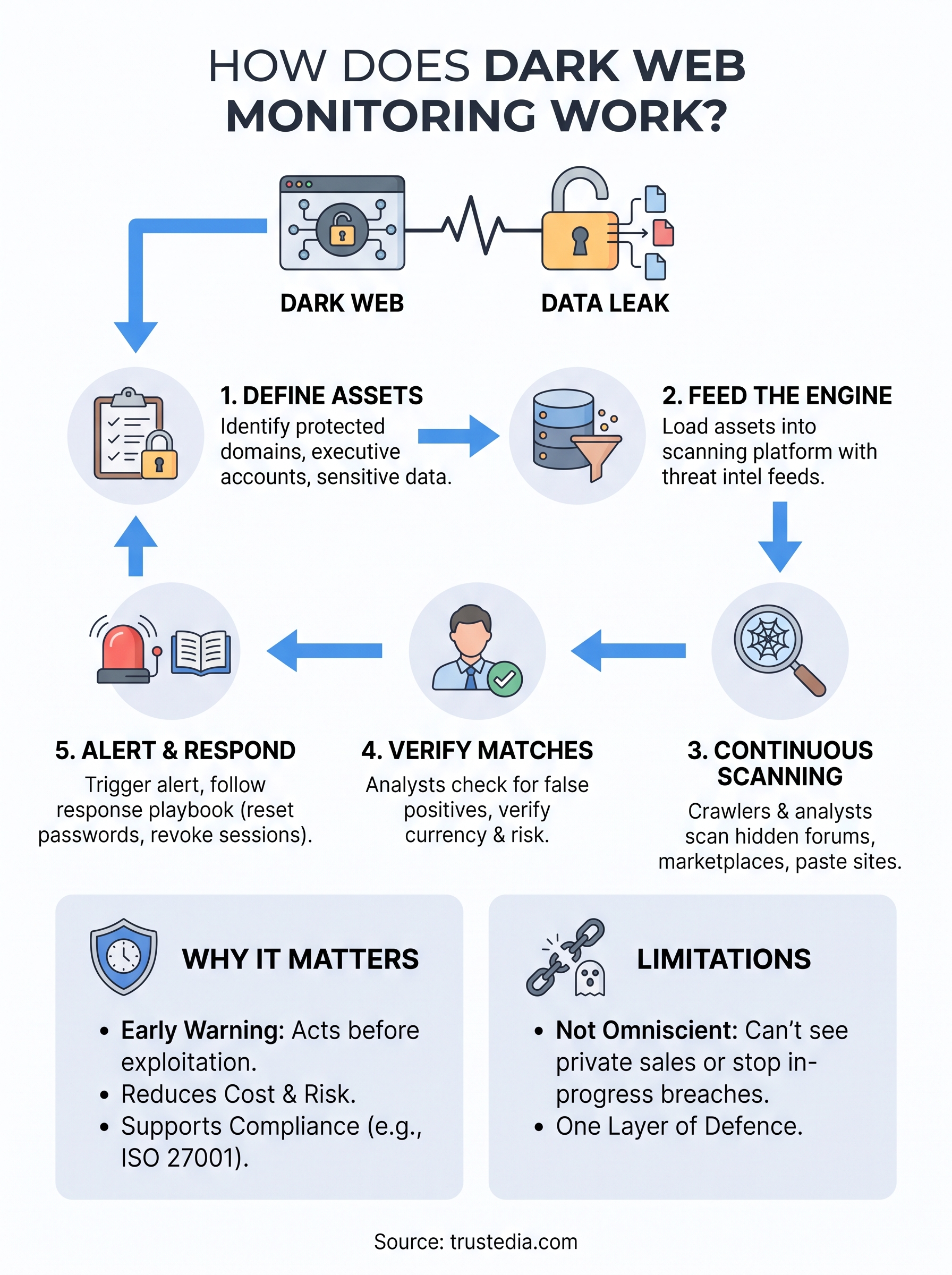
In short, dark web monitoring tools use automated crawlers and human analysts to scan hidden forums, marketplaces, and paste sites where stolen data gets traded. When your company’s email domain, credentials, or customer records show up in a data dump or breach listing, the system flags it and triggers an alert, often within hours of the data appearing.
This guide walks through that process step by step: how data ends up on the dark web in the first place, the scanning methods and data sources monitoring tools rely on, how matches get verified against false positives, and what happens once you receive an alert. By the end, you’ll understand exactly what’s happening behind the scenes when a service like ours reports a compromise, and why that speed matters for protecting your business.
Why dark web monitoring matters for your business
Breached credentials don’t just sit quietly once they’re stolen. They get bundled into combo lists, sold on marketplaces, and tested against banking portals, VPNs, and cloud services within days of a breach. Verizon’s Data Breach Investigations Report has consistently found that stolen or weak credentials are involved in a huge share of confirmed breaches, and once your data is circulating on the dark web, you’re a target whether you know it or not. That’s the gap dark web monitoring closes: it tells you your data is exposed before a criminal uses it against you, rather than after the damage is done.
The cost of not knowing
Most businesses find out about a breach the hard way, through a locked-out employee, a fraudulent invoice, or a ransomware note. IBM’s Cost of a Data Breach research has repeatedly shown that breaches identified late cost far more to contain than those caught early, both in direct remediation and lost business. Without monitoring, you’re relying on luck or a customer complaint to tell you something’s wrong. With it, you get a warning while there’s still time to reset passwords, isolate accounts, and notify affected parties before attackers move.
The real value of dark web monitoring isn’t the alert itself, it’s the time it buys you between exposure and exploitation.
Credential stuffing and the domino effect
One leaked password rarely stays contained to a single account. Credential stuffing attacks work by taking usernames and passwords stolen from one breach and automatically trying them against dozens of other services, banking apps, email providers, internal systems, on the assumption that people reuse passwords. If one employee’s credentials from an old, unrelated breach turn up on the dark web, and they’ve reused that password anywhere in your business, you’ve got an open door you don’t even know exists. Monitoring catches that exposure regardless of where the original breach happened, which is why it matters even if you’ve never suffered a breach yourself.
Compliance and third-party pressure
Regulators and insurers increasingly expect businesses to demonstrate proactive risk management, not just reactive incident handling. If you’re pursuing or maintaining ISO 27001 certification, being able to show continuous monitoring of external threats, including exposed credentials, strengthens your case during audits. Cyber insurers are also asking harder questions before renewing policies, and evidence of dark web monitoring can be the difference between a smooth renewal and a rejected claim after an incident.
Who’s actually at risk
It’s tempting to assume dark web monitoring is only for large enterprises with sprawling attack surfaces, but that’s backwards. Smaller businesses often have fewer defences and less capacity to absorb a breach, making early warning even more valuable:
- Businesses without a dedicated security team, who need automated alerts to compensate for limited in-house expertise
- Companies handling customer payment or health data, where a leak carries regulatory and reputational consequences
- Firms with remote or hybrid staff, who use personal devices and are more likely to reuse passwords across services
- Organisations working with insurers or supply chain partners, who increasingly demand evidence of proactive monitoring
If your business fits any of those descriptions, and most do, dark web monitoring isn’t a nice-to-have. It’s a basic layer of visibility you can’t get any other way.
How to implement dark web monitoring step by step
Setting up dark web monitoring isn’t a single switch you flip. It’s a sequence of decisions and technical steps that determine how much value you actually get from the service. Here’s how the process typically unfolds when a business brings in a monitoring provider like TrustedIA.
Step 1: Define what you’re protecting
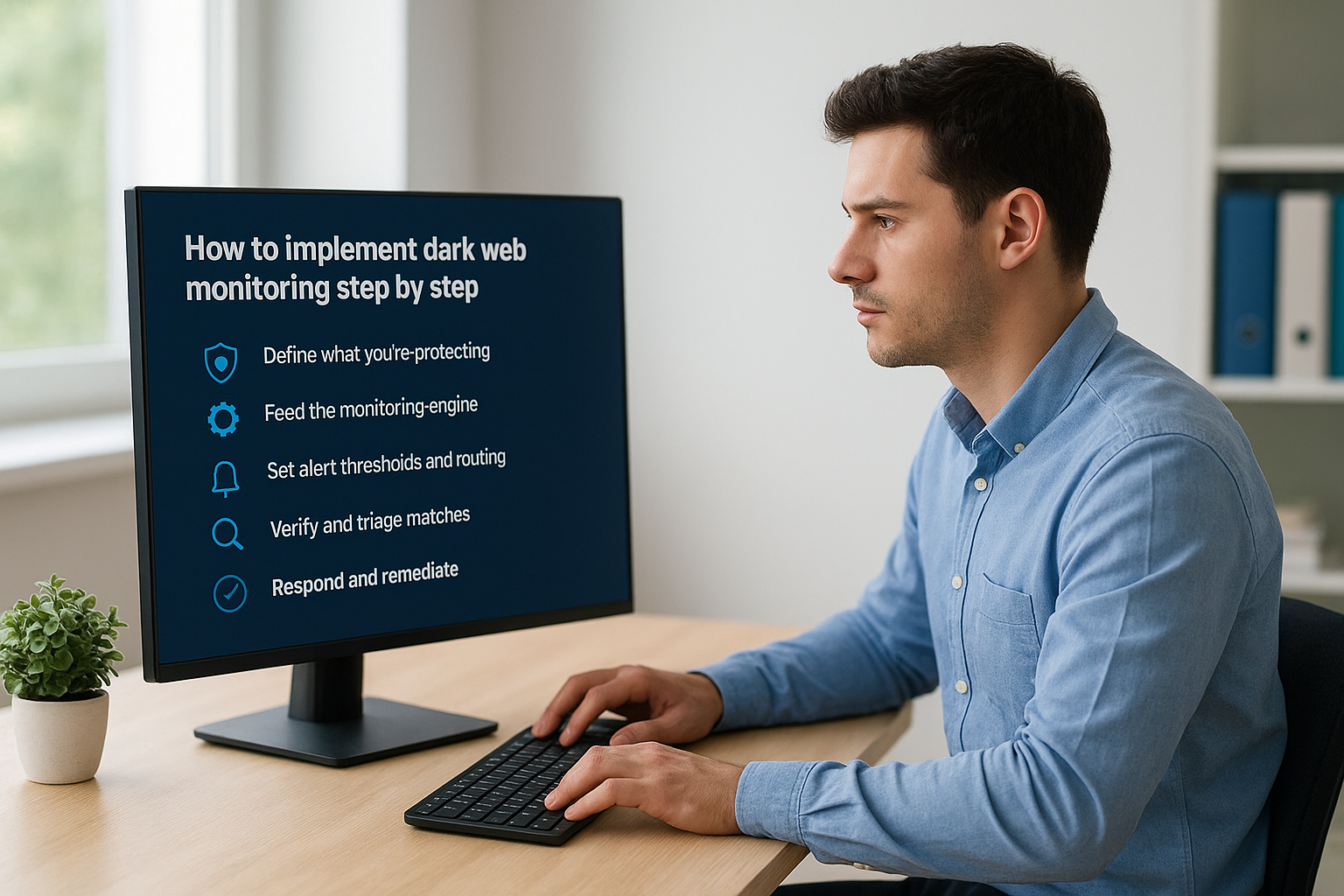
Before any scanning starts, you need a clear list of monitored assets: company email domains, executive names, key employee accounts, customer databases, VPN credentials, and any third-party systems that touch sensitive data. Skip this step and you’ll either miss exposures or drown in irrelevant noise.
Step 2: Feed the monitoring engine
The provider loads those assets into a scanning platform that continuously checks dark web sources against them. This includes crawlers that index forums and marketplaces, plus feeds from threat intelligence partners who already track known breach dumps and combo lists.
Step 3: Set alert thresholds and routing
You decide who gets notified, how fast, and for what severity of match. A leaked customer database warrants an immediate call to your incident response team; a single stale password from an old, low-risk breach might just go into a weekly summary.
Monitoring only works if the alerts reach the right person fast enough to act on them.
Step 4: Verify and triage matches
When the system flags a hit, an analyst checks it isn’t a false positive, confirms whether the data is current or years old, and assesses real-world risk before it lands in your inbox.
Step 5: Respond and remediate
Once confirmed, you follow a predefined response playbook: force password resets, revoke sessions, check for suspicious login activity, and notify affected staff or customers if required.
Step 6: Review and refine
Every few months, revisit your monitored asset list. New hires, new domains, and new third-party vendors all expand your exposure, and your monitoring scope needs to keep pace with that growth.
Done properly, this whole cycle runs quietly in the background, only surfacing when there’s something worth your attention.
What dark web monitoring can and cannot detect
Dark web monitoring is powerful, but it’s not omniscient. It’s worth being clear-eyed about what it actually covers, because vendors sometimes oversell the scope of what a scan can find. Understanding the boundaries helps you set realistic expectations and layer other defences where monitoring falls short.
What it reliably catches
Monitoring tools are good at spotting data that’s already been packaged and traded. That means breach dumps, combo lists, stolen session cookies, and credentials posted on known forums and marketplaces. If your company email domain appears in a leaked database that’s circulating, a decent monitoring service will pick it up, often within hours.
- Leaked usernames and passwords tied to your domain
- Stolen payment card details linked to your business
- Exposed API keys, tokens, and internal system credentials
- Mentions of your company name on hacking forums or ransomware leak sites
- Personal data belonging to staff or customers found in third-party breaches
Dark web monitoring tells you what’s already been stolen, not what’s about to be stolen.
Where the gaps are
Here’s the part vendors don’t always spell out: monitoring can’t see data that hasn’t been shared or sold yet. If an attacker has breached your systems but is sitting on the data quietly, or selling it privately without posting it anywhere a crawler can reach, you won’t get an alert. Private, invite-only channels on encrypted messaging apps are especially hard to penetrate, and some criminal groups deliberately avoid the forums that monitoring tools index.
It also can’t detect a breach in progress inside your own network, predict which specific account will be targeted next, or replace vulnerability scanning and endpoint protection. Think of it as one layer in a wider defence, not a standalone solution. The UK’s National Cyber Security Centre makes a similar point in its own guidance: monitoring for exposure works best alongside, not instead of, good access controls and patching discipline (https://www.ncsc.gov.uk/). Treat alerts as one signal among several, not the whole picture.
What to do when your data is found on the dark web
Getting an alert is only useful if you act on it fast. Panic isn’t a strategy, but delay is worse. The moment a monitoring service confirms your credentials or customer data are circulating, you’re in a race against whoever else has already seen that same listing.
The first 24 hours
Treat the first day as damage control. Speed matters more than perfection here, because attackers often test leaked credentials within hours of a dump surfacing.

- Force a password reset for every affected account, not just the one flagged
- Revoke active sessions and tokens tied to that account across all connected systems
- Enable multi-factor authentication if it wasn’t already in place
- Check login logs for unfamiliar IP addresses, locations, or access times
- Isolate the account temporarily if there’s any sign of unauthorised activity
The first 24 hours after a dark web alert decide whether you contain the exposure or become the next headline.
Beyond the immediate fix
Notifying the right people comes next. If customer data was exposed, you may have legal obligations under UK GDPR to inform the Information Commissioner’s Office and affected individuals within 72 hours, depending on the severity. If it’s internal, tell the employee directly and walk them through what was exposed and why reusing that password elsewhere is now a serious risk.
Investigating the source matters too. Was the leak tied to a breach at a third-party supplier, an old service you’d forgotten about, or your own systems? Answering that question shapes whether you need a wider incident response process or just a targeted fix.
Finally, document everything. Regulators, insurers, and auditors will all want a record of what happened, when you found out, and what you did about it. That paper trail is exactly what strengthens your position during an ISO 27001 audit or an insurance claim review.
Choosing the right dark web monitoring service
Not every monitoring provider works the same way, and the differences matter once you’re relying on them to catch a live exposure. Some tools scrape a handful of public paste sites and call it monitoring; others combine automated crawlers with human analysts and paid access to closed criminal forums. Before signing a contract, ask exactly which dark web sources the provider covers and how often those sources get refreshed, because a monitoring feed that updates weekly is far less useful than one that flags matches within hours.
What actually separates good providers from average ones
Pricing pages rarely tell you this, so you need to ask directly. Look for a provider that pairs automated scanning with human verification, so you’re not left chasing false positives, and one that lets you define monitored assets precisely rather than bundling your whole domain into one generic alert.
| Question to ask | Why it matters |
|---|---|
| Do you use human analysts or automation only? | Human review cuts down false positives significantly |
| How many dark web sources do you cover? | Wider coverage catches more of the criminal marketplace |
| What’s your average alert turnaround time? | Faster alerts mean less time for credentials to be exploited |
| Can you integrate with our incident response process? | Alerts are only useful if they trigger action |
| Do you support ISO 27001 audit evidence? | Compliance teams need documented, repeatable monitoring |
A monitoring service is only as good as the speed and accuracy of its alerts, not the size of its marketing claims.
Fitting it into a wider security strategy
Genuine value comes from monitoring that plugs directly into your existing defences rather than sitting as a standalone report nobody reads. TrustedIA builds dark web surveillance into a broader managed security service, so an alert about leaked credentials connects straight into incident response and endpoint protection, not a separate dashboard you have to check manually. That integration is what turns a warning into an actual defence.
Staying ahead of dark web threats
Dark web monitoring works because it turns an invisible problem into a visible one. Crawlers and analysts scan the forums and marketplaces where stolen data trades hands, match that data against your assets, and alert you before criminals act on it. That’s the whole mechanism, no magic involved, just consistent scanning paired with fast, verified alerts.
What separates businesses that recover quickly from those that don’t isn’t luck. It’s preparation: knowing your monitored assets, having a response playbook ready, and choosing a provider whose alerts actually reach the right person in time. Skip any of those steps and the monitoring itself becomes far less useful.
Your data will end up on the dark web eventually, whether through your own systems or someone else’s breach. The only real question is whether you find out first. If you want that kind of continuous visibility built into a wider security strategy rather than a standalone alert nobody checks, talk to TrustedIA about dark web surveillance.