Most UK SMEs run a vulnerability scan once, tick a compliance box, and move on. That’s how gaps stay open for months while attackers find them first. If you’re searching for vulnerability assessment best practices, you’ve probably already spotted that scanning tools alone don’t cut it, and you need a repeatable process that actually reduces risk rather than just producing a long PDF nobody reads.
This article gives you a practical answer: eight concrete steps that turn vulnerability assessment from a one-off exercise into an ongoing part of your security programme. You’ll see how to scope your assets properly, prioritise findings by real business impact rather than raw CVSS scores, and build remediation workflows your IT team can sustain without burning out.
We’ve built this guidance from what we see working with SMEs preparing for ISO 27001 and running managed vulnerability programmes day to day. Each step below is designed to be usable immediately, whether you’re setting up your first assessment or tightening a process that’s grown stale. By the end, you’ll have a clear framework for continuous vulnerability management that stands up to audits and, more importantly, to real attackers.
1. Build and maintain a complete asset inventory
You can’t assess what you don’t know exists. An asset inventory is the foundation of every vulnerability assessment programme, listing every device, application, cloud service, and endpoint connected to your network, including the shadow IT nobody signed off on. Skip this step and your scans will only ever cover a fraction of your real exposure.
You can’t protect an asset you don’t know you have.
What it involves
Building a complete inventory means cataloguing servers, laptops, mobile devices, IoT kit, SaaS subscriptions, and third-party integrations, then tagging each one with an owner, location, and business criticality. This isn’t a one-off spreadsheet exercise. Assets change weekly in most SMEs as staff join, leave, or start using a new cloud tool without telling IT. A proper inventory also captures software versions and dependencies, since that’s the detail vulnerability scanners actually match against known CVEs.
Why it matters for UK SMEs
Many smaller businesses run lean IT teams that simply don’t have visibility into everything connected to the network, especially with remote and hybrid working now standard. Personal devices, forgotten test servers, and unmanaged Wi-Fi routers all create blind spots. The National Cyber Security Centre’s guidance on asset management makes clear that organisations of any size struggle here, and attackers routinely exploit exactly these forgotten systems because they’re unpatched and unmonitored. If your ISO 27001 ambitions include Annex A control 5.9 on inventory of information and other associated assets, this step isn’t optional, it’s a certification requirement.
How to put it into practice
Start small and build discipline rather than chasing a perfect list on day one.
- Use an automated discovery tool to scan your network and cloud environments, rather than relying on manual spreadsheets that go stale within weeks.
- Assign an owner to every asset category, so accountability doesn’t disappear when someone leaves the business.
- Classify assets by criticality (customer data, financial systems, public-facing services) to inform later prioritisation.
- Review and reconcile the inventory monthly, or trigger updates automatically through your onboarding and offboarding processes.
- Include third-party and supply chain assets that touch your data, not just internally owned hardware.
Get this right and every later step, from scanning to prioritisation, becomes faster and more accurate because you’re working from a true picture of your environment rather than guesswork.
2. Map your attack surface and identify threats
Once you know what you own, the next step in solid vulnerability assessment best practices is understanding how each asset can actually be reached and attacked. Your attack surface is every point where an outsider, or a malicious insider, could gain entry: exposed ports, public web apps, VPN gateways, email systems, and third-party integrations all count. Mapping this properly turns your asset list into a threat-aware picture rather than a static inventory.

What it involves
Attack surface mapping means tracing every route into your systems, both external and internal, and matching it against realistic threat scenarios. You’re looking at network segmentation, exposed services, authentication points, and data flows between systems. Threat modelling frameworks, such as those referenced in NCSC guidance on network defence, help structure this so you’re not just listing technology but asking who would target it and how.
Why it matters for UK SMEs
SMEs often underestimate how exposed they are because they assume attackers only target large enterprises. That’s wrong. Automated attack tools scan the entire internet indiscriminately, and a poorly configured remote desktop or forgotten test environment gets found within hours of going live.
If you don’t know how attackers can get in, you’re guessing at what to protect.
How to put it into practice
Build your map methodically:
- Identify every external-facing IP address, domain, and cloud service
- Document data flows between internal systems and third parties
- Flag internet-facing admin interfaces and remote access points
- Cross-reference findings against known attacker tactics, such as MITRE ATT&CK patterns
- Update the map whenever infrastructure changes, not just annually
3. Run regular, automated vulnerability scans
Scanning is the engine room of any vulnerability assessment programme, and it needs to run on a schedule, not whenever someone remembers. Automated tools check your assets against constantly updated databases of known weaknesses, flagging misconfigurations, missing patches, and outdated software before an attacker does. Treating this as a quarterly chore rather than a continuous process is where most SMEs fall behind.
What it involves
Running automated scans means deploying tools that probe your network, endpoints, and cloud services against CVE databases and configuration benchmarks, then generating reports you can actually act on. Good scanning covers internal and external surfaces separately, since an exposed database looks very different from an internet-facing web app. Scans should run on a fixed cadence, with ad hoc scans triggered after major changes like new deployments or acquisitions.
Why it matters for UK SMEs
Attackers exploit newly disclosed vulnerabilities within days, sometimes hours, of publication. A scan run six months ago tells you nothing about the critical flaw disclosed last week. NCSC’s vulnerability management guidance stresses that timely scanning is one of the cheapest, highest-value controls an organisation can run, yet many SMEs still rely on manual annual reviews that leave enormous windows of exposure.
A scan that ran six months ago can’t tell you about the vulnerability disclosed last night.
How to put it into practice
- Schedule internal and external scans at least monthly, weekly for critical assets
- Automate scan triggers after code deployments or infrastructure changes
- Feed results into a central dashboard your IT team actually checks
- Validate scanner coverage against your asset inventory regularly
- Rotate or supplement tools periodically to catch blind spots any single scanner might miss
4. Prioritise vulnerabilities using a risk-based approach
A scan report listing 400 vulnerabilities is useless if you fix them in the order they appear. Risk-based prioritisation means ranking findings by what actually matters to your business, not just by a raw severity score. Get this step wrong and your team burns weeks patching low-impact issues while a genuinely dangerous flaw sits open on your customer database.
What it involves
Prioritisation combines the technical severity score (usually CVSS) with business context: is the affected asset internet-facing, does it hold sensitive data, is there a known exploit circulating? A medium-severity flaw on a public payment gateway deserves attention before a critical-rated bug on an isolated test server nobody uses. This step turns a flat list into a ranked action plan your team can actually work through.
Why it matters for UK SMEs
Smaller teams rarely have the headcount to fix everything at once, so ranking by real risk is what keeps limited resources pointed at the exposures attackers are most likely to exploit. NCSC’s guidance on vulnerability management explicitly recommends weighing exploitability and business impact alongside severity scores, rather than treating CVSS as the final word.
A critical score on an isolated test box matters less than a medium score on your customer-facing site.
How to put it into practice
- Combine CVSS scores with asset criticality from your inventory (step one)
- Check whether a public exploit already exists for each finding
- Factor in exposure: internet-facing systems jump the queue over internal ones
- Set target remediation windows by risk tier, not a single blanket deadline
- Revisit rankings whenever new intelligence or exploit activity changes the picture
Done consistently, this step stops your team firefighting low-value patches while genuine risk sits unaddressed.
5. Validate findings with manual and penetration testing
Automated scanners flag potential weaknesses, but they can’t tell you whether a flaw is actually exploitable in your specific environment. Manual validation and penetration testing close that gap, confirming which findings pose real risk and which are false positives that would otherwise waste your team’s remediation time. Skipping this step means you’re acting on assumptions rather than evidence.

What it involves
Validation means a skilled tester manually attempts to exploit flagged vulnerabilities, chaining together weaknesses the way a real attacker would rather than testing them in isolation. Penetration testing goes further, simulating an actual attack against your network, applications, or people, often uncovering issues automated tools miss entirely, like business logic flaws or weak access controls between systems.
Why it matters for UK SMEs
Scanners routinely produce false positives, and SME teams without dedicated security staff often can’t distinguish a genuine threat from noise. Worse, scanners miss chained exploits where two low-severity issues combine into a serious breach. The NCSC’s guidance on penetration testing notes that testing should reflect realistic attacker behaviour, not just a checklist exercise, because that’s what actually reveals exploitable risk.
A vulnerability that looks critical on paper might be unreachable in practice, and vice versa.
How to put it into practice
- Commission penetration tests at least annually, and after major infrastructure or application changes
- Use manual validation to confirm high-priority scanner findings before committing remediation resources
- Test both external attack paths and internal lateral movement scenarios
- Include social engineering and phishing simulations alongside technical testing
- Ensure testers document exploitation steps clearly, so your team understands the real-world impact, not just a CVSS number
This step turns your prioritised list from step four into a verified set of genuine risks worth fixing first.
6. Patch and remediate within clear timescales
A verified list of risks is worthless if nobody fixes them on a schedule. Patching and remediation is where vulnerability assessment either proves its value or collapses into another report gathering dust. Set firm timescales tied to the risk tiers you built in step four, and hold your team to them the same way you’d hold them to any other operational deadline.
What it involves
Remediation covers patching software, reconfiguring insecure settings, replacing unsupported systems, and applying compensating controls where a direct fix isn’t immediately possible. Each fix needs an assigned owner, a deadline, and a way to confirm the patch actually worked once deployed. Testing patches in a staging environment before wider rollout matters too, since a badly applied update can break production systems and create a fresh incident of its own.
Why it matters for UK SMEs
SMEs often patch reactively, only after an alert or an audit finding forces the issue. That delay is exactly what attackers exploit, particularly with critical flaws that get weaponised within days of disclosure. NCSC guidance on vulnerability management recommends fixing critical, internet-facing issues within days rather than weeks, a target many smaller IT teams miss simply because nobody owns the deadline.
A patch that sits in the backlog for three months offers no more protection than no patch at all.
How to put it into practice
- Set remediation SLAs by risk tier, for example 72 hours for critical internet-facing flaws, 30 days for medium-risk internal issues
- Assign a named owner to every fix, not just a team
- Test patches in staging before production rollout where systems allow it
- Re-scan after remediation to confirm the fix actually closed the gap
- Escalate overdue items automatically rather than letting them quietly slip
7. Document and track remediation for accountability
A fix that isn’t recorded anywhere might as well not have happened, at least from an audit or insurance perspective. Documentation and tracking turns individual remediation actions into a defensible history you can point to when a client, insurer, or auditor asks how you handle vulnerabilities. Without this record, you’re relying on memory and Slack messages, which fall apart the moment someone leaves the team.
What it involves
Tracking means logging every vulnerability found, who owns the fix, the target deadline, the actual resolution date, and the evidence that confirms the gap closed, usually a re-scan result or a change ticket. This lives in a ticketing system or a dedicated vulnerability management platform, not a spreadsheet someone forgets to update. Good documentation also captures why a fix was delayed or accepted as a residual risk, since regulators and auditors care as much about your decision-making as the outcome.
Why it matters for UK SMEs
ISO 27001 auditors expect to see evidence, not assurances, that vulnerabilities were identified, assessed, and closed within stated timescales. Insurers asking about your cyber posture after an incident will want the same trail. Without it, you can’t demonstrate due diligence, and that gap can affect claims, certification renewals, and client trust equally.
If you can’t show when a vulnerability was fixed, an auditor will assume it wasn’t.
How to put it into practice
- Log every finding in a central system with owner, deadline, and status fields
- Record evidence of remediation, such as re-scan results or change records
- Capture risk acceptance decisions formally, with sign-off from someone senior
- Generate monthly reports showing open, overdue, and closed items by risk tier
- Retain records for at least the duration your compliance framework requires, typically several years under ISO 27001
8. Review and continuously improve the process
A vulnerability assessment programme that never changes eventually stops working, even if nothing about your setup looks obviously broken. Continuous improvement means stepping back periodically to ask whether your scanning, prioritisation, and remediation steps still match the risks you actually face, rather than assuming last year’s process is still fit for purpose.
What it involves
Reviewing the process means looking at metrics over time: average time to remediate by risk tier, recurring vulnerability types, scanner coverage gaps, and how often re-scans confirm fixes actually held. You’re checking whether the process itself is improving, not just whether individual vulnerabilities got closed. This usually means a quarterly or biannual retrospective involving whoever owns security, IT operations, and compliance.
Why it matters for UK SMEs
Threats evolve, your infrastructure grows, and a process built for ten servers doesn’t automatically scale to fifty plus a cloud migration. SMEs that treat vulnerability assessment as a permanent, unchanging checklist often find their remediation SLAs slipping quietly as workload increases, with nobody noticing until an audit or incident exposes the gap. ISO 27001’s continual improvement requirement under Clause 10 exists precisely because static processes decay.
A process that worked last year isn’t automatically the right process for today.
How to put it into practice
- Review remediation metrics quarterly against your SLA targets
- Identify recurring vulnerability types and address root causes, not just symptoms
- Reassess scanning tools and coverage annually against your current asset inventory
- Incorporate lessons from any incidents or penetration test findings into updated procedures
- Benchmark your process against NCSC and ISO 27001 guidance periodically to catch drift early
Making vulnerability assessment part of daily practice
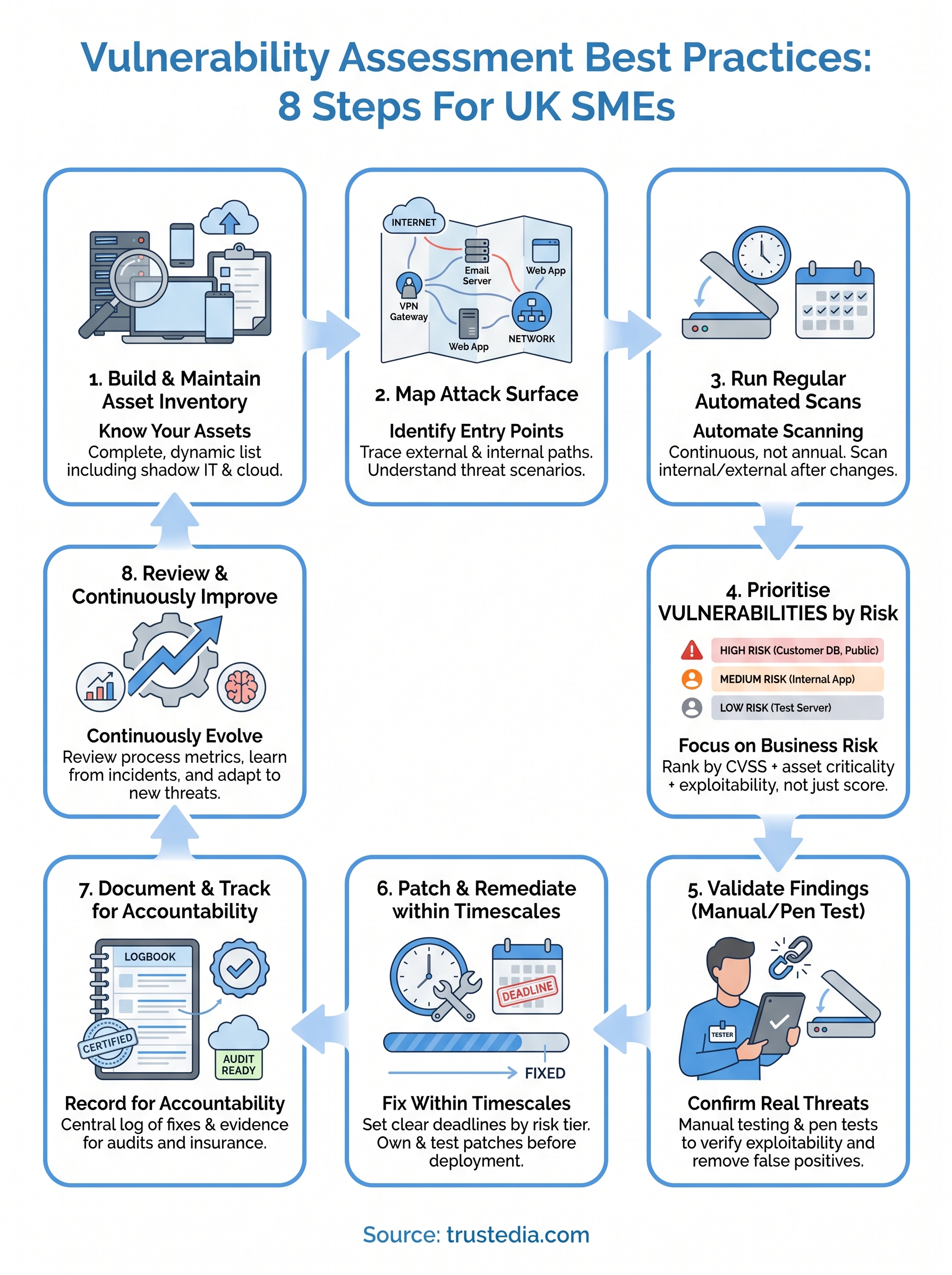
Eight steps, one habit: treat vulnerability assessment as ongoing practice, not an annual event you scramble to finish before an audit. Asset inventory, attack surface mapping, scanning, prioritisation, validation, remediation, documentation, and review all reinforce each other. Skip one and the whole chain weakens, leaving gaps attackers find faster than your next scheduled scan.
Getting this right takes more than good intentions. It needs the right tooling, consistent scanning cadence, and a team with time to validate and remediate findings properly, something many SME IT departments simply don’t have spare capacity for alongside day-to-day support work.
That’s exactly where a managed partner earns its keep. TrustedIA runs vulnerability assessments, penetration testing, and remediation tracking as part of a broader managed security service, built around the ISO 27001 requirements SMEs are working towards anyway. If you’d rather have specialists handle the scanning, prioritisation, and reporting while your team focuses on fixing what matters, get in touch with TrustedIA to talk through your current process.