
Most people use only a thin slice of the internet. Beneath the surface sits a hidden layer that search engines like Google never index, and understanding what is the dark web explained in plain terms matters more now than ever. It’s a part of the internet that fuels genuine privacy needs and serious criminal activity in equal measure, yet misconceptions about it are everywhere.
The dark web is where stolen company credentials, customer databases, and leaked passwords regularly end up for sale. At TrustedIA, our Dark Web Surveillance service exists specifically because of this threat, we monitor these hidden marketplaces so businesses can act before stolen data is weaponised against them. We’ve seen first-hand how exposed organisations can be without even knowing it.
This article breaks down exactly how the dark web works, what distinguishes it from the deep web, what people actually use it for, and the real safety and legal risks involved. Whether you’re an IT manager, a business owner, or simply curious, you’ll walk away with a clear, grounded understanding of what the dark web is and why it should be on your radar.
Why the dark web matters for everyday users and SMBs
The dark web is not just a problem for governments or large corporations. Everyday internet users and small to medium-sized businesses (SMBs) sit squarely in the crosshairs of the criminal activity that takes place there. If you use email, shop online, or store customer data, then understanding what is the dark web explained in practical terms is directly relevant to your security posture.
Your personal data is already on sale
Every time a company suffers a data breach, the stolen records often end up on dark web marketplaces within hours. Email addresses, passwords, bank card details, and National Insurance numbers are bought and sold there routinely, and the sellers rarely know, or care, who the original victims are. You do not need to visit the dark web to be affected by it. Your information can appear there without any action on your part.
The UK’s National Cyber Security Centre (NCSC) consistently reports that credential theft is one of the most common precursors to serious cyber incidents against businesses of all sizes.
Once criminals acquire your credentials, they use them in credential stuffing attacks, where automated tools test stolen username and password combinations across hundreds of services simultaneously. If you reuse passwords across accounts, one breached database can unlock many others. This is why dark web exposure is a live, ongoing threat rather than an abstract one that only affects someone else.
Why SMBs are particularly exposed
Many small business owners assume they are not interesting enough to target. Attackers think differently. SMBs typically hold valuable customer and payment data but invest far less in security than large enterprises, which makes them easier targets with meaningful rewards. A single leaked employee credential can give an attacker a foothold into your entire network.
Business email compromise, ransomware delivery, and fraudulent supplier invoices all frequently trace back to credentials or internal information already circulating on the dark web. By the time a business notices something is wrong, the attacker may have been inside the network for weeks. The operational disruption and reputational damage that follows can be severe, particularly for businesses without a tested incident response plan in place.
The gap between knowing and acting
Most organisations are aware that the dark web exists. Far fewer actively monitor whether their data is being traded there. This gap between awareness and action is exactly where criminals profit. Dark web surveillance services close that gap by scanning hidden marketplaces and forums for leaked credentials, company email domains, and sensitive business information before attackers get the chance to use it.
Without monitoring in place, you are essentially waiting to discover a breach through your customers, the press, or a regulator, none of which is an ideal way to find out. Proactive surveillance gives you time to reset credentials, notify affected parties, and contain damage before it escalates into something larger. For SMBs in particular, that early warning can be the difference between a manageable incident and a business-ending one.
Open web vs deep web vs dark web
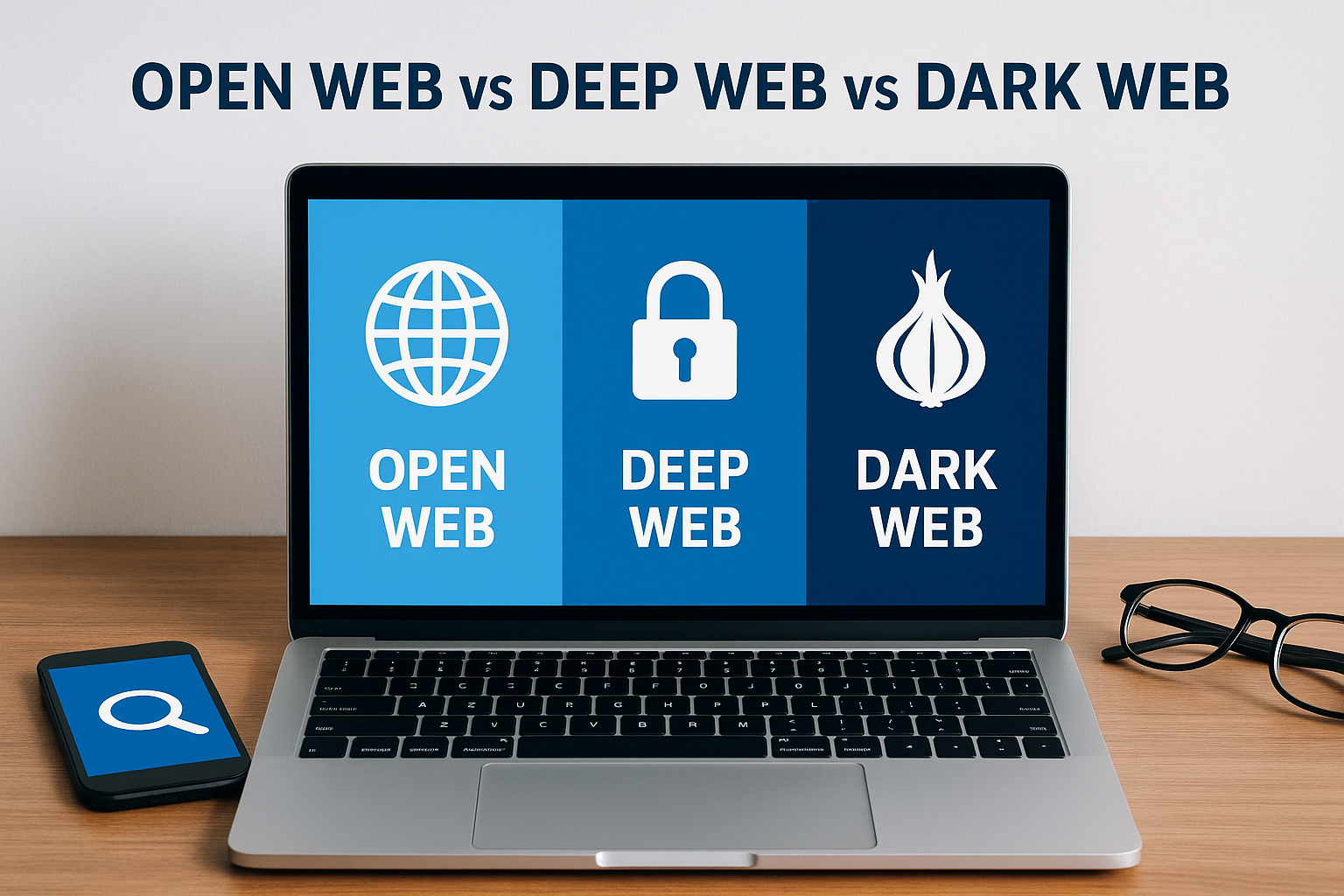
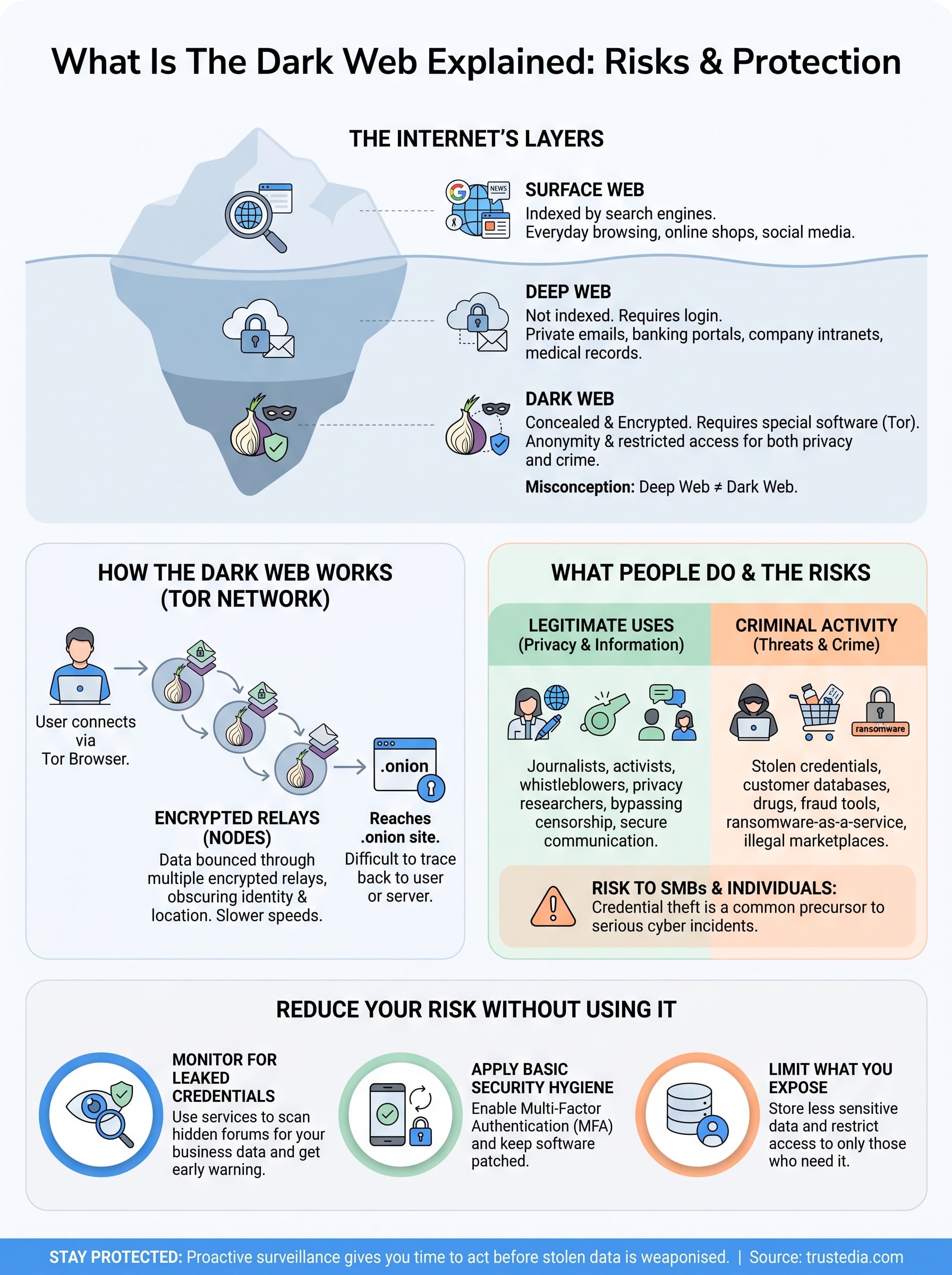
People often use "deep web" and "dark web" as though they mean the same thing. They do not. Understanding the difference between these three layers of the internet is the foundation for grasping what is the dark web explained correctly, and it clears up a lot of unnecessary confusion about what is genuinely dangerous and what simply is not.
The open web
The open web is the part of the internet you interact with every day. Search engines like Google index its pages, which means anyone with a browser and an internet connection can find and access them without needing a login or special software. News websites, online shops, social media platforms, and company websites all sit here. Despite feeling vast, the open web represents only a small fraction of all content that actually exists online.
The deep web
The deep web covers everything online that search engines cannot index. This includes your online banking portal, private email inboxes, company intranets, medical records, subscription platforms, and any page sitting behind a login. None of this content is hidden for malicious reasons. It simply requires authentication or a direct URL to reach, which keeps it out of public search results by design.
The deep web is enormous and accounts for the bulk of internet traffic every day. Most of what you store in cloud services, or access through a password, sits here. It is not dangerous by default, it exists specifically to keep your private information private.
Conflating the deep web with the dark web leads many people to overestimate the danger of routine online activity and underestimate the very specific risks the dark web actually presents.
The dark web
The dark web is a small, deliberately concealed portion of the deep web that a standard browser cannot reach. Accessing it requires specific software, most commonly the Tor browser, which routes your connection through multiple encrypted relays to obscure your identity and location. Unlike the open or deep web, the dark web is built from the ground up to resist tracing.
Websites on the dark web use ".onion" domains rather than standard addresses like ".co.uk" or ".com", and they do not appear in any public directory. This combination of anonymity and restricted access is what attracts both privacy-conscious individuals and those engaged in serious criminal activity. The same infrastructure that protects a journalist’s source also shelters marketplaces selling stolen business credentials.
How the dark web works
To grasp what is the dark web explained at a technical level, you need to understand one core concept: the Tor network. Tor stands for The Onion Router, and it is the primary infrastructure that makes the dark web function. Standard internet traffic travels a relatively direct path between your device and a website’s server, which makes it straightforward to trace. Tor breaks that pattern entirely.
Onion routing and how your traffic moves
When you connect through the Tor browser, your traffic is encrypted in multiple layers and bounced through a chain of volunteer-operated servers called relays or nodes. Each relay strips away one layer of encryption and passes the data to the next node, but no single relay ever knows both where the traffic originated and where it is going. This layered encryption is precisely why the network takes its name from an onion.

This multi-hop routing is what makes it extremely difficult for anyone monitoring the network to link a user’s identity to their online activity on the dark web.
The process does introduce a noticeable trade-off: connection speeds are significantly slower than on the standard internet, because your data travels a longer and more complex route before reaching its destination. That is a cost most dark web users accept in exchange for anonymity.
What .onion addresses are and why they exist
Dark web sites use .onion domains rather than the familiar extensions you encounter on the open web. These addresses are not registered through standard domain registrars, and they do not resolve through regular DNS servers. Instead, they are generated automatically from cryptographic keys, which means they function as both an address and a form of authentication.
You cannot stumble across a .onion site through a Google search, and you cannot reach one using Chrome or Safari. Access requires the Tor browser, which knows how to route requests correctly through the Tor network. This combination of non-standard addressing and specialised software creates a layer of access control that keeps dark web content hidden from the general public by default.
Dark web servers can also conceal their own physical location using a similar relay mechanism, which is why law enforcement agencies invest significant resources into identifying the servers behind major criminal operations. The technical barriers are real, and they are intentional.
What people do on the dark web
Understanding what is the dark web explained in full requires looking honestly at both sides of how people actually use it. The dark web is not a single type of place with a single type of user. It hosts an uncomfortable mix of entirely legitimate activity and serious organised crime, often running through the same technical infrastructure simultaneously.
Legitimate and privacy-driven uses
Journalists, activists, and whistleblowers use the dark web to communicate and share information in environments where their identities could otherwise put them in danger. In countries with authoritarian governments, accessing uncensored news or contacting foreign media without detection can be a genuine matter of personal safety. Organisations like the BBC and The New York Times operate .onion versions of their sites specifically so people in restricted regions can read their reporting.
Privacy researchers, cybersecurity professionals, and law enforcement agencies also access the dark web to study criminal infrastructure, gather threat intelligence, and build defences against emerging attacks.
Beyond journalism, some individuals simply value anonymity for personal reasons that have nothing to do with illegal activity, whether that is avoiding commercial tracking, communicating without surveillance, or accessing forums that discuss sensitive personal topics without fear of public identification.
Criminal activity and what it means for your business
The criminal ecosystem on the dark web is organised, commercially structured, and persistent. Stolen credentials from business data breaches are listed for sale alongside personal banking details, forged identity documents, and access to compromised corporate systems. Ransomware-as-a-service platforms allow attackers with limited technical skills to launch sophisticated attacks against businesses in exchange for a share of the ransom payment.
Drug marketplaces, fraud toolkits, and contract services for various criminal purposes also operate there, often with customer reviews and dispute resolution systems that mirror legitimate e-commerce platforms. The professionalisation of dark web criminal markets is precisely what makes the threat so persistent and scalable for attackers targeting businesses of every size.
Your company does not need to have any connection to the dark web for it to affect you. A single phishing attack against one employee, or a breach at a third-party supplier, can land your business credentials in one of these marketplaces within days. That is why knowing what takes place there is genuinely useful, not just morbid curiosity.
Is the dark web illegal in the UK
Accessing the dark web is not illegal in the UK. Downloading the Tor browser and visiting .onion sites does not break any law by itself. The legality depends entirely on what you do once you are there, not simply the act of connecting to it. This distinction matters, because conflating the two leads many people to misunderstand the actual legal framework they operate under.
What accessing the dark web actually means legally
The UK does not prohibit citizens from using anonymising software or browsing .onion domains. Tor is legal to download and use, and many entirely legitimate professionals, including security researchers and journalists, use it routinely for lawful purposes. The Computer Misuse Act 1990 and related legislation focus on actions and intent, not the technical means used to reach a network.
Simply being on the dark web does not constitute a criminal offence under UK law, but what you access, purchase, or facilitate there absolutely can.
Where the law draws the line
Purchasing illegal goods, such as drugs, counterfeit currency, or stolen financial data, is a criminal offence regardless of whether the transaction takes place on the dark web or anywhere else. UK law does not create a loophole because a marketplace uses Tor encryption. If you buy a stolen credential database, you are committing a criminal act under the Fraud Act 2006 and potentially the Computer Misuse Act, and law enforcement agencies including the National Crime Agency actively pursue these cases.
Accessing certain categories of content, particularly child sexual abuse material, carries severe criminal penalties and is treated as an absolute offence with no ambiguity whatsoever. Attempting to hire criminal services, participating in money laundering through cryptocurrency mixing, and facilitating ransomware attacks all carry serious legal exposure under existing UK statutes.
What this means if you run a business
If your employee accesses the dark web on a company device for personal reasons, you may face complications around acceptable use policies, regulatory obligations, and potential liability if that activity leaves a security footprint. Organisations operating under GDPR also carry obligations around how they respond to data that surfaces on the dark web, particularly if it relates to customer personal data that originated from a breach of your systems.
Understanding what is the dark web explained in legal terms helps you set appropriate policies, train staff on acceptable use, and respond correctly when dark web exposure affects your organisation. Knowing the legal boundaries also means you can engage dark web monitoring services with confidence, since passive surveillance of publicly accessible dark web forums for your own leaked data is a legitimate and sensible security measure.
How to reduce your risk without using it
You do not need to visit the dark web to protect yourself from the threats that originate there. Most of the meaningful risk reduction you can do happens through straightforward security practices that directly limit the value of any data that leaks from breaches and ends up in criminal marketplaces. Understanding what is the dark web explained in practical terms makes it clear that your exposure is largely determined by how you manage your credentials, devices, and third-party access rather than anything you do or do not do on the dark web itself.
Monitor for leaked credentials
Dark web monitoring services scan hidden forums and marketplaces for email addresses, passwords, and business data associated with your organisation. When a match surfaces, you receive an alert early enough to act before attackers can use what they have found. Several reputable services offer this as a managed function, which means you benefit from continuous surveillance without any direct dark web access on your part.
Receiving early warning of a credential leak allows you to reset affected passwords, notify relevant parties, and contain potential damage before it escalates into a serious incident.
Change passwords immediately for any accounts flagged in a breach notification, and ensure those new passwords are entirely unique across every service your business uses. Reusing passwords across multiple accounts is one of the clearest ways to turn a single leaked record into a much larger compromise.
Apply basic security hygiene consistently
Multi-factor authentication (MFA) is one of the most effective controls available against credential-based attacks. Even if a stolen password appears on a dark web marketplace, MFA stops an attacker from using it to access your systems without a second form of verification. Enable it across email, remote access tools, cloud platforms, and any system that holds sensitive data.
Keeping software and operating systems patched removes vulnerabilities that attackers actively scan for after purchasing access to target lists circulating on dark web forums. Combine this with regular phishing simulation training for your staff, since most initial breaches start with a convincing email rather than a sophisticated technical exploit.
Limit what you expose in the first place
The less sensitive data you store unnecessarily, the less value a breach of your systems holds for criminals. Audit what personal and business data you actually retain, where it sits, and who inside your organisation can access it. Restricting data access to only those who genuinely need it shrinks your attack surface and reduces the potential reward for anyone who does manage to breach your defences.
Next steps to stay protected
Now that you understand what is the dark web explained in full, the priority is turning that understanding into concrete action. The dark web is not going away, and the criminal marketplaces operating there will continue to trade in stolen business data, leaked credentials, and compromised access for the foreseeable future. What changes is how prepared your organisation is when that exposure affects you.
Start by auditing your current password policies, enabling multi-factor authentication across your key systems, and finding out whether any of your business data already appears in known breach databases. These three steps alone significantly reduce your risk before you invest in anything else.
For ongoing protection, professional dark web surveillance removes the guesswork entirely. TrustedIA monitors hidden marketplaces continuously so you receive early warnings rather than discovering a breach through your customers or the press. Find out how our Dark Web Surveillance service protects your business before attackers get the chance to use what they find.



