

A single ransomware attack can shut down operations for days or even weeks. For UK SMEs, that kind of downtime doesn’t just hurt, it can be fatal. According to the Federation of Small Businesses, around 5.5 million small businesses operate across the UK, and many of them have no formal plan for what happens when things go wrong. That raises a critical question: why is business continuity planning important, and what happens to businesses that ignore it?
The answer is straightforward. Without a continuity plan, a cyber incident, supply chain failure, or even a power outage can spiral into lost revenue, damaged client relationships, and regulatory trouble. UK SMEs face particular pressure here because they often run with lean teams and tight margins, meaning there’s very little room to absorb unexpected disruption without a structured response in place.
At TrustedIA, we work with businesses across the UK to build resilience against exactly these scenarios. Our managed security services, from disaster recovery and incident response to vulnerability assessments and ISO 27001 compliance, are designed to keep organisations running when disruption strikes. We’ve spent over 30 years helping businesses prepare for the threats that matter most.
This article breaks down why business continuity planning is essential for UK SMEs, what the real risks of operating without one look like, and how to start building a plan that actually holds up under pressure.
What business continuity planning means in practice
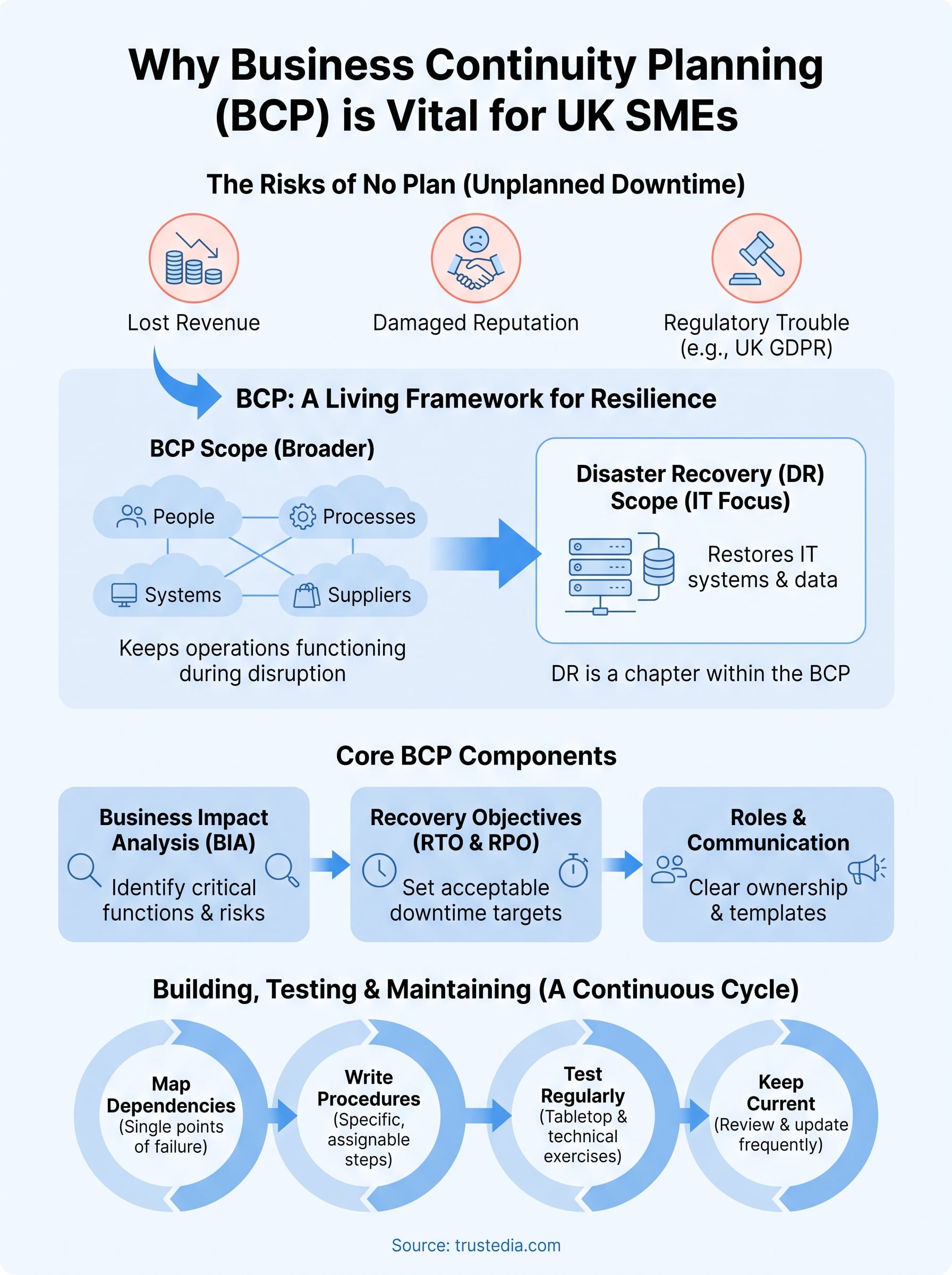
Business continuity planning (BCP) is the process of identifying potential threats to your organisation and building structured procedures to keep operations running when those threats hit. It isn’t a single document you file away and revisit once a year. It’s a living framework that covers your people, processes, systems, and suppliers, designed so your business can keep functioning even when something goes seriously wrong. The goal isn’t just survival. It’s maintaining an acceptable level of service while you deal with the disruption and work toward full recovery.
The difference between a BCP and a disaster recovery plan
People often use business continuity planning and disaster recovery interchangeably, but they describe different things with different scopes. A disaster recovery (DR) plan focuses on restoring IT systems and data after an incident. Your BCP is much broader. It covers everything your business needs to continue operating, from who handles client communications during a crisis to how your team functions if your main office becomes inaccessible or a key supplier fails.

Understanding why is business continuity planning important starts with recognising that most disruptions don’t destroy a business outright; they expose the gaps in how it operates under pressure.
Think of disaster recovery as one chapter inside a larger BCP. When a ransomware attack hits, your DR plan kicks in to restore systems and recover data. But your BCP determines how your business communicates with clients, fulfils services, and maintains cash flow while that recovery is happening. Without the broader plan, even a successful technical recovery can still result in serious commercial damage.
What a BCP actually documents
A properly built BCP doesn’t just describe what might go wrong. It specifies exactly who does what, when, and how across a range of disruption scenarios. This typically includes:
- Critical business functions and the minimum resources needed to sustain them
- Recovery time objectives (RTOs) for each function, meaning how long the business can tolerate them being offline
- Contact lists and escalation paths for key staff, clients, and suppliers
- Alternative working arrangements, such as remote working protocols or backup premises
- Communication templates for notifying customers, regulators, or the press
Each of these elements forces you to examine what your business genuinely depends on, which is often far more revealing than most business owners expect when they first go through the process.
The scope goes beyond IT
Many SMEs make the mistake of treating BCP as an IT problem, but that misses the full picture. Your supply chain, your staff availability, your physical premises, and your communications infrastructure all represent potential points of failure. If a key supplier goes under, a flood renders your office unusable, or a senior member of staff is suddenly unavailable for an extended period, your plan needs to address those scenarios with the same level of detail as a cyberattack.
Regulatory expectations add further weight here. The UK’s National Cyber Security Centre guidance and frameworks like ISO 27001 both expect organisations to demonstrate that business continuity has been considered as part of their broader security posture. For SMEs working with enterprise clients or pursuing certification, having a documented, tested BCP is increasingly a contractual requirement rather than something optional.
Why business continuity planning matters for UK SMEs
UK SMEs face a different set of pressures compared to large enterprises. You typically operate with smaller teams, tighter budgets, and less redundancy built into your processes, which means a single disruption can cascade quickly into a serious operational crisis. Understanding why is business continuity planning important isn’t an abstract exercise for SMEs; it directly affects whether your business survives an incident or folds under it.
The financial cost of unplanned downtime
Downtime costs money in very direct ways. Lost revenue, idle staff costs, emergency IT support, and client compensation can stack up within hours of a serious incident. IBM’s Cost of a Data Breach Report consistently shows that smaller organisations take longer to contain breaches and suffer proportionally higher costs relative to their size.
For an SME running on tight margins, even a few days of disrupted operations can wipe out weeks or months of profit. Without a plan, you’re also likely to make expensive decisions under pressure, such as paying a ransom, hiring emergency contractors at inflated rates, or losing contracts because you couldn’t fulfil your commitments on time.
The businesses that recover fastest from disruptions are almost always the ones that planned before the incident, not after it.
Reputational and regulatory exposure
Beyond the immediate financial hit, your reputation takes damage that’s far harder to quantify. Clients, partners, and suppliers all make judgements about how well you handle pressure. If your response to an incident is chaotic or slow, those relationships can erode permanently. UK businesses also operate under legal obligations around data protection through the UK GDPR, administered by the Information Commissioner’s Office. Failing to demonstrate a structured response to a data incident can result in regulatory fines and mandatory reporting requirements.
Why cyber threats make this more urgent
Cyber incidents are now the most common cause of serious business disruption for UK organisations. The UK Government’s Cyber Security Breaches Survey reports that nearly half of UK businesses identified a cyberattack or breach in the past year. SMEs are frequently targeted precisely because attackers assume smaller businesses lack the defences that larger organisations maintain. A business continuity plan that accounts for cyber scenarios gives you a structured way to respond rather than improvising under pressure when it matters most.
The core parts of a strong BCP
Understanding why is business continuity planning important becomes much clearer once you look at what a well-built plan actually contains. A strong BCP isn’t a generic template you download and fill in. It’s built around your specific operations, your tolerance for downtime, and the realistic threats your business faces. Each component addresses a distinct layer of risk, and together they give you a complete picture of what to do and who does it when something goes wrong.
Business impact analysis
Your BCP needs to start with a business impact analysis (BIA). This is the process of identifying which functions are critical to your operations and what the consequences are if each one fails. Rather than treating all processes equally, the BIA forces you to rank them honestly. Customer-facing services, financial processing, and data access typically sit at the top of that list for most SMEs.
A BIA is only useful if it reflects how your business actually works, not how you think it works on paper.
The output gives you the evidence to make smarter decisions about where to invest in resilience, and it highlights which gaps pose the highest operational risk before an incident forces you to find out the hard way.
Recovery objectives
Two specific metrics sit at the heart of any recovery strategy. Your recovery time objective (RTO) defines the maximum time a function can be offline before the impact becomes unacceptable. Your recovery point objective (RPO) defines how much data loss is tolerable, meaning how far back in time you can afford to roll back after an incident. Without both of these clearly defined in advance, your team has no fixed target to work toward during a live incident, which leads to slower, costlier responses.
Roles, responsibilities, and communication
A plan without clear ownership falls apart quickly under pressure. Your BCP should name specific individuals for each response role, including a crisis lead, a technical lead, and a communications lead. Each person needs to understand their responsibilities before an incident occurs, not during it. Alongside named roles, your plan needs pre-written communication templates for notifying clients, staff, and where required, regulators, so your team isn’t drafting messages from scratch while managing an active disruption.
How to build a business continuity plan step by step
Knowing why is business continuity planning important is one thing; building a plan that actually works under pressure is another. Most SMEs that have a BCP treat it as a one-off document rather than a structured process, and that creates serious gaps when a real incident hits. The steps below give you a practical sequence to follow so you build a plan that reflects your actual operations rather than a generic template someone else wrote.
Define the scope and establish context
Before you write anything, you need to decide what your plan covers and what sits outside its boundaries. This means identifying the business units, locations, systems, and services that fall within scope. For most SMEs, that is everything that directly affects your ability to deliver to clients and maintain cash flow. You also need to establish which threats are most relevant to your business at this stage, whether that is cyber incidents, loss of key personnel, supplier failure, or physical disruption to your premises.
Map your critical dependencies
Once you know your scope, you need to trace the dependencies that underpin your critical functions. Start with your people: who are the individuals your operations genuinely depend on, and what happens if they are unavailable for an extended period? Then move to your systems and data, your suppliers, and your physical infrastructure.
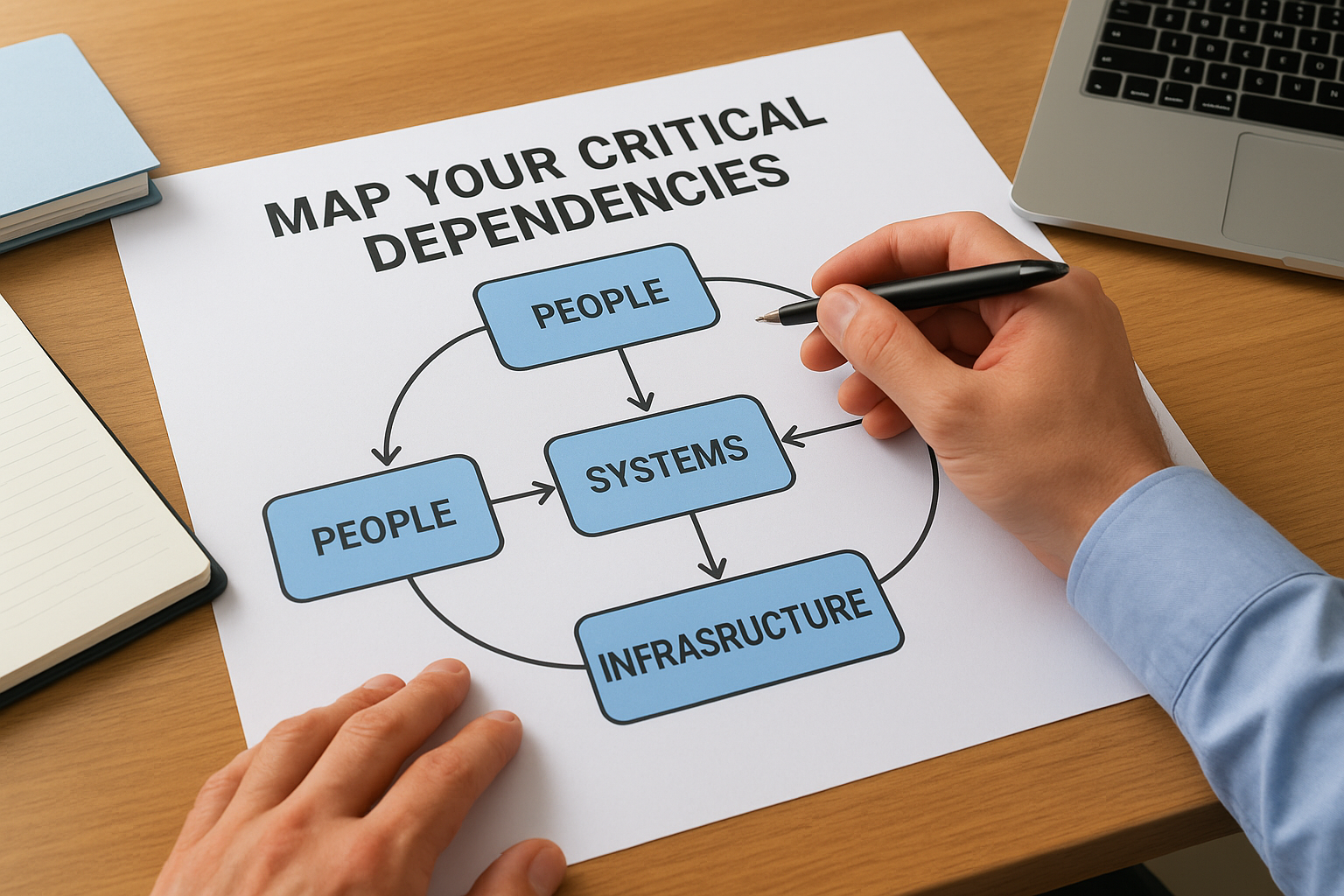
The businesses that suffer most during an incident are usually the ones that did not know how dependent they were on a single person, system, or supplier until it was already gone.
Mapping these dependencies identifies single points of failure and gives you a clear picture of where your resilience is weakest before an incident forces you to find out at the worst possible moment.
Write and assign procedures
With your scope defined and your dependencies mapped, you can write the actual response procedures. Each procedure needs to be specific enough to be followed by someone under stress, which means short sentences, named individuals, and clear decision points rather than vague guidance. Assign ownership for every procedure to a named person, confirm they have read and understood it, and make sure a backup individual is identified for each critical role. Store your plan somewhere accessible outside your primary systems, because a BCP locked inside a server you cannot reach during an outage is of no use to anyone.
How to test, maintain, and improve your plan
A BCP that sits in a folder and never gets tested is not a real plan. Regular testing is what separates a document that looks good on paper from one that actually holds up when something goes wrong. Many SMEs write a plan, file it, and then discover during a live incident that key contacts have changed, systems have been replaced, or the procedures no longer reflect how the business actually runs. Testing reveals these gaps before they cost you.
Run tabletop exercises
A tabletop exercise is the most accessible way to test your plan without disrupting day-to-day operations. You bring together key staff and walk through a realistic incident scenario step by step, asking who does what, in what order, and using which resources. These sessions expose assumptions that seemed reasonable on paper but fall apart when someone asks a specific question under simulated pressure.
The point of a tabletop exercise is not to prove your plan works; it is to find out where it does not.
Aim to run at least one tabletop exercise per year and rotate the scenarios so you cover different types of disruption. Ransomware, loss of a key supplier, and sudden staff unavailability all make useful starting points for separate sessions.
Test your technical recovery
Alongside scenario exercises, you need to verify that the technical components of your plan function in practice. This means confirming that your backups restore correctly, that your team can access critical systems from alternative locations, and that your recovery time objectives are genuinely achievable rather than simply documented. Schedule these tests separately from your tabletop sessions, and record the results so you have a clear audit trail of what worked and what needs adjustment before the next review.
Keep the plan current
Understanding why is business continuity planning important also means recognising that a plan becomes outdated quickly. Any significant change to your business, such as a new supplier, a shift in key personnel, a new system, or a change in the services you deliver, should trigger a review of the relevant sections. Set a fixed review cycle of at least every six months and assign a named owner responsible for keeping the document accurate between scheduled reviews. Without that ownership, updates slip and the plan drifts further from reality each month.
A simple way to get started
If you’ve read this far, you already understand why is business continuity planning important and what it takes to build one that holds up under real pressure. The harder part for most SMEs isn’t understanding the need; it’s finding the time and expertise to build a plan that genuinely reflects how your business operates rather than a generic document that looks complete but falls apart at the first test.
That’s where working with experienced specialists makes a practical difference. At TrustedIA, we help UK SMEs build resilience that goes beyond a single document, covering disaster recovery, incident response, and vulnerability management within a broader framework designed to keep your business running when it matters most. Rather than leaving you to figure it out alone, we bring the structure, the tools, and the expertise to do it properly from the start.
Talk to TrustedIA about building your business continuity plan and find out what genuine resilience looks like for your organisation.



