
Most cyber attacks don’t start with a sophisticated hack. They start with someone clicking a link they shouldn’t have, reusing a password, or trusting a spoofed email. According to the UK Government’s Cyber Security Breaches Survey, phishing remains the most common attack vector, and it targets people, not systems. That’s exactly why the security awareness training benefits go far beyond ticking a compliance box. Training your team is one of the most cost-effective defences a business can invest in.
Yet many UK organisations still treat security awareness as a one-off exercise or an afterthought bolted onto onboarding. The result? Staff who can’t spot a phishing attempt, inconsistent reporting of suspicious activity, and a false sense of security that leaves the business exposed. When a breach happens, and the average cost for a UK SMB keeps climbing, the question isn’t whether you had firewalls in place. It’s whether your people knew what to do.
At TrustedIA, we deliver cyber training as part of our managed security services, alongside phishing simulations and broader security posture assessments. We’ve seen first-hand how the right training programme transforms a workforce from a liability into a genuine line of defence. This article breaks down seven specific benefits of security awareness training and explains why UK businesses that prioritise it are better protected, more resilient, and ahead of their competitors.
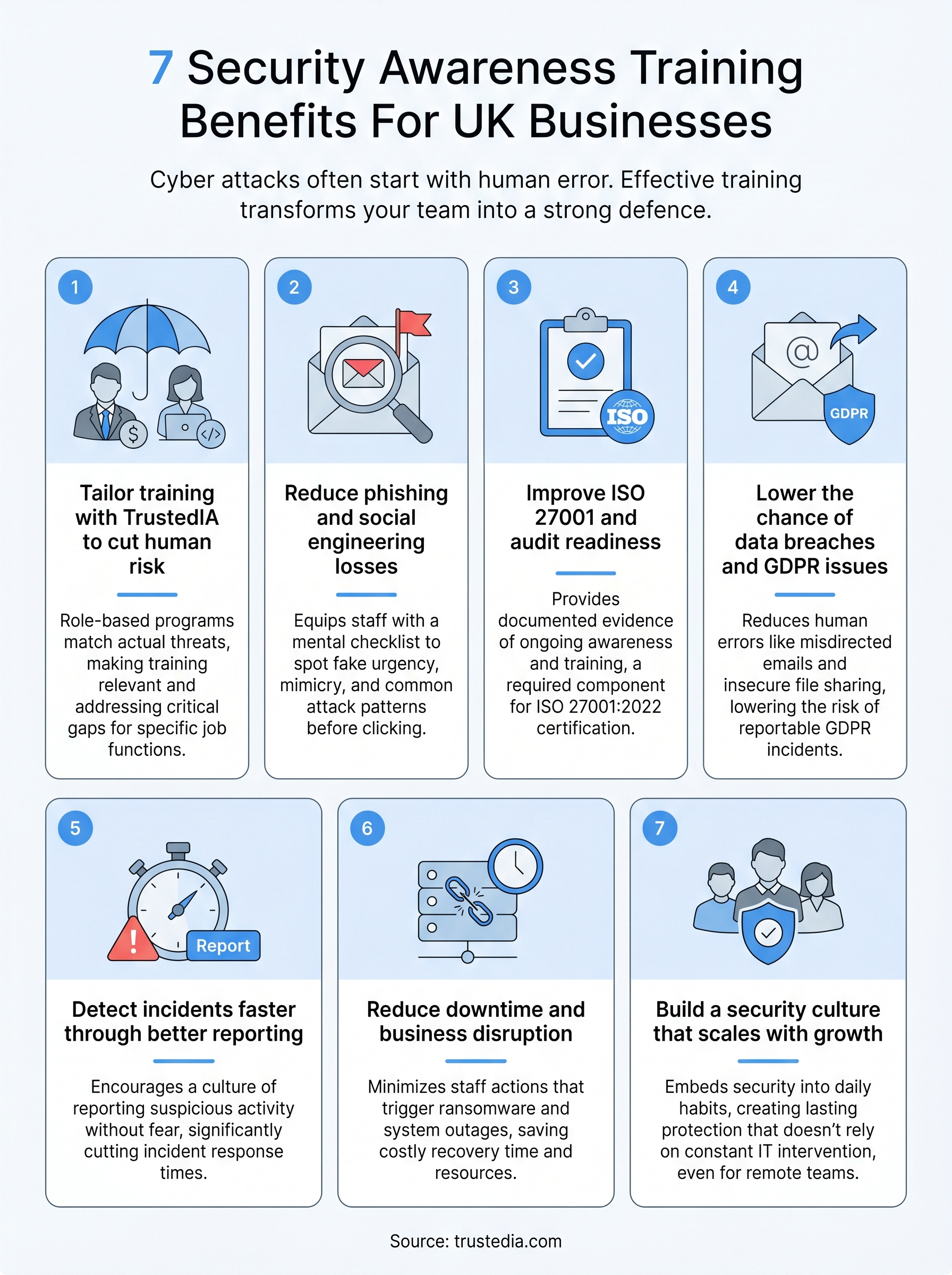
1. Tailor training with TrustedIA to cut human risk
Generic security awareness training treats every employee the same, and that’s where most programmes fail. A finance assistant and a software developer face very different threats in their day-to-day work, so pushing them through identical content wastes time and leaves critical gaps unaddressed. TrustedIA builds role-based training programmes that match the actual risks your people face, making each session relevant and far more likely to change real behaviour.
How a role-based programme reduces real-world risk
When you tailor training to specific job functions, staff see scenarios that reflect their actual working environment rather than abstract examples they’ll forget by Friday. A finance team member learns to spot payment redirection fraud and CEO impersonation; a customer-facing employee learns to handle data requests safely and recognise social engineering calls. This relevance drives genuine behavioural change rather than passive box-ticking.
The more closely training mirrors the threats a specific role encounters, the faster staff apply what they’ve learned when it counts.
Role-based programmes also let you prioritise higher-risk departments without overloading the rest of the organisation. Focusing your effort where exposure is greatest gives you the most measurable return on the security awareness training benefits your business should be seeing.
What to include for UK teams and common attack paths
UK businesses face a specific threat landscape that generic off-the-shelf content often misses. Attackers routinely exploit HMRC, Royal Mail, and NHS branding in phishing campaigns because these names carry immediate trust with your staff. Your training should address these local attack paths directly, with examples people will actually recognise.
Cover the key attack types that consistently breach UK organisations:
- Business email compromise targeting finance and procurement teams
- Smishing and vishing using trusted UK service brands
- Credential harvesting through fake login pages
- Removable media risks in physical workplaces
Including TrustedIA’s phishing simulations alongside formal training modules gives staff repeated, low-stakes exposure to real attack patterns, building muscle memory rather than one-off awareness.
How to prove improvement with clear metrics
Training without measurement is just an activity. You need clear baseline data before you start, then consistent tracking over time to demonstrate genuine risk reduction to leadership, insurers, and auditors. TrustedIA’s phishing simulation reporting gives you click rates, repeat offenders, and department-level breakdowns that show exactly where the risk sits.
Track these figures quarterly: phishing simulation click-through rate, reported suspicious email volume, and time taken to report an incident. A downward click rate combined with an upward reporting rate confirms the training is working and gives you evidence you can present directly during an ISO 27001 audit.
2. Reduce phishing and social engineering losses
Phishing attacks succeed because they exploit human instinct, not technical weaknesses. Attackers create urgency, mimic trusted brands, and exploit habits that most staff don’t even know they have. One of the most immediate security awareness training benefits is giving your team the specific knowledge to slow down and challenge what they’re reading before they act on it.
Why phishing still works and where staff slip up
Staff slip up most often when they’re busy, pressured, or expecting a particular type of message. An email that arrives just after a colleague mentions a package delivery is far more convincing than one that appears out of nowhere. Attackers study behaviour and time their campaigns deliberately around payroll cycles, tax deadlines, and seasonal events to increase the chance your staff react without thinking.
The gap between a convincing phishing email and a real one is shrinking, which makes human judgement the most important control you have.
The practical checks staff should use before they click
Training should give staff a repeatable mental checklist they can run in seconds. Check the sender’s full email address, not just the display name. Hover over links before clicking to reveal the actual destination. Question any request that involves payments, credentials, or personal data, regardless of how familiar the sender appears. These habits take very little time to build and significantly reduce the chance of a successful attack reaching its goal.

Metrics that show whether the risk is dropping
Track your phishing simulation click rate monthly and compare it against your baseline. A drop in click rate combined with a rise in reported simulations tells you the training is working. Time-to-report is equally valuable: faster reporting gives your security team a stronger chance of containing a real incident before it causes wider disruption across the business.
3. Improve ISO 27001 and audit readiness
ISO 27001 certification signals to clients, partners, and regulators that your business takes information security seriously. One of the less obvious security awareness training benefits is how directly it supports your certification journey. Clause A.6.3 of ISO 27001:2022 explicitly requires information security awareness, education, and training, meaning a documented and active training programme isn’t optional if you want to achieve or maintain certification.
How awareness training maps to ISO 27001 controls
Training connects to multiple controls across the ISO 27001 framework, not just the awareness clause. It supports access control policies by helping staff understand why sharing credentials undermines security. It reinforces incident reporting procedures by setting clear expectations for what counts as a reportable event. When your training programme is designed with the standard in mind, every session contributes evidence that your controls are operating as intended.
A training programme built around ISO 27001 controls gives you audit evidence throughout the year, not just in the weeks before a review.
What auditors expect to see in evidence and records
Auditors want to see dated completion records, training content, and evidence of ongoing delivery, not a one-off session from eighteen months ago. You should maintain logs that capture who completed each module, when, and with what result. For phishing simulations, keep click-rate reports and remedial training records for anyone who fails a simulation. This documentation demonstrates active risk management rather than passive intent.
How to keep training current without overloading staff
Short, frequent sessions work better than long annual refreshers. Monthly five-minute modules covering a single topic keep awareness high without pulling your team away from productive work. Rotate content to reflect current threats, including any UK-specific campaigns flagged by the National Cyber Security Centre, so your staff always train against realistic and relevant attack patterns.
4. Lower the chance of data breaches and GDPR issues
Data breaches in UK businesses rarely start with a sophisticated technical exploit. They start with staff sending sensitive data to the wrong recipient, storing personal information in unsecured locations, or misunderstanding what GDPR actually requires of them. These are human errors, and one of the clearest security awareness training benefits is reducing how often they happen.
The most common data handling mistakes in UK businesses
UK teams most frequently breach data through misdirected emails, accidental file sharing with external parties, and weak password practices on systems holding personal data. Staff often don’t realise that forwarding a client spreadsheet to a personal email account, even to finish work at home, creates a reportable GDPR incident under ICO guidelines.
A single misdirected email containing personal data can trigger an ICO notification obligation, a difficult client conversation, and reputational damage that takes months to recover from.
Habits that prevent misdirected email and oversharing
Training gives your staff concrete habits they can apply before sending any message or file externally. The following checks take seconds but significantly cut the chance of accidental exposure:
- Double-check recipient addresses before hitting send
- Use secure file transfer tools rather than email attachments for sensitive data
- Apply a need-to-know principle before granting access to any shared folder or document
Measures that demonstrate stronger data protection
Track the number of self-reported data handling errors your teams log each quarter. A rising report rate early in a training programme usually means awareness is improving rather than that mistakes are increasing. Over time, combine this with fewer ICO notifications and cleaner data audit results to show regulators and clients that your protection posture is genuinely strengthening.
5. Detect incidents faster through better reporting
When a staff member spots something suspicious but doesn’t report it, your security team loses the window to contain a real incident before it spreads. One of the most underrated security awareness training benefits is that it shifts staff from passive bystanders into active participants in your incident detection process. Faster reporting consistently cuts the damage any single incident causes.
How training changes reporting behaviour in practice
Staff don’t report incidents by default because they fear blame or disrupt their workflow. Training removes that hesitation by making it clear that reporting a suspected phishing email is the right action, not an admission of failure. When you frame reporting as a contribution rather than a confession, your team’s willingness to flag unusual activity rises significantly and consistently.
The faster your team reports a suspicious event, the shorter the window attackers have to move laterally through your systems.
What a simple reporting process should look like
Your reporting process needs to be fast and frictionless or staff will default to doing nothing. A single email alias, a dedicated button in your email client, or a short-form digital report gives employees a clear path to action. Remove any steps that require staff to diagnose the threat themselves before they report it, as that expectation delays action and discourages reporting altogether.

KPIs to track time-to-report and triage quality
Track average time-to-report from the moment a suspicious message lands in an inbox to when your security team receives the alert. Combine this with triage accuracy, which measures how many reported items genuinely require investigation. Improvement in both figures over successive quarters confirms your training programme is building the right habits across the business.
6. Reduce downtime and business disruption
Ransomware, credential theft, and accidental misconfiguration all share one common trigger: staff action that could have been avoided. One of the most financially significant security awareness training benefits is that it directly reduces the frequency of the human decisions that lead to system outages and prolonged recovery periods. Every hour your business spends offline carries a measurable cost attached to it.
How staff actions trigger ransomware and outages
The majority of ransomware infections enter a business through a clicked phishing link or a downloaded malicious attachment. From that single action, attackers can move through connected systems, encrypt data, and bring operations to a halt within hours. Staff who don’t understand how these attacks propagate are far more likely to take the action that starts the chain reaction without realising what they’ve done.
A single click on a well-crafted phishing email can take an entire business offline for days, and recovery rarely comes cheap or quickly.
The behaviours that protect backups, endpoints, and access
Training builds consistent habits around endpoint hygiene and access discipline. Staff should understand why they must never disable security tools, why they should lock their screen when stepping away, and why they should never store credentials in shared documents or browsers on shared devices. Protecting backup integrity is equally important; staff need to know not to connect removable media to systems holding critical backups.
Ways to quantify avoided disruption and recovery effort
Track the volume of security incidents that required IT intervention before and after your training programme. Combine this with an estimate of the average recovery time per incident. Reducing incident frequency by even a small percentage produces a measurable saving in staff hours and IT resource costs that you can present directly to leadership.
7. Build a security culture that scales with growth
One of the longest-lasting security awareness training benefits is that it creates a security culture your business carries forward as it grows. Training individuals is valuable, but embedding security into daily habits and team norms is what produces lasting protection that doesn’t rely on constant intervention from your IT or security team.
How to make security part of everyday work
Security behaviours stick when they become routine rather than exceptional. Encourage managers to reference security practices in team meetings, include security reminders in onboarding checklists, and make it normal for staff to question unusual requests without embarrassment. When leadership visibly models these habits, the rest of the business follows without needing repeated reminders or enforcement.
A security culture doesn’t require constant policing when staff genuinely understand why the behaviours matter.
How to keep remote and hybrid teams consistent
Remote and hybrid working creates gaps in security consistency that attackers actively exploit. Staff working from home face different risks, including unsecured Wi-Fi networks, shared household devices, and reduced oversight. Your training programme needs to cover these scenarios explicitly rather than assuming office-based content applies equally to staff working outside the building.
Deliver short, digital-first training modules that remote staff can complete without being on-site. Use the same phishing simulations and completion tracking across all locations so you maintain a consistent baseline of awareness regardless of where your people work.
Signs your culture is improving and where to focus next
Track unsolicited security questions from staff as a leading indicator of cultural improvement. When people start asking whether a process is secure, rather than waiting to be told, your culture is shifting in the right direction. Focus your next training cycle on the departments with the highest incident or near-miss rates to target effort where it still matters most.
What to do next
The security awareness training benefits covered in this article don’t arrive automatically. They come from building a programme that fits your team’s actual risks, measures real outcomes, and stays current as the threat landscape shifts. Whether your immediate priority is reducing phishing click rates, strengthening your ISO 27001 evidence, or cutting the likelihood of a costly GDPR incident, consistent and well-structured training is the mechanism that delivers all of them.
Starting is straightforward when you work with a partner who understands both the technical and human sides of cyber security. TrustedIA combines phishing simulations, role-based training, and security posture assessments to give your organisation a clear picture of where the gaps are and how to close them. Your workforce is either your biggest vulnerability or your strongest control, and training is what determines which one it becomes. Talk to TrustedIA about protecting your team and find out what the right programme looks like for your business.