

If you’ve ever wondered what is a pen test, the short answer is this: it’s a controlled, simulated attack on your systems designed to find security weaknesses before a real attacker does. Think of it as hiring someone to break into your own business, with your permission, so you can fix the gaps they exploit.
Penetration testing is one of the most practical ways to understand where your organisation is genuinely vulnerable. It goes beyond automated scans by using the same tactics, techniques, and tools that real-world threat actors rely on. The result is a clear picture of what’s at risk and what needs fixing, prioritised by severity.
At TrustedIA, penetration testing is a core part of the managed security services we deliver to businesses across the UK. With over 30 years of experience in IT services and cybersecurity, we run pen tests that give organisations actionable findings, not just a generic report that collects dust. This article breaks down how the process works, the different types of pen tests, and exactly what to expect before, during, and after an engagement.
What a pen test is and what it is not
A penetration test, commonly called a pen test, is a structured security exercise where a qualified tester deliberately attempts to exploit weaknesses in your systems, applications, or network. The goal is straightforward: find the vulnerabilities that a malicious actor would target before they get the chance to use them against you. The tester follows a defined scope, works within agreed boundaries, uses real attack techniques, and documents every finding so you can act on the results with confidence.
What a pen test actually does
When you ask what a pen test in practical terms is, the answer comes down to a deliberate attempt to breach your defences under controlled conditions. A skilled tester will probe for misconfigured systems, unpatched software, weak credentials, and logical flaws in your applications or infrastructure. They use the same methods real attackers use, which means the findings reflect genuine risk, not theoretical concern pulled from a checklist.
A pen test does not just tell you what could go wrong – it shows you what would go wrong if someone tried.
The output is a detailed report that maps each finding to its potential business impact, explains how each was discovered, and provides clear remediation steps. You leave the engagement knowing exactly what to fix, in what order, and why each issue matters to your organisation specifically.
What a pen test is not
A pen test is not the same as a vulnerability scan. Automated scanning tools identify known weaknesses by matching your systems against a database of signatures. That has value, but it misses the human element entirely. A skilled tester chains multiple small issues together to achieve access that an automated tool would never flag, which is exactly how real breaches tend to play out.
It is also not a one-time tick-box exercise. Your systems change, new code gets deployed, and the threat landscape shifts constantly. Running a pen test once and assuming you are covered is like checking your locks once and never checking them again. Regular testing keeps pace with those changes and gives you an accurate, current picture of where you stand.
Finally, a pen test is not a guarantee that your environment is breach-proof. No single test can cover every possible scenario or predict every future threat. What it does give you is evidence-based confidence that the most significant, exploitable risks have been identified and that you have a concrete remediation plan to address them before they cause real damage to your business.
Why penetration testing matters for UK businesses
UK businesses face a growing and increasingly targeted threat environment. The UK Cyber Security Breaches Survey consistently shows that a significant proportion of businesses identify attacks or breaches each year, and the consequences range from operational disruption to serious financial loss. Understanding what a pen test is and why it matters puts you in a much stronger position than simply hoping your defences hold.
The regulatory and legal context
The UK General Data Protection Regulation (UK GDPR) requires organisations to implement appropriate technical and organisational measures to protect personal data. Regulators expect you to actively test and verify those measures, not just document them. A pen test provides concrete evidence that you have assessed your security controls meaningfully, supporting your compliance posture and demonstrating accountability to the Information Commissioner’s Office.
If a breach occurs and you cannot show you took reasonable steps to test your security, that gap in your due diligence will be visible during any regulatory investigation.
For organisations working towards ISO 27001 certification, penetration testing is directly aligned with the standard’s requirement to identify and manage information security risks. TrustedIA supports businesses through that entire process, from audit to certification.
The cost of not testing
The financial case for pen testing is straightforward. Identifying and fixing a vulnerability before it is exploited costs a fraction of what a breach costs in terms of recovery, legal exposure, notification obligations, and reputational damage. The average cost of a cyber incident for a UK SMB is not trivial, and downtime alone can threaten business continuity.
Regular pen testing means vulnerabilities get found by you first, not by an attacker operating in your network without your knowledge. That shift in timing makes the difference between a controlled fix and a crisis response.
Types of pen tests and when to use each
Not every pen test looks the same, and understanding which type fits your situation is just as important as understanding what a pen test is in the first place. The right choice depends on what you are trying to test, how much information you want to give the tester up front, and where your highest-risk areas are within your environment.
Black box, white box, and grey box testing
These three terms describe the amount of information the tester receives before the engagement begins. In a black box test, the tester starts with nothing, simulating an external attacker with no prior knowledge of your systems. A white-box test gives the tester full access to documentation, source code, and architectural details, allowing for deeper, more thorough coverage. The grey box sits in the middle, providing limited information, such as user-level credentials, and reflects the perspective of an insider threat or a compromised account.

The approach you choose shapes both the scope and the depth of what the test will uncover, so align it with the threat scenario you are most concerned about.
Infrastructure, web application, and social engineering tests
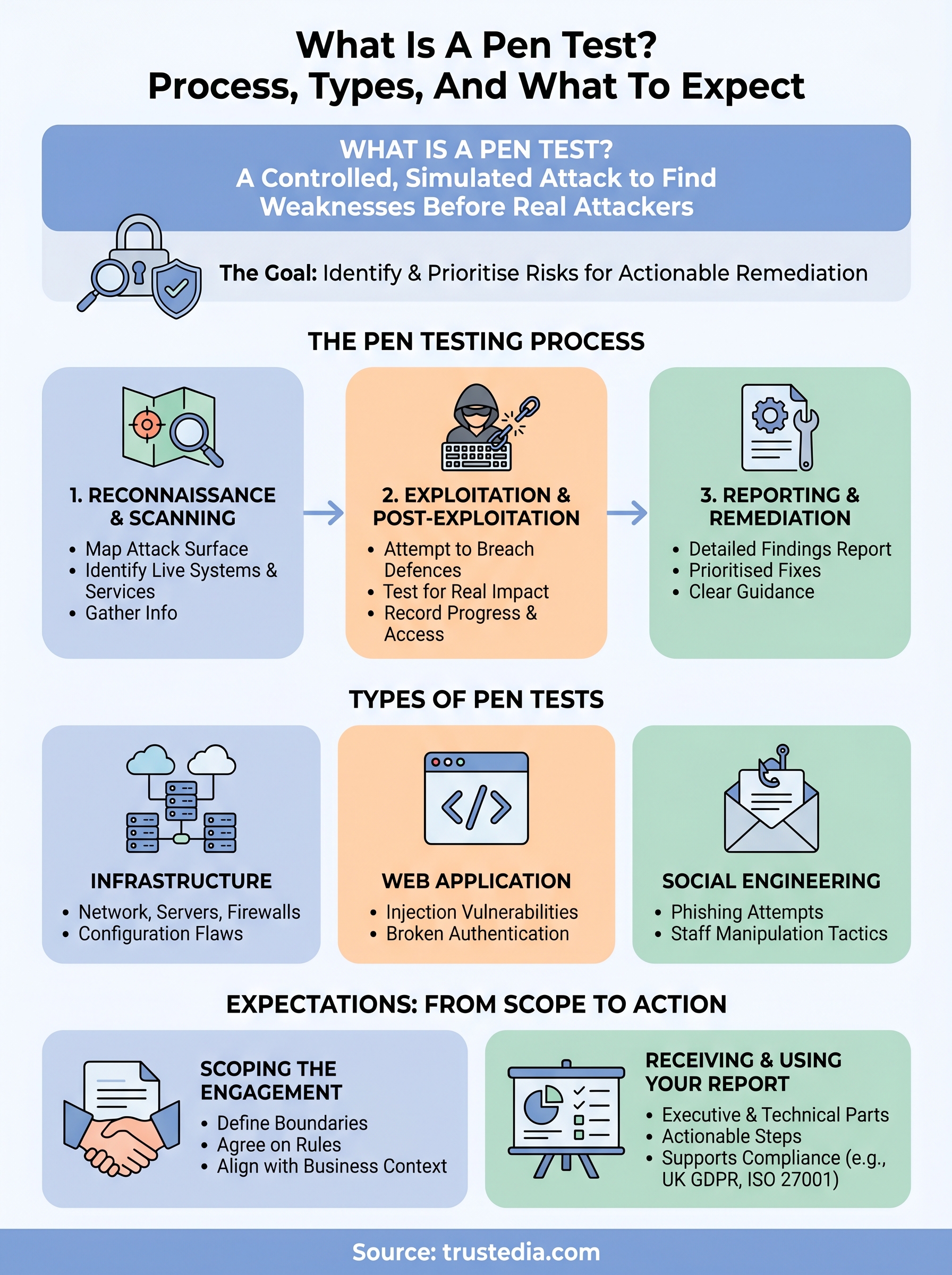
Infrastructure testing targets your network, servers, firewalls, and connected devices to find exploitable weaknesses in how your environment is built and configured. Web application testing focuses on your customer-facing or internal applications, looking for flaws such as injection vulnerabilities, broken authentication, and insecure data handling. Social engineering tests assess whether your staff would fall for phishing attempts or other manipulation tactics, which remain among the most common initial access methods attackers use.
Running more than one type in a single engagement gives you a more complete picture. Attackers rarely limit themselves to a single avenue, so testing in isolation can leave significant blind spots that only surface when someone exploits the gap between your application layer and your network controls.
How a pen test works step by step
Once you understand what a pen test conceptually, seeing the stages laid out in sequence makes the value much clearer. A pen test follows a defined methodology rather than random probing, which ensures findings are accurate, repeatable, and directly tied to real risk in your environment.
Reconnaissance and scanning
The tester starts by mapping your attack surface, identifying live systems, open ports, running services, and exposed entry points. This phase uses a combination of passive research and active scanning to build a detailed picture of what is visible and reachable before any exploitation attempt begins. The information gathered here shapes every decision that follows.
Key areas covered during reconnaissance typically include:
- External IP ranges and subdomains
- Open service ports and software versions
- Web application entry points and login interfaces
- Publicly exposed accounts or credentials
Exploitation and post-exploitation
With reconnaissance complete, the tester actively attempts to exploit the weaknesses identified. This is the stage that separates a pen test from an automated scan. Rather than flagging a potential issue, the tester tries to use it to gain access, escalate privileges, or move through your network as a real attacker would.
A vulnerability scanner tells you a door might be unlocked. A pen tester tries the handle and walks through if they can.
Following successful exploitation, the tester records what was accessible, how far they progressed, and what systems or data came within reach. That evidence gives you a realistic picture of actual business impact, not just theoretical exposure.
Reporting and remediation guidance
The tester documents every step and finding in a structured report that your technical team can act on directly. Each issue is mapped to its business impact and paired with clear remediation steps, so you know exactly what to fix and in what order.
What to expect from scoping to reporting
Understanding what a pen test in theory is is one thing; knowing exactly how an engagement runs from the first conversation to the final deliverable removes the uncertainty that often holds organisations back from commissioning one. The process is more structured than most people expect, and your involvement at the start directly shapes the quality of the output.
Scoping the engagement
Before any testing begins, your tester will work with you to clearly define the scope: which systems, applications, and environments are included, what is explicitly excluded, and what success looks like for your organisation. This conversation covers your business context, compliance requirements, and specific areas of concern, so the test reflects your actual risk profile rather than a generic template applied to every client.
A clear scope also establishes the rules of engagement, including testing windows, points of contact, and how the tester should handle critical findings discovered during the engagement. Getting this right at the start keeps the test focused and prevents unnecessary disruption to your day-to-day operations.
Receiving and using your report
Once testing concludes, you receive a structured report divided into two core parts: an executive summary written for non-technical stakeholders and a technical section that provides your IT team with the details they need to remediate each finding. Each vulnerability is rated by severity, explained in context, and paired with specific remediation guidance rather than vague recommendations that your team has to interpret themselves.
The report is only valuable if your team acts on it, so a good tester will walk you through the findings and answer questions before closing the engagement.
Your remediation process typically involves addressing high-severity findings first, retesting confirmed fixes where possible, and scheduling a follow-up assessment to verify that your security posture has genuinely improved over time.
Where to go from here
You now have a clear answer to what a pen test is and a solid understanding of how the process works from the first scoping conversation through to remediation. The key takeaway is that pen testing gives you evidence, not assumptions, about where your security controls hold up and where they fall short. That evidence is what turns a vague concern about cyber risk into a prioritised, actionable plan your team can actually execute.
Your next step is to speak with someone who can scope the appropriate test for your specific environment and risk profile. TrustedIA works with businesses across the UK to deliver penetration testing that produces real findings, not generic reports. Whether you are preparing for ISO 27001, responding to a compliance requirement, or simply want to know where you stand, we can help. Get in touch with TrustedIA to discuss what a pen test engagement would look like for your organisation.



