Most cyber attacks don’t start with a hacker breaking through a firewall. They start with an employee clicking a link they shouldn’t have. Phishing emails, weak passwords, and mishandled data account for the majority of security breaches, and no amount of technology alone can fix that. This is exactly why cybersecurity awareness training for staff has become a non-negotiable part of any serious defence strategy.
The problem is that many organisations treat staff training as a tick-box exercise. A one-off presentation, a PDF nobody reads, a quiz people forget about within a week. That approach doesn’t work. Effective training changes behaviour, not just knowledge. It needs to be ongoing, relevant, and tied directly to the real threats your people face every day.
At TrustedIA, we deliver cyber training as part of our managed security services, alongside phishing simulations and vulnerability assessments, because we’ve seen firsthand how well-prepared staff can stop an incident before it starts. With over 30 years of experience in IT services and cybersecurity, we know that technology and people need to work together; one without the other leaves gaps.
This guide breaks down what cyber security awareness training actually involves, what good programmes look like, how to roll one out across your organisation, and what to avoid along the way. Whether you’re starting from scratch or improving an existing programme, you’ll find practical, actionable guidance to raise your team’s security posture and reduce your exposure to threats.
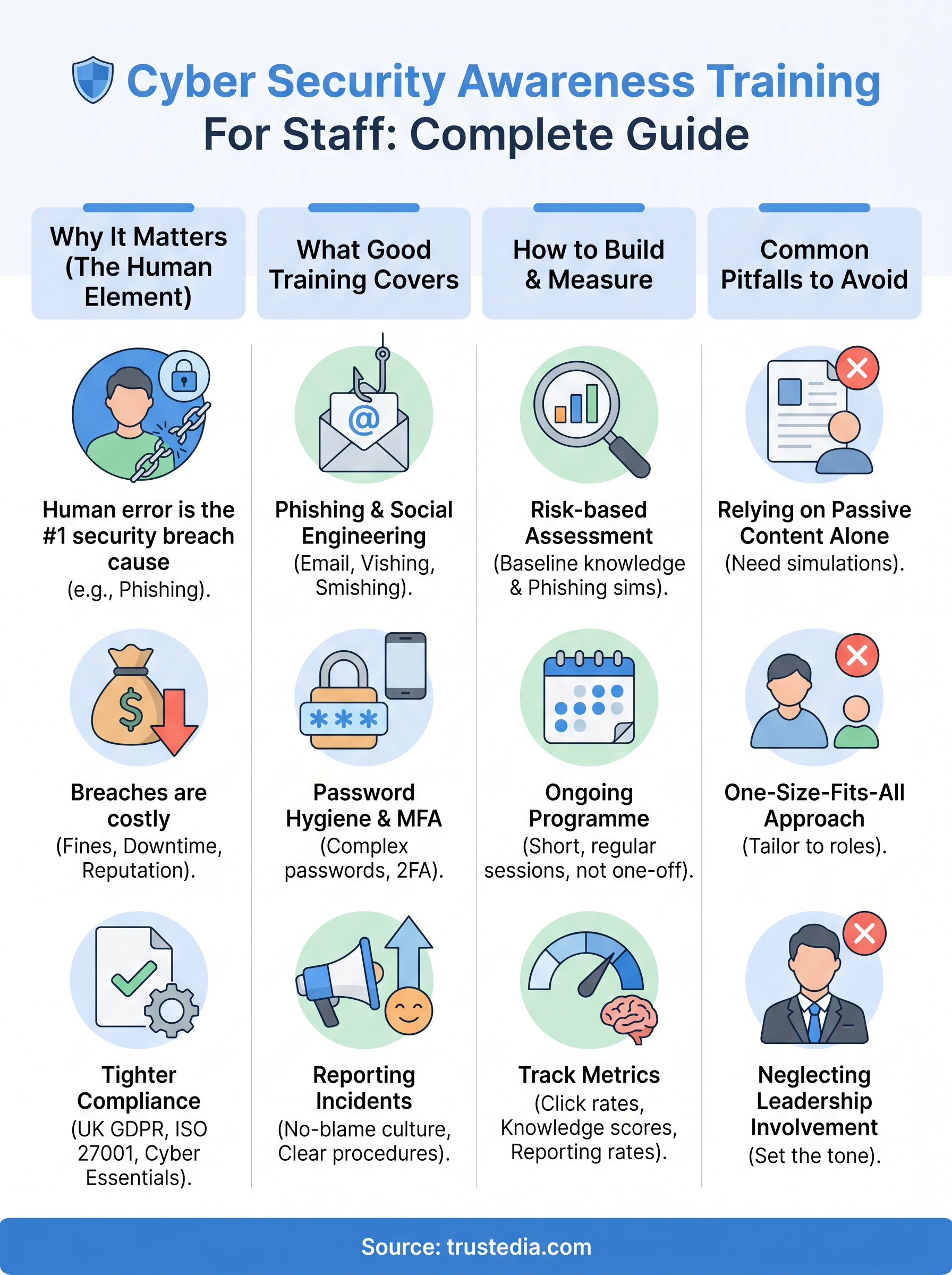
Why staff cyber awareness training matters
Cyber threats don’t discriminate by company size or sector. Small businesses, mid-sized firms, and large enterprises all face the same fundamental risk: someone on the inside making a mistake that opens the door to an attacker. The human element remains the most consistently exploited vulnerability in cybersecurity, and until you address it directly, every other investment in security tools and technology sits on an unstable foundation.
People are the most targeted attack surface
Attackers take the path of least resistance, and in most organisations, that path runs straight through your staff. Phishing attacks account for the vast majority of data breaches, according to guidance published by the UK’s National Cyber Security Centre (NCSC). These attacks don’t require sophisticated technical skills from the attacker; they rely on deception, urgency, and familiarity. An email that looks like it’s from your IT department or a trusted supplier can be enough to trick even an experienced employee into handing over credentials or downloading malware.
A single compromised account can give an attacker access to your entire network, your client data, and your financial systems within hours.
Social engineering tactics have become increasingly targeted, with attackers conducting detailed research on organisations before making contact. Staff who haven’t received proper cybersecurity awareness training are significantly more likely to fall for these approaches, regardless of seniority or technical background. Assuming that only less experienced employees get caught out is one of the most dangerous positions your organisation can take.
The real cost of a breach
When a breach happens, the damage extends well beyond the immediate technical response. Regulatory fines under the UK GDPR can run into the millions for organisations that fail to adequately protect personal data. Beyond fines, you face operational downtime, reputational damage, loss of client trust, and recovery costs, which typically involve forensic investigation, system remediation, and legal advice.
Research consistently shows that the average cost of a data breach for UK businesses has continued to rise year on year. Small and medium-sized businesses are particularly vulnerable because they often lack the in-house resources to recover quickly, and many never fully recover. Investing in staff training costs a fraction of what you would spend dealing with the aftermath of a preventable incident.
Compliance requirements are tightening
Regulatory bodies and industry standards increasingly expect organisations to demonstrate that their staff receive regular security training. ISO 27001, the international standard for information security management, includes specific requirements around security awareness and training for all personnel. If your organisation is working toward certification or maintaining it, a structured training programme isn’t optional; it’s a core requirement.
The UK Government’s Cyber Essentials scheme also encourages organisations to build a culture of awareness as part of their broader security posture. Beyond meeting minimum compliance thresholds, well-trained staff actively reduce your day-to-day risk exposure, which is exactly what regulators and auditors want to see evidence of when they assess your organisation’s controls.
What good training will be covered in 2026
The threat landscape evolves every year, and training built around outdated attack patterns won’t prepare your staff for what they’ll actually face. Effective cybersecurity awareness training for staff needs to reflect current attacker tactics, not recycled content from a decade ago. Here is what a well-structured programme should address.
Phishing and social engineering
Phishing remains the most common entry point for attackers, and the tactics have grown far more convincing. Staff need to recognise not just obvious spam but highly targeted spear-phishing attempts that impersonate trusted colleagues, suppliers, or internal IT teams. Training should cover how to inspect sender addresses, spot suspicious links, and understand why urgency is a classic manipulation tactic.

The most convincing phishing attempts look like a normal message from someone your team already trusts, which is exactly what makes them dangerous.
Vishing (voice phishing) and smishing (SMS phishing) are also on the rise alongside email-based attacks. Simulated phishing exercises consistently outperform theory alone, because they give staff realistic practice at recognising the signs before a real attack tests them.
Password hygiene and access management
Weak and reused passwords remain a leading cause of account compromise. Training should explain the reasoning behind password length, complexity, and the use of a password manager, not just demand policy compliance. Staff who understand why a control exists are far more likely to adopt it consistently.
Multi-factor authentication (MFA) deserves dedicated coverage in every programme. Microsoft’s own research shows that MFA blocks the vast majority of automated account compromise attacks, making it one of the most impactful and straightforward controls your organisation can enforce.
Reporting incidents and near misses
Building a no-blame reporting culture is one of the most overlooked elements of staff training. People who fear embarrassment or consequences are far less likely to flag a suspicious email or admit they clicked something they shouldn’t have. Early reporting limits damage, and training should reinforce that message clearly and consistently.
Clear, memorable reporting procedures matter just as much as the awareness content itself. Keep the process simple, and make sure everyone knows exactly who to contact and how, well before they ever need to use it.
How to build a programme that works
Building an effective programme starts before you write a single slide or book a training session. You need to understand where your organisation’s biggest human risks lie, which means examining your current security posture, your staff’s existing knowledge gaps, and the threats most relevant to your sector. Without that foundation, you risk building a programme that feels comprehensive on paper but misses the threats your team will actually encounter.
Start with a risk-based assessment.
Before selecting any training content or platform, conduct a [baseline assessment](https://www.trustedia.com/audit-services/cybersecurity-audit/) of your staff’s current security awareness. This could involve a simulated phishing campaign, a short knowledge survey, or a review of recent security incidents and near misses. The results tell you where to focus, rather than spreading your budget across generic content that may not move the needle for your specific organisation.
A baseline assessment also gives you a clear starting point to measure improvement against, which is essential for demonstrating value to leadership and meeting compliance requirements like ISO 27001.
Make it ongoing, not a one-off
One session per year is not a training programme; it is a box-ticking exercise. Attackers constantly update their tactics, and your staff training needs to keep pace. Deliver content in regular, shorter sessions throughout the year rather than a single lengthy event. Monthly bite-sized modules, quarterly phishing simulations, and brief updates when new threats emerge all help to keep security front of mind without overwhelming people.
Frequency also reinforces retention. Research consistently shows that spaced repetition produces far better long-term recall than a single intensive session, and this applies directly to cybersecurity awareness training for staff. Short, regular touchpoints build habits rather than just awareness.
Tailor content to your team’s roles
Not everyone in your organisation faces the same threats. Your finance team is far more likely than your warehouse team to encounter invoice fraud and CEO impersonation attempts. Role-specific training content is significantly more effective than a one-size-fits-all approach because it reflects the actual situations your staff encounter in their day-to-day work, making the guidance feel relevant rather than theoretical.
How to measure results and keep improving
Running a training programme without measuring its impact means you’re spending the budget without knowing whether it’s working. Tracking specific, agreed metrics from the outset gives you concrete evidence of progress and helps you identify exactly where your staff still need support. Without measurement, improvement becomes guesswork, and guesswork doesn’t satisfy auditors, leadership, or regulators.
Track the right metrics from the start
Phishing simulation click rates are one of the clearest indicators of how well your training is landing. If the percentage of staff clicking simulated phishing links drops consistently over several months, your programme is changing behaviour, which is the actual goal. Knowledge assessment scores taken before and after each training module give you a direct view of learning outcomes and highlight specific teams or individuals who need additional attention.
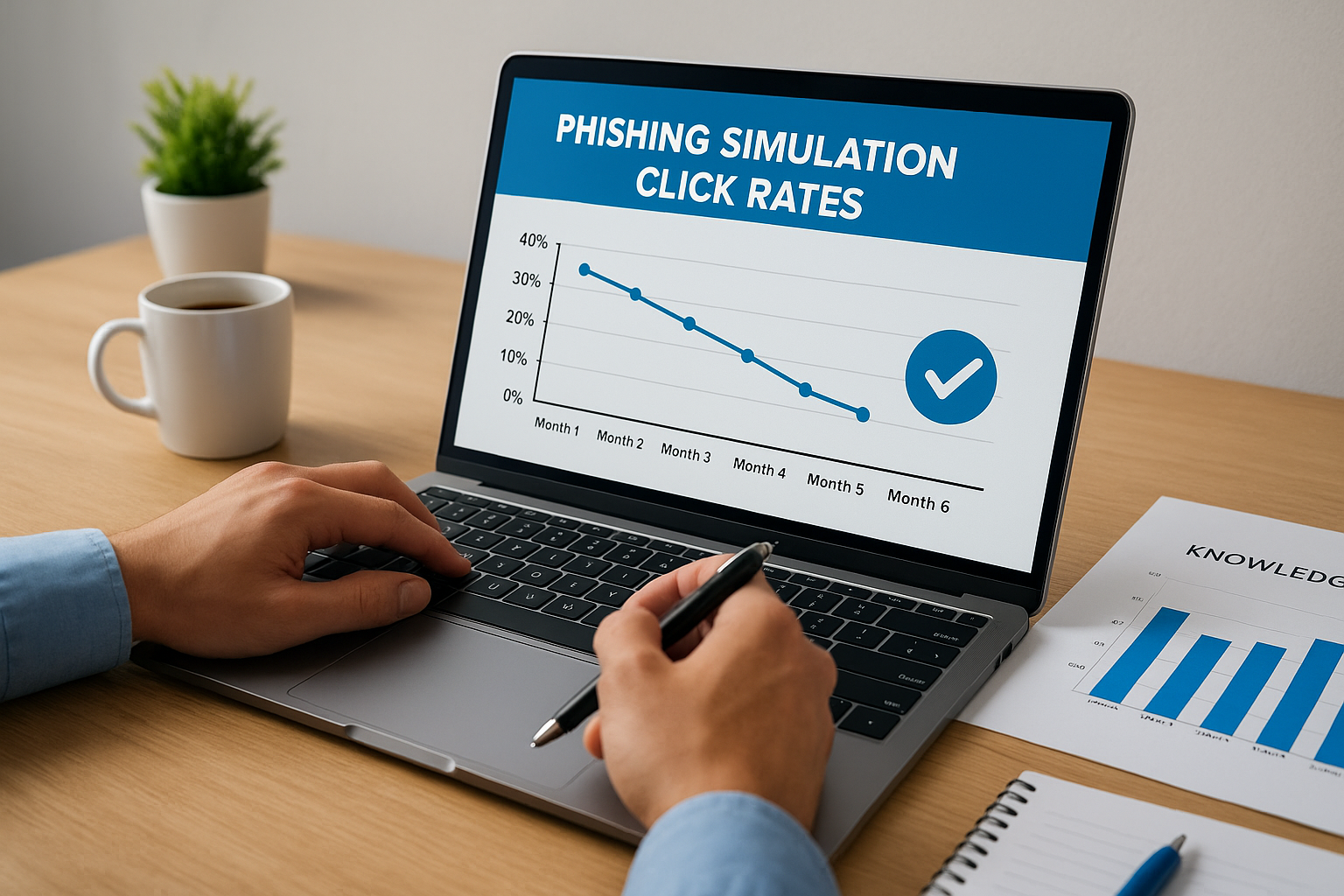
A falling click rate on simulated phishing campaigns, combined with a rise in staff-reported suspicious emails, is one of the strongest signals that your cyber security awareness training for staff is genuinely shifting how people respond to threats.
Incident reporting rates tell a more nuanced story. As your training culture matures, staff should feel more confident in flagging suspicious activity rather than ignoring it or hoping someone else will deal with it. An increase in reports often signals a healthier security culture rather than a surge in actual incidents. Map each of these metrics against your training schedule over time so you can see clearly what’s driving change.
Build in regular reviews
Setting a fixed review cadence keeps your programme from going stale. Review your training content at least every six months to ensure it reflects current threats and attacker techniques. Check your metrics quarterly to spot underperformance early and adjust before a gap becomes a serious exposure.
Bring your findings to leadership regularly. Presenting measurable improvements in staff behaviour builds internal support for ongoing investment far more effectively than general arguments about awareness. If your data shows a specific team consistently underperforming in simulations, use that insight to commission targeted sessions rather than repeating the same content across the whole organisation. Your programme’s data is one of its most valuable outputs, so use it deliberately.
Common pitfalls and how to avoid them
Even well-intentioned organisations fall into patterns that undermine their staff’s cybersecurity awareness training. Knowing what these pitfalls look like before you encounter them saves you both time and budget, and keeps your programme from becoming exactly the kind of tick-box exercise you set out to avoid.
Relying on passive content alone
Slide decks, videos, and written guides all have a place in a training programme, but they cannot carry the entire load. Passive content builds knowledge; it rarely changes behaviour on its own. Simulated phishing campaigns, realistic scenario exercises, and hands-on practice are what actually test whether your staff can apply what they’ve learned when it counts. If your programme leans entirely on self-paced reading modules, you should expect limited impact on real-world decision-making.
The gap between knowing what a phishing email looks like and correctly identifying one under time pressure is exactly where passive-only training programmes fail.
Assuming everyone learns the same way
Your workforce is not a single audience, and treating it as one is one of the most common mistakes organisations make. A content approach that resonates with your IT team may feel entirely abstract to your sales team or your front-line operations staff. Tailoring language, examples, and threat scenarios to the day-to-day realities of different roles helps the material land more effectively and increases the likelihood that staff will actually retain and apply it. Build role-specific modules where the risk profile genuinely differs, rather than applying the same content across the board and assuming it will stick.
Neglecting to involve leadership
Training that staff see leadership ignoring sends a clear message that it isn’t really a priority. When senior leaders visibly participate in the same exercises, acknowledge their own results, and champion the programme internally, it shifts the organisational culture around security far more effectively than any internal communication campaign could. Make leadership participation a visible and consistent part of your programme from day one, not an afterthought. If your board completes the same phishing simulation your junior staff do, it signals that security is everyone’s responsibility regardless of seniority, which is precisely the message you need your team to internalise.
Next steps for your team
You now have a clear picture of what effective cyber security awareness training for staff looks like, what it covers, how to build it properly, and what to avoid along the way. The next move is to act on it. Start with a baseline assessment so you understand where your team’s knowledge gaps actually sit before you invest in content or platforms. From there, build a programme that’s ongoing, role-relevant, and tied to measurable outcomes you can track over time.
Getting this right matters, and you don’t have to approach it alone. TrustedIA delivers cyber training alongside phishing simulations, vulnerability assessments, and fully managed security services, all built around your organisation’s specific risk profile rather than a generic template. If you want expert support putting a programme together that actually changes behaviour, speak to the TrustedIA team and find out how we can help you protect your people and your business.