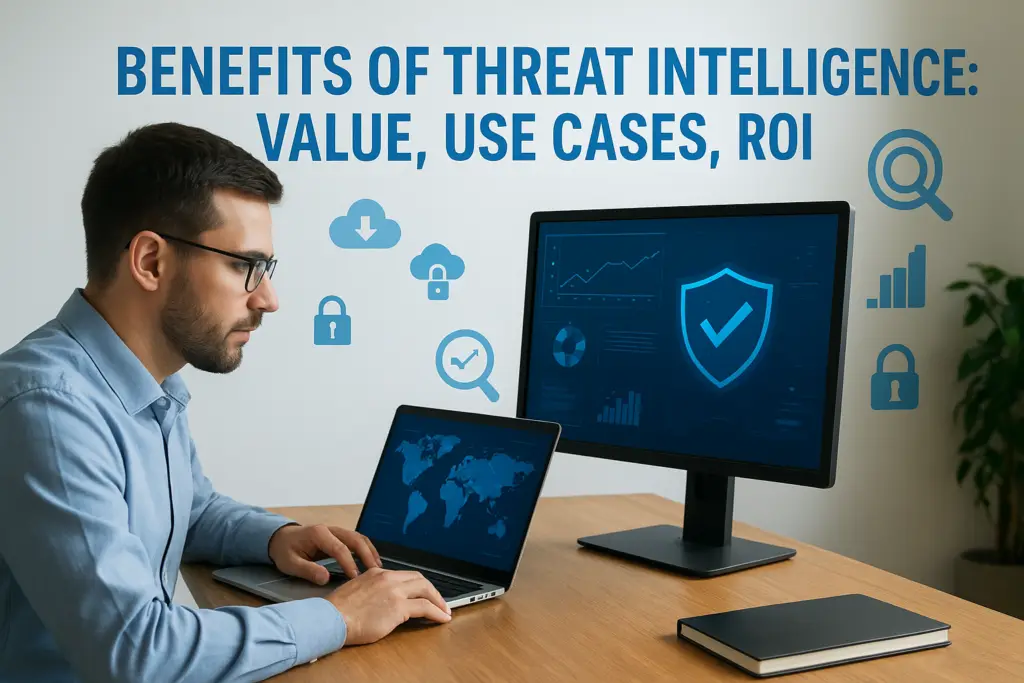
Most organisations know cyber threats are growing more sophisticated. Fewer know exactly what’s heading their way, or how to act on that knowledge before damage is done. That gap between awareness and action is precisely where the benefits of threat intelligence become clear. Rather than reacting to incidents after they unfold, threat intelligence gives security teams the context they need to anticipate, prioritise, and neutralise risks proactively.
But understanding its value goes beyond “better security.” Threat intelligence directly supports decision-making across risk management, compliance, and incident response, areas where guesswork can be extraordinarily costly. For businesses working towards or maintaining ISO 27001 certification, it also strengthens the evidence base for continuous improvement and risk treatment. At TrustedIA, we build threat intelligence into our managed security services, from Dark Web Surveillance and SOC operations to vulnerability assessments, because isolated tools without context only tell half the story.
This article breaks down the practical advantages of threat intelligence, outlines real-world use cases, and addresses how to measure its return on investment. Whether you’re building a case for adoption or looking to get more from an existing programme, you’ll find a clear framework for understanding its business value.
Why threat intelligence matters for UK businesses
UK organisations face a specific threat environment shaped by regulatory pressure, sector-specific targeting, and a persistent shortage of in-house security expertise. The National Cyber Security Centre (NCSC) consistently reports that UK businesses are among the most frequently targeted in Europe, with phishing, ransomware, and supply chain attacks accounting for the majority of recorded incidents. Without intelligence feeding your security decisions, you’re essentially responding to threats you never saw coming rather than preparing for them in advance.
The UK threat landscape is shifting fast.
Attackers have become more selective. Rather than casting wide nets, criminal groups and state-sponsored actors now conduct detailed reconnaissance before launching attacks, often focusing on sectors like finance, healthcare, manufacturing, and professional services. For UK SMBs, this is particularly significant: many assume they’re too small to be a target, yet they’re frequently chosen precisely because their defences are weaker than those of larger enterprises.
Threat actors often use smaller organisations as entry points into larger supply chains, making no business too small to warrant proper protection.
Your sector, your suppliers, and even your geography all influence who is likely to come after you and how. Understanding which threat actors are active, what techniques they favour, and when campaign activity spikes is exactly what threat intelligence provides. It converts raw data about cyber activity into context that your team can act on.
Compliance requirements add another layer of urgency
For UK businesses working towards ISO 27001 certification or maintaining alignment with frameworks like Cyber Essentials, threat intelligence is not just a security tool. It is part of demonstrating a systematic approach to risk identification and treatment. The standard requires organisations to identify threats relevant to their information assets, and an intelligence programme gives you the evidence to do that with precision rather than guesswork.
One of the clearest benefits of threat intelligence in a compliance context is that it creates a continuous, documented record of your threat awareness, something auditors and insurers look for when assessing your security posture. Combining intelligence with managed security services means you’re building a live, evolving picture of your risk environment rather than relying on point-in-time assessments alone.
Core benefits of threat intelligence in practice
Knowing that threats exist is one thing. Knowing which specific threats are relevant to your organisation, your sector, and your infrastructure is another matter entirely. The core benefits of threat intelligence are most evident when security teams shift from reactive firefighting to informed, prioritised defence.
Faster detection and reduced response times
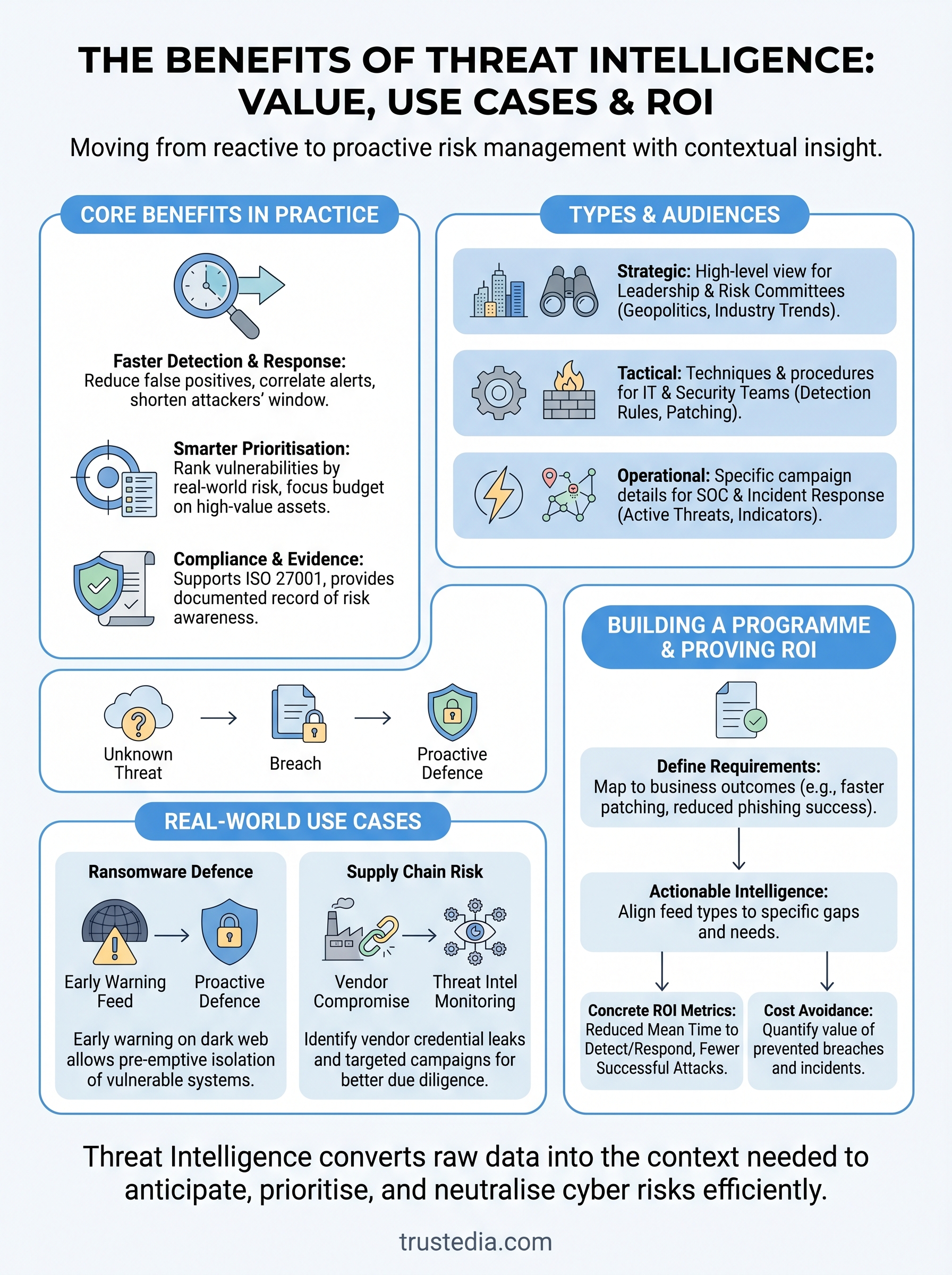
When your team has contextual intelligence about active threat actors and their preferred attack vectors, analysts spend less time chasing false positives and more time responding to genuine risks. Threat intelligence feeds directly into your Security Operations Centre (SOC), allowing analysts to correlate alerts with known indicators of compromise in near real time.
Organisations with mature threat intelligence programmes typically detect breaches significantly faster than those relying on alerts alone, reducing the window attackers have to move laterally through a network.
Smarter prioritisation of security resources
Not every vulnerability carries the same risk, and without intelligence to contextualise severity, security teams often waste effort patching low-priority flaws while high-value targets remain exposed. Threat intelligence lets you rank vulnerabilities based on active exploitation in the wild, your sector’s exposure, and your specific asset profile.
Your budget and your team’s time are finite. Directing both towards the threats most likely to materialise in your environment is where threat intelligence delivers its clearest operational value and begins to generate a measurable return.
Types of threat intelligence and who uses them
Threat intelligence is not a single uniform feed. It comes in distinct types, each serving a different audience within your organisation and answering different questions about your specific risk exposure.
Strategic, tactical, and operational intelligence
Strategic intelligence provides senior leadership with a high-level view of the threat landscape relevant to your industry, including geopolitical factors. Tactical intelligence focuses on the techniques, tactics, and procedures used by threat actors, feeding directly into your security controls and detection rules. Operational intelligence sits between the two, providing specific details about planned or active campaigns, such as a ransomware wave targeting UK professional services firms in a defined window.
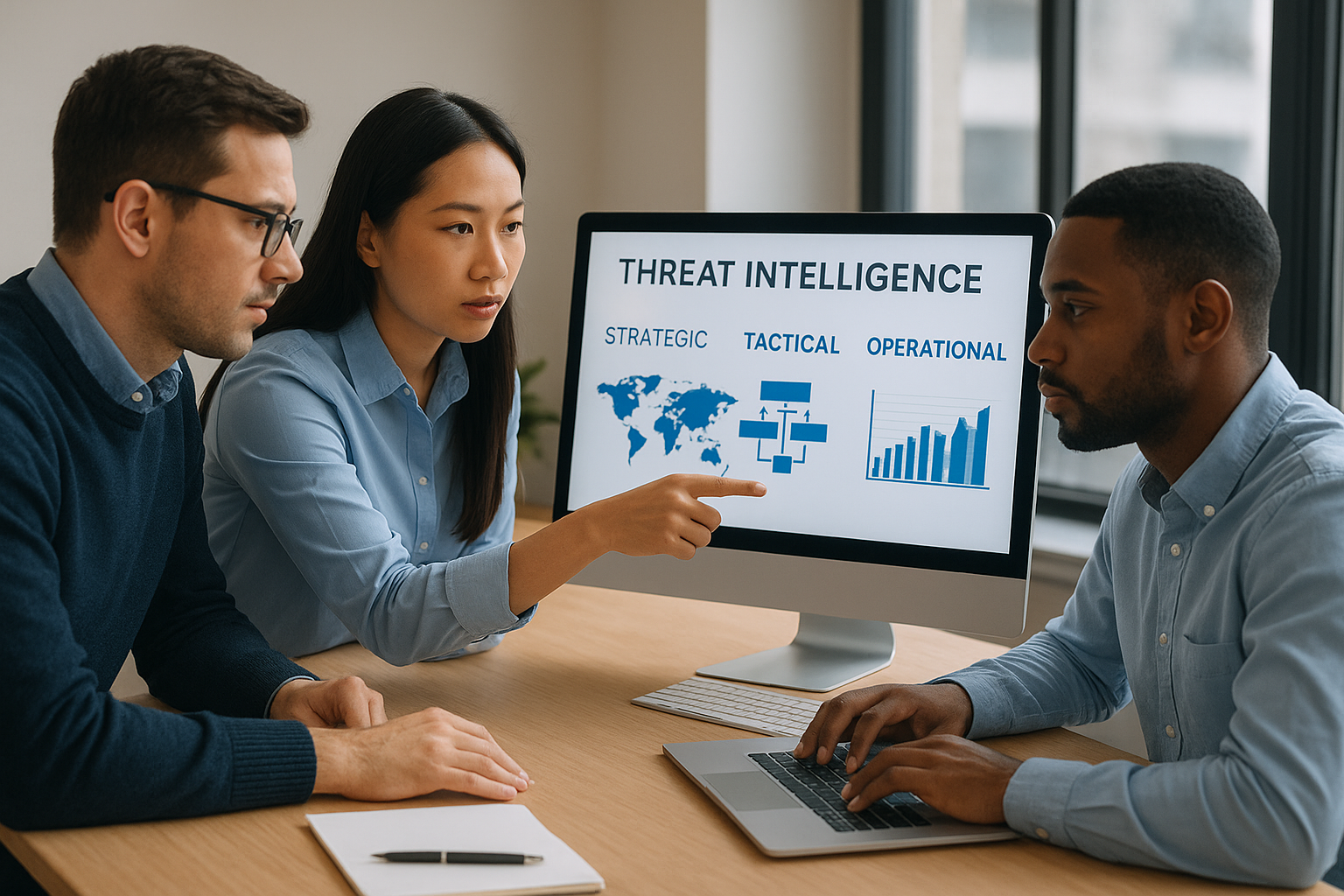
Understanding which type of intelligence your team needs prevents you from collecting data that looks impressive but never actually improves your defences.
Who uses threat intelligence and how
Your security team is the obvious consumer, but the benefits of threat intelligence extend across multiple functions within a business. IT managers use tactical and operational feeds to tune detection rules and prioritise patching. Compliance officers draw on strategic intelligence to demonstrate risk awareness to auditors and to satisfy requirements under frameworks such as ISO 27001. Business leaders and risk committees use it to make informed decisions about cyber insurance, supplier due diligence, and investment in controls. Insurers and loss adjusters also rely on threat intelligence when assessing claims and advising clients, which is why it features prominently in how TrustedIA structures its incident response engagements.
Common threat intelligence use cases and outcomes
The benefits of threat intelligence become most tangible when you examine specific scenarios where organisations have applied it to real problems. Across industries and organisation sizes, a handful of use cases consistently deliver the strongest and most measurable outcomes for security teams and decision-makers trying to justify investment.
Ransomware defence and early warning
Ransomware groups announce themselves on dark web forums and criminal marketplaces long before they deploy payloads. Dark Web Surveillance feeds alert your team when your organisation, sector, or suppliers are being discussed or actively targeted. Acting on that intelligence early, whether by tightening access controls, isolating legacy systems, or accelerating the deployment of critical patches, considerably shrinks the window attackers have to establish a foothold.
Early warning intelligence about ransomware campaigns has allowed organisations to pre-emptively isolate vulnerable systems before attackers completed their reconnaissance.
Supply chain and third-party risk
Your supply chain is often the weakest link in your security posture, and it is an area where many businesses have no visibility at all. Threat intelligence helps you monitor for compromises affecting your key suppliers, flagging when vendor credentials appear in breach data or when a known threat actor is targeting your industry’s supply base. This gives you the evidence needed to adjust supplier due diligence and strengthen contractual security requirements before an incident in a third party’s environment cascades into your own. Typical signals worth monitoring include:

- Credentials from your vendors appearing in dark web breach data
- Threat actor campaigns targeting your specific supply sector
- New vulnerabilities in software shared across your supplier network
How to build a threat intel programme and prove ROI
Building a threat intelligence programme does not require a large budget or a dedicated team from day one. What it does require is clarity about your risk profile and a structured approach to turning data into decisions. Start by identifying your most valuable assets, your likely threat actors based on your sector, and the intelligence types that address your most pressing gaps. That foundation shapes every subsequent investment.
Define requirements before selecting tools
Most organisations make the mistake of acquiring intelligence feeds before deciding what questions they need answered. Defining your intelligence requirements first prevents you from paying for data your team cannot act on. Map each requirement to a business outcome, such as faster patch prioritisation, reduced phishing success rates, or evidence of continuous risk assessment for ISO 27001. This alignment is what makes the benefits of threat intelligence measurable rather than theoretical.
Measuring ROI in concrete terms
ROI from threat intelligence shows up in several ways that your finance team and leadership can understand directly. Reduction in mean time to detect and mean time to respond are the clearest indicators, alongside fewer successful phishing attempts following simulation-and-intelligence-driven training. You can also track the cost of avoided incidents by documenting cases in which early-warning intelligence prevented a breach or accelerated a patching decision.
Framing ROI around avoided costs rather than abstract security scores makes the business case significantly easier to present to decision-makers.
Key takeaways and next steps
The benefits of threat intelligence are practical, measurable, and directly tied to how well your business can anticipate and manage risk. Throughout this article, you have seen how intelligence improves detection speed, sharpens resource prioritisation, supports ISO 27001 compliance, and strengthens supply chain oversight. These are not theoretical gains. They are outcomes that security teams and business leaders can track and report on.
Your next step depends on where you currently stand. If you have no intelligence programme in place, start by defining your highest-priority assets and the threat actors most likely to target your sector. If you already have some capability, audit whether your intelligence feeds are actually influencing decisions or just generating reports that nobody acts on.
Either way, having experienced support makes the difference between collecting data and using it effectively. Speak to TrustedIA about our managed security services and find out how we can help you build a threat intelligence programme that works.