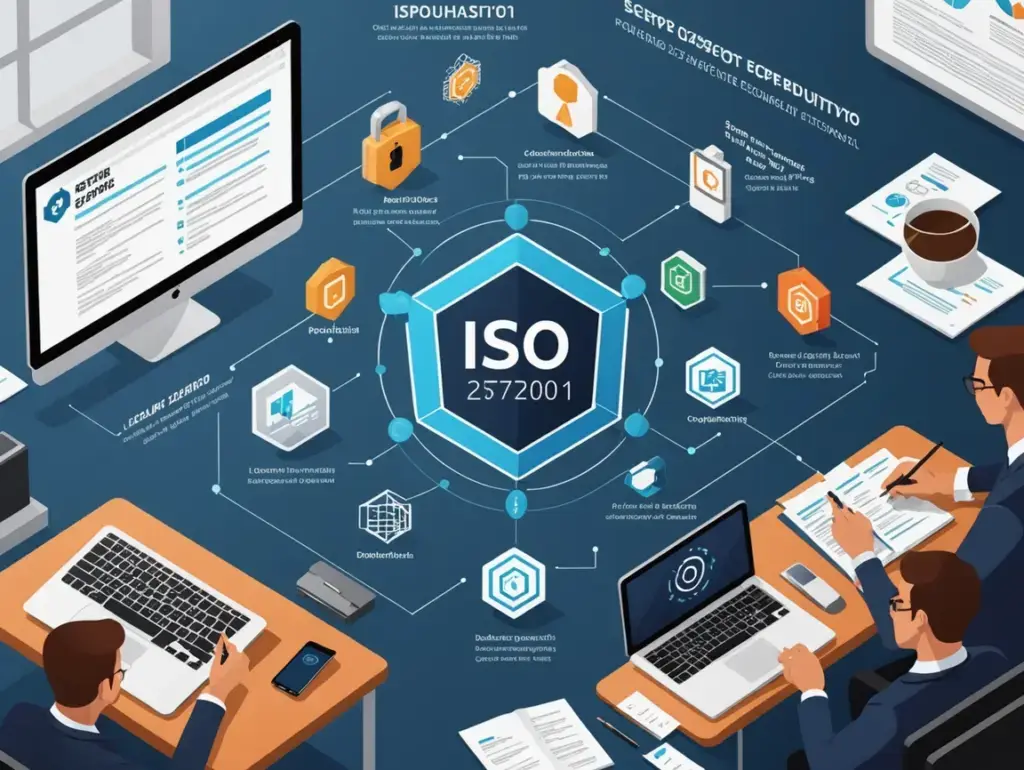
The stakes for information security have never been higher. As cyber threats become more sophisticated and regulatory scrutiny intensifies, organisations are under relentless pressure to safeguard their data, reputation and operations. For many UK businesses, ISO 27001 offers a proven framework—a blueprint for building resilience and trust by embedding robust information security management into the heart of the organisation.
ISO 27001 isn’t just another tick-box exercise; it’s an internationally recognised standard that sets out how to identify, manage and reduce information security risks systematically. When implemented well, it delivers more than compliance. It strengthens risk management, inspires confidence among clients and stakeholders, and sets your business apart in a competitive market.
But where do you start, and how can you ensure your efforts lead to certification and lasting improvement? This step-by-step guide demystifies the ISO 27001 implementation process, breaking it down into 10 practical steps designed for small and medium-sized enterprises, larger organisations, IT managers, CISOs and compliance leads alike. Along the way, you’ll find hands-on templates, examples and direct links to authoritative guidance—including data protection and Cyber Essentials mapping—to support your journey.
Whether you’re aiming for your first ISO 27001 certification or seeking to refresh and optimise your existing ISMS, this guide will equip you with the structure, clarity and confidence to move forward. Let’s get started on building a security-first culture that protects your business now and for the future.
Step 1: Create Your ISO 27001 Implementation Team
Before you get into policies or risk assessments, assemble a dedicated, cross-functional team to own and drive the ISMS project. A cohesive team with clear authority, deep expertise and representation from every corner of the business will ensure that security becomes an organisational priority rather than an IT side-project. Involving stakeholders from IT, legal, HR, operations and finance right from the outset helps to break down silos, surface hidden dependencies and secure buy-in for later phases.
Once you’ve defined who will sit on the team, it’s crucial to formalise the structure: appoint a project leader with the right credentials, map out roles and responsibilities, and secure the resources you’ll need to keep momentum. Below we outline how to choose your core group, establish a RACI matrix for key activities, and build a simple template to track roles, required time, budget and tools.
1.1 Appoint a Project Leader and Core Team
Your project leader should be someone with proven experience in information security—typically a CISO, an IT manager who has led compliance initiatives, or an external consultant with ISO 27001 credentials. This person needs the authority to set priorities, allocate resources and escalate issues to the board level when necessary.
Next, identify core team members drawn from:
- Information security: to advise on technical controls and threat landscapes
- Legal or compliance: to ensure regulatory and contractual obligations are met
- HR: to coordinate training, awareness campaigns and role-based access
- Operations or facilities: to address physical security and business continuity
- Finance or procurement: to manage budgets, vendor contracts and insurance
A simple RACI matrix can help clarify who’s Responsible, Accountable, Consulted or Informed for each major activity:
| Activity | Project Leader | IT Manager | Legal | HR | External Consultant |
|---|---|---|---|---|---|
| Define ISMS scope | A | R | C | I | I |
| Conduct gap analysis | R | A | C | I | C |
| Develop a risk treatment plan | C | R | C | I | A |
| Prepare management review | A | I | I | I | R |
1.2 Define Roles, Responsibilities and Resources
Once the core team is in place, spell out each person’s duties and the resources they’ll need. Typical roles include the ISMS Manager (oversees day-to-day ISMS tasks), Risk Owner (identifies and scores risks), Asset Owner (maintains the asset register) and Internal Auditor (verifies controls are working). Don’t forget to secure board-level sponsorship and carve out a dedicated budget for tools, training and any external audits.
Below is a template to help you capture roles, responsibilities, time allocation, budget estimates and required tools:
| Role | Responsibilities | Time Allocation | Budget Required | Tools |
|---|---|---|---|---|
| ISMS Manager | Lead ISMS implementation, update policies, and reporting. | 0.5 FTE | £12,000 | Document management system |
| Risk Owner | Identify, assess and prioritise risks | 0.3 FTE | £6,000 | Risk register application |
| Asset Owner | Maintain asset inventory, classify critical assets | 0.2 FTE | £3,000 | CMDB or spreadsheet template |
| Internal Auditor | Plan and execute internal audits, report findings | As needed | £5,000 | Audit checklist & logs |
By clarifying these elements at the outset, you’ll minimise confusion later on and provide a clear mandate for each team member—setting the stage for a more efficient, well-governed ISO 27001 project.
Step 2: Secure Management Approval and Establish Policy Framework
Having set up your core team, the next critical milestone is obtaining top management commitment and establishing a clear policy framework. ISO 27001 Clause 5 requires leadership to not only endorse the ISMS but also actively steer it—without visible board support, the project risks stalling or becoming a low-priority IT initiative. A robust policy framework signals to every department that information security is a strategic priority, backed by the organisation’s highest authority.
2.1 Obtain Top Management Commitment
Securing the board’s buy-in begins with a concise, data-driven business case. Focus on:
- Quantifying risk exposure: recent incidents, projected costs of downtime or data loss
- Comparing breach remediation costs versus ISMS implementation investment
- Highlighting compliance drivers: client requirements, regulatory fines, insurance premiums
- Demonstrating competitive advantage: winning tenders, reassuring partners
Deliver this in a short slide deck or executive memo that covers the ISMS objectives, scope, timeline, and a clear return-on-investment estimate. Be ready to answer questions on resource requirements and how progress will be measured.
Example: Management Approval Sign-off Form
| Project | ISO 27001 ISMS Implementation |
|---|---|
| Objectives | • Establish a formal ISMS • Achieve certification by Q4 |
| Scope | • All digital and physical information assets in UK offices |
| Budget | £50,000 over 12 months |
| Timeline | January 2026 – December 2026 |
| Name | Role | Signature | Date |
|---|---|---|---|
| [CEO Name] | Chief Exec | ||
| [CFO Name] | Finance Dir | ||
| [CISO Name] | CISO |
By signing above, top management confirms their commitment to provide sponsorship, adequate resources and ongoing oversight throughout the ISMS lifecycle.
2.2 Develop an Information Security Policy
With formal approval secured, the next step is drafting the overarching Information Security Policy—the keystone of your documentation hierarchy. This high-level policy should:
- Define the ISMS scope and key objectives
- Assert management’s commitment to risk management and continual improvement
- Assign roles and responsibilities (e.g. ISMS Manager, Risk Owners)
- Reference compliance obligations (GDPR, industry standards)
- Outline internal communication and awareness plans
Once the policy draft is ready, circulate it to senior stakeholders for review. Incorporate their feedback, then obtain a final sign-off from the board. Version control is essential: record the approval date, the policy owner, and the next review cycle (typically annual).
A well-crafted Information Security Policy makes it clear where your organisation stands on confidentiality, integrity and availability. It not only fulfils the requirements of ISO 27001 Clause 5 but also provides a visible commitment that resonates at every level—down to the individual access-badge user or remote-working employee.
Step 3: Understand Organisational Context and Stakeholder Requirements
An effective ISMS aligns with both your internal environment and the wider ecosystem in which you operate. ISO 27001 Clauses 4.1 and 4.2 ask you to examine the factors that influence information security and to capture the needs of parties who care about or can affect your ISMS. By taking time to understand these elements up front, you ensure that controls are relevant, risks are realistic, and compliance obligations are met.
Mapping your organisational context helps you tailor policies and risk treatments to genuine business drivers. Similarly, recording stakeholder expectations avoids surprises later—whether it’s a customer demanding tighter data-handling practices or a regulator insisting on specific reporting timelines. Below, we explain how to document internal and external issues through a SWOT analysis and how to build a stakeholder requirements register.
3.1 Identify Internal and External Issues (Clause 4.1)
Clause 4.1 requires a snapshot of the landscape in which your organisation operates. This includes:
- Market conditions and competitive pressures
- Regulatory environment and emerging legislation
- Business objectives, strategy and growth plans
- Current technology stack and legacy systems
A simple SWOT analysis can help capture these factors:
| Strengths | Weaknesses | Opportunities | Threats |
|---|---|---|---|
| Experienced IT and security team | Limited formal documentation | Expansion into new markets | New data protection regulations |
| Established vendor relationships | Fragmented asset inventory | Adoption of cloud services | Sophisticated cyber-attackers |
| Solution-agnostic approach | Minimal staff security training | Partnerships with industry bodies | Supply-chain vulnerabilities |
Use this table as a living document—review and update it regularly, especially when business strategies shift or new regulations arise.
3.2 Determine Needs and Expectations of Interested Parties (Clause 4.2)
Clause 4.2 focuses on the people, groups and organisations that have a stake in your ISMS. Typical interested parties include:
- Customers and prospects are looking for assurance on data security
- Regulators enforcing data protection and sector-specific rules
- Suppliers and partners with access to your systems or data
- Employees whose roles span from senior management to contractors
Record each stakeholder’s requirements in a register, noting the source and priority:
| Stakeholder | Requirement | Source | Priority | Owner |
|---|---|---|---|---|
| Major client | Annual evidence of encryption standards | Contract clause 5.2 | High | ISMS Manager |
| ICO | GDPR documentation and breach notification plan | UK GDPR | High | Legal Lead |
| Cloud provider | Proof of secure configurations and patching | SLA | Medium | IT Operations |
| All employees | Completion of annual security awareness training | HR policy | Medium | HR Manager |
By maintaining and reviewing this register, you can verify that your ISMS meets everyone’s expectations and remains aligned with contractual and regulatory requirements.
Step 4: Conduct a Gap Analysis Against ISO 27001 Requirements
Before you can remediate anything, you need to know where you stand today. A gap analysis is your toolbox for that: it compares existing processes, policies and technical controls against the full set of ISO 27001 clauses and Annex A controls. The aim is to uncover missing or weak areas and to capture them in a Gap Analysis Report. This report will form the basis of your remediation plan, highlighting which items require immediate attention and which can be addressed in subsequent ISMS cycles.
A thorough gap analysis does more than tick boxes. It’s an honest assessment of how far your current security posture aligns with the standard’s requirements and where you need to focus resources. By combining a simple “Yes/No” check with maturity scoring—say on a 0–5 scale—you get both a qualitative and quantitative view of each control. From there, you can drive targeted improvements, allocate budget sensibly and demonstrate progress clearly to management.
4.1 Map Existing Controls to ISO 27001 Clauses and Annex A
Begin by listing every ISO 27001 clause and each Annex A control. For each one, record whether you have a corresponding control, the location of evidence (policies, logs or configurations) and a maturity rating. A maturity score of 0 might mean “no control in place,” while 5 indicates “fully documented, tested and optimised.”
| ISO 27001 Clause / Annex A Control | Current Status (Y/N) | Evidence / Location | Maturity (0–5) |
|---|---|---|---|
| A.5.1 Information security policy | Y | ISMS Policy v1.2, SharePoint/corp | 4 |
| A.9.2.1 User access provisioning | N | — | 0 |
| A.12.6.1 Technical vulnerability management | Y | Vulnerability report, Tool X, Server | 3 |
| … | … | … | … |
That table forms the core of your Gap Analysis Report. Include a short narrative for each entry, noting key strengths (e.g. automated patching) and weaknesses (e.g. ad hoc user reviews). Capture any anomalies or undocumented exceptions—these often hide risks that become clean-up projects later.
4.2 Document Gaps and Prioritise Remediation Actions
Once you’ve mapped out your controls, identify the gaps (status “N” or maturity below your target threshold). Use a risk matrix to assign a priority based on likelihood and impact. For example, unauthorised access (A.9.2.1) may score High–High and require immediate remediation, whereas less critical items can be scheduled in line with annual budgets.
| Gap ID | Description | Impact / Likelihood | Priority (H/M/L) | Owner | Target Date |
|---|---|---|---|---|---|
| G-001 | No formal process for user provisioning | High / Medium | High | IT Manager | 2025-09-30 |
| G-002 | Outdated information security policy draft | Medium / Low | Medium | ISMS Manager | 2025-12-15 |
| G-003 | Incomplete vulnerability scan coverage | High / High | High | Security Lead | 2025-08-10 |
| G-004 | Missing incident response work instruction | Medium / Medium | Medium | Ops Manager | 2026-01-20 |
This gap remediation plan should be a living document. Update it after each progress review, and include status notes—“in progress”, “under review” or “completed.” Present these updates at your ISMS steering meetings or management reviews to maintain visibility and to secure any extra resources needed.
By systematically mapping controls, scoring maturity and prioritising gaps, you turn an abstract standard into a pragmatic action plan. This ensures that your ISO 27001 implementation is both structured and agile, focusing first on the most critical vulnerabilities and then tackling the rest in a controlled, auditable sequence.
Step 5: Perform a Comprehensive Risk Assessment
A thorough risk assessment lies at the heart of ISO 27001 (Clause 6.1). It reveals which information assets matter most, the threats they face and the vulnerabilities that could be exploited. The insights you gain here will drive your choice of controls, ensuring your effort and budget focus on the highest-priority risks rather than a one-size-fits-all approach.
Below, we guide you through three key activities: creating an asset register, mapping threats and vulnerabilities, and integrating Data Protection Impact Assessments (DPIAs) for GDPR compliance.
5.1 Create an Asset Inventory and Asset Register
Begin by cataloguing every asset that supports your information security objectives. Assets aren’t just servers and applications; they include data, physical devices, people and even critical facilities.
A simple asset register might look like this:
| Asset ID | Description | Owner | Location | Value (High/Med/Low) | C / I / A Rating |
|---|---|---|---|---|---|
| A-001 | Customer database | Database Admin | Data centre, London | High | C: High I: Med A: High |
| A-002 | Workstations (50 units) | IT Operations | HQ office, Manchester | Medium | C: Med I: Med A: Med |
| A-003 | HR policies and records | HR Manager | SharePoint | High | C: High I: High A: Med |
Key columns to include:
- Asset ID: Unique identifier for cross-referencing
- Description: Brief summary of what the asset is and its role
- Owner: Person responsible for the asset’s security
- Location: Physical or logical place (on-premises, cloud, mobile)
- Value: Business significance (High, Medium, Low)
- C / I / A Rating: Confidentiality, integrity and availability priorities
Maintaining this register is an ongoing task. Schedule periodic reviews—especially when you add new systems, merge with another organisation or retire obsolete assets.
5.2 Identify Threats, Vulnerabilities and Risks
With your asset register in place, list the threats and vulnerabilities associated with each item. Threats are potential events (e.g. malware outbreaks, phishing campaigns, insider misuse), while vulnerabilities are weaknesses (e.g. unpatched software, weak passwords, lack of segregation of duties).
Use a risk matrix to prioritise:
| Likelihood \ Impact | Low | Medium | High |
|---|---|---|---|
| High | Medium | High | Critical |
| Medium | Low | Medium | High |
| Low | Low | Low | Medium |
Then calculate a risk score, for example:
Risk Score = Likelihood x Impact
Assign numerical values (e.g. 1–3) to each axis if you prefer quantitative analysis. Capturing risks in a register helps track them:
| Risk ID | Asset ID | Threat | Vulnerability | Likelihood | Impact | Risk Level | Owner |
|---|---|---|---|---|---|---|---|
| R-001 | A-001 | Data breach via SQL injection | Web server unpatched | High | High | Critical | IT Security |
| R-002 | A-002 | Credential theft by phishing | No multi-factor authentication | Medium | Medium | Medium | HR Lead |
This structure makes it clear which risks demand immediate treatment and which can be monitored until more critical projects wrap up.
5.3 Integrate Data Protection Impact Assessments (DPIAs)
Under the UK GDPR, a DPIA is mandatory when your processing is likely to result in a high risk to individuals’ rights (for example, large-scale profiling or handling special category data). Embedding DPIAs within your ISO 27001 risk assessment ensures you meet both legal and security obligations.
Follow these steps:
- Describe the processing: What personal data is in scope and how it flows through your systems.
- Assess necessity and proportionality: Why is each processing activity required, and is there a less intrusive way?
- Identify risks to individuals: Consider the likelihood of harm and severity of consequences (e.g. identity theft, reputational damage).
- Propose and evaluate mitigations: From pseudonymisation and encryption to stricter access controls and retention limits.
For detailed guidance, refer to the ICO’s DPIA resource: Data Protection Impact Assessments (DPIAs).
By weaving DPIAs into your broader risk assessment, you build a more holistic picture of information risk—one that safeguards both business continuity and individual privacy.
Step 6: Develop a Risk Treatment Plan and Statement of Applicability
With your risks identified and prioritised, it’s time to decide how to handle each one. ISO/IEC 27001 outlines four treatment options: avoid, mitigate, transfer or accept. A risk treatment plan records these decisions, assigns control measures and sets timelines. Alongside this plan, you’ll produce a Statement of Applicability (SoA) to justify which Annex A controls you’ve implemented—or consciously omitted.
A clear, well-structured treatment plan ensures that resources are focused where they matter most. It also provides a transparent audit trail, showing how management agreed to handle risks and which safeguards are in place. Meanwhile, the SoA serves as a single reference document that maps your risks to the chosen controls and demonstrates compliance with ISO 27001.
6.1 Select Controls from Annex A
First, review each risk entry and choose the best treatment:
- Avoid the risk by changing processes or decommissioning risky assets
- Mitigate the risk by applying security controls (technical, administrative or physical)
- Transfer the risk via insurance, outsourcing or contractual agreements
- Accept the risk when it falls within your risk appetite and budget constraints
Here’s a sample mapping table:
| Risk ID | Treatment Option | Annex A Control | |
|---|---|---|---|
| R-001 | Mitigate | A.12.6.1 Technical vulnerability management | |
| R-004 | Transfer | — | |
| R-007 | Avoid | A.9.4.2 Secure log-on procedures | |
| R-009 | Accept | — |
Use this template as a starting point, then expand it with URLs to your policies, expected completion dates and resource requirements. Keep the table under version control to capture updates as your ISMS matures.
6.2 Document Your Statement of Applicability (SoA)
The Statement of Applicability is your master control register. It lists every Annex A control, states whether you have implemented it, and explains your rationale. A typical SoA contains:
| Control Number | Control Description | Status (Implemented/Excluded) | Justification |
|---|---|---|---|
| A.5.1.1 | Policies for information security | Implemented | Core to the ISMS policy framework |
| A.9.2.1 | User access provisioning | Implemented | Addresses critical access risks |
| A.10.1.1 | Cryptographic controls | Excluded | No high-risk data requiring encryption; compensating controls in place |
| … | … | … | … |
To make your SoA audit-ready:
- Apply strict version control—include version numbers, dates and authors.
- Secure sign-off from senior management to confirm that the chosen controls and exclusions are acceptable.
- Store the SoA alongside your risk treatment plan and asset register in a central, access-controlled repository.
By completing the risk treatment plan and Statement of Applicability, you create a robust link between your risk assessment and your ISMS controls. This not only drives effective risk reduction but also lays the groundwork for internal audits and eventual certification.
Step 7: Establish ISMS Policies, Procedures and Documentation Structure
Effective documentation is the backbone of any Information Security Management System. ISO 27001 requires a clear hierarchy of documents—policies, procedures, work instructions and records—that reflects how your organisation governs, executes and evidences its security practices. A well-defined structure not only makes audits smoother but also ensures everyone knows which rules to follow and where to find them.
At its simplest, you can think of your documentation as a pyramid:
- Policies (the “what” and “why”)
- Procedures (the “who” and “when”)
- Work Instructions (the “how”)
- Records (proof that tasks were completed)
By applying consistent naming conventions, version control and approval workflows, you keep documents current, accessible and auditable. In the sections below, we’ll show you how to map your ISMS hierarchy and implement a document control process.
7.1 Define Policy, Procedure and Work Instruction Hierarchy
Start by listing your high-level policies—these outline management’s commitment and set the direction for the entire ISMS. Common examples include:
- Access Control Policy: Rules for granting, reviewing and revoking user rights
- Password Management Policy: Minimum complexity, rotation and storage requirements
- Incident Response Policy: Roles, escalation paths and communication protocols
Each policy should reference the procedures that implement it. For example, the Access Control Policy might link to a “User Provisioning Procedure”, which in turn refers to a “Workstation Account Setup” instruction.
Use a simple table to visualise the hierarchy:
| Tier | Document Type | Purpose | Example |
|---|---|---|---|
| Level 1 – Policy | Policy | Define objectives, scope and leadership intent | Information Security Policy v1.0 |
| Level 2 – Procedure | Procedure | Describe roles, responsibilities and high-level steps | Access Control Procedure v1.2 |
| Level 3 – Work Instruction | Work Instruction | Provide detailed, step-by-step guidance | Account Setup – Windows 10 v2.0 |
| Level 4 – Record | Record | Capture evidence of compliance (logs, forms) | User Access Log – Nov 2025 |
Key points:
- Link each procedure to its controlling policy
- Ensure work instructions are concise and task-oriented
- Store records in a retention-aware repository (e.g. monthly audit logs)
7.2 Implement Document Control and Approval Processes
Without a robust control process, documentation can quickly become outdated or inconsistent. ISO 27001 mandates that all ISMS documents be reviewed, approved and versioned. Here’s how to set that up:
- Document Control Register: Maintain a central table listing every ISMS document along with its owner, version and review dates.
- Naming Convention: Adopt a clear format, for example:
DOC-ISO27001-{TypeCode}-{ShortTitle}-v{Major.Minor}
whereTypeCodeis P (Policy), PR (Procedure), WI (Work Instruction) or R (Record). - Approval Workflow: Require sign-off from the document owner and a senior member of management before publication.
- Review Cycle: Define review intervals (typically annually) and automatically flag documents nearing their review date.
- Obsolescence: Archive superseded versions, retaining them for audit purposes but excluding them from active use.
Below is a template for your Document Control Register:
| Document ID | Title | Type | Owner | Version | Approval Date | Next Review | Status |
|---|---|---|---|---|---|---|---|
| DOC-ISO27001-P-InfoSec-v1.0 | Information Security Policy | Policy | ISMS Manager | 1.0 | 2025-06-01 | 2026-06-01 | Active |
| DOC-ISO27001-PR-Access-v1.2 | Access Control Procedure | Procedure | IT Security Lead | 1.2 | 2025-03-15 | 2026-03-15 | Active |
| DOC-ISO27001-WI-SetupWin10-v2.0 | Account Setup – Windows 10 | Work Instr. | IT Operations | 2.0 | 2025-04-30 | 2026-04-30 | Active |
| DOC-ISO27001-R-UserLogNov25-v1.0 | User Access Log – Nov 2025 | Record | ISMS Administrator | 1.0 | n/a | n/a | Archived |
By embedding these controls into your ISMS, you’ll ensure that every document is up to date, compliant and easy to navigate—laying a solid foundation for audits, training and continual improvement.
Step 8: Implement Controls and Conduct Awareness Training
With your policies in place and your risk treatment plan approved, it’s time to put controls into action and ensure your team knows how to use them. Implementing technical, physical and administrative measures in line with your Statement of Applicability is a practical step towards reducing risk. Equally important is cultivating a security-aware workforce—after all, human error remains a leading cause of breaches. In this step, you’ll deploy the safeguards you’ve selected and roll out a training programme that embeds security into everyday operations.
8.1 Deploy Technical, Physical and Administrative Controls
Begin by staging your technical controls in a controlled environment, where you can verify they work as intended without disrupting business services. Examples include:
- Firewalls and intrusion detection systems to monitor and block unauthorised traffic
- Encryption technologies for data at rest and in transit, ensuring confidentiality
- Multi-factor authentication (MFA) on all remote and privileged accounts to prevent credential theft
- Regular vulnerability scanning and patch management tools to maintain up-to-date systems
Alongside these, review your physical security measures: CCTV coverage, door-entry systems, secure storage for media and visitor logging. Administrative controls—such as formal change-management processes, third-party security requirements and incident response playbooks—must also be codified in your procedures.
Pilot each control with a small user group or in one location first. Track performance metrics (for instance, patch-deployment times or successful MFA logins) and adjust configuration settings before rolling out broadly. This phased approach reduces operational risk and builds confidence among stakeholders.
8.2 Conduct Staff Training and Build a Security Culture
Even the best technical defences can be bypassed if staff aren’t aware of their responsibilities. A structured training programme helps reduce human error and reinforces the importance of following ISMS procedures. Key elements include:
- Phishing simulations to test and improve email hygiene
- Secure coding workshops for development teams, covering input validation and error handling
- Data-handling modules that outline classification, storage and disposal requirements
- Role-based training for high-risk groups (e.g. finance, HR or privileged IT users)
Track training attendance and knowledge retention through quizzes or practical exercises. Record completion status in an LMS or spreadsheet, and require refresher sessions at least annually. Publicise your security champions and highlight real-life lessons learned from incident debriefs. By celebrating wins—for example, catching a simulated phishing attack—you reinforce positive behaviour and cement security as part of your culture.
In combination, effective control deployment and a vibrant training programme turn policy into practice. They ensure your ISMS is more than a paperwork exercise: it becomes a living, evolving framework that protects your organisation and its people.
Step 9: Monitor, Measure, Audit and Review Your ISMS
Once your controls are in place and staff are trained, the work has only just begun. ISO 27001 Clause 9 mandates ongoing performance evaluation and periodic audits to ensure your ISMS remains aligned with business objectives and responds effectively to emerging threats. By defining meaningful metrics, conducting internal audits and holding structured management reviews, you’ll keep your information security measures both relevant and robust.
Regular monitoring highlights emerging gaps before they become incidents. Coupled with transparent reporting, it provides the evidence you need to demonstrate continual improvement, satisfy external auditors and secure ongoing management support.
9.1 Define Metrics, KPIs and Reporting Mechanisms
Choosing the right metrics helps you focus on what really matters—whether that’s incident response, control effectiveness or staff engagement. Common KPIs include:
- Number of security incidents detected and resolved
- Frequency and severity of internal audit non-conformities
- Average time to close corrective actions
- Percentage of critical systems patched within defined SLAs
- Staff completion rate for security awareness training
A simple KPI register might look like this:
| KPI | Target | Frequency | Data Source |
|---|---|---|---|
| Security incidents per month | ≤ 2 | Monthly | SIEM dashboard |
| Audit non-conformities (high/medium/low) | 0 / ≤ 3 / ≤ 5 | Quarterly | Internal audit reports |
| Mean time to close corrective actions (days) | ≤ 14 | Monthly | Issue tracking system |
| Patch compliance rate for critical systems (%) | ≥ 95 % | Monthly | Vulnerability management |
| Training completion rate (%) | ≥ 100 % annually | Annually | Learning management system |
To keep stakeholders informed, present these KPIs in a concise dashboard. For example:
| Category | KPI | Current | Target | Trend |
|---|---|---|---|---|
| Incident Response | Incidents this quarter | 1 | ≤ 2 | ↗ Stable |
| Audit | Open high-priority findings | 0 | 0 | ✔ Good |
| Remediation | Avg. time to close corrective actions | 12 days | ≤ 14d | ↘ Improving |
| Patch Management | Critical systems patched on time | 97 % | ≥ 95 % | ✔ Exceeds |
| Awareness Training | Staff completion rate | 100 % | ≥ 100 % | ✔ Achieved |
Visualisations—charts, traffic lights or trend arrows—make it easy for senior management to spot issues at a glance and to prioritise follow-up actions.
9.2 Carry Out Internal Audits and Management Reviews
Internal audits are your built-in health check. They verify that documented processes are being followed, controls are operating effectively, and any non-conformities are being addressed.
Key phases of an internal audit:
- Planning: Define scope, frequency and audit criteria. Develop an audit plan and schedule to ensure you cover all high-risk areas over time.
- Preparation: Create an audit checklist based on ISO 27001 clauses, Annex A controls and your own procedures. Notify auditees and gather relevant documents in advance.
- Fieldwork: Interview process owners, observe controls in action and sample records. Capture evidence—screenshots, logs, policy and procedural documents.
- Reporting: Summarise findings, classify non-conformities (minor, major) and propose corrective actions. Share the draft report with the responsible parties for factual review.
- Follow-up: Track the implementation of corrective actions, verify effectiveness and close out findings in your issue tracker.
Once internal audits are complete, it’s time for a formal management review. This meeting brings together senior leaders to evaluate ISMS performance and direct continual improvement:
Typical Inputs to a Management Review
- Results of internal audits and external assessments
- Status of corrective and preventive actions
- Changes in organisational context or risk landscape
- Feedback from interested parties (customers, regulators)
- KPI and trend reports
Expected Outputs
- Decisions on resource allocation (tools, training, budget)
- Updates to risk treatment plans or policies
- New objectives and targets for the next period
- Assignment of responsibilities for improvement projects
A simple template for management review minutes might be:
| Item | Discussion Summary | Action Owner | Deadline |
|---|---|---|---|
| Audit Findings | No major issues; two medium issues raised | IT Security | 2025-08-15 |
| KPI Performance | Incident rate stable; patch compliance up | Ops Manager | Ongoing |
| Risk Landscape | New cloud service onboarding adds risk | Risk Owner | 2025-09-30 |
| Resource Needs | Additional budget for the training platform | CISO | 2025-10-01 |
| Continual Improvement Projects | Review of remote access controls | ISMS Manager | 2025-12-01 |
By rigorously monitoring, measuring and auditing your ISMS—and by acting on the insights you gather—you’ll embed a culture of continual improvement. This not only keeps you audit-ready but also strengthens resilience as your organisation and its risk environment evolve.
Step 10: Prepare for ISO 27001 Certification and Ensure Continual Improvement
Implementing and running an ISMS brings you to the doorstep of formal certification—and beyond that, into a cycle of continual enhancement. At this stage, you’ll choose a suitable certification body, prepare your organisation for audit scrutiny, and establish processes to address non-conformities, conduct surveillance audits, and plan for future recertification. A disciplined approach here ensures you not only earn the ISO 27001 badge but also sustain and improve your security posture over the long term.
10.1 Select a Certification Body and Plan Audit Stages
Start by researching accredited certification bodies. Look for organisations listed in the International Accreditation Forum (IAF) database to ensure they meet global accreditation standards. Industry experience matters too—finding a reviewer who understands your sector’s nuances can speed up the audit and reduce unnecessary back-and-forth.
Certification audits happen in two main stages:
- Stage 1: Documentation review. The auditor checks that your ISMS documentation—policies, procedures, SoA, risk treatment plan and evidence of internal audits—meets ISO 27001 requirements. You’ll want all documents to be version-controlled, signed off, and readily accessible.
- Stage 2: On-site assessment. Auditors verify that the ISMS is operating as documented. They’ll interview staff, observe controls in action and sample records. Be prepared to demonstrate how policies translate into daily practice—from user provisioning to incident response drills.
Well before the audit, conduct a mock assessment or “pre-audit” to uncover any lingering gaps. Assign an audit coordinator to manage schedules, collate evidence and liaise with the certification body. Confirm timelines and deliverables in a formal contract, including dates for Stage 1 and Stage 2 reviews, estimated durations and fee structures.
10.2 Manage Corrective Actions and Surveillance Audits
After each audit stage, you may receive minor or major non-conformities. Treat these observations as opportunities for improvement:
- Analyse the root cause: Were they unclear procedures, a lack of training or missing records?
- Define corrective actions: Update the relevant policy or process, retrain the team or adjust your toolset.
- Verify effectiveness: Once changes are in place, test the control and document the result.
- Close the finding: Record closure evidence in your issue tracker and include it in your next management review.
Certification is not a one-off event. To maintain your ISO 27001 status, you’ll face annual surveillance audits to confirm ongoing compliance. Plan these reviews into your calendar and budget—typically conducted by the same certification body. Every three years, you’ll undergo a full recertification audit to renew your certificate.
By coupling audit preparation with an ingrained Plan-Do-Check-Act (PDCA) routine, you embed continual improvement at the heart of your ISMS. This ensures that your information security processes evolve alongside new threats, business changes and regulatory updates—keeping your organisation resilient and certified for years to come.
Next Steps in Your ISO 27001 Journey
Implementing ISO 27001 is a significant achievement, but the real value lies in sustaining and enhancing the Information Security Management System over time. By methodically working through the ten steps—from assembling your ISMS team and securing leadership approval, through risk assessment, control deployment and internal audits, to certification preparation—you’ve built a firm foundation for robust risk management, regulatory compliance and increased stakeholder confidence.
Certification marks a milestone, yet an effective ISMS is never static. Embrace a culture of continual improvement: monitor new threats, refine your controls, conduct refresher training and review policies regularly. Annual surveillance audits, management reviews and the Plan-Do-Check-Act cycle ensure your security measures evolve with your organisation’s needs and emerging risks.
If you’re ready to transform these next steps into measurable success, explore how TrustedIA’s ISO 27001 professional services and managed security solutions can help you maintain certification, optimise your controls and strengthen business resilience. Discover tailored support for every phase of your ISMS at TrustedIA ISO 27001 Services.