
Most organisations know they need better cyber security. Fewer know where to start. A cyber security strategy framework gives you that starting point, a structured, repeatable approach to identifying risks, setting priorities, and building defences that actually hold up when tested. Without one, security efforts tend to be reactive, patchy, and expensive. With one, every decision ties back to a clear plan.
Whether you’re exploring recognised frameworks like NIST or the NCSC’s Cyber Assessment Framework, or building something tailored to your organisation’s risk profile, the goal is the same: protect what matters and prove you’ve done it properly. For businesses working towards ISO 27001 certification, a well-defined strategy framework isn’t optional, it’s foundational.
At TrustedIA, we’ve spent over 30 years helping organisations move from ad-hoc security to structured, measurable resilience. Our work spans managed security services, ISO 27001 implementation, and hands-on incident response, so we’ve seen what works and what falls apart under pressure.
This guide walks you through each step of building a cyber security strategy framework, from assessing your current posture to selecting controls, assigning ownership, and keeping the whole thing current. No theory for theory’s sake, just a practical process you can put to work.
What a cyber security strategy framework is
A cyber security strategy framework is a structured set of principles, processes, and controls that guides how your organisation identifies, manages, and responds to cyber risk. Think of it as the governing document behind all your security decisions: it defines what you’re protecting, who owns each function, and how you’ll measure progress over time. Without this structure, individual security tools and policies float in isolation, and gaps appear between them that attackers find quickly.
The framework sits above day-to-day operations. It doesn’t replace your firewall configuration or your patching schedule. Instead, it sets the direction those operational activities follow. A well-built framework connects business objectives to security controls, so every investment and every response decision can be justified in terms your board, your auditors, and your insurers will accept. That alignment is what separates organisations with genuine resilience from those that simply have a lot of security products installed and no coherent plan binding them together.
A strategy framework doesn’t make you immune to attack. It makes sure that when something goes wrong, you know exactly what to do next.
The difference between a framework and a policy
A policy is a rule. A framework is the architecture that holds all your rules together. Your acceptable use policy tells staff what they can’t do with company devices. Your framework tells you which policies you need, how they relate to each other, who reviews them and when, and how they connect to the organisation’s broader risk appetite. One policy in isolation solves one problem. A framework solves the problem of having too many disconnected policies pulling in different directions.
This distinction matters in practice. Organisations that write policies without a governing framework tend to end up with overlapping, contradictory, or out-of-date documentation that nobody reads and nobody enforces. A framework forces you to treat security as a system rather than a checklist. Each control exists for a documented reason, maps to a documented risk, and has a documented owner, which is precisely what auditors and regulators want to see.
Recognised frameworks you can draw from
You don’t need to build from scratch. Several well-established, publicly available frameworks exist that you can adopt wholesale or use as a reference point when designing your own approach. The most commonly used include:
| Framework | Origin | Best suited for |
|---|---|---|
| NIST Cybersecurity Framework (CSF) | US National Institute of Standards and Technology | Organisations wanting a flexible, risk-based structure |
| NCSC Cyber Assessment Framework (CAF) | UK National Cyber Security Centre | UK operators of essential services and public sector bodies |
| ISO/IEC 27001 | International Organisation for Standardisation | Organisations seeking formal certification and auditable controls |
| CIS Controls | Centre for Internet Security | Organisations wanting a prioritised, practical control list |
Each of these frameworks covers similar ground in different ways. ISO 27001 is particularly relevant if you need external certification or operate in a regulated sector, since it provides a certifiable information security management system with clear documentation requirements. The NCSC CAF is the UK government’s preferred reference for critical national infrastructure and public sector organisations. Most organisations find it useful to pick one primary framework and supplement it with elements from others where their specific risk profile demands it, rather than trying to implement every framework simultaneously.
Step 1. Set scope, outcomes, and governance
Before you touch any framework, controls, or risk registers, you need to answer three questions: what does this strategy cover, what does success look like, and who is accountable for it. Skipping this step is the most common reason security programmes drift. Without clear scope and governance, teams make decisions in isolation, ownership stays ambiguous, and the whole effort eventually collapses into a set of documents nobody updates.
Define what’s in scope
Your scope statement tells everyone inside and outside the security function which parts of the organisation this strategy governs. It should name specific business units, systems, geographic locations, and data types. If you operate cloud infrastructure alongside on-premise servers, both belong in scope. If a third party processes data on your behalf, their access points and responsibilities need to appear here too. Use this template as a starting point:
This cyber security strategy framework applies to [organisation name], covering all business units, systems, and data processed across [locations/environments], and extends to third parties with access to [specific data types or systems].
Outcomes should be equally specific. Avoid vague goals like "improve security posture" and state something measurable instead: "Achieve ISO 27001 certification by Q4" or "Reduce mean time to detect a breach from 14 days to 48 hours within 12 months." Measurable outcomes give you something to report against and give the board a clear reason to stay engaged.
Assign ownership and governance
Every part of your framework needs a named owner, not a team, not a department, but a named individual. This person signs off on that control area, fields audit questions about it, and escalates when something slips. Without named ownership, accountability distributes itself into nothing.
Your governance model should also define how often the framework gets reviewed and who holds authority to approve changes. A quarterly review cadence works for most organisations, with a full annual review tied to any significant change in the business, such as a merger, a new product line, or a major infrastructure shift. Document this formally, because auditors will ask to see it and the absence of a documented process tells them exactly what they need to know.
Step 2. Map assets, data, and business services
You cannot protect what you haven’t identified. Before your cyber security strategy framework can assign controls to anything, you need a clear, accurate inventory of every asset, dataset, and business service that the strategy governs. Most organisations underestimate how much ground this covers. Shadow IT, legacy systems, and unmanaged endpoints regularly appear during mapping exercises in places nobody expected them.
Build your asset inventory
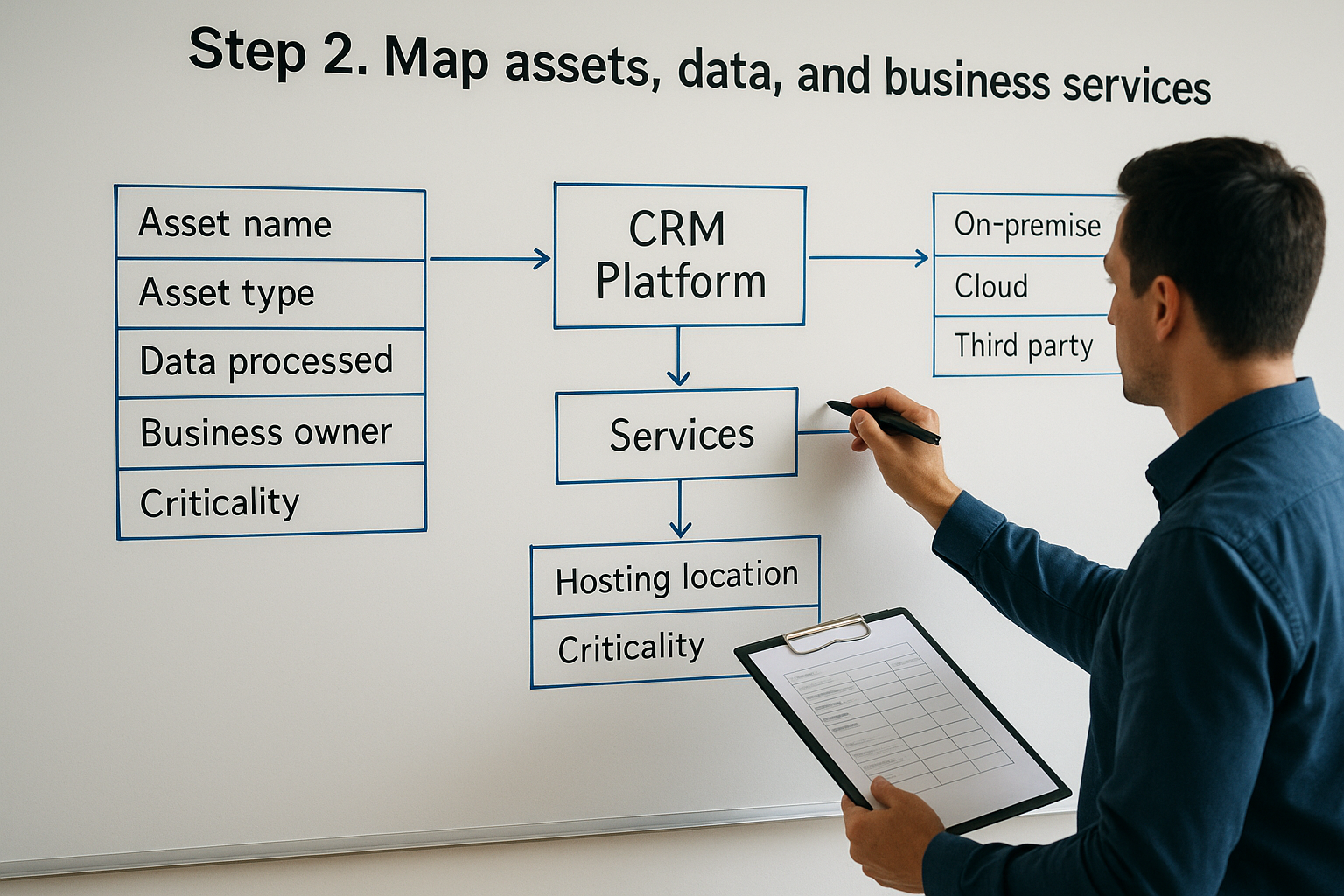
Your asset inventory is the foundation that everything else builds on. Start by categorising assets across four types: hardware (servers, endpoints, networking equipment), software (applications, operating systems, SaaS platforms), data (customer records, financial data, intellectual property), and services (business processes that depend on the above). For each asset, record the owner, its business criticality, and where it lives: on-premise, cloud, or with a third party.
Use this template as a starting point for each entry:
| Field | Example |
|---|---|
| Asset name | CRM Platform |
| Asset type | SaaS application |
| Data processed | Customer PII |
| Business owner | Sales Director |
| Hosting location | Cloud (vendor-managed) |
| Criticality | High |
| Third-party dependency | Yes |
Criticality ratings drive everything downstream. An asset rated "High" should immediately attract stronger controls, stricter access policies, and more frequent review cycles.
Identify data flows and business dependencies
Once you have your inventory, map how data moves between assets and which business services depend on which systems. A breach affecting a low-priority-looking server can cascade quickly if that server sits in the path of a critical data flow you hadn’t traced. Walk through each high-criticality service and ask: what does this depend on, and what depends on it? Document both directions, not just inbound dependencies.
Third-party connections deserve particular attention. Suppliers, partners, and cloud providers that touch your data extend your attack surface whether you account for them or not. Documenting these dependencies now means you can assign appropriate controls, set contractual security requirements, and respond faster if a supplier suffers an incident that ripples into your environment.
Step 3. Assess risk and current maturity
With your assets and data flows mapped, you’re ready to look at two things in parallel: how exposed you are to risk, and how capable your current security programme is of handling that exposure. Running these assessments together gives you a realistic picture of where your cyber security strategy framework needs to close gaps first, rather than spreading effort evenly across controls that don’t all carry the same weight.
Score your current maturity
Maturity scoring tells you how developed your security capabilities are across key domains. A simple five-level scale works well for most organisations:
| Level | Label | What it means |
|---|---|---|
| 1 | Initial | Ad hoc, no documented processes |
| 2 | Developing | Some processes exist but are inconsistent |
| 3 | Defined | Processes documented and consistently applied |
| 4 | Managed | Processes measured and controlled |
| 5 | Optimising | Continuous improvement embedded |
Score each control domain, such as access management, incident response, vulnerability management, and third-party risk, against this scale. Be honest. Most organisations discover they’re operating at level 2 or 3 in several areas they assumed were mature, and those gaps become your highest-priority workstreams.
Maturity scores are only useful if they reflect reality. Overrating your own capabilities means your roadmap will underinvest in exactly the areas that need the most work.
Build your risk register
Your risk register captures every identified risk, its likelihood, and its potential impact, alongside the controls currently in place to mitigate it. For each risk, assign a residual risk rating after accounting for existing controls, then decide whether to treat, tolerate, transfer, or terminate that risk. Use this structure for each entry:
| Field | Example |
|---|---|
| Risk description | Ransomware encrypts critical file server |
| Likelihood (1-5) | 4 |
| Impact (1-5) | 5 |
| Current controls | Endpoint detection, daily backups |
| Residual risk score | High |
| Treatment decision | Treat: add offline backup, test restoration quarterly |
| Risk owner | IT Manager |
Populate this register from your asset inventory and data flow mapping completed in Step 2. Every high-criticality asset should have at least one corresponding risk entry, and you should review and update the register whenever your environment changes significantly, and formally at each quarterly governance review.
Step 4. Choose a framework and build controls
Your risk register and maturity scores from Step 3 now tell you where your biggest gaps sit and which domains carry the most unmitigated exposure. That information drives your framework selection. Choosing a framework without this context is guesswork. Choosing one with it means you can immediately map its control requirements against your actual risk profile and see precisely what work needs doing first.
Select your primary framework
Pick the framework that best matches your organisation’s regulatory environment, certification goals, and existing capability. For most UK businesses, the shortlist comes down to ISO 27001 if you need a certifiable standard, the NCSC Cyber Assessment Framework if you operate critical infrastructure or supply public sector contracts, or the NIST Cybersecurity Framework if you want a flexible, risk-based reference without mandatory certification. You can layer controls from multiple frameworks, but designate one as your primary governance structure to avoid conflicts.
Trying to implement every framework at once pulls resource in too many directions and typically results in none of them being done well.
Use this decision guide to narrow your choice:
| Primary driver | Recommended framework |
|---|---|
| Formal certification required | ISO/IEC 27001 |
| UK public sector or CNI supplier | NCSC CAF |
| Flexible, risk-led approach | NIST CSF |
| Prioritised, practical control list | CIS Controls |
Map controls to your risks
With your framework selected, work through your risk register and assign at least one control to every high and critical risk entry. For each control, document the framework reference it comes from, the asset or risk it addresses, the named owner, and the current implementation status. This mapping is what your auditors will trace during any formal review, and it is also what keeps your cyber security strategy framework from becoming a shelf document that nobody consults day to day.
Use this template for each control entry:
| Field | Example |
|---|---|
| Control reference | ISO 27001 A.8.3 |
| Risk addressed | Ransomware via unpatched endpoint |
| Control description | Automated patch deployment within 48 hours of release |
| Asset covered | All managed endpoints |
| Owner | IT Manager |
| Implementation status | Partially implemented |
| Target completion | Q3 2026 |
Prioritise controls that close high residual risk entries from your register before addressing medium or low-rated gaps. This keeps your implementation effort proportional to actual exposure rather than spreading it evenly across the control catalogue.
Step 5. Create a roadmap, metrics, and review cadence
Controls without a delivery timeline stay permanently half-finished. Your cyber security strategy framework only delivers value when it moves from a list of intentions to a scheduled, sequenced plan with clear owners and dates attached. Step 5 turns everything you’ve built in the previous steps into something executable.
Build your implementation roadmap
Organise your control implementation across three time horizons: immediate actions (0-3 months) for high residual risk items, medium-term improvements (3-12 months) for defined and managed capability gaps, and strategic investments (12 months plus) for optimisation-level work. Pull directly from your control mapping in Step 4 and slot each item into the appropriate horizon based on its risk rating.
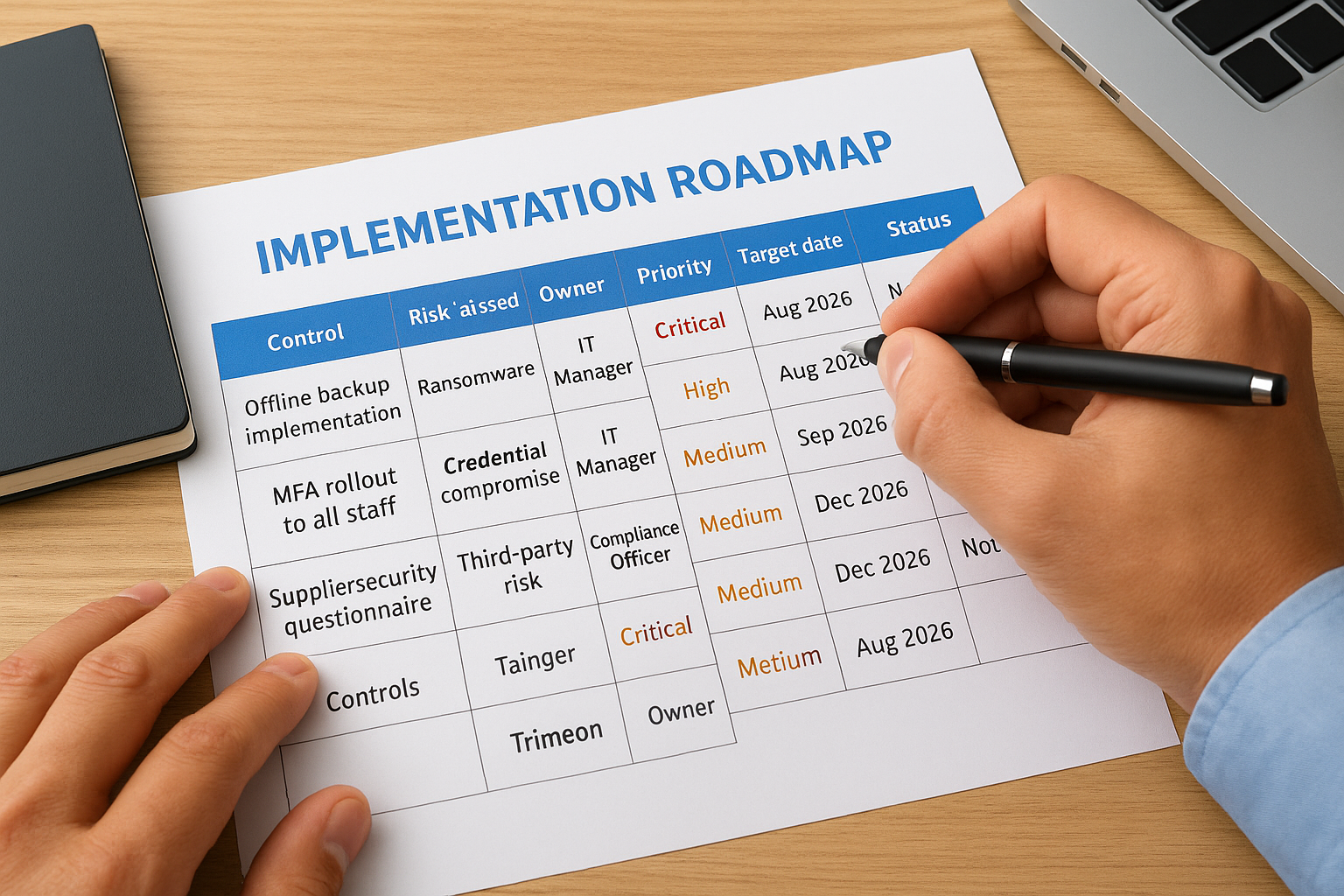
Use this template structure for each roadmap entry:
| Control | Risk addressed | Owner | Priority | Start date | Target date | Status |
|---|---|---|---|---|---|---|
| Offline backup implementation | Ransomware | IT Manager | Critical | Jul 2026 | Aug 2026 | Not started |
| MFA rollout to all staff | Credential compromise | IT Manager | High | Jul 2026 | Sep 2026 | In progress |
| Supplier security questionnaire | Third-party risk | Compliance Officer | Medium | Sep 2026 | Dec 2026 | Not started |
Define your metrics
Metrics keep your board engaged and your programme honest. Choose a small number of indicators that reflect real-world security performance rather than activity, and review them consistently at every governance meeting. Tracking whether patches are applied tells you much less than tracking how quickly critical patches reach every endpoint after release.
Metrics you don’t act on aren’t metrics. They’re just numbers in a spreadsheet.
A practical starting set includes: mean time to detect (MTTD) and respond (MTTR) to incidents, percentage of critical vulnerabilities remediated within your defined SLA, phishing simulation click rates over time, and percentage of staff with up-to-date security training. Each metric should have a defined owner, a baseline, and a target.
Set your review cadence
Quarterly governance reviews keep the framework current without creating review fatigue. Each quarterly session should check metric performance, update the risk register for any environmental changes, and confirm that roadmap milestones are on track. Pair this with a full annual review that reassesses scope, maturity scores, and strategic priorities, particularly after any significant business change such as a new system, acquisition, or regulatory requirement.
Bringing it all together
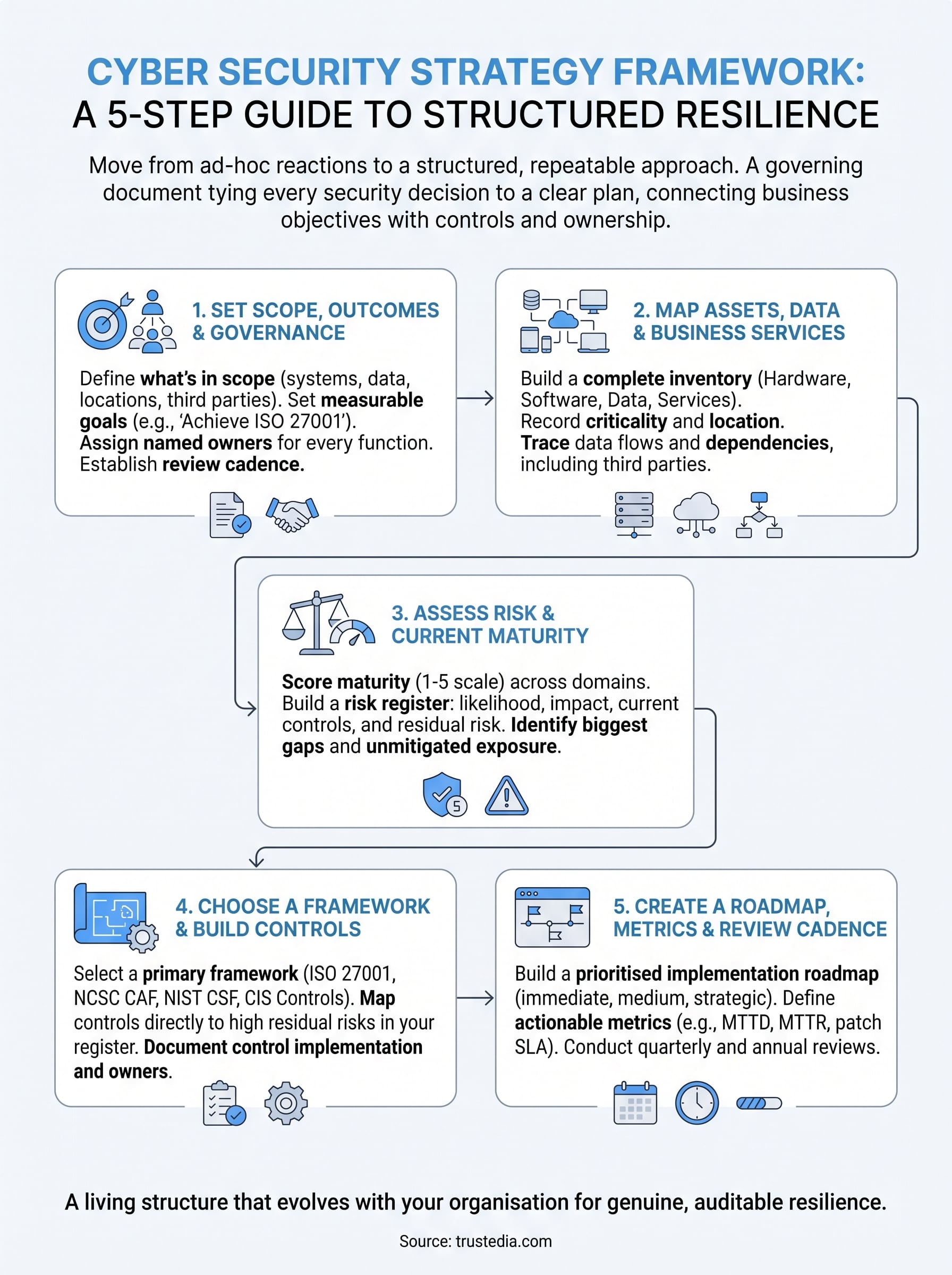
A cyber security strategy framework is not a one-time project. It is a living structure that grows with your organisation, your threat environment, and your business priorities. The five steps in this guide give you a repeatable process: define scope and governance, map assets, assess risk and maturity, select controls, and build a roadmap you actually deliver against. Each step feeds the next, so cutting corners early means compounding problems later.
Most organisations struggle not because the frameworks are complicated, but because they lack the internal resource to run the process properly and keep it current. That is where having experienced support makes a measurable difference to both the quality of your strategy and the speed at which you close gaps. If you want expert guidance on building or strengthening your security programme, speak to TrustedIA and find out how we help organisations turn strategy into genuine, auditable resilience.



