
The best external data protection officer services give you a named, qualified and independent DPO on a clear contract, with enough sector knowledge to understand your data. A fully outsourced DPO suits most small and mid-sized UK firms. A law firm suits high-risk or cross-border processing. An interim DPO suits a vacancy or a clean-up project, and a shared DPO suits school groups, councils and related companies.
The problem is that providers sell very different things under the same label. Some give you a named person on a retainer. Others sell a software platform with advice attached. If you choose on price alone, you can end up with a DPO who has no time for you, or one who cannot meet the independence rules.
This article sets out six models of data protection officer services in the UK, who each one suits, and how each is priced. We work on the cyber security side at TrustedIA, so we also show where a DPO’s advice meets the security controls you have to run.
What an external DPO does under UK GDPR

An external DPO is an outside person or organisation that holds the statutory DPO role for you under a service contract. The ICO confirms you can contract out the role, and an external appointee has the same position, tasks and duties as an internal one. Every option below has to meet that standard.
When you must appoint one
You must appoint a DPO if one of three conditions applies. You can also appoint one voluntarily, but the same requirements then apply, so do not use the title loosely.
- You are a public authority or body, other than a court acting in its judicial capacity.
- Your core activities involve large-scale, regular and systematic monitoring of individuals, such as tracking online behaviour.
- Your core activities involve large-scale processing of special category data or criminal offence data.
The ICO is reviewing its data protection officers guidance following the Data (Use and Access) Act, so check the current version before you sign anything.
What the role involves
The DPO’s tasks come from Article 39, which sets out the role of the data protection officer under GDPR. They inform and advise you and your staff, monitor compliance through policies, training and audits, advise on data protection impact assessments (DPIAs), and act as the ICO’s first point of contact. They should focus on the riskiest processing first, such as special category data. If you decide not to follow their advice, record your reasons.
The DPO is not personally liable for your compliance. Responsibility stays with you as controller or processor.
An external DPO advises on compliance, but the legal responsibility never leaves your organisation.
Rules that outsourcing does not change
Your provider must be independent, report to your highest management level, and have the time, resources and data access to do the job. You cannot penalise them for doing it. Conflicts of interest matter too. The ICO’s example is a head of marketing who plans campaigns, and who therefore cannot also be the DPO.
You must publish the DPO’s contact details and give them to the ICO. You do not have to publish their name. You do have to give the name when you report a personal data breach to the ICO and to the people affected.
1. Fully outsourced DPO as a service
How it works
A provider appoints a named, qualified DPO to your organisation on a service contract, usually with a team covering holidays and sickness. This is the most common form of external data protection officer services in the UK. Typical deliverables include:
- A yearly monitoring plan covering policies, records and training
- Advice on DPIAs and data protection by design
- A contact route for staff and data subjects
- ICO liaison and breach advice
Who it suits
Small and mid-sized firms with no privacy specialist get the most from this model. Think of a software company tracking user behaviour at scale, or a clinic holding health records. You gain qualified expertise without a salary, and the provider’s other clients give them useful benchmarks for what good looks like.
It also works when your obvious internal candidate has a conflict. An IT director or marketing head decides how data is used, so they cannot act independently.
If your internal candidate decides how data is used, an outsourced DPO is the cleaner answer.
Cost and trade-offs
Expect a fixed monthly or annual retainer, which makes budgeting easy. The trade-off is time. Your DPO serves other clients, so get contact hours and response times in writing. A generic annual review adds little, so ask how quickly they will learn your business.
Ask who the named DPO is and what happens if they leave. Continuity is the real product you are buying.
2. Interim or fixed-term external DPO
How it works
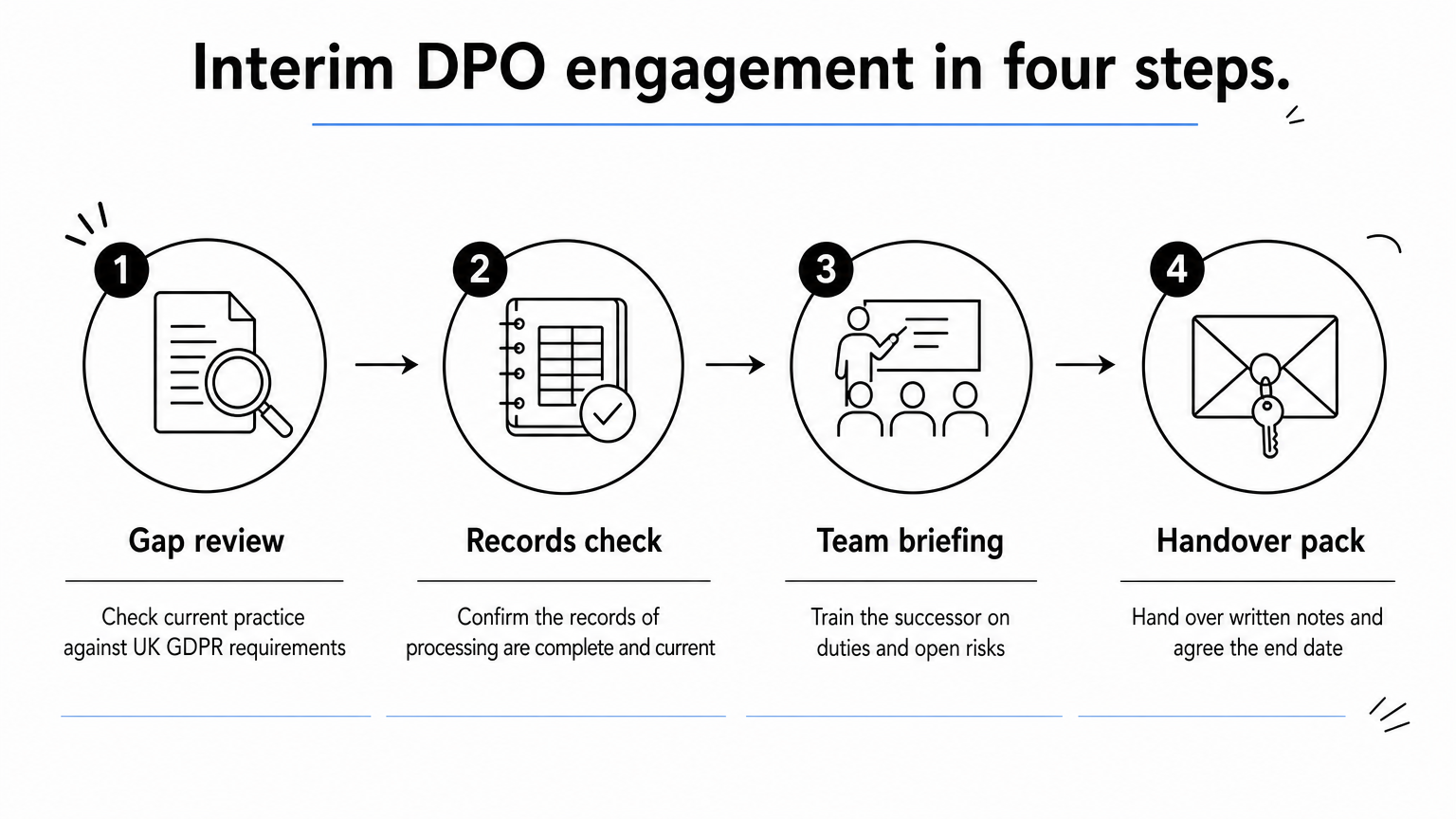
An interim DPO is appointed for weeks or months, not years. They hold the statutory role while you recruit, cover a resignation or leave of absence, or lead a defined project such as post-incident remediation or a merger. A good engagement ends with a handover pack.
- A gap review against UK GDPR
- A check of your records of processing
- Training or briefing for the successor
Who it suits
This fits firms that have just lost their DPO, or have discovered they cross a mandatory threshold and need an appointment fast. It also suits businesses preparing for investment or sale, where a clean data protection position speeds up due diligence.
It is a poor fit if you simply want the cheapest long-term cover. A rolling interim contract costs more per day than a standard retainer.
Cost and trade-offs
Pricing is usually a fixed term or day rate. You pay more per day, but only for the time you need. The risk is the handover. Insist on written handover notes and an agreed end date, or you will repeat the onboarding cost with each new person.
Treat an interim DPO as a bridge, and agree what the bridge leads to before it starts.
3. Law firm DPO service
How it works
A privacy law firm acts as your DPO and puts one of its lawyers forward as the named individual. You get the DPO role plus legal depth on tricky questions, such as international transfers, contract terms and regulatory enquiries. Some firms keep the DPO role separate from their wider legal advice, so check how engagements are structured.
Who it suits
This model suits organisations where the legal risk is high. Examples include large-scale special category data, processing across several countries, or a regulator already taking an interest in you. If a DPO’s advice may be tested in front of the ICO, a lawyer’s reasoning carries weight.
For a ten-person consultancy with a customer list and a payroll system, it is usually more than you need.
Cost and trade-offs
Law firms usually charge hourly rates or capped fixed fees, and this is typically the most expensive option. Ask whether the named DPO is a senior lawyer or a junior one supervised by a partner. Also confirm how the firm manages the line between independent DPO advice and its other work for you, because conflicts can arise.
Pay for a law firm DPO when the legal exposure is real, not for routine compliance.
4. Shared DPO for groups and public bodies
How it works

One DPO serves several organisations. The ICO says you can appoint a single DPO for a group of companies or public authorities, provided they can still do the job effectively given the size and structure of each body. The DPO must be easily accessible to staff, individuals and the ICO, and may need a team behind them.
Who it suits
Shared DPOs are common among schools, multi-academy trusts, local councils and groups of related companies. These bodies often must appoint a DPO but cannot justify a full-time post. A common DPO also gives you consistent policies across sites.
Sharing works best when the members process similar data. A group mixing a nursery and a software house gets little benefit.
Cost and trade-offs
The fee is split across members, so each pays a fraction of a dedicated role. The risk is capacity. Ask how many bodies the DPO covers and how many hours each gets. The ICO also expects a team where the group is large or complex, so ask whether support staff sit behind the named DPO.
5. DPO bundled with a compliance platform
How it works

Here the DPO service comes with software. The platform holds your records of processing, DPIAs, data subject request log, incident register and training records. The DPO reviews and advises using that data, so evidence is stored in one place that you can show an auditor.
Who it suits
It suits firms that want an audit trail, or that are also working towards ISO 27001. The 2022 edition of the standard includes a control on privacy and protection of personally identifiable information (Annex A 5.34), and a shared evidence base serves both aims. It also helps organisations where several people handle data subject requests and need a shared log.
If you have a handful of processing activities, a spreadsheet and a good DPO may do just as well.
Cost and trade-offs
You usually pay a subscription plus a service fee. Check what happens to your records if you leave, and whether you can export them in a usable format. Software does not replace judgement. Make sure a named person reviews your risks, not just a dashboard.
A platform stores your evidence, but only a competent DPO can tell you what it means.
6. External advisory support alongside an internal DPO
How it works
Your own DPO or privacy lead stays in the role, and an outside provider sells blocks of hours for second opinions, DPIA reviews, audits or ICO correspondence. This is not an outsourced DPO. The ICO says you must designate a single DPO, and other specialists you hire should not be called your DPO.
Who it suits
It suits larger organisations with a capable in-house DPO who occasionally need specialist input. It also helps where an employee carries the DPO title on top of another job and lacks capacity for a large project.
It does not fix independence. If your internal DPO also decides how data is used, adding advisory hours will not cure the conflict. You would need a different model.
Cost and trade-offs
Pricing is typically prepaid hours or a day rate, so you only pay when you need help. The downside is that nobody outside your business monitors compliance continuously. Agree a target response time and a named contact, so urgent questions do not wait in a queue behind other clients.
How to choose an external DPO provider
Choose the model first, then the provider. Match the risk of your processing to the option, then test the provider’s answers on time, independence and continuity. A cheap retainer with no guaranteed hours is a poor deal.
Comparing the six options
| Option | Best for | Commitment | Main risk |
|---|---|---|---|
| Outsourced DPO | SMEs without privacy staff | Ongoing retainer | Limited contact time |
| Interim DPO | Vacancies and projects | Fixed term | Weak handover |
| Law firm DPO | High-risk, cross-border | Hourly or capped fee | Highest cost |
| Shared DPO | Groups, schools, councils | Ongoing, shared fee | Stretched capacity |
| Platform bundle | Audit evidence needs | Subscription plus fee | Lock-in |
| Advisory support | Firms with a DPO already | Prepaid hours | No independent oversight |
Questions to ask before you sign
Put these to every shortlisted provider:
- Who is the named DPO, and what qualifications and sector experience do they have?
- How many hours or contact days are included, and what is the response time?
- How do you handle conflicts of interest with our other suppliers or advisers?
- What happens if the named DPO leaves?
- Will the DPO report to our board or senior management directly?
- What do we get on exit, and in what format?
Where security fits
A DPO tells you what the law expects. You still have to build the controls, such as access management, testing and incident response. We help with that side at TrustedIA, through ISO 27001 support, audits and incident response. Your DPO will lean on those controls when advising on breaches, so line the two up early.
Pick the DPO model that fits your risk, then test the provider on hours, independence and continuity.
Picking a DPO you can rely on
The right external DPO is a named, qualified and independent person who has real hours for your business and a contract that survives staff changes. Most small and mid-sized UK firms will land on a fully outsourced DPO. Higher-risk or cross-border firms should look at a law firm, groups and public bodies at a shared model, and anyone with a gap at an interim one.
Whichever option you take, remember that the legal responsibility stays with you. Your DPO advises, and you act on it. That means the security controls behind your data matter as much as the DPO’s opinion.
If you want to see how ISO 27001 and GDPR compliance work together, and how audits and incident response fit around your data protection obligations, talk to TrustedIA about the security side of your compliance.



