
Attack surface management vs vulnerability management comes down to scope. Attack surface management (ASM) continuously discovers and reduces everything an attacker can reach, including assets you did not know you had. Vulnerability management (VM) finds, prioritises and fixes known weaknesses in assets you already track. ASM answers "what do we have exposed?" and VM answers "what is wrong with it?"
This guide goes beyond that bare definition. You will see why the distinction matters, how the two differ on scope, asset discovery and approach, and how to run them together as one cycle. You will also see what each one catches in practice and where a small team should start.
At TrustedIA we run vulnerability assessments, penetration tests, dark web surveillance and ISO 27001 projects for UK businesses, and one pattern keeps repeating. Organisations scan diligently, then get caught out by the one system that was never on the list. The aim here is to stop that happening to you.
Why the difference between ASM and VM matters

The difference matters because each discipline fails exactly where the other is strong. A vulnerability management programme can run flawlessly and still miss the system that causes your breach, because it only ever scans what is on the list.
Each approach fails in a different place
Vulnerability management is only as good as its asset list. Point a scanner at 200 known IP addresses and it reports on 200 addresses, nothing more. A forgotten test server or an unrecorded cloud instance never appears in the results, so nobody sees the gap or the risk behind it.

Attack surface management has the opposite weakness. It is excellent at finding what is exposed, but discovery on its own fixes nothing. Without a working remediation process and regular vulnerability scanning, an ASM tool simply produces a longer list of things nobody has time to act on.
Vulnerability management tells you how healthy your known assets are, while attack surface management tells you whether you know all of them.
How the gaps appear in real businesses
Gaps rarely come from carelessness. They come from normal business activity. A marketing team launches a campaign microsite, a developer creates a staging environment for a week and forgets it, or a supplier hosts a portal under your domain. Each one widens your external attack surface without passing through IT change control.
Speed adds pressure. Attackers often begin exploiting a newly disclosed flaw within days, and sometimes sooner. When a vendor announces a serious issue in a VPN appliance or web server, your first question is which of our systems run it. Only a current, accurate inventory answers that in minutes rather than weeks. That is why attack surface management vs vulnerability management is not an either/or choice.
What it means for ISO 27001
If you work towards ISO 27001:2022, the link is explicit. Control 5.9 expects an inventory of information and associated assets, and control 8.8 expects you to manage technical vulnerabilities. Auditors reading 8.8 will look for evidence that you identify flaws, assess your exposure and act on both.
That evidence is only as credible as the inventory behind control 5.9. In our experience of ISO 27001 projects, external discovery is the quickest way to test whether that inventory is really complete.
How the two differ on scope, discovery and approach
Vulnerability management starts from a list of assets you know and checks them for known flaws. Attack surface management starts from the attacker’s side and finds assets you did not know existed. Every other difference follows from that contrast.
Scope and starting point
Vulnerability management covers the assets in your inventory: servers, endpoints, network devices, databases and applications, both internal and internet-facing. Its scope is defined by you, through IP ranges, agents and asset registers. It goes deep, because scanners test each asset against thousands of known weaknesses, but it is only as wide as your records.
Attack surface management works from the outside in. It maps domains, subdomains, IP addresses, TLS certificates, cloud services, APIs, login portals and third-party services that hold your data. Most products focus on the external view, often called external attack surface management, although some also model internal exposure. Here the scope is set by what an attacker can see, not by what you have recorded.
Asset discovery
Discovery is where the two diverge most sharply. Vulnerability management tools generally need you to supply targets, or to install agents on devices you manage. ASM tools build the inventory themselves from public data, using DNS records, certificate transparency logs, IP range ownership and internet-wide scanning. They start from your company name and primary domains and expand outwards, which is how they surface unknown subdomains and shadow IT.

A scanner can only report on what it has been pointed at, and discovery decides what it is pointed at.
Approach, cadence and risk scoring
The working rhythm differs too. VM usually runs on a schedule, such as weekly or monthly scans, or continuously through agents. It ranks findings using CVSS scores (0.0 to 10.0) plus context, such as whether a public exploit exists. ASM monitors continuously and alerts on change, for example a new subdomain, an opened port or an expired certificate.
ASM also treats exposure itself as risk. An internet-facing database or admin panel may have no CVE and therefore no CVSS score, so many scanners log it as informational. An ASM view flags it because it should not be reachable at all. In broad terms, VM is largely reactive, fixing flaws once they exist, while ASM is proactive, shrinking what can be attacked in the first place.
Side-by-side comparison
Teams weighing attack surface management vs vulnerability management usually want the short version, so here it is.
| Factor | Attack surface management | Vulnerability management |
|---|---|---|
| Starting point | The attacker’s outside view | Your asset inventory |
| Asset discovery | Automatic, finds unknown assets | Relies on known targets and agents |
| Primary question | What is exposed and reachable? | What is weak on what we know? |
| Scope | Domains, IPs, cloud, APIs, third parties | Servers, endpoints, networks, applications |
| Cadence | Continuous, with change alerts | Scheduled scans or agents |
| Risk basis | Exposure plus vulnerabilities | Severity (CVSS) plus context |
| Typical output | Asset inventory and exposure findings | Prioritised list of fixes |
| Posture | Proactive: reduce what can be attacked | Reactive: fix known flaws |
Neither replaces the other, and neither contains the other. Some vendors bundle both into one platform, which is convenient, but they remain separate jobs. ASM feeds VM with a complete target list, and VM acts on what ASM finds.
How to run both together in one programme
Run them as a single loop. Attack surface management finds and maintains the inventory, vulnerability management scans and fixes what is in it, and any change to the surface triggers a fresh scan. That turns attack surface management vs vulnerability management into one programme rather than two competing budgets.
A five-step workflow
Use this sequence as a starting point and adjust the cadence to your size and risk.
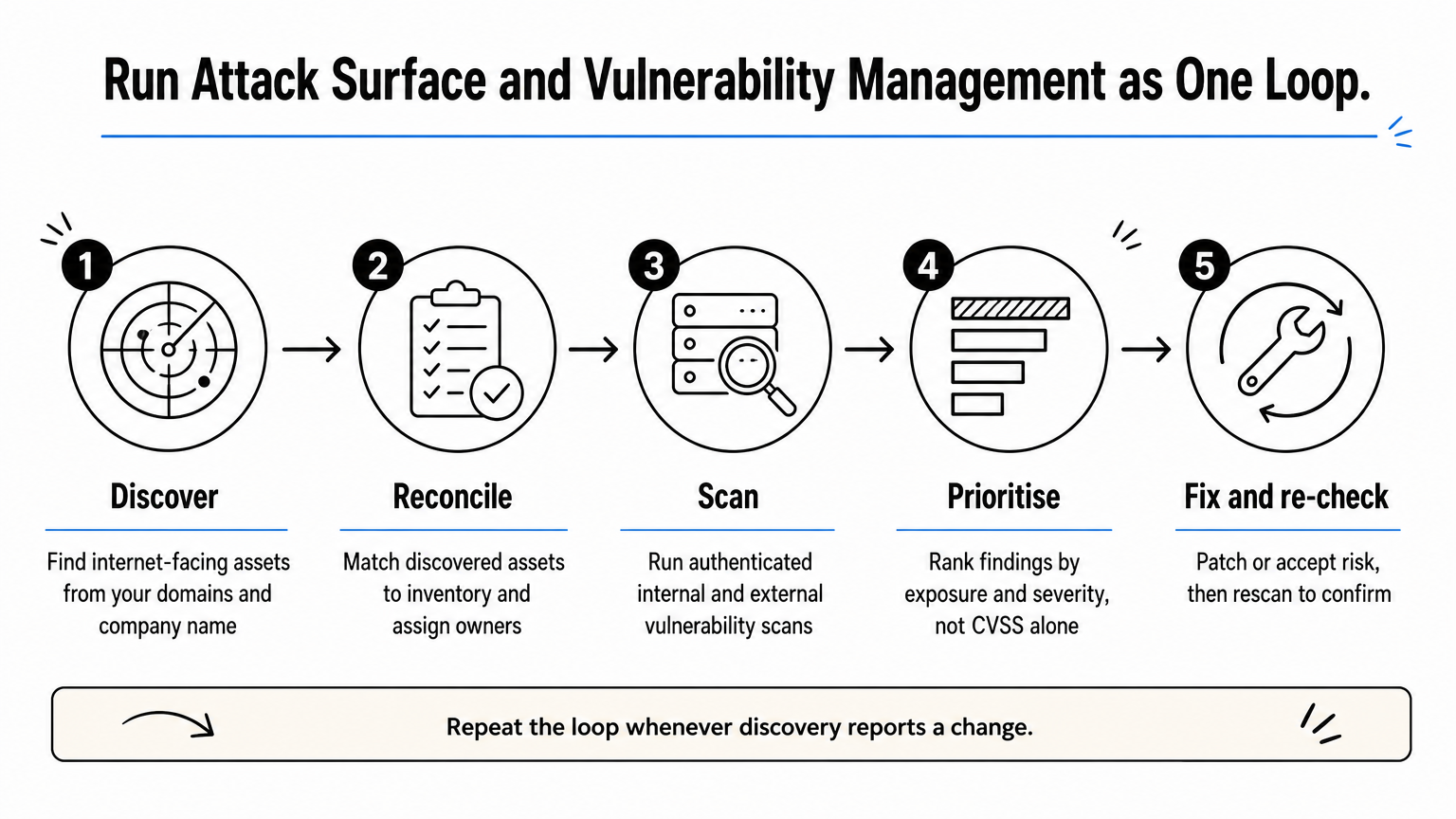
- Discover. Run external discovery from your primary domains and company name to build a list of internet-facing assets.
- Reconcile. Compare that list with your internal inventory. For each unknown asset, find an owner, then decide whether to adopt it, decommission it or investigate it.
- Scan. Run vulnerability scans against every confirmed asset. Use authenticated scans internally where you can, and external scans for anything internet-facing.
- Prioritise. Rank findings by severity and by exposure, not by CVSS alone.
- Fix and re-check. Patch, reconfigure, remove or formally accept the risk, then rescan to confirm the fix. Repeat whenever discovery reports a change.
Reconciliation is the step most teams skip, and it is where much of the value sits. Unowned assets are the ones that stay unpatched, so assign an owner to every asset and record the decision you made about it.
Prioritising with severity and exposure
CVSS is a sound starting point but a blunt instrument. A medium-severity flaw on a customer-facing payment portal can matter far more than a high-severity flaw on an isolated test machine. Ask three questions: is the asset reachable from the internet, does a public exploit exist, and what would you lose if it fell? Anything that is internet-facing, exploitable and business-critical goes to the top of the queue.
Rank by how reachable and how valuable the asset is, not by the score alone.
Ownership and metrics
Decide who does what before you start. Typically IT or a managed provider runs discovery and scanning, system owners fix their own assets, and a security lead reviews exceptions. Then track a handful of numbers each month:
- Unknown assets found, and how many now have an owner
- Share of discovered assets covered by scanning
- Time to remediate critical and high findings on internet-facing assets
- Number of unnecessary exposed services closed
These figures show whether the loop is actually closing gaps, and they give boards and auditors a clear trend to read.
What each approach catches and misses in practice
Each approach catches problems the other overlooks, and a few everyday scenarios show where. The deciding question is whether the problem is an unknown asset or a flaw in a known one, which is the core split in attack surface management vs vulnerability management.
Five common scenarios
| Scenario | Attack surface management | Vulnerability management |
|---|---|---|
| Forgotten staging site on a subdomain | Finds it through DNS and certificate data | Misses it unless someone adds it to scan scope |
| Known web server running outdated software | Shows it is exposed | Identifies the exact CVE and the fix |
| Database open to the internet, no CVE | Flags it as unnecessary exposure | May list it as an informational finding |
| New critical flaw in an edge device | Shows which assets run it, including unknown ones | Confirms which are vulnerable and tracks patching |
| Cloud estate inherited through an acquisition | Reveals assets missing from your inventory | Cannot scan what is not registered |
Scenario two is classic VM territory, where scanner depth does the work. Scenarios one, three and five need discovery before anything else, because no scan can start without a target. Scenario four needs both at once, since you must find every affected asset and then verify and patch each one.
If an asset is unknown, only discovery can find it. If it is known, scanning goes deeper.
What the pattern tells you
The pattern is consistent. ASM wins on unknown and unnecessary exposure, while VM wins on depth and precision for known assets. Buying only one leaves you strong on one axis and blind on the other.
Penetration testing sits alongside both. A pen test is a point-in-time, human-led attempt to exploit weaknesses, so it is valuable for validating findings and testing chained attacks. It only covers the scope agreed, though, so it cannot replace continuous discovery or routine scanning.
Where to start if you have a small security team
Start by building an honest external inventory, then bring everything in it into a regular scanning routine. For most small and medium-sized businesses, attack surface management vs vulnerability management is a question of order, not budget. A complete list and a steady fix cycle beat an expensive tool bought before the basics are in place.
A sensible order of work
Begin by listing what you already know. Pull domains from your registrar, accounts from your cloud consoles, and third-party services from your finance and SaaS admin records. Then run external discovery and compare the results with your list. The differences are your first findings, and they are often the most valuable.
Next, scan everything confirmed and fix in order of exposure. The cheapest wins are usually unnecessary services reachable from the internet, such as remote desktop, databases and admin panels. Closing them reduces risk before any new flaw is disclosed. Set a rhythm of at least monthly scanning, plus a fresh scan whenever discovery reports a change.
Tools differ in how they discover and report, so judge them on coverage, noise and how easily findings reach the people who must fix them, not on brand.
Close what should never have been exposed before you rush to patch what has been exposed for good reason.
Mistakes that undermine both
Most failures come from a short list of habits:
- Treating a yearly penetration test as attack surface management
- Scanning only what appears in the asset register
- Ignoring informational findings that describe exposed services
- Discovering assets nobody owns, then leaving them as they are
- Buying discovery with no capacity to act on the results
The common thread is findings without follow-through. If your team cannot absorb more alerts today, limit the scope and fix those findings first rather than widening the net.
Treat the two as one cycle
Attack surface management shows you everything an attacker can reach. Vulnerability management tells you how weak each of those assets is and drives the fix. Used alone, each leaves a blind spot, but used together they form a loop that keeps your inventory honest and your exposure shrinking.
Start with an outside-in look at what you expose, assign owners, scan what you find and fix by exposure as well as severity. Measure the loop monthly and repeat it.
If you want help turning this into a working routine, whether through external and internal vulnerability assessments, penetration testing or ISO 27001 support, speak to TrustedIA’s security team. We are solution agnostic, so we will recommend what fits your estate rather than what fits a vendor.



