
If you are weighing up an outsourced provider, you probably have a gap. Perhaps nobody in your business owns GDPR compliance, your backups are untested, or a client has asked for proof of how you protect their data. Managed data protection services exist to close that gap without you hiring a full in-house team.
In short, they are an ongoing, contracted service where a specialist takes responsibility for protecting the personal and business data you hold. That usually covers GDPR compliance support, DPO-as-a-service, backup and recovery, and security monitoring. The best data protection services are not the longest feature lists. They are the ones that match your risks, your size and your regulatory obligations.
This article explains what each part of the service involves, what you should expect to pay for versus handle yourself, and which questions separate a credible provider from a reseller. At TrustedIA, we have spent over 30 years running managed security and ISO 27001 projects, so we will also point out the warning signs we see most often when businesses choose a provider.
Why managed data protection services matter
The cost of getting it wrong

Regulators do not scale their expectations to your headcount. Under UK GDPR, the ICO can fine organisations up to £17.5 million or 4% of global annual turnover, whichever is higher. Few small firms face anything near that, but the figure shows how seriously the law treats weak controls.
The larger bill is usually operational. A ransomware attack that hits an untested backup can mean days offline, missed orders and an awkward call to your insurer. Downtime and lost customer trust often cost more than any fine.
Data protection fails where responsibility is unclear, so someone has to own it every day, not once a year.
Why outsourcing closes the gap
Most small and medium-sized businesses cannot justify hiring a data protection officer, a security analyst and a backup engineer. Outsourcing gives you specialist skills for a predictable monthly fee, plus cover when your one IT person is on holiday or leaves.
A good service also gives you proof that the work is happening. In practice, you should expect:
- Documented records of processing, risk assessments and policies that you can show a client or auditor
- Backups that are restored and timed on a schedule, rather than assumed to work
- Monitoring that spots problems early, which matters because you must report a notifiable personal data breach to the ICO within 72 hours of becoming aware of it
What managed data protection services typically include
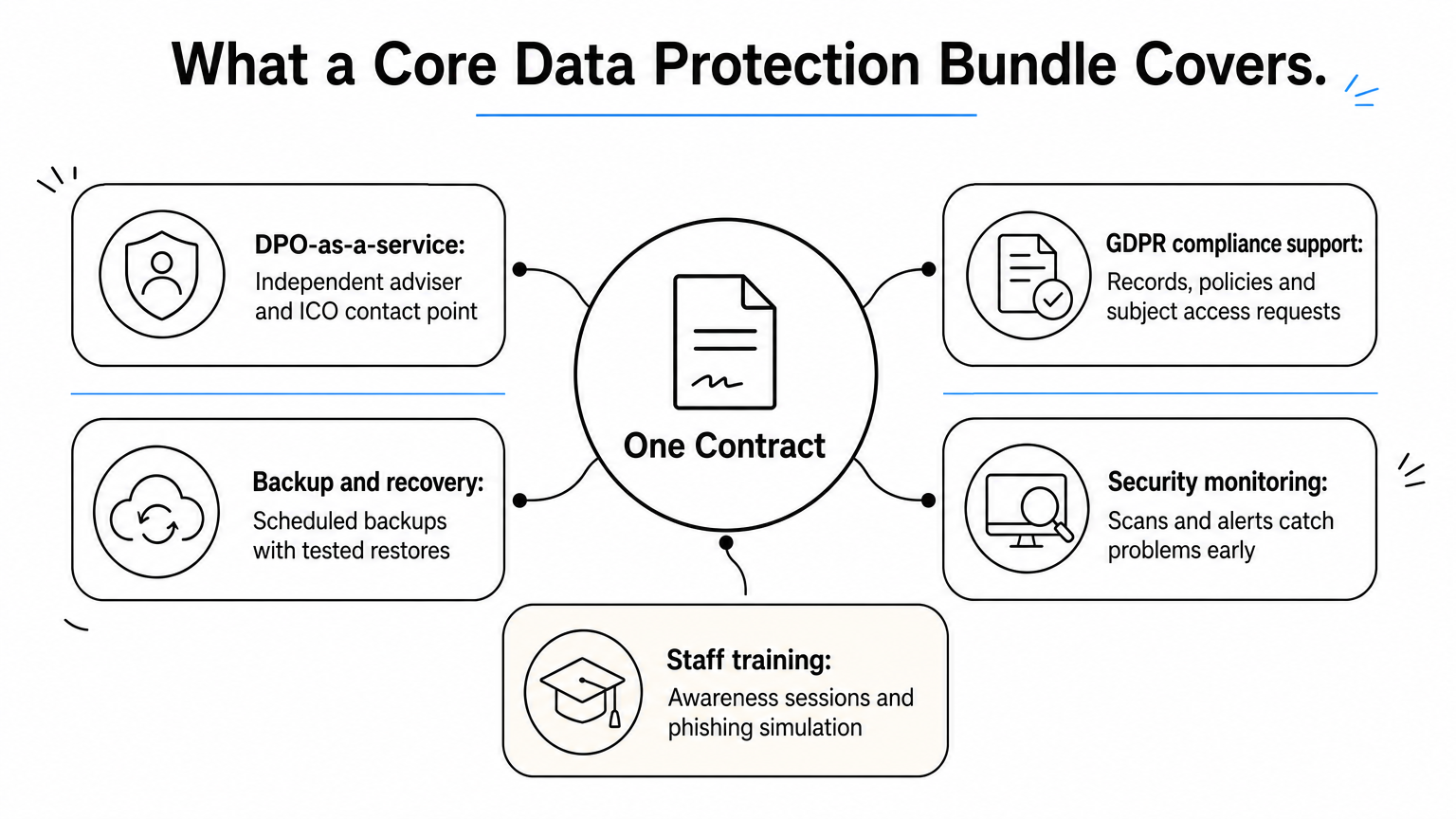
Most managed data protection services bundle legal, technical and people controls under one contract. Packages vary a lot, so check what is actually included.
The core components
Expect a core bundle of five elements, with scope and response times written into the agreement.
| Component | What it covers |
|---|---|
| DPO-as-a-service | Independent adviser, ICO contact point, impact assessments |
| GDPR compliance support | Records of processing, policies, subject access requests |
| Backup and recovery | Scheduled backups, tested restores, offsite copies |
| Security monitoring | Endpoint protection, vulnerability scans, alerting |
| Staff training | Awareness sessions, phishing simulation |
What often costs extra
Incident response, penetration testing and ISO 27001 certification support usually sit outside the base fee. Ask for them to be priced separately, so you can compare quotes like with like.
Without that detail, a cheap quote may simply cover far less work than a dearer one.
A data protection package is only as good as its written scope.
How to choose a managed data protection provider
Judging managed data protection services is easier when you measure providers against your own needs, not their brochures. Work out your risks first, then test the evidence each provider can show you.
Define what you need
Start by listing the personal data you hold, where it sits and which rules apply to it. Then mark the gaps that hurt most, because they decide which providers make your shortlist:
- Nobody owns GDPR compliance today, so you need DPO-as-a-service
- Backups have never been restore-tested
- Clients or insurers ask for ISO 27001 evidence
Test the evidence
Next, ask for named, qualified people and relevant certifications rather than logos. Request a sample report and a reference from a business of your size, and check that the reference can describe a real incident or audit.
Finally, favour a provider that is solution-agnostic. One tied to a single vendor will recommend that vendor’s product whether or not it fits your setup.
Choose the provider who can show their work, not the one with the longest feature list.
What to look for in the best data protection services
Signs of a mature service
The best data protection services report on outcomes, not activity. Look for defined recovery targets, such as restoring key systems within a stated number of hours, and monthly reports you can read without a glossary.
Joined-up delivery matters as well. A risk your DPO flags should reach the engineers, so it becomes a fixed backup or access gap rather than a line in a PDF. Without that link, legal and technical work drift apart.
Good providers report on outcomes, not activity.
Contract details that separate strong from weak
Several contract details also divide strong managed data protection services from weak ones. Check these before you shortlist anyone:
- Data stored in the UK or a country with an adequacy decision
- Sub-processors named in the contract
- A clear exit plan, including how you get your data and records back
- A defined route to incident response if something goes wrong
Any provider that hesitates on these points is showing you how it will behave after you sign.
Questions to ask providers before you sign
Questions about delivery

Ask these first, because they test who actually does the work and how fast they act when something breaks.
- Who will be my named DPO or lead contact, and what are their qualifications?
- When did you last restore a client’s data, and how long did it take?
- What response time do you guarantee if I report a suspected breach?
- What happens to my service if a key member of your team leaves?
Questions about accountability
Next, find out what the provider is liable for. Ask to see their professional indemnity and cyber insurance, and how the contract caps liability if their error causes a breach. Then ask how they prove the work each month.
- Can I see a sample report and speak to a client of my size?
- Which tasks stay with me, and which do you own?
- What will renewal cost after year one?
A provider who cannot answer these in writing should not be holding your data.
Making the right choice for your business
Managed data protection services work when someone owns the outcome every day. The right provider gives you named people, written scope and tested recovery, not a long list of features. Match the service to your own risks, and you avoid paying for work you do not need or missing work you do.
Before you sign, check the contract details and the answers to the questions above. Data location, sub-processors, liability and exit terms tell you more about a provider than any sales deck. If a supplier hesitates, treat that as your answer.
If you want a second opinion, talk to a team with over 30 years of managed security and ISO 27001 experience that recommends solutions on merit, not by brand. You can speak to TrustedIA about managed data protection through its data protection consulting services and get a clear view of what your business needs.



