
You’ve probably been told that getting certified against ISO 27001 means you’ve ticked the GDPR box too. It’s a comfortable assumption, and it’s wrong. ISO 27001 GDPR compliance is a genuine and powerful combination, but the two frameworks aren’t interchangeable, and treating them as one and the same leaves gaps that a regulator or a breach will expose fast.
Here’s the direct answer: ISO 27001 gives you the information security management system that supports most of what GDPR compliance means in practice, but GDPR adds legal obligations around consent, data subject rights, and lawful processing that the standard doesn’t cover on its own. Get the relationship right and you build a genuinely compliant, defensible position rather than a false sense of security.
In this article, we’ll unpack where these two frameworks overlap, where they diverge, and how organisations we work with use ISO 27001 certification as the backbone for GDPR readiness. You’ll come away knowing exactly what still needs addressing separately, and how to close those gaps properly.
Why ISO 27001 matters for your GDPR compliance
GDPR runs on a simple principle: personal data needs "appropriate technical and measures" to keep it secure, a phrase lifted almost word for word from Article 32 of the regulation. ISO 27001 exists to build exactly that. Its risk-based approach forces you to identify where personal data lives, who can access it, and what could go wrong, then apply controls proportionate to that risk. This is why regulators, including the UK’s Information Commissioner’s Office, regularly point to recognised security standards as evidence of "appropriate" measures when assessing GDPR compliance. Read the ICO’s own guidance on security under the UK GDPR and you’ll see the language mirrors ISO 27001’s control objectives almost line for line.
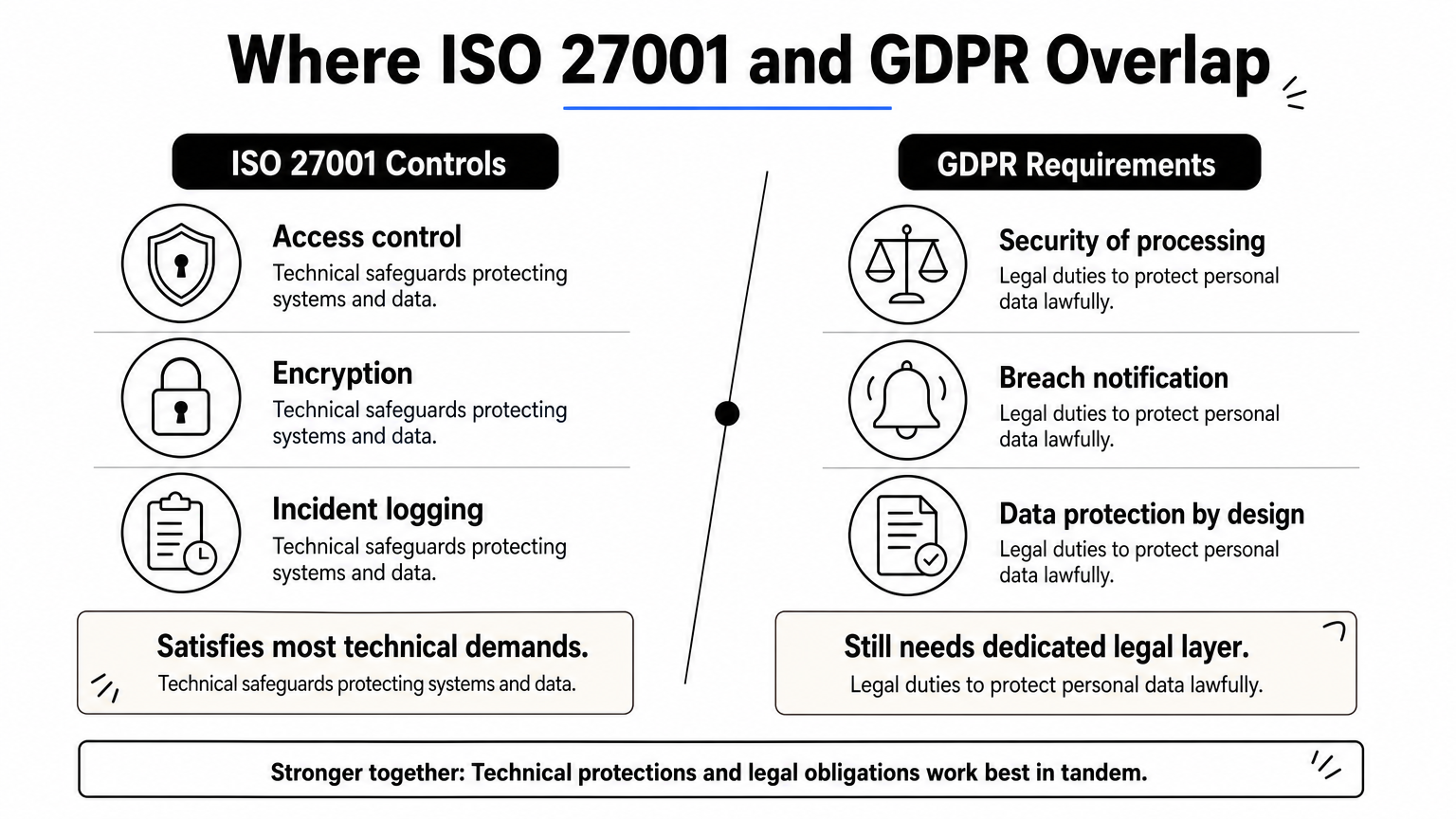
Annex A of ISO 27001 reads like a checklist for half the technical demands GDPR makes. Access control, encryption, incident logging, supplier management, and physical security all appear in both. Organisations that already hold certification typically find 60 to 70% of their GDPR technical requirements are satisfied before they’ve written a single privacy-specific policy.
Strong ISO 27001 controls don’t replace GDPR compliance, but they remove most of the heavy lifting needed to get there.
Here’s where the two frameworks line up most directly:
| GDPR requirement | ISO 27001 control area |
|---|---|
| Security of processing (Art. 32) | Annex A.8 (Asset management), A.10 (Cryptography) |
| Breach notification readiness (Art. 33/34) | Annex A.16 (Incident management) |
| Accountability and governance (Art. 5(2), 24) | Clause 5 (Leadership), 9 (Performance evaluation) |
| Data minimisation and integrity (Art. 5(1)) | A.8.2 (Information classification), A.12.1 |
| Third-party processor oversight (Art. 28) | A.15 (Supplier relationships) |
Without this foundation, most GDPR programmes end up bolted together from scratch, duplicating work that a mature information security management system already does. We see this constantly with clients who arrive after a near-miss breach: the ones with ISO 27001 already embedded recover faster, document their response better, and face fewer awkward questions from the ICO because the audit trail already exists.
Certification also changes the conversation with your board and your customers. When a client asks how you protect their data, "we hold ISO 27001 certification" carries more weight than a policy document nobody outside compliance has read. That credibility matters just as much as the technical overlap when you’re trying to demonstrate genuine ISO 27001 and GDPR compliance working together rather than sitting in separate silos.
How to use ISO 27001 to strengthen GDPR compliance
Getting the most out of ISO 27001 for GDPR purposes means mapping your controls deliberately rather than assuming coverage. Start by treating your risk assessment as a data protection exercise, not just a security one: identify every process that touches personal data, then run it through the same risk register you already maintain for the ISMS.
Map your Annex A controls to specific GDPR articles
Don’t leave the overlap implicit. Build a control mapping document that shows an auditor, a regulator, or a customer exactly which Annex A control satisfies which GDPR obligation. This single document does more to demonstrate accountability under Article 5(2) than almost anything else you can produce.

- List each GDPR article relevant to your processing activities
- Match it against the Annex A control that addresses it
- Flag any article with no clear control, that’s your gap list
- Review the mapping at every internal audit cycle
Extend your ISMS scope to cover personal data explicitly
Many organisations approach ISO 27001 scope definition around systems and assets, then forget to name personal data as an asset category in its own right. Widen your statement of applicability to reference personal data processing activities directly, and your risk treatment plan starts working double duty for both frameworks.
If your ISMS doesn’t name personal data as an asset, it can’t properly protect it under GDPR.
Use your internal audit programme for both frameworks
Run your scheduled ISO 27001 internal audits with a GDPR compliance checklist alongside the standard one. It costs almost nothing extra and catches compliance gaps before an external assessor or the ICO does. This dual-purpose auditing is exactly how our clients keep both frameworks moving in step rather than drifting apart over time.
Does ISO 27001 certification guarantee GDPR compliance?

No, and anyone who tells you otherwise is selling you something. The claim that ISO IEC 27001 certification guarantees GDPR compliance is one of the most persistent myths in this space, and it’s dangerous precisely because the overlap is so substantial that it feels like it should be true. Certification proves your information security management system meets a recognised standard. It says nothing about whether you have a lawful basis for processing, whether your privacy notices are accurate, or whether you can respond to a subject access request within the statutory 30 days.
Certification proves your security is sound; it doesn’t prove your data processing is lawful.
What ISO 27001 leaves untouched
Several GDPR obligations sit entirely outside what the ISO 27001 standard covers, no matter how mature your ISMS is:
- Establishing and documenting a lawful basis for each processing activity
- Managing consent capture, withdrawal, and records
- Handling data subject rights requests (access, erasure, portability)
- Conducting Data Protection Impact Assessments for high-risk processing
- Appointing and supporting a Data Protection Officer where required, including understanding the Data Protection Officer role and responsibilities
- Maintaining Article 30 records of processing activities
Where organisations get caught out
Audits repeatedly find that certified organisations assume these gaps are covered simply because the security side looks pristine. We’ve seen certified clients fail an ICO information request because nobody owned the Article 30 register, despite an otherwise flawless ISMS. Genuine GDPR compliance ISO 27001 synergy only happens when you treat certification as the security foundation and build the legal and procedural layer on top, deliberately, with named owners and its own audit schedule rather than an afterthought bolted onto the ISMS review.
ISO 27701: closing the privacy gap ISO 27001 leaves open
Given everything ISO 27001 doesn’t cover, you might wonder if there’s a standard built specifically to close that gap. There is. ISO 27701 extends your existing ISMS into a full Privacy Information Management System, adding the legal and procedural controls that GDPR demands and ISO 27001 simply wasn’t designed to address. It’s not a replacement certification, it’s an add-on module that plugs directly into the ISMS you’ve already built, which is exactly why organisations already certified to ISO 27001 find it far quicker to adopt than starting a privacy programme from scratch.
Think of ISO 27701 as the missing wiring between your security controls and your legal obligations.
What ISO 27701 actually adds
Where ISO 27001 stops at "is the data secure," ISO 27701 pushes into "is the processing lawful and accountable":
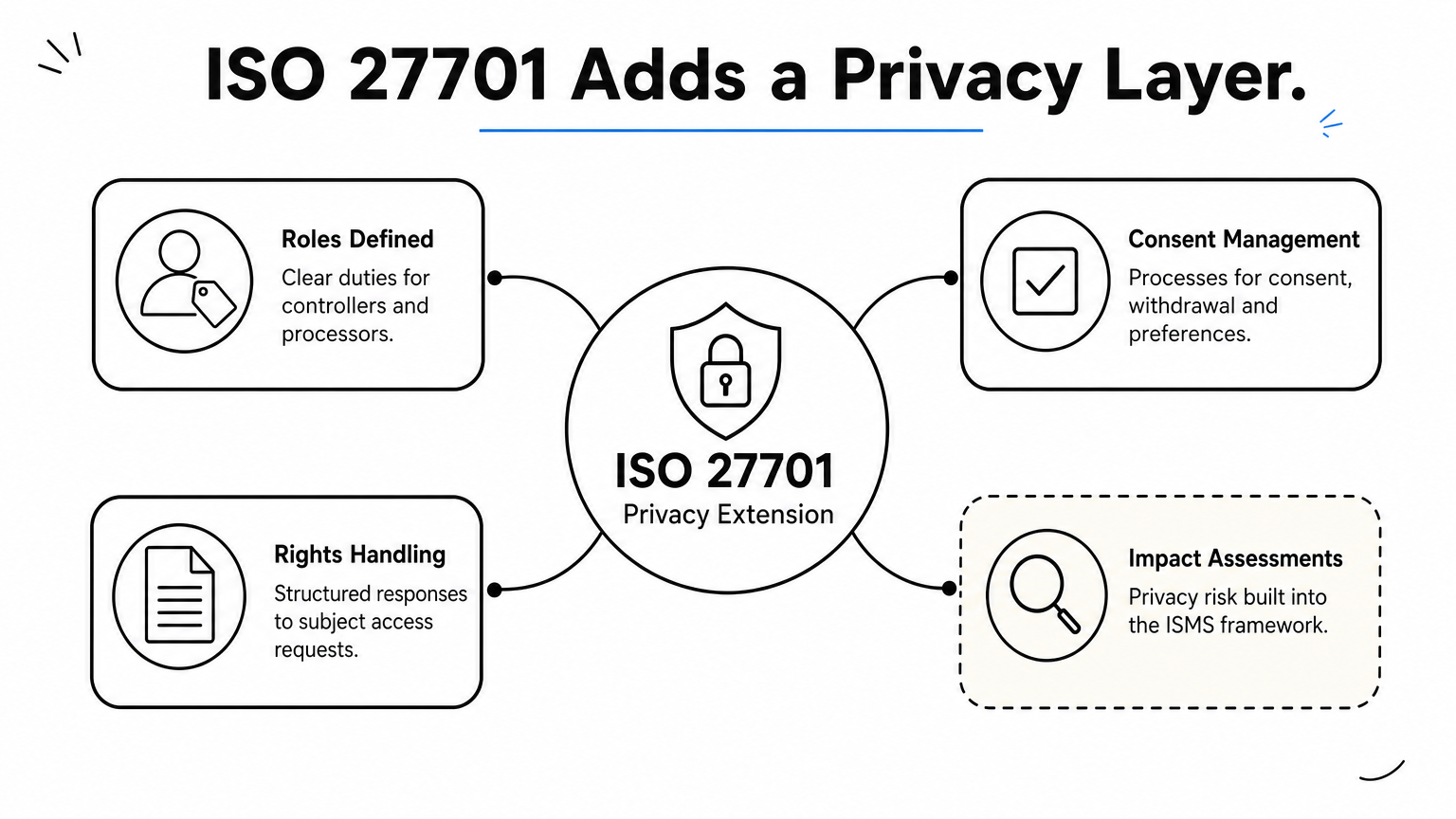
- Defined roles for data controllers and processors
- Formal processes for consent, withdrawal, and preference management
- Structured handling of data subject rights requests
- Privacy impact assessment procedures baked into the risk framework
- Clear documentation trails auditors and regulators expect to see
Who should consider it
Organisations processing large volumes of personal data, or acting as a processor for other businesses, get the most value from ISO 27701. If your ISMS already covers most technical requirements but your Article 30 records and consent management are patchy, that’s your signal to extend rather than duplicate. We help clients scope this extension as part of our wider ISO 27001 professional services, building the privacy layer onto proven security foundations rather than running two disconnected projects side by side.
Where your compliance journey goes from here
Getting ISO 27001 GDPR compliance right means respecting what each framework actually does. ISO 27001 gives you a security foundation regulators recognise and trust. GDPR then asks harder questions about lawfulness, consent, and individual rights that no security certificate can answer for you. Treat one as a substitute for the other and you’re left exposed exactly when it matters most, during a breach investigation or a regulator’s request.
Build the mapping properly, extend into ISO 27701 where your processing demands it, and you end up with something far stronger than a tick-box exercise: a defensible, evidenced compliance position that holds up under scrutiny. That’s the real goal, not certification for its own sake.
If you’re unsure where your current setup falls short, talk to TrustedIA about mapping your ISMS against your UK GDPR and DPA 2018 obligations before a regulator does it for you.



