
You know you need better cyber protection, but hiring a full security team isn’t realistic on a small business budget. That’s the gap managed security services for small businesses fill, and it’s why so many owners end up searching for answers instead of vendors, because the term itself gets thrown around loosely by providers trying to sell you something before you understand what you’re buying.
At its core, managed security services mean outsourcing your cyber defence to a specialist provider who monitors, detects, and responds to threats on your behalf, around the clock. Instead of buying separate tools and hoping someone in-house knows how to configure them, you get ongoing protection delivered as a service, covering everything from endpoint detection to disaster recovery, without needing your own security operations centre.
This article breaks down exactly what’s included in a typical managed security package, why SMBs are prime targets for attackers who assume you’re under-defended, and how to evaluate whether a provider actually fits your risk profile and budget. We’ll also cover the practical questions to ask before signing a contract, so you’re not left exposed by a vague service agreement when an incident actually happens.
Why small businesses need managed security services
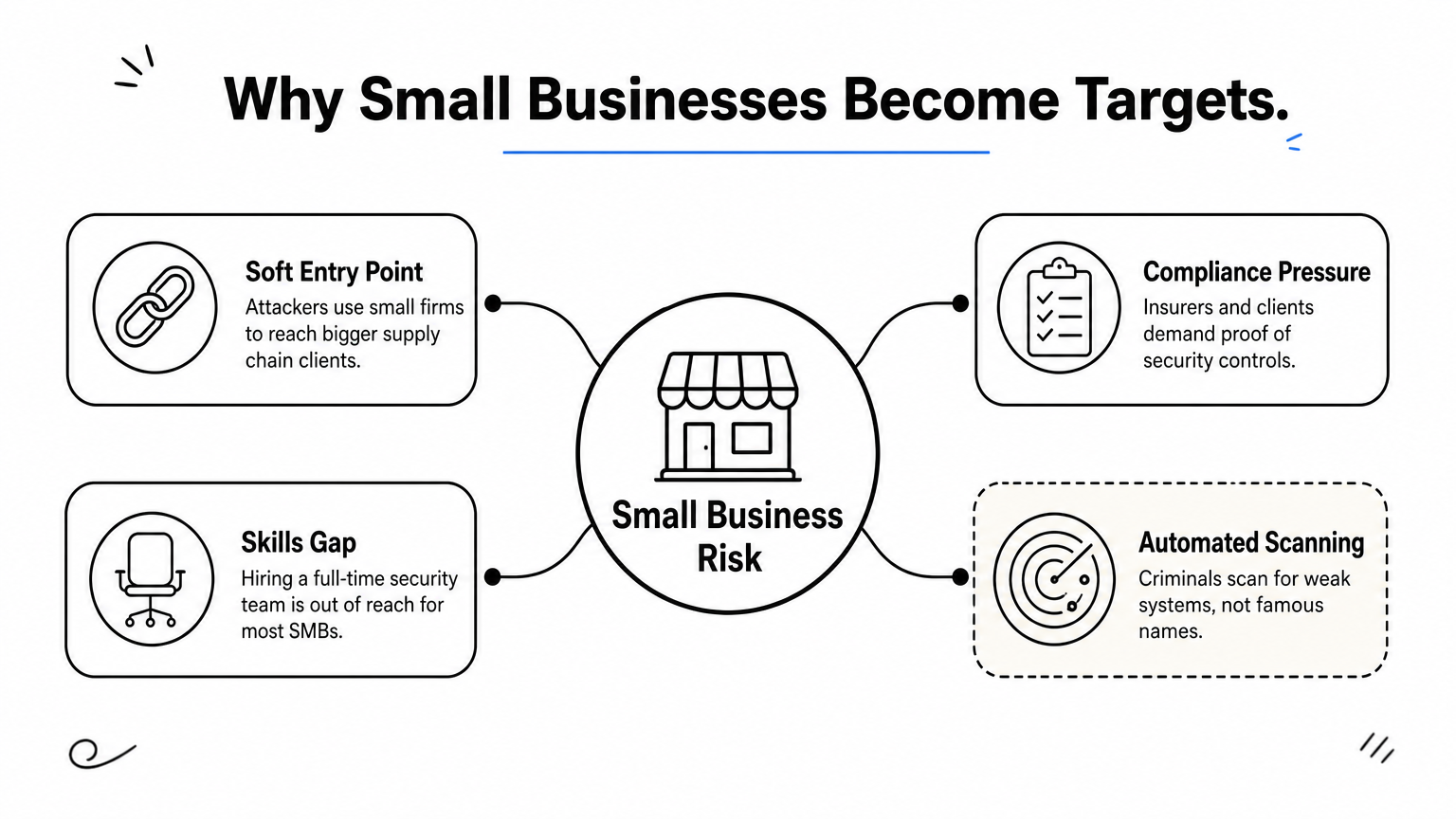
Small businesses often assume attackers go after bigger fish. That assumption gets exploited daily. Criminals run automated scans across millions of IP addresses looking for unpatched software and weak remote access, not household names. A ten-person accountancy firm is just as visible to a ransomware crew as a national bank, and often far easier to breach because the defences are thinner. The UK government’s own Cyber Security Breaches Survey has repeatedly found that a large share of UK businesses experience a breach or attack attempt within a single year, and smaller firms are less likely to have formal incident response plans in place.
Small businesses are targets, not afterthoughts
Attackers treat small firms as soft entry points into larger supply chains. If you supply parts, services, or data to bigger clients, a breach on your side can cascade into theirs, which is exactly why more enterprise contracts now demand proof of cyber controls before they’ll sign. Losing that contract because you can’t demonstrate basic monitoring costs you more than any security service ever would.
A small business doesn’t need to be a target to get breached, it just needs to be reachable.
The skills gap you can’t hire your way out of
Building an in-house security operations centre, rather than using SOC as a service for UK businesses, means hiring analysts who work shifts, buying and tuning detection tools, and keeping everyone trained on threats that change monthly. Very few SMBs can justify that headcount, and the cybersecurity job market is tight enough that even if you had the budget, filling the roles takes months. Outsourced monitoring solves this by giving you access to a team that already has the tooling, the threat intelligence services, and the experience, spread across many clients rather than paid for by one.
Compliance and insurance pressure keeps rising
Cyber insurers now ask detailed questions before they’ll issue or renew a policy, and vague answers push your premium up or get you declined outright. Standards like ISO 27001 for a small business are increasingly requested by clients and regulators alike, and getting certified without expert guidance usually takes far longer than it should. A managed provider who understands both the technical and audit side speeds that process up considerably.
Here’s what typically drives an SMB to bring in outsourced protection:
- A near-miss or actual breach that exposed how unprepared the business was
- A client or insurer demanding evidence of security controls
- Growth that’s outpaced the IT team’s capacity to monitor everything
- Pressure to achieve ISO 27001 or a similar accreditation
- Simple recognition that downtime from an incident would be financially crippling
Managed security services exist precisely because doing all of this alone, well, is no longer realistic for most small businesses, and that’s where the benefits of an MSSP for UK SMEs become obvious.
How to choose the right managed security service provider
Picking a provider isn’t about finding the cheapest monthly quote. It’s about finding a team whose response times, expertise, and contract terms actually match what happens when something goes wrong at 2am on a Sunday. Too many SMBs sign up based on a glossy sales pitch, then discover during an actual incident that "24/7 monitoring" meant an alert sitting in a queue for six hours.

Ask about response times before you ask about price
Question how fast a provider commits to acting once a threat is detected, not just detecting it. A service level agreement should specify response windows in writing, ideally under an hour for critical alerts. If a salesperson can’t give you a number, that’s your answer.
If a provider can’t tell you their response time in writing, assume it’s slower than you need.
Check for genuine incident response capability
Detection without recovery is half a service. Ask whether the provider runs its own incident response function, like TrustedIA’s CyberSOS containment and recovery service, or simply hands you off to a third party once something’s confirmed. That handoff adds delay exactly when speed matters most.
Look for solution-agnostic advice
Some providers push whichever tools they resell, regardless of fit. A solution-agnostic approach means recommendations are based on your risk profile, not a vendor kickback.
Use this shortlist when comparing providers:
- Do they publish clear SLAs for detection and response times?
- Can they support ISO 27001 alignment, not just generic advice?
- Do they run network penetration testing and vulnerability assessments regularly, not once a year?
- Is pricing transparent, with no hidden costs for incident response?
- Can they show references from businesses your size, not just enterprise logos?
Verify experience with businesses your size
A provider built for enterprises may overcomplicate things for a ten-person firm, while one used to microbusinesses might lack the depth for a scaling company with 80 staff. Match the provider’s typical client size to yours before you sign anything.
What’s typically included in a managed security service
Most providers bundle several layers of protection into one contract, rather than selling you a single tool. Managed security services for small businesses typically combine round-the-clock monitoring with proactive testing, so threats get caught before they turn into incidents rather than after.

Core protective layers
Understanding what sits inside a typical package helps you spot gaps in a provider’s pitch. Here’s what a solid offering usually covers:
| Component | What it does |
|---|---|
| Security Operations Centre (SOC) | Watches network activity 24/7 for suspicious behaviour |
| Endpoint Detection & AV | Blocks and isolates threats on laptops, servers, and devices |
| Vulnerability Assessments | Scans systems regularly for exploitable weaknesses |
| Penetration Testing | Simulates real attacks to test your defences |
| Phishing Simulation | Trains staff by testing them with fake phishing emails |
| Dark Web Surveillance | Flags if your credentials or data appear in breach dumps |
| Business Continuity & Disaster Recovery | Keeps operations running, or restores them fast, after an incident |
A managed service that skips business continuity and disaster recovery planning isn’t really managing your risk, it’s just watching it happen.
Reporting and human oversight
Good providers pair automated tools with actual analysts reviewing alerts, not just dashboards nobody reads. Reporting should arrive on a schedule you understand, showing what was blocked, what was investigated, and what needs your attention, translated into plain business language rather than raw log data.
Where services often stop short
Smaller packages sometimes leave out incident response, meaning you’re covered until something actually happens, then you’re on your own to coordinate recovery. TrustedIA bundles this directly through its managed security services, so detection and response sit under one team rather than two separate contracts you have to stitch together mid-crisis.
How much managed security services cost in the UK
Pricing varies more than most providers admit upfront, because cost depends on how many devices you have, how many users need monitoring, and which layers of protection you actually need. Managed security services for small businesses in the UK typically range from a few hundred pounds a month for a lean package covering endpoint detection and basic monitoring, up to several thousand for a full stack that includes penetration testing, SOC coverage, and dedicated incident response. Expect providers to quote per user or per device rather than a flat fee, since a 15-person office costs far less to protect than an 80-person one with multiple sites.
Typical monthly pricing bands
Quotes below are broad UK market ranges, not fixed figures, since your final cost depends on infrastructure complexity and existing controls.
| Business size | Typical monthly range | What’s usually included |
|---|---|---|
| 1-15 staff | £300-£800 | Endpoint AV, basic monitoring, monthly reporting |
| 16-50 staff | £800-£2,500 | SOC monitoring, vulnerability scans, phishing simulation |
| 51-100+ staff | £2,500-£6,000+ | Full SOC, penetration testing, incident response, ISO 27001 support |
Cheap monitoring that skips incident response usually costs more later than paying properly upfront.
What pushes the price up or down
Regulatory pressure often decides the final figure. Businesses pursuing ISO 27001 certification typically pay more upfront for assessment and audit support, but that cost usually offsets what you’d spend hiring a consultant separately. Similarly, firms holding cyber insurance sometimes negotiate lower premiums once a provider can demonstrate documented monitoring and response, which partly offsets the service fee.
Comparing quotes properly
Treat every quote as incomplete until you know what happens during an actual incident. Some providers price incident response separately, so a low monthly figure can hide a large bill the moment something goes wrong. Ask for a breakdown that separates monitoring, testing, and response costs, so you’re comparing genuinely equivalent packages rather than a cheap headline number against a comprehensive one.
Where to go from here
Managed security services for small businesses aren’t a luxury reserved for enterprises with dedicated IT teams. They’re the practical answer to a real problem: attackers don’t care how many staff you have, and building an in-house SOC isn’t realistic for most SMBs. What matters now is matching the right level of cover to your actual risk, not the cheapest quote you can find, and asking hard questions about response times and incident handling before you sign anything.
If you’ve read this far, you already know the gaps a vague provider can leave you exposed to. Solution-agnostic advice and genuine incident response capability separate a real partner from a reseller pushing tools. TrustedIA combines both, backed by over 30 years of experience and its own CyberSOS recovery service, so detection and response never sit in separate contracts. Get in touch about 24/7 managed security services for small businesses to talk through what your business actually needs, and what it should cost.



