

Searching for a business continuity plan sample usually means one thing: you’ve been told to have a BCP in place, and you’d rather adapt something real than start from a blank page or build your own business continuity plan template from scratch. Whether it’s a client demanding proof of resilience, an insurer asking questions, or a near-miss that made you realise you had no proper plan at all, staring at an empty document is the last thing you need right now.
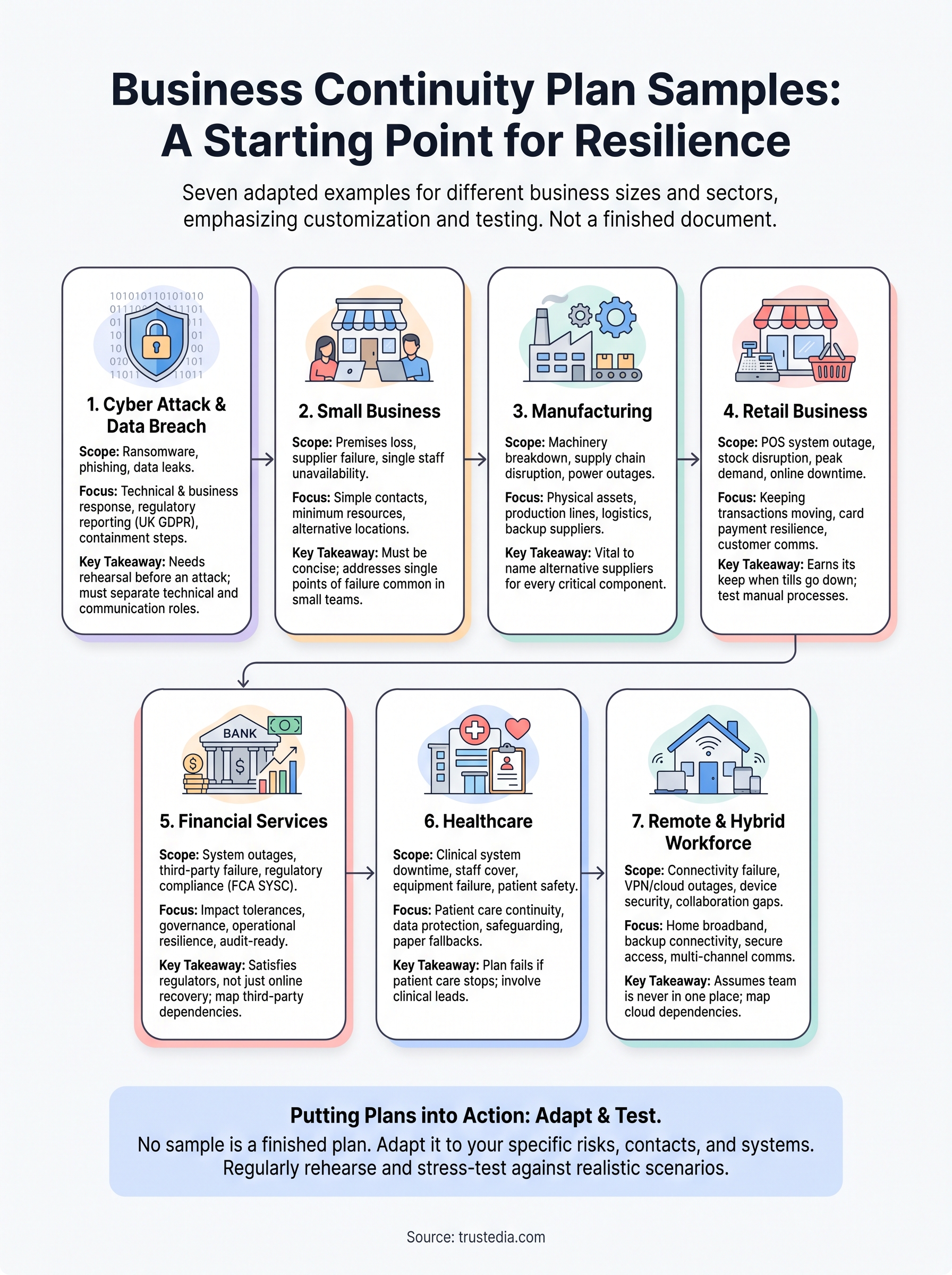
This article gives you exactly that. We’ve pulled together seven business continuity plan examples, covering different business sizes and sectors, so you can see how real organisations structure their plans, what sections they include, and how much detail actually belongs in each one. You’ll find options suited to a small business continuity plan as well as more layered examples for larger operations with multiple sites or dependencies.
Each sample below breaks down the key components: risk assessment, recovery priorities, communication protocols, and roles during an incident. We work with businesses every day helping them prepare for and recover from cyber incidents, so we know which plans hold up under pressure and which ones fall apart the moment they’re tested. Use these as your starting point, not your finished document.
1. Cyber attack and data breach continuity plan sample
Ransomware, phishing-led breaches, and third-party data leaks now sit at the top of most risk registers, so this is the business continuity plan sample most businesses reach for first. It maps out exactly what happens in the hours after an attacker locks your systems or a breach notification lands, including who declares the incident, how you isolate affected systems, and how you keep the business running while IT works the problem. Unlike a generic BCP template, this one assumes the disruption is deliberate and possibly ongoing, which changes how you respond compared to a fire or flood.

Scope and risks it covers
This type of plan typically covers ransomware infections and how you contain them, business email compromise, data exfiltration, denial-of-service attacks, and third-party or supply chain breaches where a vendor’s systems compromise yours. It also addresses regulatory exposure, since a data breach in the UK often triggers reporting obligations to the ICO within 72 hours under UK GDPR, so the steps to take after a data breach need to be written down in advance. A good sample will separate the technical response (containment, forensics, system restoration) from the business response (client communication, staff instructions, legal notifications), because trying to run both from the same checklist creates confusion when everyone’s under pressure.
Who this sample suits
Any organisation holding customer data, processing payments, or relying on connected systems should have a version of this plan, regardless of size. It particularly suits businesses that have already faced a phishing attempt or near-miss and want a proper sample business continuity plan pdf to formalise what they learned. Insurers and loss adjusters also expect to see this level of detail when assessing cyber cover, so if you’re renewing a policy soon, this is the plan worth getting right first.
A cyber continuity plan only works if it’s rehearsed before the attack, not written after it.
What the plan should include
A solid plan of this kind covers the following, at minimum:
- Incident declaration criteria: what counts as an incident versus routine IT trouble
- Roles and escalation contacts: who leads response, who authorises system shutdowns, who speaks to clients
- Containment steps: isolating affected devices, disabling compromised accounts, preserving evidence
- Communication templates: pre-drafted messages for staff, customers, and regulators
- Recovery sequencing: which systems come back online first based on business impact
- Post-incident review: how you capture lessons and update controls
Samples that skip the communication templates or recovery sequencing tend to fall apart fastest, because those are the sections teams need instantly and have no time to write from scratch mid-incident.
How to adapt it for your business
Start by mapping your own critical systems and data flows rather than copying the sample’s list wholesale; your payment processor or booking platform might be someone else’s afterthought. Test the plan with a tabletop exercise and other continuity test scenarios involving whoever would actually be in the room during a real incident, not just IT. Update contact details and escalation paths every quarter, since outdated numbers are one of the most common reasons response plans fail when they’re needed. If you want a plan that’s been stress-tested against real attack scenarios rather than assembled from a checklist, TrustedIA’s rapid containment and recovery service builds and rehearses this exact type of plan alongside your team, so it holds up when it matters.
2. Small business continuity plan sample
Most enterprise-grade BCP templates assume resources you simply don’t have: a dedicated IT team, a backup office, a communications department. A proper small business continuity plan example pdf strips all that away and focuses on the handful of things that actually keep a small operation trading after a disruption. It’s shorter, plainer, and built around one or two people wearing multiple hats during a crisis, which is the reality for most businesses under 50 staff.
Scope and risks it covers
This sample usually covers the disruptions small businesses face most often: losing your premises to fire, flood, or a landlord dispute, a key supplier going under, a single laptop or server holding critical files failing, or the owner or a key staff member being unavailable for an extended period. It rarely needs multi-site failover or complex regulatory sections. Instead it concentrates on single points of failure, because a five-person business often has one person who knows where everything is, one laptop with the accounts on it, and one supplier for a critical part. Losing any of those can stop trading within days.
Who this sample suits
This fits sole traders, family businesses, and small limited companies with fewer than 20 or so employees, particularly those without an in-house IT or facilities function, where business continuity planning for small businesses has to stay simple. It also suits businesses that need a sample business continuity plan to satisfy a client contract or tender requirement but don’t want to pay for consultancy on something they can largely build themselves with the right template.
A small business continuity plan only works if it fits on a couple of pages someone can actually read during a crisis.
What the plan should include
Keep it lean and practical:
- Emergency contacts for staff, key suppliers, landlord, and insurer
- A list of critical business functions and the minimum resources needed to keep each running
- Backup arrangements for data, documents, and access to accounts
- An alternative working location or remote-working fallback
- A simple decision tree for who takes charge if the owner is unavailable
How to adapt it for your business
Walk through each critical function and ask what would genuinely happen if it stopped tomorrow, then write the answer down rather than assuming someone would figure it out. Review the plan whenever you change suppliers, premises, or key staff, since small businesses change faster than the paperwork usually keeps up with.
3. Manufacturing continuity plan sample
Manufacturing businesses live or die by uptime, so a business continuity plan example built for this sector looks very different from an office-based one. It centres on physical assets: production lines, machinery, raw material supply, and the logistics that get finished goods out the door. A plant standing idle for even a few days can mean missed contracts and penalty clauses, so this sample weighs equipment and supply chain failure far more heavily than IT outages.

Scope and risks it covers
This type of plan addresses machinery breakdown, power outages, raw material shortages, supplier failure, and health and safety incidents that halt production. It also covers supply chain disruption in detail, since most manufacturers depend on a small number of suppliers for critical components, and a single delayed shipment can stop an entire line. Site-specific risks like fire, flooding of a warehouse, or equipment failure at a single point in the process usually get their own section, because losing one machine can be as damaging as losing the whole building.
Who this sample suits
This sample suits factories, fabricators, food producers, and any business running physical production lines, particularly those with contractual delivery deadlines or penalty clauses for late fulfilment. It also fits manufacturers who supply larger clients that now demand a business continuity plan pdf as part of their vendor onboarding or ongoing supplier review process.
A manufacturing continuity plan means nothing if it doesn’t name a backup supplier for every critical component.
What the plan should include
A thorough plan for this sector covers:
- Alternative suppliers for every critical raw material or component
- Contingency plans for equipment failure, including maintenance contacts and spare parts sourcing
- Minimum staffing levels needed to keep a reduced production run going
- Health and safety incident response linked into the wider continuity plan
- Logistics fallback if primary transport or warehousing is unavailable
How to adapt it for your business
Start by identifying your single points of failure on the production line itself, not just your suppliers, since one broken machine can be as damaging as losing a whole warehouse, then work through the steps for creating a continuity plan around them. Speak to your top three suppliers about their own continuity arrangements too, because their failure becomes your failure the moment a delivery doesn’t arrive on schedule.
4. Retail business continuity plan sample
Retail businesses lose money the moment tills stop ringing, so this business continuity plan sample focuses on keeping transactions moving whether the disruption hits a single store, a warehouse, or the online checkout. Unlike manufacturing or professional services, retail continuity has to account for customer-facing downtime in real time, because a shopper who can’t pay walks out and often doesn’t come back. This sample also weighs stock and payment system failures more heavily than most, since both can bring trading to a halt within minutes.
Scope and risks it covers
This type of plan typically covers point-of-sale system outages, payment processing failures, stock and supply chain disruption, store or warehouse loss through fire or flood, and seasonal demand spikes that overwhelm systems or staffing. Online retailers add website downtime, hosting failures, and fulfilment delays to the list. Card payment resilience gets particular attention, since most retailers can’t legally or practically fall back to cash-only trading for long, and a prolonged payment outage during peak trading hours can cost more than a full day closed.
Who this sample suits
This fits independent shops, multi-site retail chains, and ecommerce businesses that depend on continuous uptime across physical and digital channels. It particularly suits retailers heading into peak trading periods like Christmas or seasonal sales, where any downtime has an outsized financial impact, and those needing a business continuity plan examples pdf to satisfy landlord, franchise, or supplier requirements.
A retail continuity plan earns its keep the moment the tills go down and customers are still standing in the queue.
What the plan should include
A workable plan for this sector covers:
- Backup payment methods and contact details for your payment processor
- Manual sales recording procedures for till or system outages
- Alternative suppliers for fast-moving stock lines
- Staff redeployment plans across multiple sites during a localised disruption
- Customer communication templates for delays, closures, or online outages
How to adapt it for your business
Test your manual sales process at least once a year, ideally during a quiet trading period rather than discovering it doesn’t work during your busiest weekend. Check your payment processor’s own resilience commitments too, since their downtime becomes your downtime the instant a card terminal stops authorising transactions.
5. Financial services continuity plan sample
Financial firms answer to regulators as much as customers, so this business continuity plan sample carries a heavier compliance layer than most. It has to prove operational resilience against the FCA SYSC continuity rules rather than just describe good intentions, which means recovery time objectives, third-party risk, and governance sit at the centre of the document rather than at the back as an afterthought. This sample suits firms that already know a generic template won’t survive an audit.
Scope and risks it covers
This type of plan covers system outages affecting trading, payments, or client account access, third-party and outsourcing failures, cyber incidents targeting financial data, and loss of key personnel with regulatory responsibilities. It also builds in operational resilience requirements, since the FCA’s rules require firms to identify important business services and set impact tolerances for how long disruption can last before causing intolerable harm to consumers or markets. Fraud and market abuse scenarios often get a dedicated section too, given how quickly reputational damage compounds in this sector.
Who this sample suits
This fits banks, building societies, insurers, wealth managers, and payment firms, along with smaller advisory or brokerage businesses that fall under FCA supervision. It also suits firms preparing for a regulatory audit and needing a properly structured business continuity plan example pdf that maps directly onto the questions an examiner will ask about impact tolerances and third-party dependencies.
A financial services continuity plan has to satisfy a regulator, not just get you back online.
What the plan should include
A compliant plan for this sector needs:
- Identified important business services and their impact tolerances
- Third-party and outsourcing risk assessments, including cloud and IT providers
- Regulatory notification procedures and named contacts
- Client communication protocols during service disruption
- Governance structure showing board-level oversight of resilience
How to adapt it for your business
Audit every third-party relationship your firm depends on, because outsourcing responsibility doesn’t outsource accountability under FCA rules. Map your important business services against realistic worst-case scenarios, then set impact tolerances your board can actually defend under questioning, not just figures that look reassuring on paper.
6. Healthcare continuity plan sample
Healthcare providers can’t simply pause operations when something goes wrong, so this business continuity plan sample puts patient safety and care continuity ahead of every other consideration. Whether it’s a GP surgery, care home, or private clinic, the plan has to keep clinical services running or safely transferred elsewhere, because a system outage or staffing gap here can affect someone’s health, not just the bottom line. That’s why this sample reads differently from a retail or manufacturing plan; clinical risk assessment sits alongside operational recovery from the first page.

Scope and risks it covers
This type of plan addresses IT and clinical system outages, including electronic patient record downtime, loss of key clinical staff, medical equipment failure, supply chain disruption for medication or consumables, and outbreaks or infection control incidents that limit capacity. Patient data protection carries particular weight, since health records fall under stricter handling rules than most personal data, and a breach here triggers both ICO reporting and safeguarding considerations that a standard data breach plan doesn’t touch. Site loss through fire or flood also gets its own section, given how quickly a clinic without premises needs a plan for redirecting patients.
Who this sample suits
This fits GP practices, dental surgeries, care homes, private clinics, and allied health providers, particularly those handling patient records digitally and relying on a small number of clinical staff to keep services running. It also suits organisations needing a business continuity plan examples pdf to satisfy CQC inspection requirements or NHS continuity planning requirements in commissioning contracts, where evidence of continuity planning is often requested directly.
A healthcare continuity plan has failed the moment patient care stops, regardless of what happens to the paperwork.
What the plan should include
A thorough plan for this sector covers:
- Clinical system downtime procedures, including paper-based fallback for records
- Staff cover arrangements for key clinical roles during absence
- Medical equipment failure response and supplier contacts
- Patient communication and rescheduling procedures
- Safeguarding and data breach reporting steps specific to health records
How to adapt it for your business
Work with clinical leads, not just IT or admin staff, to identify which services genuinely cannot pause and which can safely wait, following the same continuity planning best practices any sector relies on. Rehearse the paper-based fallback annually, since staff who’ve never used it under pressure tend to lose valuable time during an actual outage.
7. Remote and hybrid workforce continuity plan sample
Hybrid working has become permanent for most office-based businesses, which means a business continuity plan sample built around a single office location no longer reflects reality. This version assumes your team is scattered across home offices, co-working spaces, and the occasional commute, and it plans for disruption to hit any of those points rather than one building. It suits businesses that already survived the shift to remote work informally but never wrote down what actually kept them running.
Scope and risks it covers
This type of plan covers home broadband and connectivity failures, VPN or cloud access outages, lost or stolen devices used outside the office and how you handle backing up laptops and other endpoints, and the collaboration gaps that appear when a team can’t get everyone in one room quickly. Device security gets particular attention here, since staff working from personal networks or shared spaces widen your attack surface well beyond what a single-office setup ever faced. It also addresses the more human risk of isolated staff missing incident alerts simply because they’re not physically present when something goes wrong.
Who this sample suits
This fits professional services firms, agencies, tech businesses, and any organisation running fully remote or hybrid teams across multiple locations. It particularly suits businesses that adopted remote work quickly and never formalised the arrangements, and now need a proper sample business continuity plan pdf to show clients or auditors that flexibility hasn’t come at the cost of resilience.
A hybrid continuity plan only holds up if it assumes your team is never in the same room when disruption hits.
What the plan should include
A solid version of this plan covers:
- Device security standards and remote access requirements
- Backup connectivity options for staff, including mobile hotspots
- Clear escalation contacts reachable outside normal office channels
- Cloud service dependency mapping and provider outage contacts
- Communication protocols that don’t rely on a single platform
How to adapt it for your business
Map every cloud tool your team depends on daily, then check what happens if any single one goes down, since a hybrid team often has more single points of failure than an office ever did. Confirm staff know how to reach each other through a second channel if your primary communication platform fails during an incident.
Putting your business continuity plan into action
Seven samples give you a running start, but none of them become a real business continuity plan until you’ve tested it against your own risks, suppliers, and staff. Copying a template word for word leaves gaps that only show up mid-crisis, usually at the worst possible moment. Pick the sample closest to your sector, strip out what doesn’t apply, and fill in the details a generic document can’t know: your actual contacts, your actual systems, your actual single points of failure.
Once it’s drafted, the real work starts: rehearsing it, updating it, and stress-testing it against scenarios you hope never happen. That’s where most plans quietly fail, because writing one is easy and maintaining one takes discipline most businesses don’t have time for alone. If you’d rather work with a team that builds and tests these plans for a living, TrustedIA’s managed business continuity support can turn your sample into a plan that actually holds up when something goes wrong.



