
Every network has weak spots, whether it’s an unpatched server, a misconfigured firewall, or a forgotten admin account with a default password. The problem is you rarely know where they are until someone exploits them. That’s exactly what vulnerability assessment services exist to fix, and understanding how they work is the first step to closing gaps before attackers find them.
In plain terms, a vulnerability assessment is a structured scan and review of your systems, networks, and applications to spot security weaknesses, rank them by risk, and give you a clear remediation path. It’s not a one-off tick-box exercise. Done properly, it combines automated scanning tools with expert analysis to separate genuine threats from noise, so your IT team isn’t chasing false positives.
This article breaks down what vulnerability assessment services actually involve, how the process runs from scoping to reporting, and where they fit alongside penetration testing and ongoing monitoring. We’ll also cover what to expect from a provider like TrustedIA, where 30 years of hands-on cyber security experience shapes how assessments get delivered and acted on.
Why vulnerability assessment services matter for your business
Attackers don’t need to be sophisticated. Most breaches start with something mundane: an unpatched CMS plugin, an exposed RDP port, a cloud storage bucket left open by mistake. Vulnerability assessment services exist because these gaps accumulate faster than most internal IT teams can track manually, especially once you’re running a mix of on-premise servers, cloud workloads, and remote employee devices. Without a structured process for finding them, you’re relying on luck rather than security.
Cost is the clearest argument for taking this seriously. The UK government’s Cyber Security Breaches Survey has consistently found that a large share of UK businesses experience some form of cyber attack or breach each year, and the financial and operational fallout from a serious incident, including downtime, recovery costs, and reputational damage, dwarfs the cost of routine assessments. Regular scanning catches the small issues before they become the headline ones.
Finding a weakness on your own terms costs a fraction of what it costs when an attacker finds it first.
Compliance adds another layer of pressure. If you’re pursuing or maintaining ISO 27001 information security standards, working with insurers, or handling client data under contractual security clauses, you’ll usually need to demonstrate ongoing vulnerability management as evidence of due diligence. Auditors and underwriters don’t just want a policy document; they want proof of regular testing, dated reports, and a remediation trail. Providers offering vulnerability assessment services alongside audit and ISO 27001 support, such as TrustedIA’s cyber security audit service, give you both the technical scan and the paperwork trail in one place.
SMBs in particular tend to underestimate their exposure because they assume attackers only target large enterprises. That’s backwards. Smaller organisations are often targeted precisely because they’re perceived as easier entry points, sometimes as a stepping stone into a larger supply chain partner’s network. A security weakness in your systems can become someone else’s problem too, which is why many enterprise clients now require their suppliers to run regular assessments as a condition of doing business.
Beyond ticking a box, there’s a real operational benefit. A good assessment doesn’t just list problems; it prioritises them by exploitability and business impact, so your team fixes what actually matters first instead of burning hours on low-risk noise. That kind of clarity is hard to get from generic vulnerability scanning tools run without expert oversight. Combined with services like simulated attacks by ethical hackers and continuous monitoring through a Security Operations Centre, vulnerability assessments give you a realistic, evidence-based picture of where your business genuinely stands, rather than a false sense of security built on assumptions.
How vulnerability assessment services work
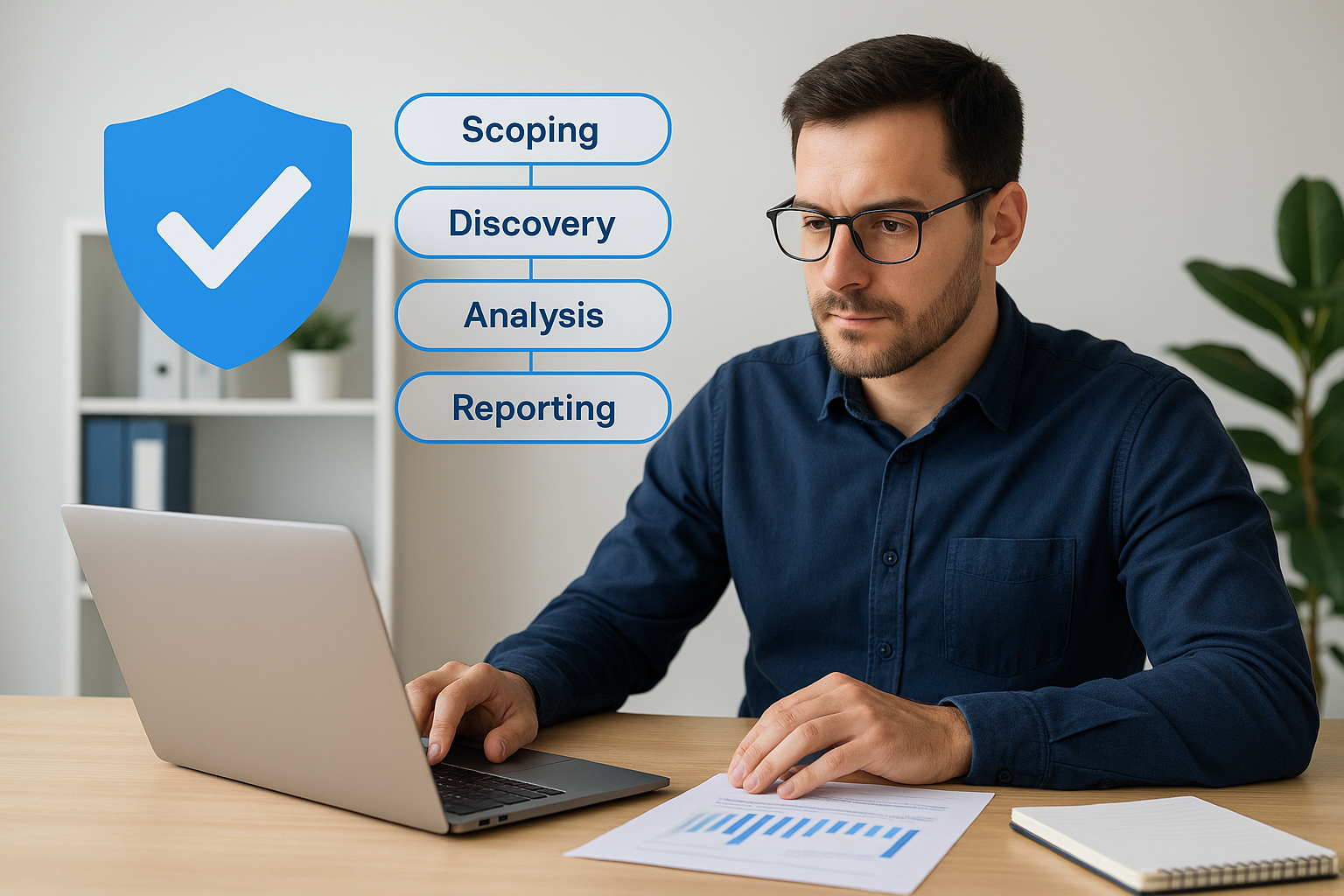
A proper assessment follows a defined process, not a single scan that spits out a PDF. Most providers, including TrustedIA, run through scoping, discovery, analysis, and reporting, following the same vulnerability assessment best practices that keep remediation support built in rather than left as an afterthought. The exact steps vary by provider, but the logic stays consistent: find everything, test everything, rank what matters, and hand over something your team can actually act on.
The core process
Here’s how a typical engagement runs from start to finish:
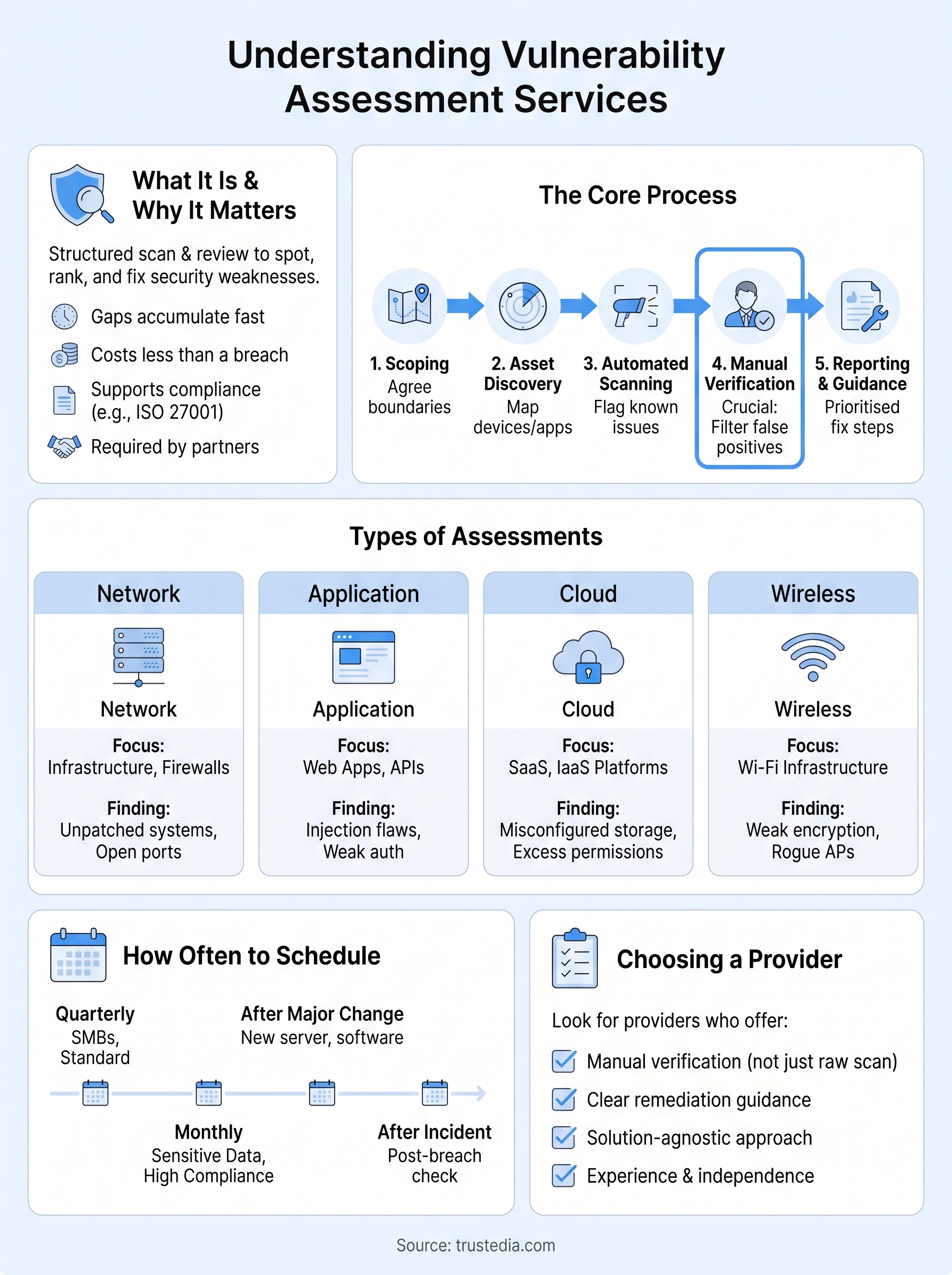
- Scoping – agree which networks, applications, cloud services, and endpoints are in scope, and what’s excluded.
- Asset discovery – map every device, server, and application connected to your environment, including shadow IT you didn’t know existed.
- Automated scanning – run tools against the discovered assets to flag known vulnerabilities, misconfigurations, and outdated software.
- Manual verification – an analyst checks flagged issues to confirm they’re real and rules out false positives.
- Risk scoring – each confirmed vulnerability gets ranked by severity and exploitability, usually against a framework like CVSS.
- Reporting and remediation guidance – you receive a report with clear priorities and practical fix instructions, not just a raw data dump.
A scan without expert verification is just a list of guesses dressed up as findings.
Where the value actually sits
Many businesses assume the scanning tool does all the work, but the real value sits in step four and five. Software flags thousands of potential issues; a skilled analyst narrows that down to the handful that genuinely threaten your business. Ongoing engagements build on this by comparing results over time, so you can track whether your vulnerability management programme is actually improving or just standing still. That trend data matters as much as any single report when you’re proving progress to auditors, insurers, or your own board.
Types of vulnerability assessments explained
Not every assessment looks the same, because not every environment carries the same risks. Vulnerability assessment services typically split into a handful of categories depending on what’s being tested, and a decent provider will scope a mix rather than treat one type as a catch-all. Knowing the difference helps you ask the right questions when you’re comparing quotes.
Network-based assessments
Generally, this is the starting point for most businesses. A network vulnerability assessment combines internal and external vulnerability scanning across infrastructure, firewalls, switches, servers, and open ports, to find misconfigurations and outdated software that an attacker could exploit from outside or inside your perimeter.
Application and web assessments
However, infrastructure isn’t the only attack surface. Application security testing looks at custom-built software, web portals, and APIs for issues like injection flaws, broken authentication, and insecure data handling, the sort of weaknesses that generic network scans simply won’t catch.
Cloud and wireless assessments
Increasingly, businesses need coverage that stretches beyond the traditional office network. A cloud security audit checks for exposed storage buckets, overly permissive access roles, and misconfigured services across AWS, Azure, or Microsoft 365 environments, while wireless assessments test whether your Wi-Fi setup gives an attacker a foothold from the car park.
| Assessment type | Main focus | Typical finding |
|---|---|---|
| Network | Servers, firewalls, ports | Unpatched systems, open ports |
| Application | Web apps, APIs | Injection flaws, weak authentication |
| Cloud | SaaS, IaaS platforms | Misconfigured storage, excessive permissions |
| Wireless | Wi-Fi infrastructure | Weak encryption, rogue access points |
Skipping one category doesn’t remove that risk, it just leaves it unmeasured.
Ultimately, most organisations need at least network and application coverage as a baseline, with cloud and wireless added once you understand your own footprint. A provider offering a solution-agnostic approach, rather than pushing one scanning tool across every environment, is better placed to match the assessment type to your actual infrastructure.
Choosing the right vulnerability assessment provider
Picking a provider isn’t just about who runs the cheapest scan. Anyone can point a tool at your network and email you a PDF, so it pays to compare UK network penetration testing services on how they actually work. What separates a genuinely useful vulnerability assessment provider from a box-ticking one is what happens after the scan finishes, how findings get verified, prioritised, and explained in language your team can act on.
Questions worth asking upfront
Before signing anything, get clear answers on how the provider actually delivers the work:
- Do they manually verify findings, or just hand over raw scanner output?
- Can they scope network, application, and cloud coverage together, or only one type?
- Do they offer remediation guidance, or leave you to interpret CVSS scores alone?
- How do they support ISO 27001 evidence requirements if you need them?
- Is their approach vendor-neutral, or are they tied to reselling one scanning platform?
A report full of jargon nobody on your team can action is worse than no report at all.
Why experience and independence matter
A provider that’s solution agnostic will recommend whatever fits your environment, not whatever earns them the biggest commission from a software vendor. That independence matters more than most buyers realise, because it means the priorities in your report reflect your actual risk, not a reseller’s product catalogue. Track record counts too. A team that’s been running assessments across different industries for decades has seen the edge cases that a newer outfit simply hasn’t encountered yet.
TrustedIA runs vulnerability assessments as part of a wider suite that includes vulnerability assessments, penetration testing, and ISO 27001 support, backed by over 30 years of hands-on IT and cyber security work. That combination matters because a security weakness flagged in isolation is far less useful than one assessed alongside your compliance obligations and broader risk posture, with a clear route to fixing it built into the same engagement.
How often you should schedule an assessment
There’s no single answer that fits every business, but "once a year and forget it" isn’t good enough anymore. Your network changes constantly, new staff join, new software gets installed, cloud services get spun up for a project and never decommissioned. Each change is a chance for a new gap to appear, which is why frequent vulnerability scanning needs to become routine rather than an annual event.
A practical schedule
Generally, the right cadence depends on how much your environment moves and what’s at stake if something slips through. As a starting point:
- Quarterly scans for most SMBs with moderate change and standard compliance needs.
- Monthly scans for businesses handling sensitive client data, running e-commerce, or operating under insurer requirements.
- After any significant change – a new server, a major software rollout, an office move, or a merger.
- Immediately after a known incident, even a minor one, to check nothing else was exposed.
Waiting a year between assessments means you’re finding out about problems that could have been fixed eleven months earlier.
Matching frequency to risk
Regulated sectors and anyone chasing or maintaining ISO 27001 certification should lean toward the more frequent end of that range, since auditors expect to see dated, recurring evidence rather than a single report gathering dust. Insurers increasingly ask the same question during renewal, and understanding what cyber insurance requires matters because a stale assessment can affect your premium or even your cover.
Combining scheduled assessments with continuous monitoring closes the gap between snapshots. A 24/7 managed SOC watching your environment day to day catches the issues that emerge between scans, while the formal assessment gives you the structured, prioritised view auditors and boards actually want to see. TrustedIA builds that combination into its ongoing managed security services, so clients aren’t left guessing what changed since the last report or scrambling to schedule one when a deadline suddenly appears.
Building a stronger security posture
Gaps in your systems are inevitable. What separates resilient businesses from vulnerable ones is whether those gaps get found and fixed before someone else exploits them. Vulnerability assessment services give you that structured, repeatable process, scoping, scanning, expert verification, and prioritised remediation, rather than a false sense of security built on assumptions or a single tool’s raw output.
Getting this right isn’t about buying the most expensive scanner on the market. It’s about working with a provider who verifies findings properly, explains them clearly, and ties the results to your wider compliance and risk picture. That’s where ongoing partnership beats a one-off engagement every time, especially as your network, staff, and cloud footprint keep changing.
If you’re ready to find out where your own weak spots sit before someone else does, talk to TrustedIA about a comprehensive vulnerability assessment built around your actual environment, not a generic template.



