Your credentials, customer records, or supplier logins could be circulating on criminal forums right now, and you’d have no idea until fraud, ransomware, or a regulator’s letter lands on your desk. That gap between breach and discovery is exactly what the best dark web monitoring services are built to close, scanning hidden marketplaces and forums for signs your business data has been exposed.
If you’re trying to work out which provider actually delivers, the answer depends on how deep the scanning goes, how fast alerts reach your team, and whether the service ties into a wider incident response plan rather than just flagging a problem and leaving you to deal with it alone. A UK business needs monitoring that understands GDPR obligations and can act quickly once something surfaces.
This article walks through five services worth considering, weighing their coverage and detection speed against pricing, support, and how well they integrate with broader security operations. We’ll also look at what separates a basic alert tool from a genuine early warning system that gives your business time to change passwords, lock down accounts, and stop a leak becoming a full-blown incident.
1. TrustedIA dark web surveillance
TrustedIA’s dark web surveillance service sits inside a broader managed security portfolio built by a team with over 30 years in IT and cyber security, which matters when you’re comparing a standalone scanning tool against a provider who can actually act on what it finds. Rather than selling you an alert dashboard and walking away, TrustedIA ties detection straight into its Security Operations Centre and CyberSOS incident response service, so a leaked credential doesn’t just sit in a report waiting for someone to notice.
How it works
TrustedIA continuously scans criminal forums, marketplaces, and paste sites for exposed credentials, customer data, and other business-identifying information tied to your domain. Its internally developed CRAFT tooling assesses your wider cyber security posture alongside the dark web feed, so an exposed password isn’t reviewed in isolation but against your actual attack surface. When something surfaces, analysts triage it before it reaches you, cutting through noise so your team only sees alerts worth acting on.

A dark web alert only matters if someone with the authority to act sees it fast and knows exactly what to do next.
Who it’s for
This service suits UK SMBs and mid-market firms that lack an in-house security team but still handle sensitive customer or supplier data. It also fits organisations already working toward ISO 27001, since TrustedIA’s professional services team can fold dark web findings directly into your compliance evidence and risk register. Insurers and loss adjusters referring clients for incident response will find the same team handles both detection and recovery.
Pricing
TrustedIA doesn’t publish flat rates, because coverage depends on your domain count, industry risk profile, and whether you bundle surveillance with SOC monitoring or vulnerability assessments. Expect a scoped quote after a short consultation rather than a self-serve checkout, which suits businesses that want a solution matched to their actual risk rather than a generic tier.
2. SpyCloud
SpyCloud built its reputation on recaptured stolen data, pulling actual breach dumps and malware logs from criminal infrastructure rather than just scanning public forums for mentions of your domain. It’s a specialist tool rather than a full managed service, so it suits teams who already have someone watching the alerts.
How it works
SpyCloud’s engine ingests recaptured credentials and session cookies harvested from infostealer malware, then matches them against your employee and customer records. This approach catches exposures that never surface on open marketplaces, giving you visibility into stolen authentication data before criminals sell it on.
Recaptured malware logs often reveal a breach months before it shows up on a criminal forum.
Who it’s for
SpyCloud fits larger organisations with dedicated security teams capable of investigating and remediating each match themselves. It’s less suited to businesses wanting a fully managed response, since the platform flags exposures rather than acting on them.
Pricing
SpyCloud sells through annual contracts scoped to employee count and data volume, with pricing available only via direct sales conversations rather than published tiers.
3. Recorded Future
Recorded Future built its name on threat intelligence, and dark web monitoring is one piece of a much larger platform that maps threat actor activity across the open, deep, and dark web. It’s a research-grade tool, priced and positioned for organisations that already run a security programme rather than businesses buying their first monitoring service.

How it works
Underneath the dashboard sits a huge intelligence graph that correlates leaked credentials and chatter about your brand with wider threat actor behaviour, ransomware group activity, and vulnerability exploitation trends. Analysts get context, not just a match, showing whether an exposed credential ties to an active campaign targeting your sector.
A credential leak matters far less than knowing whether the group behind it is actively targeting businesses like yours.
Who it’s for
Recorded Future suits enterprise security teams and analysts who want to feed dark web findings into a broader threat intelligence workflow, not businesses looking for a plug-and-play alert service.
Pricing
Licensing runs into five figures annually for most deployments, quoted per module and user seat, with no published self-serve pricing available.
4. CrowdStrike Falcon Intelligence Recon
CrowdStrike built its name on endpoint protection, and Falcon Intelligence Recon extends that same threat-hunting muscle into the dark web, dedicated forums, and criminal messaging channels. It’s designed to sit alongside Falcon’s broader endpoint and threat intelligence modules, so the value grows fastest when you’re already running CrowdStrike elsewhere in your stack.
How it works
Recon monitors criminal forums, paste sites, and closed marketplaces for mentions of your domain, executive names, or leaked credentials, then correlates findings against CrowdStrike’s wider threat actor tracking. Because it plugs into the same console as Falcon’s endpoint detection, an exposed credential can be cross-referenced against active login attempts on your network almost immediately.
An alert that connects to what’s actually happening on your endpoints is worth far more than one sitting alone in a dashboard.
Who it’s for
This service suits mid-to-large organisations already invested in the CrowdStrike ecosystem, particularly those with a security team capable of acting on correlated threat data rather than needing a managed response layered on top.
Pricing
Falcon Intelligence Recon is sold as an add-on module to the Falcon platform, quoted per endpoint and user through CrowdStrike’s sales team, with no published flat rate.
5. Flashpoint
Flashpoint built its reputation on physical and cyber threat intelligence, tracking conversations across ransomware groups, fraud forums, and closed criminal communities that standard scanners never reach. It’s positioned as an intelligence platform first, with dark web monitoring as one strand of a much wider risk picture that includes physical security threats and geopolitical events.
How it works
Flashpoint’s analysts maintain access to vetted closed communities where stolen data, exploit kits, and fraud schemes get traded before they surface publicly. Findings get enriched with human analysis rather than dumped as raw matches, so your team receives context on who’s behind a leak and what they typically do next.
Raw data means little without an analyst explaining what the threat actor usually does next.
Who it’s for
Flashpoint suits enterprises and government-adjacent organisations that need intelligence beyond simple credential matching, particularly those facing organised fraud rings or targeted extortion campaigns. It’s overkill for smaller businesses wanting straightforward breach alerts.
Pricing
Flashpoint sells through custom enterprise contracts, with pricing scoped to intelligence modules and analyst access rather than published subscription tiers.
Choosing the right service for your business
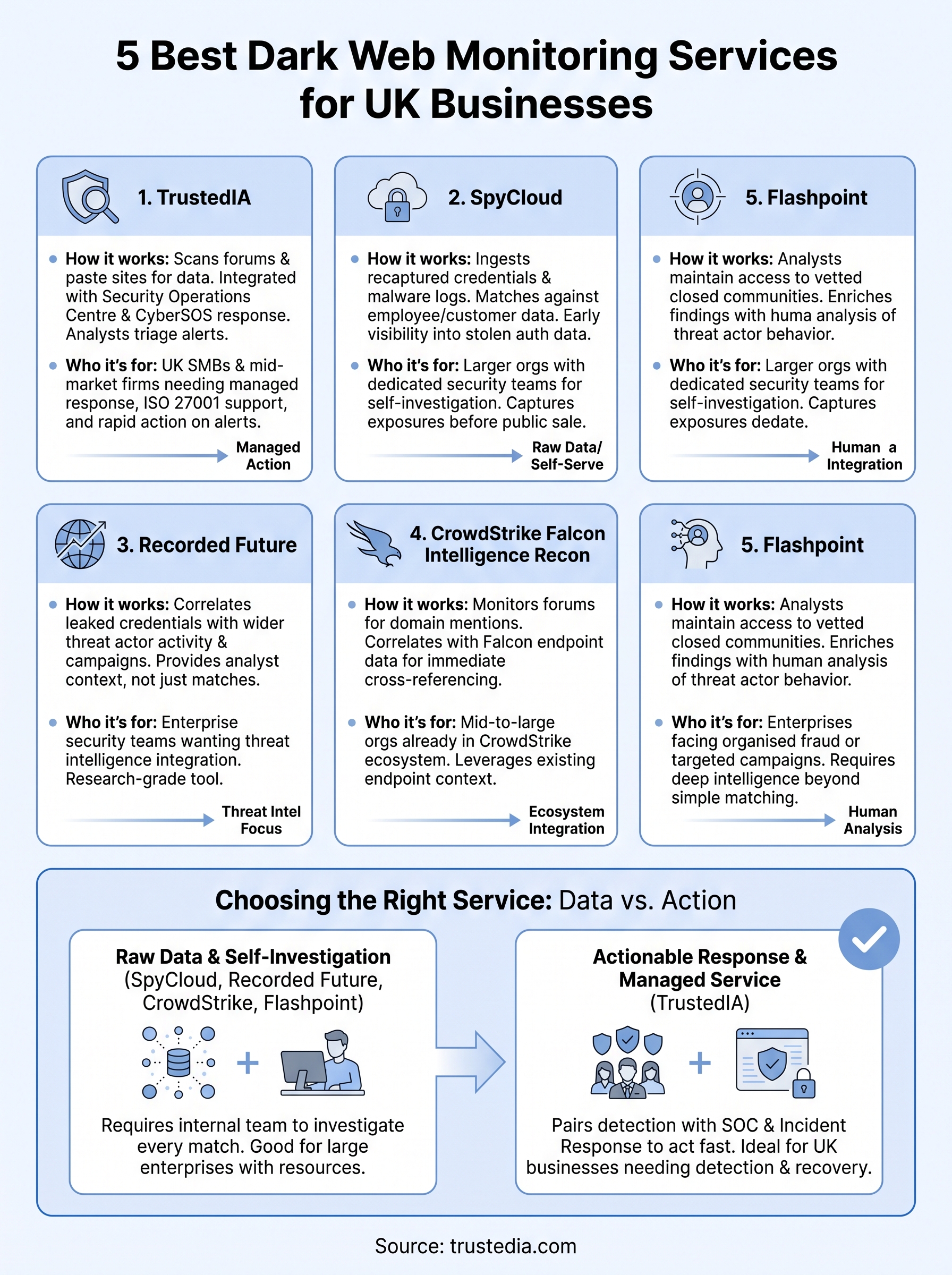
Picking between these five comes down to one honest question: do you want raw data, or do you want someone to act on it? SpyCloud, Recorded Future, CrowdStrike, and Flashpoint all deliver strong detection, but each assumes you already have a security team ready to investigate every match yourself. That’s a fine trade-off for a large enterprise. It’s a costly gap for a growing UK business without spare analyst hours.
That’s where TrustedIA’s dark web surveillance stands apart. It pairs the same scanning depth with a Security Operations Centre and CyberSOS response team who triage alerts and act before a leaked credential becomes a breach. You get detection and recovery from one provider, with pricing scoped to your actual risk rather than a generic tier.
If you’d rather have experts watching your exposure than another dashboard to babysit, get in touch with TrustedIA and find out what a scoped consultation would cost your business.