

Traditional perimeter-based security operates on a simple assumption: everything inside the network is safe. That assumption has been failing businesses for years. Credentials get stolen, endpoints get compromised, and attackers move laterally through networks with little resistance. The zero trust security benefits address this head-on by flipping the model, no user, device, or application is trusted by default, regardless of where it sits on the network.
Zero Trust isn’t just a technical framework. It’s a shift in how organisations think about access, verification, and risk. For businesses managing remote teams, cloud infrastructure, and growing compliance requirements like ISO 27001, it offers measurable improvements to security posture and operational resilience. But understanding what those gains actually look like, beyond the buzzwords, matters more than ever.
At TrustedIA, we help businesses across the UK build and strengthen their cyber security through managed services, audits, and hands-on expertise. Our solution-agnostic approach means we focus on what actually works for your organisation, not what a specific vendor wants to sell you. Zero Trust aligns closely with the work we do every day, from endpoint detection and SOC services to ISO 27001 implementation.
This article breaks down nine specific business and security gains that come with adopting a Zero Trust model, so you can assess whether it’s the right move for your organisation and where to start.
Why zero trust matters for UK organisations
Cyber threats in the UK are not hypothetical. The NCSC reported in its 2024 Annual Review that ransomware remains one of the most disruptive threats facing UK organisations, with attacks against critical infrastructure, SMBs, and public sector bodies increasing in both frequency and sophistication. Traditional security models were not built for this environment, and the gap between what legacy perimeters can protect and what attackers can exploit has never been wider. Understanding the zero trust security benefits in this context means understanding why the old model is breaking down.
The UK cyber threat landscape
Attackers today rarely break in through brute force. Credential theft, phishing, and supply chain compromise are the dominant entry points, and once an attacker has valid credentials, a flat network with implicit trust offers almost no resistance. UK organisations faced millions of cyber incidents in recent years, with businesses of all sizes reporting breaches that caused operational disruption and data loss. The financial and reputational damage from a single breach can be significant enough to threaten business continuity entirely.
Stolen credentials used inside a trusted network are invisible to perimeter-based defences. Zero Trust treats every access request as potentially hostile, regardless of where it originates.
Remote and hybrid work has changed the attack surface
Your workforce is no longer sitting inside a single office on a managed network. Remote and hybrid working has expanded the attack surface dramatically, with employees connecting from home networks, personal devices, and public Wi-Fi. Each of those connection points is a potential entry into your systems. Legacy VPNs and perimeter firewalls were designed for a world where the office boundary mattered. That boundary no longer exists in the same way, and tools built around it are struggling to keep up.
The practical consequence is that many UK businesses are running security controls that assume a level of network containment they no longer have. Devices outside the office carry the same access privileges as those inside the building, which means a compromised remote device can reach the same sensitive data as if an attacker were physically on-site. Zero Trust solves this by enforcing continuous verification at every access point, regardless of location or device.
Compliance requirements are pushing organisations to act
UK GDPR, the Network and Information Systems (NIS) Regulations, and ISO 27001 all require organisations to demonstrate that they have appropriate technical and organisational controls in place to protect personal data and critical systems. Regulators are paying closer attention to access controls, audit trails, and incident response capability. Failing to demonstrate adequate controls can result in significant fines, enforcement action, and reputational damage, particularly for organisations operating in regulated sectors like finance, healthcare, and legal services.
Zero Trust maps naturally onto these compliance frameworks. Principles like least-privilege access, continuous monitoring, and identity verification align directly with the control requirements in ISO 27001 and the access management expectations under UK GDPR. For organisations working towards certification or trying to maintain it, implementing Zero Trust can strengthen your compliance position in a structured and auditable way.
What zero trust is and what it is not
Zero Trust is a security model built on one core principle: never trust, always verify. It was formalised by Forrester Research analyst John Kindervag in 2010, and it directly challenges the assumption that anything inside your network deserves implicit trust. Every access request, whether from a user, device, or application, must be authenticated, authorised, and continuously validated, regardless of whether it originates inside or outside the traditional network boundary.
What zero trust actually is
At its core, this architecture combines several overlapping controls to enforce strict access management. Identity verification sits at the centre of the model, ensuring that every user and device proves who they are before they can reach any resource. Alongside identity, the model relies on least-privilege access, which means users and systems only get access to what they specifically need for a given task, nothing more. Continuous monitoring then validates that trust earned at login is maintained throughout a session, not assumed indefinitely.

The core components that make Zero Trust work in practice include:
- Identity and access management (IAM) to verify users and enforce multi-factor authentication
- Micro-segmentation to divide the network into isolated zones that limit lateral movement
- Device health checks to confirm endpoints meet security standards before granting access
- Continuous monitoring and logging to detect anomalies and support incident response
What zero trust is not
Zero Trust is not a single product you can buy and deploy in an afternoon. No vendor sells a complete Zero Trust solution in a box, and organisations that approach it as a one-time purchase will be disappointed. It is a framework and a philosophy that requires you to assess your existing controls, identify gaps, and build towards the model incrementally.
Understanding what Zero Trust is not matters as much as understanding what it is, because misaligned expectations lead to poorly implemented controls and a false sense of security.
Realising the full zero trust security benefits also requires organisational change, not just technical change. Policies, processes, and user behaviour all need to align with the model for it to function effectively. Zero Trust without strong governance is simply a collection of tools that do not work together.
The 9 zero trust security benefits
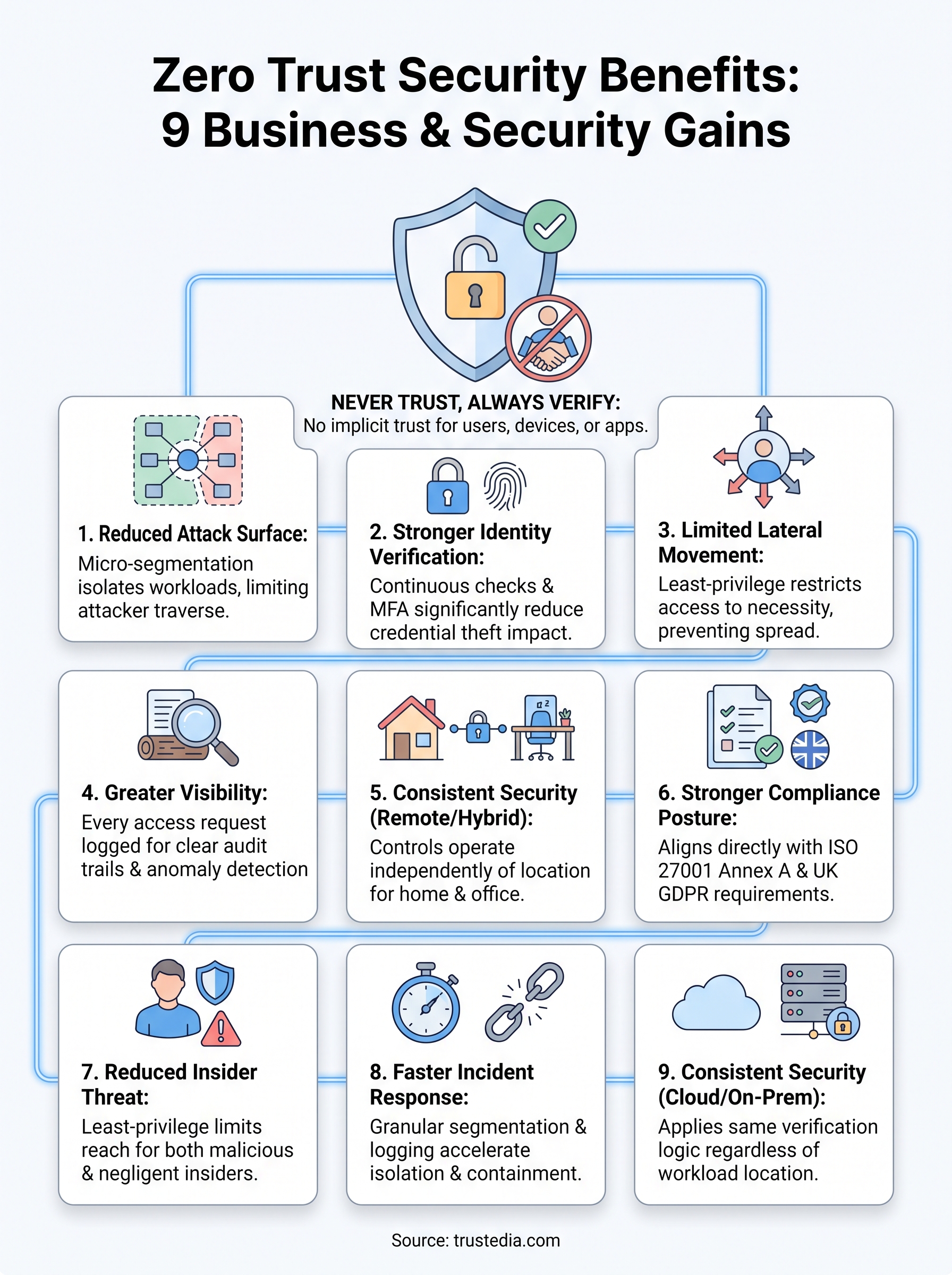
The zero trust security benefits extend well beyond stopping individual attacks. They reshape how your organisation manages access, responds to incidents, and demonstrates security competence to regulators and insurers. Here are the nine specific gains you can expect from adopting the model.
- Reduced attack surface – Micro-segmentation isolates workloads so an attacker with a foothold in one area cannot freely traverse your network.
- Stronger identity verification – Continuous identity checks and multi-factor authentication reduce the impact of stolen credentials significantly.
- Limited lateral movement – Least-privilege access means a compromised account can only reach what that account was permitted to access, nothing beyond it.
- Greater visibility across your environment – Every access request is logged, giving you clear audit trails and the data needed to detect anomalies early.
- Consistent security for remote and hybrid workers – Access controls operate independently of location, so a home worker carries the same protections as an office-based one.
- Stronger compliance posture – Zero Trust controls align directly with ISO 27001 Annex A controls and UK GDPR access management requirements.
- Reduced insider threat exposure – Least-privilege limits what any user can reach, regardless of intent, reducing risk from both malicious and negligent insiders.
- Faster incident response – Granular segmentation and logging make it easier to isolate compromised systems and contain damage before it spreads.
- Consistent security across cloud and on-premises environments – Zero Trust applies the same verification logic regardless of where workloads sit.
Why business resilience is at the centre of these gains
Many organisations evaluate Zero Trust through a purely technical lens, but the business resilience outcomes are equally important to consider. Containing lateral movement during a ransomware attack, for example, is not just a security win. It is the difference between a contained incident affecting one system and a company-wide shutdown that halts operations for days or weeks.
Cyber insurers are also paying close attention to how organisations manage access and authentication. Demonstrating Zero Trust principles, such as enforced MFA, micro-segmentation, and continuous monitoring, can strengthen your position when negotiating coverage terms or responding to underwriter questionnaires.
Organisations that treat Zero Trust as a resilience investment rather than a compliance checkbox see returns in both security posture and operational continuity.
Zero trust vs VPN and legacy perimeter security
VPNs and perimeter firewalls were built for a different era. When your entire workforce sat inside one office and all your data lived on local servers, placing a secure boundary around the network made sense. That boundary no longer holds for most UK organisations. Cloud platforms, remote workers, and third-party integrations have stretched the perimeter to the point where traditional tools create a false sense of protection rather than actual security.
Why VPNs fall short today
A VPN grants network access, not application access. Once your user connects, they typically receive broad access to internal systems, often far beyond what their role requires. If their credentials are stolen, an attacker inherits that same broad access and can move through your network without triggering perimeter-based alerts. VPNs were not designed to verify trust continuously; they verify it once at login and then step aside.
Scaling VPN infrastructure across a growing remote workforce also creates performance problems that affect productivity. Users experience slow connections, which pushes them towards workarounds that introduce further risk. The tool itself becomes an obstacle to secure, productive working rather than a reliable control.
A compromised VPN account gives an attacker the same internal access as any legitimate employee, and legacy controls will not flag the difference.
What the perimeter model gets fundamentally wrong
Legacy perimeter security operates on implicit trust. Everything inside the boundary is assumed safe, and once an attacker crosses it, through phishing, a stolen credential, or a compromised supplier, lateral movement faces almost no resistance. Internal traffic is trusted by design, which means a threat actor with a foothold can reach sensitive systems quietly and at pace.
Zero Trust removes that implicit trust entirely. Instead of asking whether a user is inside the network, it asks whether this user, on this device, has verified their identity and deserves access to this specific resource right now. That question gets asked continuously, not just at login. This is where the core zero trust security benefits become concrete: every access request is treated on its own merits, closing the gaps that legacy perimeter tools were never designed to address.
How to implement zero trust step by step
Zero Trust is not a single deployment. It is a structured progression that builds on your existing controls rather than replacing everything at once. Most organisations approach it in phases, starting with the highest-risk areas and expanding coverage as confidence grows. The zero trust security benefits only materialise if the implementation is grounded in your actual environment, not a generic blueprint.
Start with visibility and your asset inventory
You cannot protect what you cannot see. Mapping every user, device, application, and data flow in your environment is the essential first step before any Zero Trust control is introduced. This inventory tells you where sensitive data sits, who accesses it, and which pathways carry the greatest risk. Without this foundation, you are applying access controls to an incomplete picture, which leaves gaps.
Visibility is not a one-time task. Keeping your asset inventory current is what makes every subsequent control accurate and effective.
Start with your identity infrastructure and confirm that you know exactly which accounts exist, what they can access, and whether any carry unnecessary privilege. This stage regularly surfaces dormant accounts, overly permissive roles, and unmanaged devices that represent immediate risk.
Apply identity controls and least-privilege access
Once you have visibility, enforce multi-factor authentication across all users and systems, prioritising admin accounts and anything touching sensitive data. Identity is the primary control surface in a Zero Trust model, and MFA is the single most effective way to reduce the impact of credential theft. Microsoft’s guidance on Zero Trust recommends treating identity as the new perimeter and verifying it continuously.
Least-privilege access should follow immediately. Review existing permissions and strip back anything beyond what a user or system genuinely needs for their current role. This step alone significantly limits what an attacker can reach with a compromised account.
Segment your network and monitor continuously
Apply micro-segmentation to isolate workloads and critical systems so that a breach in one area cannot spread freely. At the same time, enable logging and monitoring across all access events. Continuous monitoring is what turns Zero Trust from a static set of controls into a living security posture that adapts as threats and your environment evolve.
How to measure and improve your zero trust
Implementing Zero Trust is not a finish line. Measuring how well your controls are working and refining them over time is what turns the model into a durable security posture rather than a one-off project. Without clear metrics, you cannot demonstrate the zero trust security benefits to your leadership, your insurers, or your auditors in any meaningful way.
Define metrics that reflect real security outcomes
Start by identifying metrics that tell you something concrete about access control and threat containment. Tracking MFA adoption across all user accounts and monitoring the volume of access requests blocked by least-privilege policies gives you a direct view of how your identity controls are functioning. Alongside these, measuring mean time to detect (MTTD) and mean time to respond (MTTR) to anomalous access events shows whether your continuous monitoring is actually accelerating your incident response capability.
Metrics that do not connect to a specific control or risk are noise. Focus on numbers that directly reflect how your Zero Trust model performs under pressure.
Useful metrics to track consistently include:
- MFA adoption rate across all user accounts
- Access requests denied by least-privilege policies
- Mean time to detect and respond to anomalous access events
- Lateral movement attempts blocked by micro-segmentation
- Audit trail completeness for sensitive data access
Run regular assessments to find gaps
Periodic reviews of your access permissions are essential because roles change, systems get added, and privilege creep accumulates quietly over time. Set a regular schedule for reviewing who holds access to what, and revoke anything no longer justified by a current business need. Penetration testing and vulnerability assessments provide an external view of whether your segmentation and access controls hold up under realistic attack conditions, and both map directly onto ISO 27001 audit requirements.
Improving your Zero Trust posture runs as a cycle of measurement, testing, and refinement. Each assessment generates findings that feed back into your controls, tightening gaps before attackers find them. Treat this cycle as part of your standard security operations rather than an occasional exercise, and your organisation builds genuine resilience over time.
Next steps to make zero trust real
The zero trust security benefits outlined in this article only become real when you start acting on them. You do not need to overhaul everything at once. Begin with visibility and identity controls, then build outward as your confidence and capability grow. Each incremental step reduces real risk and strengthens your compliance position.
Working with an experienced partner accelerates this process significantly. TrustedIA’s managed security services, SOC capabilities, and ISO 27001 expertise mean you get practical support at every stage, from initial auditing to ongoing monitoring and incident response. You gain a clearer security posture without needing to build every capability in-house.
Ready to take the first step? Understand your current gaps and risk exposure by working with a team that brings hands-on expertise across the full security lifecycle. Get in touch with TrustedIA to find out what a structured path to Zero Trust looks like for your organisation.



