
Most small business owners know they should be doing something about GDPR compliance for small businesses UK, but "something" often means a privacy policy copied from a competitor and hoping for the best. The problem? The Information Commissioner’s Office (ICO) doesn’t grade on effort. Fines can reach up to £17.5 million or 4% of annual global turnover, whichever is higher, and small businesses are not exempt.
The good news is that GDPR compliance isn’t as overwhelming as it looks. It does require structure, attention to how you collect and store personal data, and a genuine commitment to protecting the people behind that data. But you don’t need a legal team or a six-figure budget to get it right. What you need is a clear, practical roadmap, which is exactly what this guide provides.
At TrustedIA, we work with businesses across the UK to strengthen their cybersecurity posture, achieve ISO 27001 certification, and build the kind of data protection practices that hold up under scrutiny. We’ve seen first-hand how proper compliance not only reduces risk but also builds real trust with customers and partners.
This guide walks you through everything: what UK GDPR actually requires from your business, the steps to get compliant, a usable checklist, and the common mistakes that trip small businesses up. Whether you’re a sole trader handling client records or an SMB processing thousands of data points, you’ll leave with a clear plan to follow.
What UK GDPR means for small businesses
After Brexit, the UK retained and adapted the EU GDPR into domestic law through the Data Protection Act 2018, creating what is now referred to as the UK GDPR. For most small businesses, the practical obligations are almost identical to the original regulation. You still need to justify every piece of personal data you collect, secure it properly, and give people meaningful control over their own information. The ICO enforces these rules, and the penalties apply regardless of your company size or turnover.
The UK GDPR applies to any organisation that processes personal data about UK residents, regardless of how small the business or how simple the data processing.
What counts as personal data
This is where many small businesses underestimate their exposure. Personal data is any information that identifies or could identify a living individual. That includes the obvious items like names, email addresses, and phone numbers, but it also covers IP addresses, cookie identifiers, and combinations of data that together point to a specific person. If you run a contact form, a client database, or an e-commerce store, you are processing personal data.
Special category data sits in a higher-risk bracket entirely. This includes health information, racial or ethnic origin, religious beliefs, and biometric data. If you process any of this, you need explicit consent and additional safeguards in place before you handle a single record.
The seven data protection principles
GDPR compliance for small businesses UK means building your data practices around seven core principles set out in Article 5 of the regulation. These are not optional guidelines; they are legal obligations you must be able to demonstrate actively.

| Principle | What it means for you |
|---|---|
| Lawfulness, fairness, and transparency | You have a valid legal reason for processing data and you tell people about it clearly |
| Purpose limitation | You only use data for the purpose you originally collected it |
| Data minimisation | You collect only what you genuinely need |
| Accuracy | You keep personal data current and correct |
| Storage limitation | You do not hold data for longer than necessary |
| Integrity and confidentiality | You protect data from loss, theft, and unauthorised access |
| Accountability | You can prove you comply, not just say you do |
The accountability principle and why it carries the most weight
Most small businesses can satisfy the first six principles with sensible policies and basic security measures. Accountability works differently because it demands documented evidence. That means written records of your data processing activities, a privacy notice your customers can actually find, and a clear process for handling data subject requests. If the ICO ever investigates your business, they will ask for documentation. Verbal assurances carry no weight.
You also need to understand the difference between a data controller and a data processor. As a data controller, you decide why and how personal data is processed. As a data processor, you handle data on behalf of another organisation, such as a payroll provider processing employee records for a client. Many small businesses act as controllers for their own customer data and as processors for certain client work simultaneously, which means both sets of obligations apply at once.
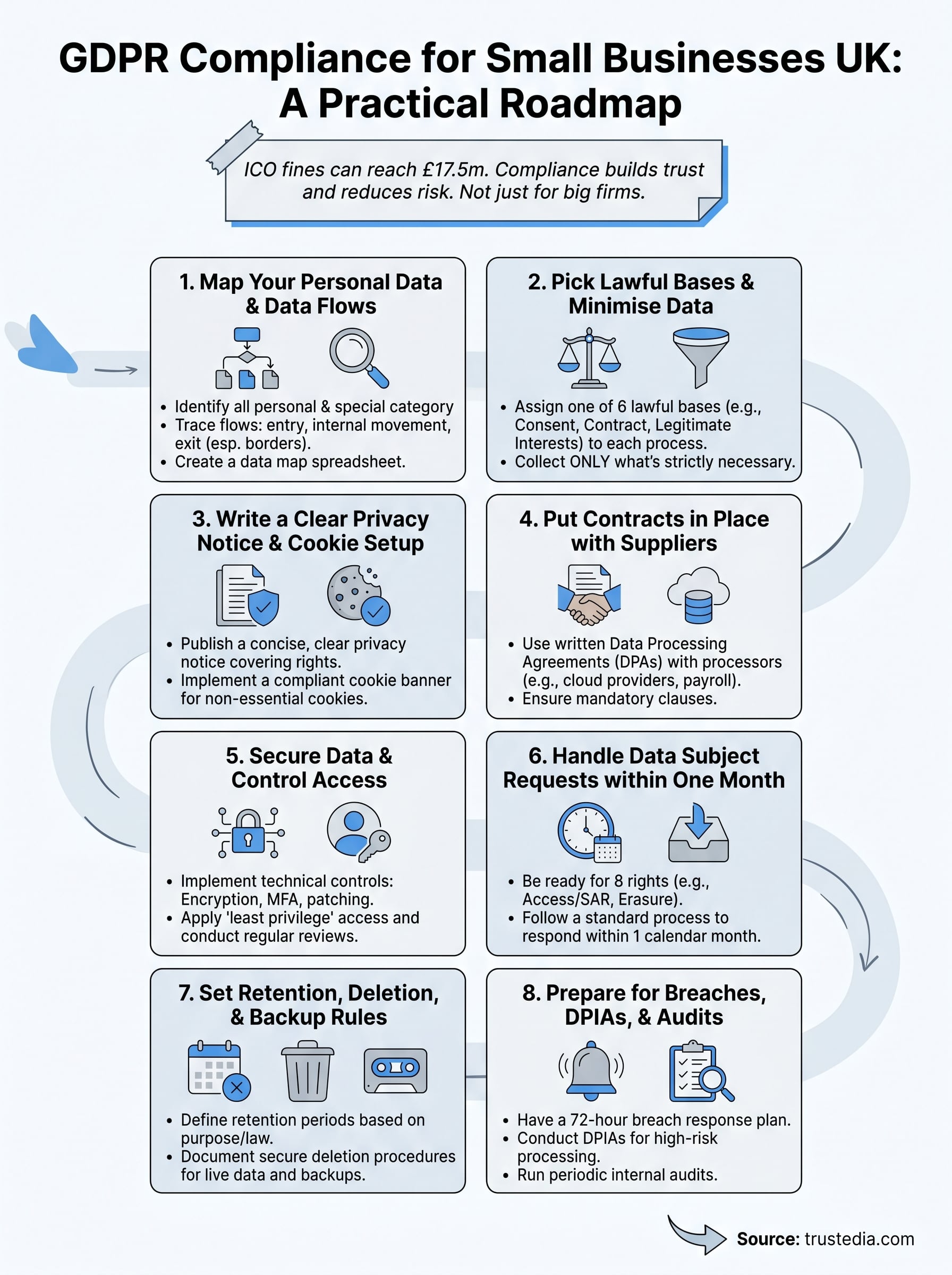
Step 1. Map your personal data and data flows
Before you can manage personal data responsibly, you need to know exactly what you hold, where it lives, and where it travels. This is called a data mapping exercise, and it forms the foundation of every other compliance step. For small businesses working through GDPR compliance for small businesses UK, skipping this step means every decision that follows is built on guesswork rather than fact.
You cannot protect data you do not know you have, so a data map is not optional; it is the starting point for everything.
What to include in your data map
Your data map should capture every category of personal data your business touches, not just the obvious customer records. Think about employee data, supplier contact details, website analytics, marketing lists, and any data passed to you by clients. For each category, record who the data belongs to, what you use it for, how long you keep it, and where it is stored.
Use a simple spreadsheet to build this out. Here is a starting template:
| Data category | Data subjects | Purpose | Storage location | Retention period | Third parties shared with |
|---|---|---|---|---|---|
| Customer contact details | Customers | Order fulfilment | CRM system | 3 years post last order | Email platform |
| Employee payroll records | Staff | Payroll processing | Accounting software | 6 years | Payroll provider |
| Website analytics | Visitors | Performance monitoring | Google Analytics | 26 months | |
| Marketing email list | Prospects | Email campaigns | Email platform | Until unsubscribe | Email provider |
How to trace data flows
Recording what data you hold is only half the picture. You also need to understand where data enters your business, how it moves internally, and where it leaves. Data flows cover every touchpoint: a contact form submission that feeds your CRM, an employee record sent to your payroll provider, or a customer file shared with a third-party courier.

Walk through each business process step by step and ask: who sends this data, who receives it, and does it cross any borders? If data travels outside the UK, additional transfer rules apply under UK GDPR. Document each flow in your spreadsheet alongside the relevant data category so everything stays in one place and you can demonstrate accountability if the ICO ever asks.
Step 2. Pick lawful bases and minimise data
Every piece of personal data you process needs a lawful basis under UK GDPR. Without one, your data collection is unlawful, full stop. This step requires you to go through your data map from Step 1 and assign a legal justification to each processing activity. Many small businesses default to consent for everything, but that is usually the wrong choice and creates more compliance work than necessary.
Consent is not the only lawful basis available, and for many business processing activities, it is not even the right one.
The six lawful bases explained
UK GDPR sets out six lawful bases for processing personal data, and each one applies to different circumstances. Choosing the right basis matters because it determines what rights the data subject has and what obligations you take on. If you rely on consent, individuals can withdraw it at any time, which means you must stop processing their data immediately. If you rely on legitimate interests, you need to carry out a balancing test to confirm your interests do not override the individual’s rights.
| Lawful basis | When to use it |
|---|---|
| Consent | Marketing emails to new prospects with no prior relationship |
| Contract | Processing customer contact details to fulfil an order |
| Legal obligation | Keeping employee payroll records as required by HMRC |
| Vital interests | Reserved for life-or-death emergencies; rarely applies to businesses |
| Public task | Applies mainly to public authorities |
| Legitimate interests | Analytics, fraud prevention, or business development where properly balanced |
How to apply data minimisation
Once you have assigned a lawful basis to each processing activity, data minimisation requires you to check that you are only collecting what is strictly necessary for that purpose. If your checkout form asks for a date of birth but you do not need it to fulfil orders, remove the field. If your contact form collects job titles that you never use in any business process, drop them entirely.
Go through each data category in your map and ask: would removing this field prevent you from carrying out the stated purpose? If the answer is no, you should not be collecting it. Keeping gdpr compliance for small businesses uk practical means regularly reviewing your forms, database fields, and third-party integrations to cut any data collection that has crept in over time without a clear purpose behind it.
Step 3. Write a clear privacy notice and cookie setup
A privacy notice is not a legal formality you bury in a footer; it is a direct communication to the people whose data you process, and UK GDPR requires it to be concise, clear, and accessible. Many small businesses copy a generic template and never revisit it, which means it bears no resemblance to what they actually do with data. Your privacy notice must reflect your real processing activities, the lawful bases you identified in Step 2, and the specific rights your visitors and customers can exercise.
A privacy notice that does not match your actual data practices is worse than no notice at all, because it creates a documented contradiction the ICO can point to.
What your privacy notice must cover
Under Articles 13 and 14 of UK GDPR, your notice must include several mandatory elements regardless of your business size. Use this as a checklist when drafting or reviewing your notice:
- Who you are: your business name and contact details, and your Data Protection Officer contact if you have one
- What data you collect and the categories of data subjects it relates to
- Why you collect it: the specific purpose for each processing activity
- Your lawful basis for each purpose (consent, contract, legitimate interests, etc.)
- Who you share it with: named third parties or categories of recipients
- How long you keep it: specific retention periods or the criteria used to determine them
- Data subject rights: the right to access, rectify, erase, restrict, object, and portability where applicable
- How to complain: a reference to the ICO and a link to www.ico.org.uk
- Whether you transfer data internationally and the safeguards in place
Setting up cookies correctly
Cookies that identify individuals count as personal data under gdpr compliance for small businesses UK rules, and you need both a cookie notice and a mechanism for obtaining valid consent before non-essential cookies fire. Strictly necessary cookies, such as session cookies that keep a shopping basket active, do not require consent. Analytics, advertising, and preference cookies do.

Place a cookie banner on your site that blocks non-essential cookies until the visitor actively accepts them. Pre-ticked boxes and implied consent do not meet the standard. Pair this with a separate cookie policy page that lists each cookie by name, its purpose, and its expiry period so visitors can make a genuinely informed choice.
Step 4. Put contracts in place with suppliers
When you share personal data with a third party that processes it on your behalf, UK GDPR requires you to have a written contract in place before any data changes hands. These agreements are called Data Processing Agreements (DPAs), and they are a legal requirement, not an optional extra. Without one, both you and your supplier are exposed, and the ICO can hold you responsible for a processor’s failure even if you had no direct involvement in the breach.
If a supplier processes personal data on your behalf and you have no written agreement covering it, you are operating outside the requirements of UK GDPR regardless of how careful you are internally.
Who counts as a data processor
A data processor is any organisation that handles personal data purely on your instructions. This covers a wide range of suppliers that most small businesses already use. Common examples include email marketing platforms, cloud storage providers, payroll bureaus, IT support companies, and customer service software vendors. If a supplier touches personal data that belongs to your customers or staff and they do it to serve your business, they are almost certainly acting as a data processor for your purposes under gdpr compliance for small businesses uk rules.
Check your existing supplier list against your data map from Step 1. Any supplier that appears in the "third parties shared with" column needs a DPA in place.
What your data processing agreement must cover
Article 28 of UK GDPR sets out the mandatory clauses every DPA must include. Many established software providers, such as those offering cloud services, will supply their own pre-drafted DPA. Review it carefully before signing rather than accepting it without reading. For smaller local suppliers without a standard agreement, you will need to draft one yourself or ask them to sign yours.
Your DPA must address the following points as a minimum:
- Subject matter and duration of the processing
- The nature and purpose of the processing activity
- The type of personal data involved and the categories of data subjects
- Your instructions to the processor and confirmation they will only act on them
- Confidentiality obligations on the processor’s staff
- Security measures the processor has in place
- Rules on sub-processors, including your right to approve any new ones
- Cooperation with your data subject rights obligations and breach notifications
- Deletion or return of data at the end of the contract
Step 5. Secure data and control access
UK GDPR’s integrity and confidentiality principle requires you to implement technical and organisational measures that protect personal data from accidental loss, unauthorised access, and deliberate attacks. This is not a vague obligation; the ICO expects you to make specific, documented security decisions appropriate to the risk level of the data you hold. For most small businesses, the gap between current practice and what the regulation requires is smaller than it looks, but it does need to be closed deliberately.
Getting security wrong is one of the fastest routes to a mandatory breach notification and regulatory scrutiny, so treat this step as a core part of your compliance work, not an IT afterthought.
Technical controls to implement
Start with the fundamentals. Encrypting personal data at rest and in transit protects information even if a device is lost or a connection is intercepted. Use HTTPS across your entire website, enable full-disk encryption on laptops and external drives, and confirm that your cloud storage provider encrypts data by default. Apply multi-factor authentication (MFA) to every account that holds or accesses personal data, including your email platform, CRM, and accounting software. These three controls alone block the majority of opportunistic attacks that target small businesses.
Alongside encryption and MFA, keep software patched and updated. Unpatched systems are one of the most common entry points for attackers, and a known vulnerability in outdated software can expose every personal data record sitting behind it. Set updates to run automatically wherever possible so this does not rely on someone remembering.
Access controls and least privilege
Not everyone in your business needs access to all personal data. The principle of least privilege means each team member gets access only to the data required for their specific role. Your marketing team does not need payroll records, and your accounts team does not need full CRM exports.
Apply this by setting role-based permissions in your systems and auditing who has access at least once a quarter. Use a simple access log to track:
- Who has access to each data system
- What level of access they hold (read, edit, or admin)
- When access was last reviewed
- The date access was removed for former staff
For gdpr compliance for small businesses uk, documenting these access decisions is as important as making them. If the ICO investigates a breach, they will ask you to demonstrate who had access to the compromised data and when you last reviewed it.
Step 6. Handle data subject requests within one month
UK GDPR gives individuals eight distinct rights over their personal data, and when someone exercises one of those rights, you have a strict one-month deadline to respond. For most small businesses, this is one of the compliance areas most likely to catch them unprepared because there is no grace period for not having a process in place. Building a simple, documented procedure now means you can respond confidently and on time if a request lands in your inbox.
The rights you must be ready to handle
The right to access (also called a Subject Access Request, or SAR) is the one you will encounter most often. An individual can ask what personal data you hold about them, why you hold it, and who you share it with. You must provide a copy of that data free of charge in most cases and within one calendar month of receiving the request. Beyond SARs, you also need to be ready for requests to rectify inaccurate data, requests to erase data (the "right to be forgotten"), and requests to restrict or object to processing. Each of these triggers the same one-month clock.
A request does not have to use formal language or even mention GDPR to count as a valid data subject request; if someone asks what you hold about them, the clock starts.
Handling these requests well is a direct part of gdpr compliance for small businesses uk obligations and one the ICO takes seriously when reviewing complaints.
Your one-month response process
Use this simple template to standardise how your team handles every request received:

| Step | Action | Timeline |
|---|---|---|
| 1. Receive the request | Log it with date received and type of request | Day 0 |
| 2. Verify identity | Confirm the requester is who they claim to be | Within 5 working days |
| 3. Locate the data | Search your data map from Step 1 across all systems | Within 2 weeks |
| 4. Compile your response | Prepare the data or carry out the requested action | Within 3 weeks |
| 5. Send the response | Deliver to the individual in a clear, accessible format | By day 30 |
Your response must be written in plain language, not legal boilerplate. If you cannot fulfil a request, for example because an exemption applies, you must still respond within one month and explain the specific reason clearly rather than simply refusing without explanation.
Step 7. Set retention, deletion, and backup rules
UK GDPR’s storage limitation principle is straightforward: you must not keep personal data for longer than necessary for the purpose you collected it. The regulation does not prescribe fixed retention periods for most data types, which means you need to set your own, document them, and stick to them. Many small businesses hold data indefinitely by default, which is a compliance failure waiting to surface during an investigation.
Setting your retention periods
Different categories of personal data carry different minimum or recommended holding periods, often driven by other legislation rather than GDPR itself. HMRC requires you to keep employee payroll records for a minimum of three years, while Companies House requires financial records for six years. For customer personal data with no other legal obligation attached, a reasonable retention period is typically two to three years after the last interaction, provided you can justify it based on your stated purpose.
Use this reference table to build your own retention schedule as part of gdpr compliance for small businesses uk:
| Data category | Recommended retention period | Legal driver |
|---|---|---|
| Employee payroll records | Minimum 3 years (6 recommended) | HMRC / Companies Act |
| Customer contact details | 2-3 years post last interaction | UK GDPR purpose limitation |
| Contracts and agreements | 6 years after contract end | Limitation Act 1980 |
| Marketing consent records | Duration of consent + 1 year | UK GDPR accountability |
| Incident and breach records | Minimum 3 years | ICO guidance |
Deletion procedures and backup rules
Once a retention period expires, deletion must be deliberate and documented, not something that happens whenever someone notices old files sitting around. Schedule a quarterly data deletion review and assign a named person to carry it out. For digital records, use secure deletion tools rather than simply moving files to the recycle bin, because recoverable data is still data you are responsible for.
Backups are not an exemption from retention rules; personal data held in a backup must be deleted within a reasonable timeframe after the live copy is removed.
Build a short deletion log to record what was deleted, when, and by whom. This supports your accountability obligations and gives you clear evidence if the ICO ever queries your retention practices directly.
Step 8. Prepare for breaches, DPIAs, and audits
No security measure is foolproof, and UK GDPR requires you to plan for failure as well as prevent it. That means having a documented breach response procedure before an incident happens, understanding when a Data Protection Impact Assessment (DPIA) is legally required, and running periodic compliance audits to catch gaps before the ICO does. For solid gdpr compliance for small businesses uk, preparation on all three fronts is what separates businesses that handle incidents well from those that face regulatory action because they had no process in place.
Responding to a data breach
When a breach occurs, you have 72 hours to notify the ICO if the incident poses a risk to individuals’ rights and freedoms. That window starts from the moment you become aware of the breach, not when you finish investigating it. Build a simple internal response checklist so every member of your team knows exactly what to do on day one.
A breach you report promptly and handle well is treated very differently by the ICO than one you discover they already know about.
Use this template to guide your first response:
| Step | Action | Owner | Deadline |
|---|---|---|---|
| 1. Contain | Isolate affected systems or accounts | IT lead | Immediate |
| 2. Assess | Determine what data was affected and who is at risk | Data lead | Within 24 hours |
| 3. Notify | Report to ICO at ico.org.uk/report-a-breach if required | Data lead | Within 72 hours |
| 4. Inform | Contact affected individuals if there is a high risk | Data lead | Without undue delay |
| 5. Record | Log the breach, its cause, and your response in your breach register | Data lead | Within 72 hours |
When you need a DPIA
A DPIA is mandatory before you begin any processing that is likely to result in a high risk to individuals. Common triggers include large-scale profiling, systematic monitoring of employees, or processing special category data as a core business activity. If you are uncertain whether your planned activity requires one, the ICO’s screening checklist helps you decide quickly and documents your reasoning.
Running a compliance audit
Schedule a brief internal audit at least once a year to check that your data map, privacy notice, supplier contracts, access controls, and retention schedules remain accurate. Assign a named owner for each area, and record the audit findings in writing. Audits keep your compliance posture current and give you documented evidence of ongoing accountability that will support you if the ICO ever opens an investigation.
Next steps you can take today
You now have a complete framework for gdpr compliance for small businesses UK, covering everything from data mapping to breach response. The gap between knowing what to do and actually doing it is where most businesses stall, so start with one concrete action today: open a spreadsheet and build your data map using the template in Step 1. That single document will unlock every other step in this guide.
From there, work through each section in order rather than trying to tackle everything at once. Assign a named owner to each compliance area, set a realistic deadline, and review your progress monthly. Small, consistent steps build a compliance posture that holds up under scrutiny. If you want expert support to assess where you stand, identify gaps, and put the right controls in place quickly, the team at TrustedIA works with businesses exactly like yours to make data protection practical and sustainable.