The GDPR is a dense piece of legislation, and the regulation itself doesn’t always spell out how its rules should be applied in practice. That’s where the EDPB GDPR guidelines come in. The European Data Protection Board regularly publishes guidance documents that clarify how specific provisions of the GDPR should be interpreted, covering everything from consent and data transfers to breach notification and legitimate interest. If you handle personal data in any capacity, these guidelines are essential reading.
Yet many organisations either don’t know these guidelines exist or struggle to find the right document when they need it. The EDPB has published dozens of guidelines, recommendations, and opinions since 2018, and they’re not always easy to navigate. Missing a relevant guideline can lead to compliance gaps that only surface during an audit or, worse, after a data protection authority comes knocking. For businesses already working towards standards like ISO 27001, an area where TrustedIA provides dedicated subject matter expertise, understanding EDPB guidance adds a critical layer to your overall data protection and cybersecurity posture.
This article breaks down what EDPB guidelines actually are, why they matter for your organisation, and exactly where to find them. Whether you’re a compliance officer building out your GDPR framework or an IT manager trying to understand your obligations, you’ll walk away with a clear, practical reference you can use straight away.
Why EDPB guidance matters for UK organisations
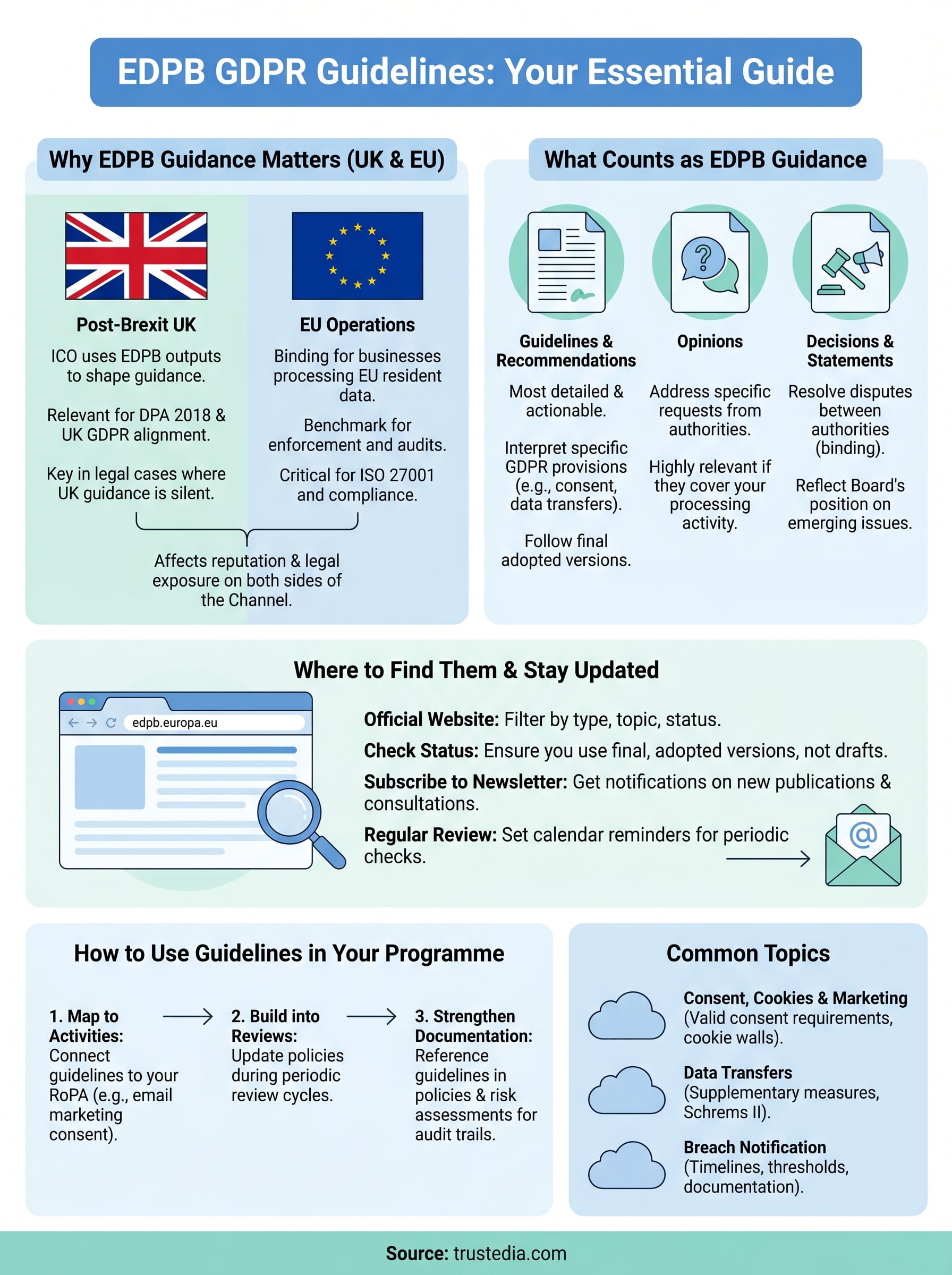
After Brexit, the UK left the EU’s regulatory framework and the Information Commissioner’s Office (ICO) became the sole supervisory authority for data protection enforcement in Great Britain. At first glance, that might make EDPB guidance seem irrelevant to UK-based businesses. In practice, the opposite is true. UK GDPR closely mirrors EU GDPR, and the ICO regularly takes EDPB outputs into account when shaping its own guidance and setting enforcement priorities.
The post-Brexit picture: UK GDPR and EDPB alignment
The UK retained EU GDPR into domestic law through the Data Protection Act 2018 and the EU (Withdrawal) Act 2019, creating what is widely referred to as UK GDPR. Because the two frameworks share the same legal foundations, the interpretations the EDPB produces carry significant weight when ICO guidance is silent, limited, or still in development. UK courts and regulators have drawn on EDPB positions in data protection cases since the UK’s departure from the EU, which makes ignoring this guidance a calculated risk rather than a neutral choice.
Beyond domestic considerations, many UK businesses operate across EU member states or process data belonging to EU residents. If your organisation falls into that category, EU GDPR applies directly to those processing activities, and the EDPB GDPR guidelines become a compliance requirement rather than optional background reading.
For any UK organisation with EU customers, partners, or employees, EDPB guidance is binding in all but name.
How EDPB guidance shapes enforcement and audits
Data protection authorities across the EU use EDPB guidelines as a benchmark when investigating complaints and conducting audits. When a supervisory authority reviews your data processing practices, it measures your approach against the standard EDPB guidance sets out. Falling short of that standard, even where UK GDPR is your primary legal obligation, creates reputational and legal exposure that can affect your operations on both sides of the Channel.
Auditors and certification bodies assessing your compliance also reference EDPB outputs directly. If you are pursuing or maintaining ISO 27001 certification, your data protection controls need to align with recognised interpretations of GDPR. EDPB guidance provides exactly that reference point, filling the practical gaps that the regulation itself leaves open.
What this means day-to-day for your team
Your data protection officers, IT managers, and legal teams need to know that EDPB guidance is not a one-time publication. The Board consults on draft guidelines, publishes final versions, and revises existing documents when case law or technology shifts the landscape. Staying current means actively monitoring these updates rather than relying on a single review completed back in 2018.
Practically, this means building a process to track and incorporate new EDPB outputs into your policies, training materials, and technical controls. Organisations that treat EDPB guidance as a live resource are far better placed to avoid compliance gaps when an audit or incident occurs.
What counts as EDPB GDPR guidance
The EDPB produces several distinct types of documents, and not all of them carry the same weight or serve the same purpose. Knowing the difference helps you prioritise which documents to act on immediately and which to treat as useful background context. The EDPB GDPR guidelines that attract the most attention are formal guidelines, but the Board publishes a wider range of outputs that your compliance programme should account for.
Guidelines and recommendations
Guidelines are the most detailed and directly actionable documents the EDPB produces. They walk through specific GDPR provisions and explain how supervisory authorities expect organisations to interpret and implement them in practice. Topics covered include data breach notification timelines, consent mechanisms, data transfers to third countries, and data subject rights. The Board typically releases a draft version for public consultation before publishing the final text, so you often have advance notice before a new standard takes effect.
Recommendations sit alongside guidelines and tend to address more technical or procedural questions, such as supplementary measures for international data transfers following the Schrems II ruling. They draw on the same legal basis as guidelines and carry similar practical authority for your compliance team.
Treat final EDPB guidelines as the closest thing to official GDPR implementation rules you will find outside the regulation itself.
Opinions and statements
Opinions are documents the EDPB issues in response to specific requests from supervisory authorities, the European Parliament, or the European Commission. They address narrower questions rather than broad compliance themes, but they can be highly relevant if they cover a processing activity or technology your organisation actively uses.
Statements and binding decisions occupy different positions within the EDPB’s output. Statements reflect the Board’s position on emerging issues, while binding decisions resolve disputes between supervisory authorities under the consistency mechanism. Both can directly influence enforcement outcomes, particularly for organisations running cross-border data processing activities where multiple supervisory authorities have oversight.
Where to find official EDPB guidelines and updates
Locating the right EDPB GDPR guidelines is straightforward once you know where to look. The challenge most organisations face is not finding the website, but knowing which documents apply to their specific activities and when those documents have been updated or superseded.
The EDPB website
The official EDPB website at edpb.europa.eu is the single authoritative source for all guidelines, recommendations, opinions, and decisions. The site organises its documents by type, making it possible to filter specifically for guidelines or recommendations without wading through every publication. Each document includes the publication date, consultation status, and links to any earlier drafts, so you can track how the Board’s position has developed over time.
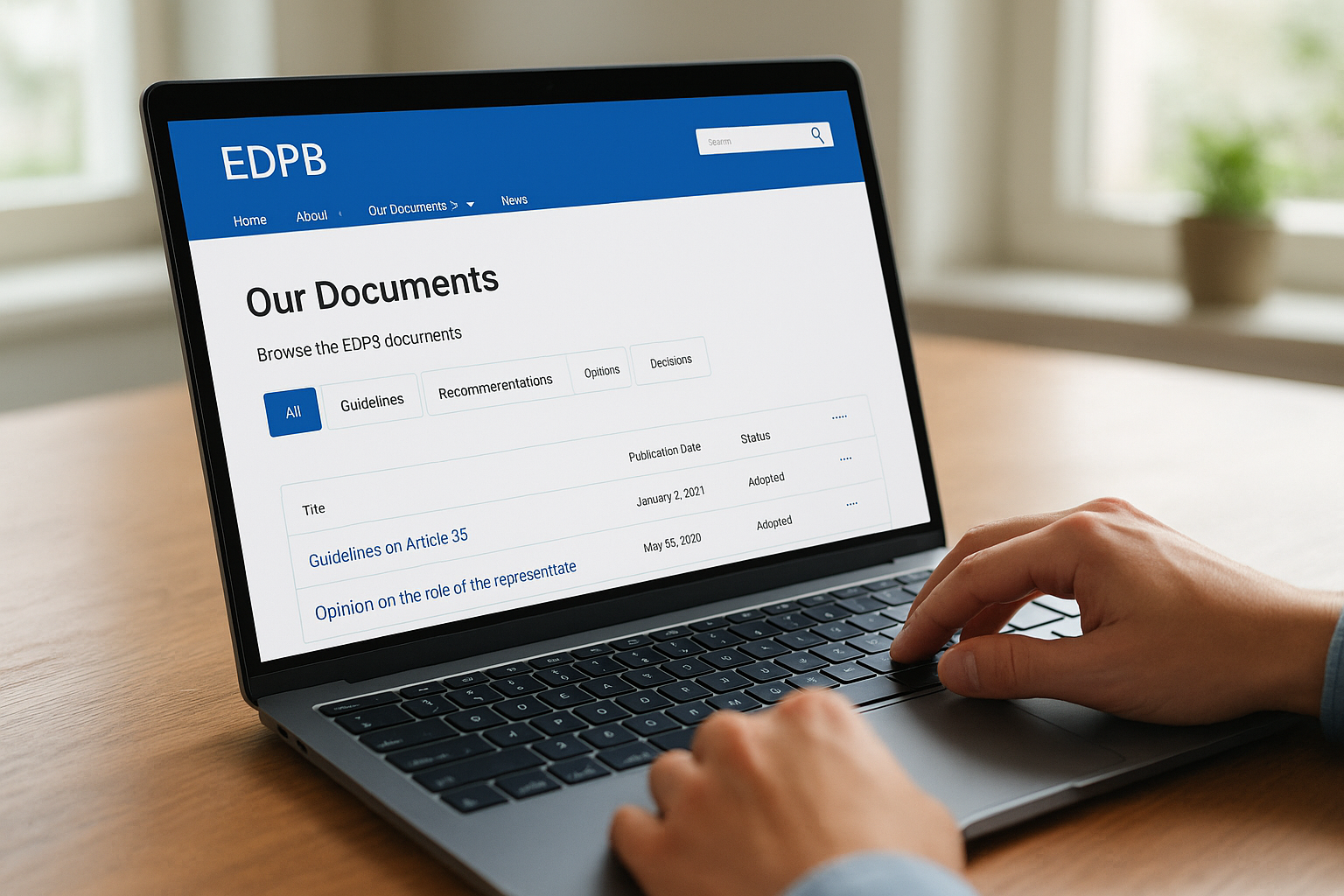
Within the site, the "Our Documents" section gives you direct access to the full library. You can filter by document type, topic, or keyword to narrow your search quickly. When reviewing any guideline, always check whether the document is a draft open for consultation or a final adopted version, since draft guidelines do not yet represent the Board’s settled position.
The adopted version of any EDPB guideline is the one your compliance programme should be built around, not earlier drafts.
Staying updated with new publications
The EDPB publishes updates without a fixed release schedule, so a passive approach means you will almost certainly miss new outputs. The most reliable method is to subscribe to the EDPB’s newsletter directly through the website, which sends notifications when new documents are published or when consultations open.
You should also review the EDPB website’s news section at regular intervals, whether monthly or quarterly depending on your organisation’s exposure to EU data subjects. Setting a calendar reminder for a structured review keeps this from becoming a reactive task rather than a proactive one, and it means your policies and training materials stay aligned with the Board’s current expectations.
How to use EDPB guidelines in your GDPR programme
Downloading a guideline and filing it away achieves nothing. To get real value from EDPB GDPR guidelines, you need to connect each relevant document to a specific data processing activity, policy, or control that your organisation actually runs.
Map guidelines to your data processing activities
Start with your Records of Processing Activities (RoPA). For each processing activity you have documented, check whether the EDPB has published guidance that applies directly to it. If you run email marketing campaigns, the Board’s guidelines on consent are directly relevant and should shape how you collect, record, and manage marketing permissions.

Treating guidelines as abstract documents rather than operational checklists is where most compliance programmes fall short.
Once you have identified the relevant guidelines, note the key requirements they set out and compare them against your current practices. Any gaps become action items for your compliance backlog, with clear ownership and target completion dates assigned to each one.
Build guidelines into your review cycle
Your GDPR programme should already include periodic reviews of your policies, privacy notices, and data subject rights processes. The EDPB publishes updates and revised guidelines on an ongoing basis, so these review cycles are the right moment to check whether any new or amended guidance affects your existing controls and procedures.
Assign a named individual, whether your DPO, a compliance lead, or an IT manager with data protection responsibilities, to check the EDPB website as part of each review cycle. This keeps your programme aligned with the Board’s current expectations rather than a snapshot from your last major compliance project.
Use guidelines to strengthen your documentation
When a supervisory authority or auditor reviews your practices, documented evidence that you considered and applied EDPB guidance carries real weight. Reference the specific guideline version in your policy documents and risk assessments, and record the date you last reviewed it. Doing this creates a clear audit trail that demonstrates your organisation acts on authoritative guidance rather than assumption.
Common EDPB guideline topics people look for
When compliance teams search for EDPB GDPR guidelines, a handful of topics come up repeatedly. Knowing which areas the Board has covered in depth helps you target your research rather than working through the full document library from scratch.
Consent, cookies, and marketing
Consent is one of the most searched areas in EDPB guidance, and for good reason. The Board has published detailed guidelines on what constitutes valid consent under GDPR, covering the requirements for freely given, specific, informed, and unambiguous agreement. These guidelines directly affect how your website collects cookie consent and how your marketing team manages opt-ins for email communications.
Consent withdrawn by a data subject must be as easy to action as it was to give in the first place, and your systems need to reflect that in practice.
The EDPB has also addressed cookie walls and pre-ticked boxes explicitly, confirming these do not meet the standard for valid consent. If your organisation runs any kind of digital marketing, this guidance shapes your consent management platform configuration and your privacy notice wording.
Data transfers and breach notification
International data transfers became a major compliance challenge following the Schrems II ruling, and the EDPB responded with detailed recommendations on supplementary measures for transfers to third countries. If your organisation uses US-based cloud services or transfers HR data internationally, these recommendations are directly relevant to your transfer impact assessments and contractual arrangements.
Breach notification is another area where organisations frequently look for specific timelines and thresholds. The EDPB guidelines on personal data breach notification set out what constitutes a notifiable breach, when you must report to your supervisory authority, and when affected individuals need to be informed. The guidance also covers documentation requirements for breaches you decide not to report, which is equally important for demonstrating accountability during an audit. Reviewing this document alongside your incident response plan ensures your team knows exactly what to do and when in the event of a security incident.
Next steps
EDPB GDPR guidelines are a live resource, not a one-time reference. The Board continues to publish new guidance and revise existing documents as technology, case law, and enforcement priorities evolve. Your compliance programme needs to treat these updates as operational inputs, not background reading, by mapping each relevant guideline to your actual data processing activities and reviewing your controls whenever the Board publishes something new.
The strongest GDPR programmes combine regulatory awareness with practical security controls that actually protect personal data from breach and misuse. If your organisation needs support connecting data protection requirements to technical and organisational measures, including ISO 27001 implementation and incident response planning, getting expert input early saves significant effort later.
To find out how TrustedIA’s cybersecurity and compliance expertise can help your business build a more resilient data protection posture, visit TrustedIA’s managed security and compliance services and speak with a specialist today.