Table of Contents
- ISO 27001 Compliance for SMEs: Why It Matters and What It Involves
- ISO 27001 Gap Analysis: The Essential First Step
- ISO 27001 Implementation Steps: A Practical Roadmap
- ISO 27001 Certification Timeline: What to Expect
- ISO 27001 Certification Cost for Small Business: Budgeting Guide
- Building an ISO 27001 Compliance Checklist for SMEs
- Common Mistakes to Avoid on the Path to ISO 27001 Compliance
- Frequently Asked Questions
Last Updated: 17 October 2026
ISO 27001 Compliance for SMEs: Why It Matters and What It Involves
ISO 27001 compliance is the process of building and running an information security management system that meets the international standard’s requirements. For an SME, that means documented policies, clear risk ownership and evidence that controls actually work. It is not a one-off IT project. It is a management system with a paper trail.
At TrustedIA, we work with small firms that have no dedicated security team. Most start in the same place: a client or tender asks for certification, and nobody knows where to begin. The good news is that the standard scales down well. You do not need enterprise headcount. You need discipline and a clear plan.
The standard itself is published by the International Organisation for Standardisation, and the certification bodies that audit against it are overseen in the UK by UKAS, the national accreditation body. That distinction matters: your auditor must be accredited, or the certificate carries little weight.
Below, we break the work into seven stages, with the timelines, budget lines and mistakes that trip up most small teams.
ISO 27001 Gap Analysis: The Essential First Step
An ISO 27001 gap analysis is a structured comparison of what you do now against what the standard requires. It tells you the size of the job before you commit budget. Skip it and you will plan blind.
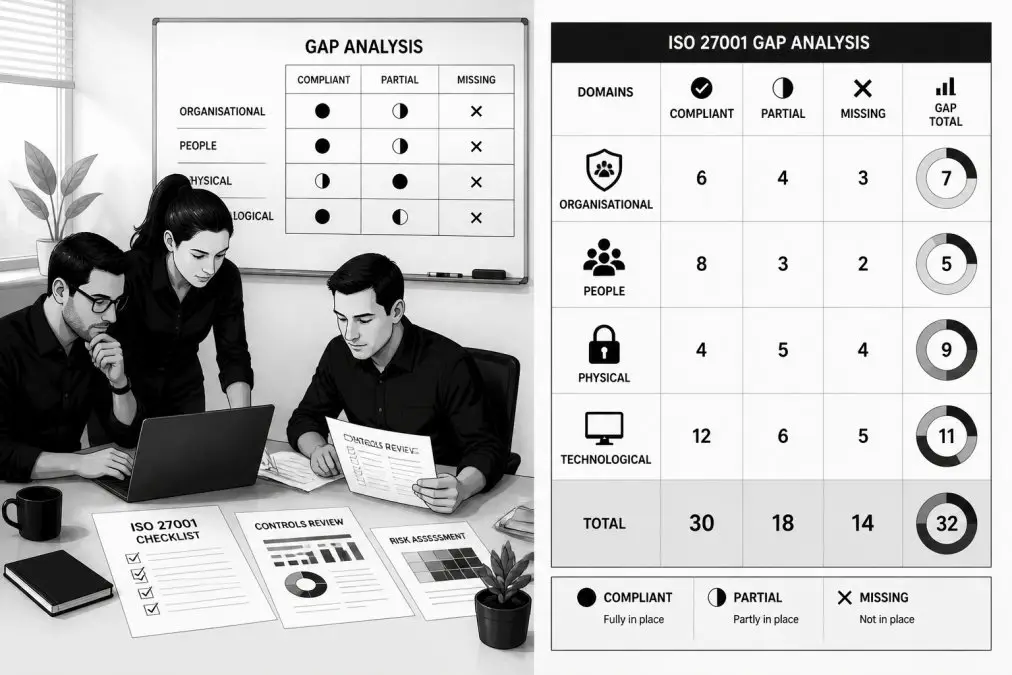
Start with the standard’s control set, listed in ISO/IEC 27001’s Annex A controls. Then score each area honestly. A common approach is a simple four-column sheet:
- Control area: what the standard asks for
- Current state: what exists today, with evidence
- Gap: what is missing or undocumented
- Owner and target date: who fixes it, and by when
ISO 27001 Implementation Steps: A Practical Roadmap
Implementation follows a predictable sequence. The ISO 27001 implementation steps below work for a 20-person firm as well as a 200-person one. The difference is how many people share the work, not the order.
- Secure leadership buy-in. The standard requires top management involvement, not just a signature.
- Define the scope. Name the systems, sites and services the management system covers.
- Run a risk assessment. Identify assets, threats and likelihood, then score them.
- Write the risk treatment plan. Decide which risks you accept, avoid, transfer or reduce.
- Build the policies and controls. Start with the Statement of Applicability.
- Train staff. Short, role-specific sessions beat a generic slide deck.
- Run internal audits and a management review. Fix what they find before the external auditor does.
Most SMEs find the risk assessment the hardest step. It is also the one auditors probe most.
ISO 27001 Certification Timeline: What to Expect
The ISO 27001 certification timeline for an SME typically runs from six to twelve months, depending on scope and how much documentation already exists. Certification bodies then run a two-stage external audit, with the second stage usually weeks after the first.
Practical planning looks like this:
| Phase | Typical duration | What happens |
|---|---|---|
Gap analysis and scoping | 2-4 weeks | Baseline assessment, scope agreed |
Risk assessment and treatment plan | 3-6 weeks | Risks scored, controls chosen |
Documentation and control build | 6-12 weeks | Policies, records, evidence in place |
Internal audit and management review | 2-4 weeks | Findings fixed before external audit |
Stage 1 external audit | 1-2 days | Readiness check, documentation review |
Stage 2 external audit | 2-5 days | Evidence sampling, interviews, findings |
Certification decision | 2-6 weeks | Certificate issued, surveillance cycle begins |
Two things stretch the timeline: waiting for staff availability during evidence gathering, and leaving documentation to the final weeks. Front-load the writing.
ISO 27001 Certification Cost for Small Business: Budgeting Guide
ISO 27001 certification cost for small business budgets has three parts: external audit fees, internal time, and any tooling or advisory support. Audit fees depend on scope and audit days, so ask two or three accredited bodies for quotes rather than relying on a rule of thumb.
Budget for these lines:
- Certification body fees: stage 1, stage 2 and annual surveillance audits
- Internal time: the largest hidden cost, usually several people part-time for months
- Tooling: document management, asset registers, log retention
- Advisory or vCISO support: optional, but it shortens the learning curve
We recommend getting a quote before you scope, not after. Scope decisions drive audit days, and audit days drive the fee. Pricing varies by provider, so ask for a written quote against your actual scope.
Building an ISO 27001 Compliance Checklist for SMEs
A workable ISO 27001 compliance checklist for SMEs covers documentation, technical controls and people. Keep it short enough to review monthly. The version below is the one we would start with.
- Scope statement signed off by leadership
- Information security policy published and communicated
- Asset register with named owners
- Risk assessment completed and reviewed
- Risk treatment plan and Statement of Applicability approved
- Access control policy, with joiners and leavers process
- Supplier security reviews for key vendors
- Incident response plan, tested at least once
- Business continuity and backup restore tested
- Security awareness training recorded for all staff
- Internal audit completed with findings closed
- Management review minutes on file
Common Mistakes to Avoid on the Path to ISO 27001 Compliance
The failures we see are rarely technical. They are organisational. Here are the patterns that cost SMEs the most time and money.
- Treating it as an IT project. The standard is a management system. HR, facilities and finance all own controls.
- Over-scoping. Certifying everything at once doubles the audit days. Start with the systems that matter to clients.
- Writing policies nobody follows. An auditor will ask staff what they actually do. Mismatches become findings.
- No evidence trail. Controls that work but leave no records fail the audit.
- Skipping the internal audit. It is a requirement, not a rehearsal you can drop.
- Ignoring suppliers. Third-party risk is a control area, not an afterthought.
What most guides miss is that certification is a snapshot. Surveillance audits follow every year, so the management system has to keep running after the certificate arrives.
Certification is achievable for a small team, but it demands steady effort over months, and most SMEs lack spare security capacity to run it alongside day-to-day work. That is where TrustedIA helps. Our vCISO advisory gives you on-demand expert capacity to run the gap analysis, risk assessment and documentation, and our 24/7 SOC monitoring and CyberSOS incident response keep the controls working after certification. You get enterprise-grade security leadership without the cost of a full-time hire. Explore how TrustedIA can take you from gap analysis to certificate.
Frequently Asked Questions
How can a small business achieve ISO 27001 compliance?
Start with an ISO 27001 gap analysis to see where you stand. Then follow the ISO 27001 implementation steps: define scope, build an asset register, assess risks, select controls, write policies and train staff. Run internal audits and a management review before the certification body’s stage 1 and stage 2 audits. Many SMEs use a vCISO or consultant to guide them through the process without hiring a full-time security team.
How much does ISO 27001 certification cost for a small business?
Costs include certification body fees, consultant support, tooling and internal staff time. Certification body fees depend on the scope and complexity of your ISMS, so they vary. Consultant support and any security tooling add to the total. Pricing for external support depends on the engagement model and scope. Request a quote from a provider such as TrustedIA to get an accurate figure for your business.
How long does it take an SME to get ISO 27001 certified?
The ISO 27001 certification timeline for an SME is typically 6 to 12 months. Smaller businesses with simple scopes can move faster, while those in regulated sectors or with complex IT estates may need longer. Key phases include gap analysis, risk assessment, control implementation, internal audit and the two-stage certification audit. The certification body’s availability and your team’s capacity also affect timing.
Can an SME implement ISO 27001 without a dedicated security team?
Yes. Many SMEs achieve ISO 27001 compliance by using a virtual CISO or external consultant to provide the missing security expertise. The standard requires a management system, not a full-time security department. You can outsource tasks such as risk assessment, policy writing and internal auditing while keeping ownership of the ISMS internally. This approach keeps costs manageable and gives you access to experienced guidance when you need it.