Most boards treat cyber security as a technical problem. It isn’t. A data breach or ransomware attack can wipe out revenue, destroy customer trust, and trigger regulatory action, all of which sit squarely on the board’s agenda. Cyber security governance principles provide the structure boards need to oversee these risks effectively, rather than leaving critical decisions buried in the IT department.
Yet many organisations still lack a clear framework for how governance, risk, and security strategy connect at the top level. Without defined principles, boards either micromanage technical details they don’t fully understand or, more commonly, delegate accountability entirely and hope nothing goes wrong. Neither approach holds up when an incident hits, or when auditors come knocking.
This guide breaks down the core principles of cyber security governance, explains why they matter at board level, and shows how to put them into practice. At TrustedIA, we’ve spent over 30 years helping organisations build robust security postures, including ISO 27001 implementation and certification. That experience has made one thing clear: effective governance is the foundation everything else is built on. What follows is a practical framework your board can act on.
Why cyber security governance matters to boards
Boards are accountable for organisational risk. Cyber security is now one of the most significant risk categories any organisation faces, yet many boards still treat it as a concern solely for the IT team. That gap between board accountability and operational reality is where governance failures occur, and where the consequences tend to be most severe.
The regulatory pressure boards face
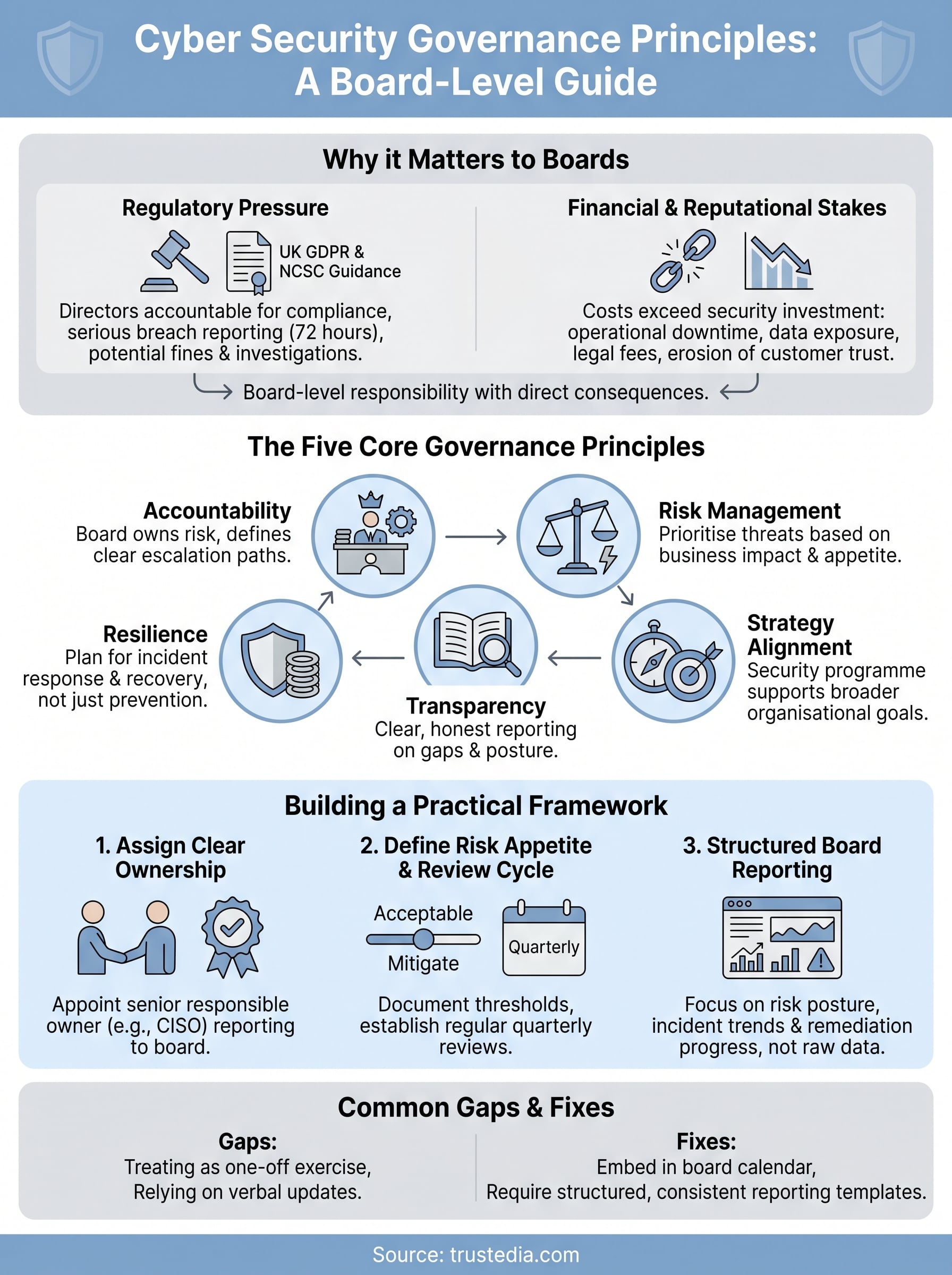
Regulators across the UK and EU have made it increasingly clear that senior leadership cannot simply delegate cyber risk downward. The UK’s National Cyber Security Centre (NCSC) publishes board-level guidance specifically because regulators expect directors to understand the threats their organisations face. Under UK GDPR, a serious data breach must be reported to the Information Commissioner’s Office within 72 hours, and the board is ultimately answerable for the response.
Governance failures don’t stay inside the IT department. They surface in regulatory investigations, fines, and public reporting, all of which carry direct consequences for board members. Demonstrating due diligence requires more than assuming your IT team has it covered; it requires a documented governance structure that boards actively oversee.
Cyber security is no longer a technical function. It is a board-level responsibility with direct legal and financial consequences.
The financial and reputational stakes
A single cyber incident can cost far more than any security investment. When ransomware locks your systems or a breach exposes customer data, the damage spans multiple areas: operational downtime, legal costs, regulatory fines, and the longer-term erosion of customer confidence. Your board needs to understand that cyber security governance principles exist precisely to reduce this exposure, not to satisfy a compliance checkbox.
When boards engage meaningfully with cyber risk, they strengthen their organisation’s resilience. Informed oversight drives better decisions about where to invest, which risks to accept, and when to escalate. Organisations with clear governance structures recover faster from incidents because roles, processes, and escalation paths are defined before a crisis hits, not during one.
The five cyber security governance principles
Clear cyber security governance principles give your board a consistent lens for evaluating risk and holding leadership to account. Rather than treating each incident or audit in isolation, these principles create a shared language between technical teams and senior decision-makers, so everyone operates from the same foundation.
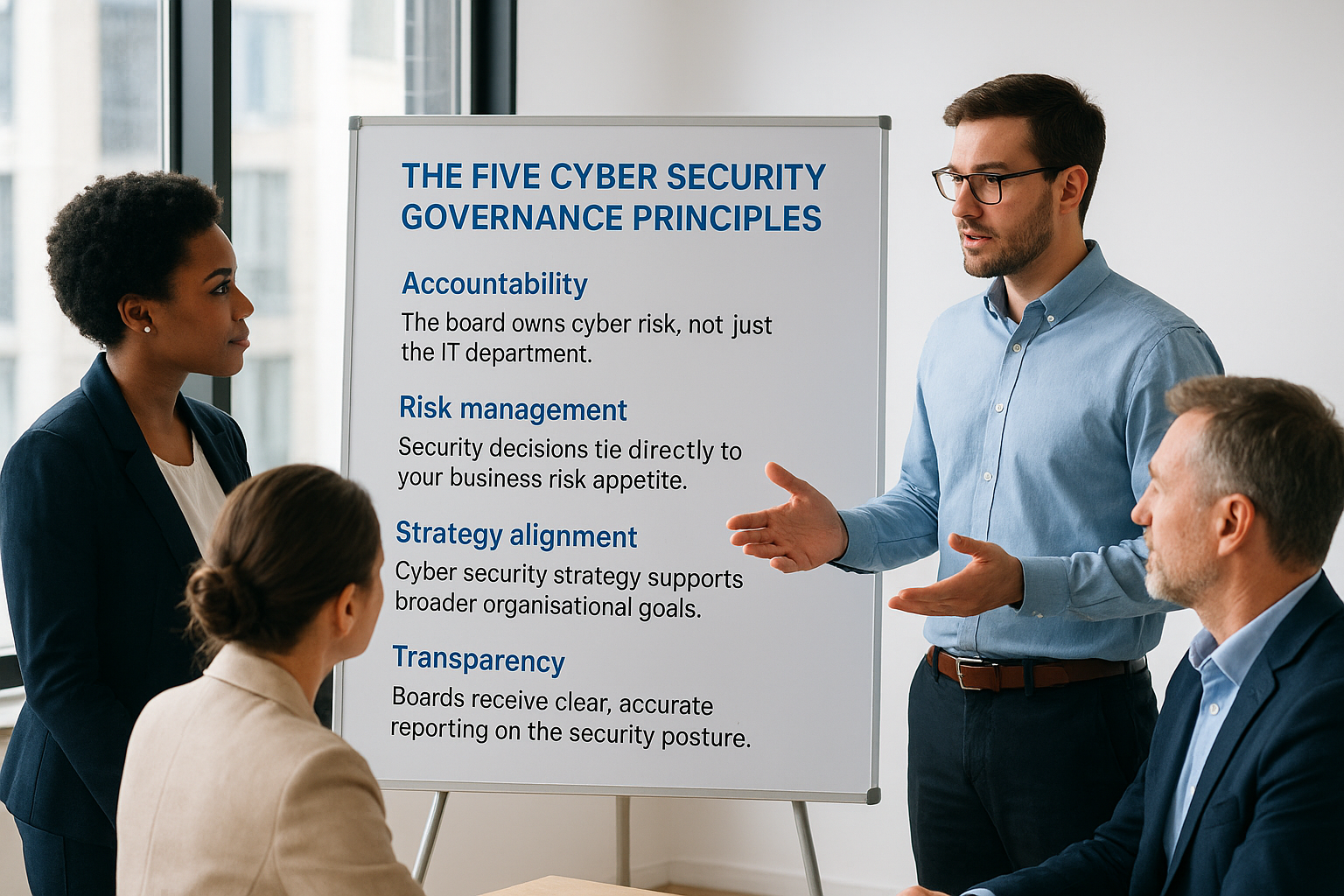
The five core principles are:
- Accountability: The board owns cyber risk, not just the IT department.
- Risk management: Security decisions tie directly to your business risk appetite.
- Strategy alignment: Cyber security strategy supports broader organisational goals.
- Transparency: Boards receive clear, accurate reporting on the security posture.
- Resilience: Organisations plan for incidents, not just prevention.
Accountability and risk management
Accountability means your board accepts formal ownership of cyber risk at the top level, with clear escalation paths defined below it. Risk management connects security investment to what actually matters to your business, prioritising threats based on their potential impact rather than technical severity alone.
Governance without accountability is just paperwork. Boards that own the risk make better decisions about where to spend and where to act.
Strategy, transparency, and resilience
Strategy alignment ensures your security programme supports business objectives rather than operating as a disconnected function. Transparency and resilience work together: honest reporting tells you where your gaps are, and resilience planning ensures your organisation can respond effectively when threats materialise rather than improvising under pressure.
How to build a cyber governance framework
Building a framework starts with assigning clear ownership. Your board needs to appoint a senior responsible owner for cyber security, typically the CISO or an equivalent role, who reports directly to board level. Without named accountability, cyber security governance principles sit on paper rather than driving decisions.
A governance framework only works when someone at the top takes responsibility for making it function.
Define your risk appetite and review cycle
Risk appetite is the starting point for every governance decision your board makes. Agree on which risks are acceptable, which require mitigation, and which would threaten your organisation’s core operations. Document these thresholds explicitly so your security team can prioritise investments and escalation decisions based on what the board actually cares about.
From there, establish a regular review cadence rather than relying on ad hoc check-ins triggered only by incidents. A quarterly review cycle works well for most organisations, covering your current risk posture, changes to the threat landscape, and progress against your security roadmap. Consistent reviews keep your board informed and ensure the framework adapts as your organisation grows, rather than becoming a static document that nobody revisits.
What to ask for in board reporting
Board reporting only works if it gives you what you need to make real decisions. Many organisations receive reports packed with technical metrics, such as patch counts or antivirus alerts, that say little about strategic risk. You need to define the reporting format and content rather than accepting whatever the IT team decides to send up the chain.
Good board reporting translates technical data into business risk language that directors can act on.
The metrics that matter
When you apply cyber security governance principles to reporting, the focus shifts from technical outputs to business outcomes. Ask for risk posture summaries, incident trends, and progress against your agreed risk appetite rather than raw vulnerability counts or jargon-heavy status updates.

A useful board report should cover at minimum:
- Current risk rating compared to your agreed appetite
- Severity and volume of incidents in the reporting period
- Progress on remediation actions carried forward from previous reviews
Escalation and frequency
Your reporting cycle needs a clear escalation trigger so that critical incidents reach the board immediately rather than sitting in a queue until the next scheduled review. Define specific thresholds upfront, such as a confirmed data breach or failure of a critical control, that require immediate notification regardless of the regular reporting cycle.
Quarterly reviews suit most organisations for routine governance oversight, but keep escalation criteria documented separately so every team member knows when the standard cycle no longer applies.
Common governance gaps and how to fix them
Most organisations know they need cyber security governance principles but stumble when putting them into practice. The gaps that cause the most damage aren’t usually technical; they’re structural and behavioural, and fixing them requires deliberate action at board level rather than further delegation.
Governance gaps rarely announce themselves until an incident exposes them.
Treating cyber security as a one-off exercise
Many boards conduct a cyber audit, file the report, and move on. The problem is that your threat landscape changes continuously, so governance structures that aren’t revisited quickly become outdated. Fix this by embedding cyber security into your standard board calendar rather than treating it as a periodic exercise tied only to regulatory deadlines.
Alongside the review cycle, make sure remediation actions carry named owners and deadlines. Without those, agreed actions from one board meeting quietly disappear before the next one begins.
Relying on verbal updates instead of structured reporting
When boards accept informal verbal updates, accountability becomes blurred and trends go untracked. You cannot identify whether your risk posture is improving or worsening without documented, structured data across reporting periods. Introduce a standard board reporting template and require it to be completed consistently each cycle, ensuring every review gives you comparable, actionable information rather than a one-off snapshot that nobody can benchmark against.
Where to go from here
Applying cyber security governance principles consistently is how boards move from reactive to resilient. The principles covered in this guide, from accountability and risk appetite through to structured reporting and gap remediation, give you a practical starting point rather than a theoretical framework that gathers dust. Your next step is to assess where your current governance structure stands against each of these areas and identify the gaps that need immediate attention.
Start with ownership and reporting: appoint a named responsible individual, agree a reporting template, and lock in a quarterly review cycle. Those three actions alone will put your board in a stronger position than most. From there, build outward into strategy alignment, resilience planning, and continuous review.
If you need expert support to assess your current posture or implement a structured programme, TrustedIA’s managed cyber security services can help you get there faster and with confidence.