
Traditional antivirus software relies on signature databases, lists of known threats that need constant updating. The problem? Attackers have moved far beyond what signature-based detection can catch. Fileless malware, zero-day exploits, and polymorphic threats slip past these defences routinely. Next generation endpoint security exists to close that gap, using behavioural analysis, artificial intelligence, and machine learning to identify threats by what they do, not just what they look like.
For businesses without deep in-house security teams, understanding this shift matters. Choosing the wrong endpoint protection, or sticking with outdated tools, leaves your organisation exposed to attacks that grow more sophisticated every month. The right solution does more than block known viruses; it detects unusual behaviour, responds autonomously, and gives your security team real visibility into what’s happening across every device on your network.
At TrustedIA, we take a solution-agnostic approach to cybersecurity, drawing on over 30 years of experience in managed IT services to recommend endpoint protection that genuinely fits your environment, not whatever a single vendor happens to sell. Our work across Endpoint Detection & Response, vulnerability assessments, and Security Operations Centre (SOC) services means we see firsthand how next generation endpoint tools perform under real-world conditions.
This article breaks down what next generation endpoint security actually is, the core technologies behind it, how it compares to traditional antivirus, and what to look for when evaluating solutions for your organisation. Whether you’re replacing legacy tools or building your security stack from scratch, this guide will help you make a grounded, informed decision.
What next generation endpoint security is
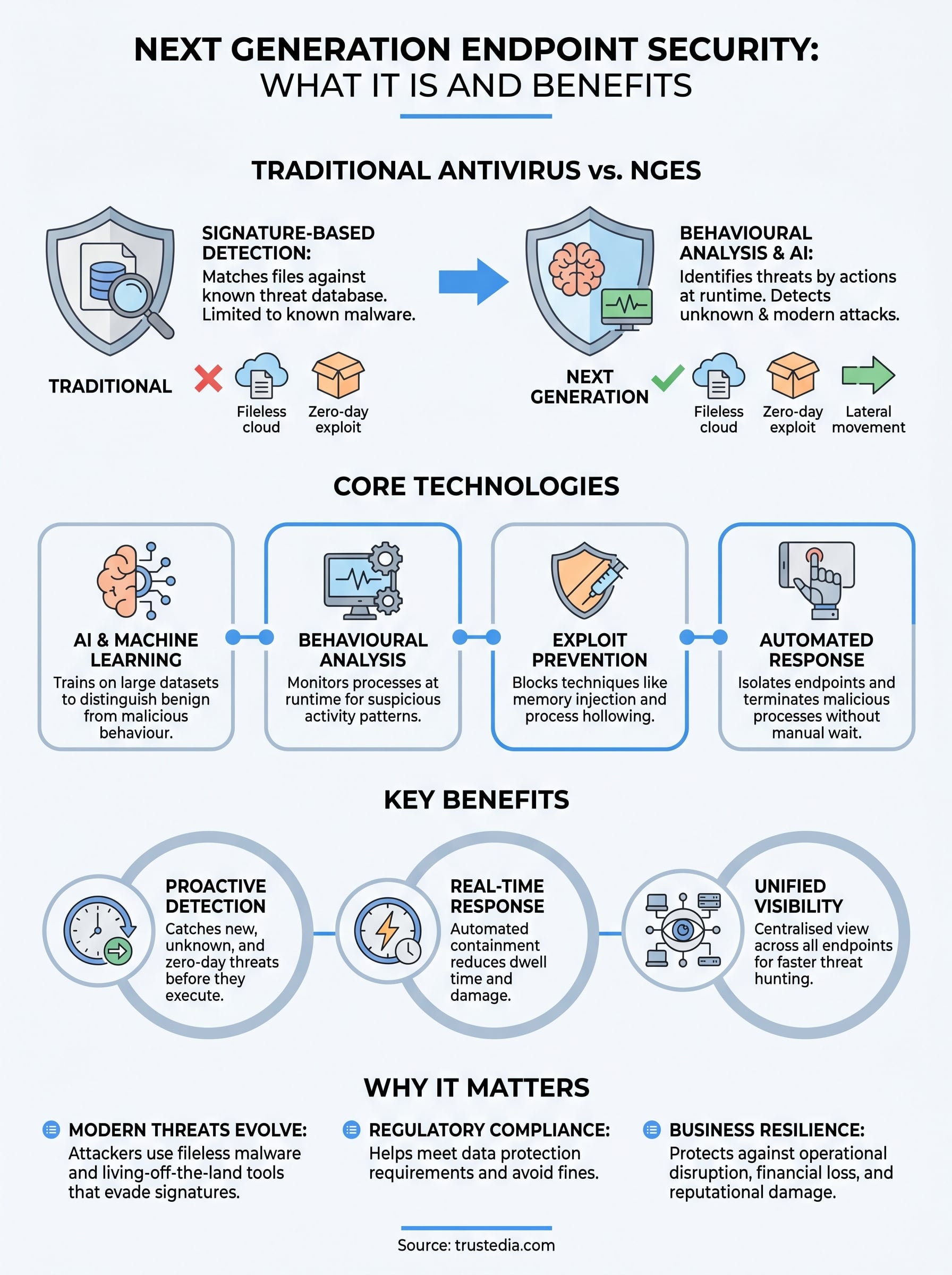
Next generation endpoint security refers to a category of endpoint protection that goes beyond matching files against a database of known malware signatures. Instead of asking "does this file match a known threat?", it asks "does this process behave like a threat?" That shift in logic is fundamental. It means the software can detect attacks it has never encountered before, including zero-day exploits and custom malware crafted specifically to evade detection by conventional tools.
The limitations it was built to address
Traditional endpoint tools, including standard antivirus and early endpoint detection products, were built around a reactive model. Vendors would discover a new piece of malware, add its signature to a database, and push an update to customers. If your antivirus received that update before the malware reached your device, you were protected. If it didn’t, you weren’t. That model worked reasonably well when the volume of new threats was manageable, but today’s attackers produce thousands of new malware variants daily, making signature-only approaches increasingly unreliable.
Attackers also adapted deliberately. Modern techniques like fileless malware execute entirely in memory, leaving no file on disk for signature scanners to detect. Living-off-the-land attacks abuse legitimate system tools such as PowerShell to carry out malicious actions, making them difficult to distinguish from normal administrative activity. Next generation endpoint security addresses these gaps by monitoring behaviour in real time rather than scanning files at rest, giving it a meaningful advantage against threats that leave no traditional footprint.
The shift from signature detection to behavioural analysis is arguably the most significant change in endpoint security in the past decade.
The core technologies involved
Artificial intelligence and machine learning form the backbone of most next generation endpoint security platforms. Rather than relying on static rule sets, these systems train on enormous datasets of both benign and malicious activity. Over time, they learn to distinguish between a legitimate script running a scheduled backup and a script exhibiting ransomware-like behaviour, such as rapidly encrypting files across shared directories. The result is a detection capability that improves with exposure, rather than one that degrades as threats evolve.

Several additional technologies work alongside AI to build a complete protection layer:
- Behavioural analysis: Monitors what processes actively do at runtime, not simply what they are
- Exploit prevention: Blocks memory injection techniques and process hollowing commonly used in fileless attacks
- Threat intelligence feeds: Pull data from global sensor networks to surface emerging attack patterns in near real time
- Automated response: Isolates compromised endpoints, terminates malicious processes, and rolls back changes without waiting for manual intervention
What counts as an endpoint
An endpoint is any device that connects to your network, and that definition has expanded considerably over recent years. Laptops, desktops, and servers are the obvious examples, but modern platforms also cover smartphones, tablets, and increasingly IoT devices and cloud workloads. Each represents a potential entry point for an attacker, and each requires monitoring if you want complete network visibility.
This breadth matters because attackers rarely target your most sensitive systems directly. They typically compromise a lower-priority endpoint first, perhaps a remote worker’s laptop or an unmanaged device that bypassed your procurement process, and then move laterally across the network. Catching that lateral movement early requires visibility across every connected device, not just the servers that hold your critical data. A platform that covers only part of your estate leaves gaps that experienced attackers will find and use.
Why next generation endpoint security matters
Endpoints are the most common entry point for a successful cyberattack. Remote working, cloud adoption, and the growing number of personal devices connecting to corporate networks have dramatically expanded the attack surface organisations need to protect, and attackers have taken full advantage of that expansion. When a single compromised laptop can give an attacker access to your entire network, the security tools protecting those devices carry significant weight for your business’s overall resilience and continuity.
Modern attacks target endpoints deliberately
Attackers focus on endpoints because they are often the weakest link in an otherwise well-defended network. A phishing email lands in a user’s inbox, they click a malicious attachment, and the attacker gains an initial foothold from which lateral movement begins quietly across your infrastructure. Traditional antivirus misses many of these entry-level compromises because the malicious code arrives obfuscated, macro-enabled, or embedded inside a legitimate file type. Next generation endpoint security closes this entry point by flagging suspicious behaviour the moment an executable starts running, regardless of whether its signature appears in any known database.
Organisations that rely on signature-based tools alone are defending against yesterday’s threats while attackers build tomorrow’s.
Ransomware groups, nation-state actors, and opportunistic cybercriminals have all adapted their tooling specifically to bypass legacy detection. The UK National Cyber Security Centre consistently identifies endpoint compromise as a primary attack vector in its annual threat assessments, reinforcing that this is not a theoretical concern but a routine operational risk for businesses of every size and sector.
The regulatory and financial stakes
A successful endpoint breach does not just create an IT problem; it creates a legal and financial one simultaneously. Under UK GDPR, organisations that suffer a data breach caused by inadequate security controls face potential fines and mandatory breach notifications to the Information Commissioner’s Office. For SMBs operating on tight margins, the combination of downtime, remediation costs, reputational damage, and regulatory penalties can be genuinely existential rather than merely disruptive.
Investing in capable endpoint protection costs considerably less than managing the aftermath of a breach. Beyond the direct financial argument, many cyber insurance providers now require demonstrable evidence of advanced endpoint controls before offering coverage, or treat it as a condition of competitive premiums. Meeting those requirements means understanding what your endpoint tools actually do and whether they are genuinely capable of detecting the threats your business faces today.
How next generation endpoint security works
Next generation endpoint security operates across multiple detection and response layers, working simultaneously rather than in sequence. When a process starts on a protected device, the platform begins collecting telemetry immediately, capturing details about parent processes, file access patterns, network connections, and memory usage. That data feeds into AI-driven analysis engines that compare observed behaviour against learned models of both normal and malicious activity, generating a risk score in real time.
Detection at runtime
The platform monitors processes continuously while they execute, not just when they first appear on a device. This matters because many sophisticated attacks unfold gradually. An attacker might compromise a legitimate application and use it to spawn child processes, make unusual registry changes, or connect to external command-and-control infrastructure over time. Signature-based tools would miss this entirely because no single action looks overtly malicious on its own. A behavioural engine, by contrast, correlates these events across a timeline, recognising patterns that individually appear benign but collectively signal a threat.
When the platform identifies an anomaly that crosses its confidence threshold, it acts without waiting for human review. Automated response capabilities can isolate the affected endpoint from the rest of your network, terminate the suspicious process, and preserve forensic artefacts for investigation, all within seconds of detection. This speed matters because the window between initial compromise and meaningful damage is often measured in minutes, not hours.
The faster a threat is contained, the less damage it causes and the less recovery work your team faces afterwards.
Centralised telemetry and visibility
Your security team gains a unified view of activity across every protected endpoint through a centralised management console. Rather than reviewing logs from individual devices, analysts see correlated event data that surfaces genuine threats rather than noise. This architecture also enables threat hunting, where analysts actively search for indicators of compromise across historical telemetry, identifying attacks that may have evaded automated detection entirely.
Cloud-based platforms extend this further by sharing anonymised threat intelligence across their entire customer base. When one organisation encounters a new attack technique, the platform updates its detection models and pushes those improvements to every connected endpoint globally, meaning your protection benefits from incidents occurring at other organisations without exposing any of their data. This collective intelligence model is one of the core reasons next generation endpoint security consistently stays ahead of how attackers adapt their tradecraft.
Next gen vs traditional antivirus and EDR
Understanding where each tool fits helps you avoid both under-protection and unnecessary duplication in your security stack. Traditional antivirus, endpoint detection and response (EDR), and next generation endpoint security are often treated as interchangeable, but they represent distinct generations of thinking about how threats should be identified and contained. Knowing the differences shapes the purchasing and configuration decisions your organisation makes.
Traditional antivirus: what it can and cannot do
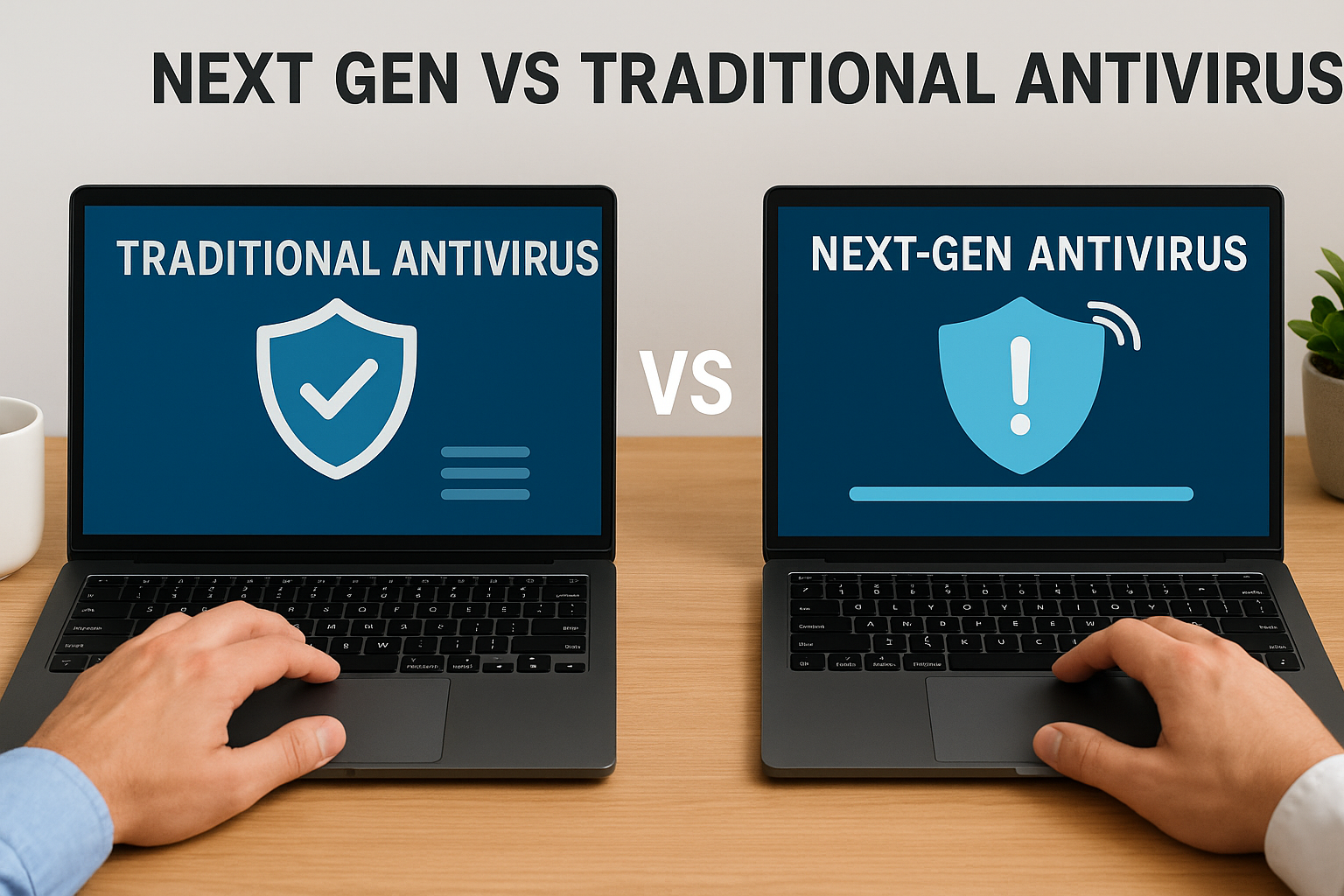
Traditional antivirus software checks files against a database of known malware signatures. When a file arrives on your device, the software computes a hash and compares it against its signature library. If it finds a match, it blocks or quarantines the file. This works reliably for well-documented, widely-circulated malware that vendors have already catalogued, and it carries a low performance overhead, which is why it remained the dominant approach for decades.
The problem is that it offers almost no protection against threats that fall outside its database. Custom malware, obfuscated code, fileless attacks, and zero-day exploits all bypass signature checking because they either produce no file for the scanner to examine or arrive in a form the database has never seen. Attackers learned this years ago and now routinely generate unique variants of known malware specifically to circumvent signature-based detection.
| Capability | Traditional Antivirus | EDR | Next Gen Endpoint Security |
|---|---|---|---|
| Known malware detection | Yes | Yes | Yes |
| Behavioural analysis | No | Partial | Yes |
| Fileless attack detection | No | Partial | Yes |
| Automated response | No | Limited | Yes |
| Threat hunting support | No | Yes | Yes |
| AI-driven detection | No | No | Yes |
Where EDR fits in
Endpoint detection and response tools were developed to address the visibility gaps that traditional antivirus left open. EDR platforms collect and store detailed telemetry from endpoints, allowing security analysts to investigate incidents, search for indicators of compromise, and understand how an attack unfolded. That forensic capability represents a meaningful step forward from antivirus, particularly for organisations with trained analysts who can act on that data.
EDR gives your team the evidence it needs to understand an attack, but it still relies on humans to interpret and act on most of what it surfaces.
Next generation endpoint security consolidates what EDR does well, adds AI-driven detection, and automates the response actions that EDR platforms leave to analysts. Rather than presenting your team with a stream of telemetry to investigate, it surfaces prioritised, actionable alerts and takes containment steps autonomously, reducing both response time and the analyst workload required to keep your environment secure.
How to choose a next gen endpoint security solution
Selecting the right platform requires more than comparing feature lists. Your decision should start with a clear picture of what your organisation actually needs to protect and how much internal capacity you have to manage endpoint security day to day. A solution that works well for a business with a dedicated security operations team may be completely unsuitable for an SMB where the IT manager handles security alongside a dozen other responsibilities.
Define your coverage requirements
Before evaluating any vendor, map out every category of endpoint in your environment, including laptops, servers, mobile devices, and any cloud workloads. A platform that covers only Windows desktops leaves your Linux servers and remote workers’ personal devices unmonitored, and attackers will find those gaps quickly. You should also confirm whether the solution supports your operating systems and device management approach, particularly if you operate a mixed environment or rely on bring-your-own-device policies.
Evaluate detection and response capabilities
The core of any next generation endpoint security platform is how it detects and contains threats, so this deserves careful scrutiny during any evaluation. Ask vendors specifically how their platform handles fileless attacks, lateral movement, and living-off-the-land techniques rather than accepting general claims about AI-powered detection.
A vendor that cannot clearly explain how their platform detects fileless attacks or lateral movement is unlikely to protect you from them.
Look for these capabilities when assessing platforms:
- Behavioural analysis that monitors processes at runtime, not just on arrival
- Automated containment that isolates endpoints without waiting for analyst intervention
- Threat hunting tools that allow your team to search historical telemetry proactively
- Integration with threat intelligence feeds that update detection models continuously
- Clear alert prioritisation that reduces noise rather than adding to it
Consider deployment and management overhead
Even the most technically capable platform fails if your team cannot operate it effectively. Evaluate how much configuration the solution requires before it reaches a useful protection state, and what ongoing management it demands from your staff. Cloud-managed platforms typically reduce deployment complexity and ensure your endpoints receive detection model updates automatically, which matters considerably when your IT resource is limited.
You should also assess vendor support quality and response times, since the value of a security platform partly depends on the help available when something goes wrong. Vendors that offer 24/7 support and clear escalation paths are far more valuable partners than those that limit access to documentation and ticket queues.
Next steps
Next generation endpoint security is not a single product but a fundamental shift in how organisations defend against modern threats. Behavioural analysis, AI-driven detection, and automated response work together to catch what signature-based tools consistently miss, giving your business a realistic chance of stopping an attack before it causes serious damage. The right platform, paired with proper deployment and ongoing management, turns your endpoints from a liability into a defended perimeter.
If you are evaluating your current endpoint protection or building a security stack from scratch, the most important step is getting an accurate picture of your existing posture before committing to any solution. Gaps in coverage are far easier to address when you identify them before an attacker does. At TrustedIA, we bring over 30 years of hands-on experience to exactly that kind of assessment. Speak to the TrustedIA team to find out where your endpoints stand and what genuinely fits your environment.