Most businesses know they need cybersecurity. Fewer know exactly what happens when they hand that responsibility, partly or fully, to someone else. That’s where managed security comes in, and understanding it properly matters before you sign any contract or commit budget to an outside provider.
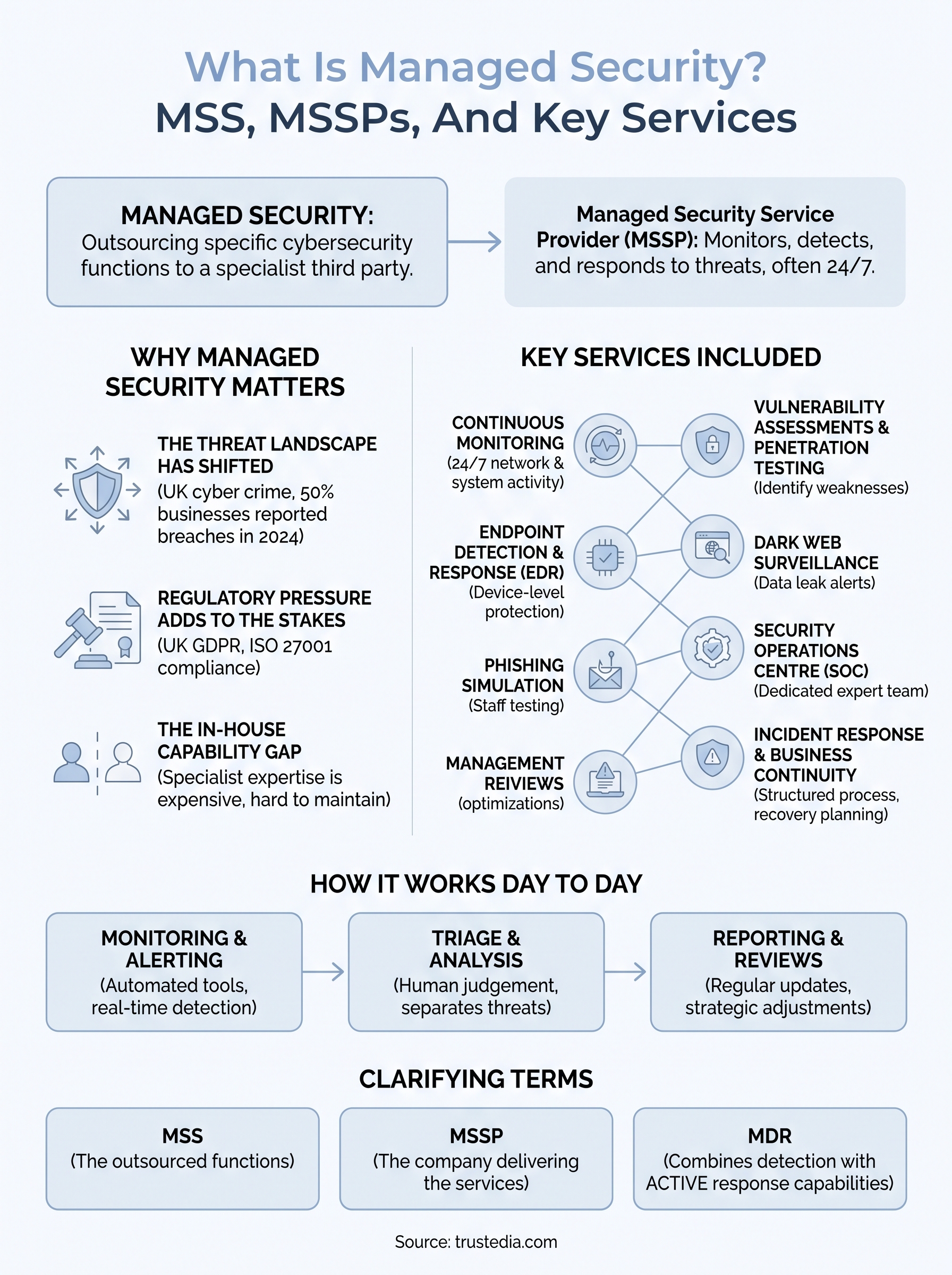
At its core, managed security means outsourcing specific cybersecurity functions to a specialist third party, known as a Managed Security Service Provider (MSSP). These providers monitor, detect, and respond to threats on your behalf, often around the clock. For organisations without a large in-house security team, this can be the difference between catching a breach early and discovering it months later.
At TrustedIA, we’ve spent over 30 years delivering IT services and managed security solutions to businesses across the UK. We’ve seen firsthand how misunderstanding these services leads to poor decisions, overspending on tools that don’t fit, or underestimating what’s actually covered. This article breaks down what managed security really means, what MSSPs do, the key services involved, and how to determine whether outsourcing makes sense for your organisation.
Why managed security matters for UK businesses
The UK has become one of the most targeted countries for cyber attacks. Understanding what managed security is and why it matters starts with recognising that cyber threats are not theoretical for most businesses – they are an operational reality. Whether you run a 10-person firm or a 500-person enterprise, the question is not really if you will face an attempt, but whether your defences will hold when it happens.
The threat landscape has shifted
Cybercrime in the UK has grown significantly over recent years. The 2024 Cyber Security Breaches Survey, published by the UK government, found that 50% of businesses reported experiencing a cyber security breach or attack in the preceding 12 months. Phishing remains the most common method, but ransomware, supply chain attacks, and credential theft have all increased. Smaller businesses are not exempt – attackers frequently target them on the assumption that defences are weaker and response times are slower.
When half of UK businesses report a breach in a given year, treating cyber security as optional is not a risk position – it is a liability.
Managed security providers respond to this directly. Rather than leaving you to patch together tools and hope for the best, an MSSP gives you continuous monitoring and a defined response process that activates the moment something suspicious appears.
Regulatory pressure adds to the stakes
UK businesses face regulatory obligations that make cyber security a compliance issue, not just a technical one. The UK GDPR requires organisations to implement appropriate technical and organisational measures to protect personal data. A breach that exposes customer information can result in significant fines from the Information Commissioner’s Office, as well as reputational damage that is far harder to recover from.
For businesses pursuing ISO 27001 certification, the demands go further. Achieving and maintaining that standard requires a systematic, ongoing approach to information security management – exactly the kind of structured work that managed security services are built to support.
The in-house capability gap
Most SMBs do not have a dedicated security team. IT generalists carry real skill, but threat detection, incident response, and security operations require specific expertise that takes years to develop. Hiring that expertise in-house is expensive, and maintaining 24/7 coverage means multiple full-time specialists. Managed security fills that gap directly, giving you access to experienced professionals, enterprise-grade tools, and proven processes without requiring you to build an entire security function from scratch. For most UK businesses, that makes managed security not just practical – it makes it the realistic option.
What managed security includes in practice.
When people ask what managed security is, they often assume it means someone watching a firewall. In practice, the scope is much broader. A capable MSSP covers multiple layers of your security environment, from endpoint protection to around-the-clock threat monitoring, giving you a coordinated defence rather than a collection of disconnected tools.
Core security functions that an MSSP covers
The services delivered under a managed security arrangement generally fall into a few well-defined categories. Continuous monitoring sits at the centre of most contracts – your MSSP watches network traffic, system logs, and endpoint activity in real time, looking for indicators of compromise before damage spreads. Alongside that, vulnerability assessments and penetration testing identify weaknesses in your defences before an attacker exploits them.
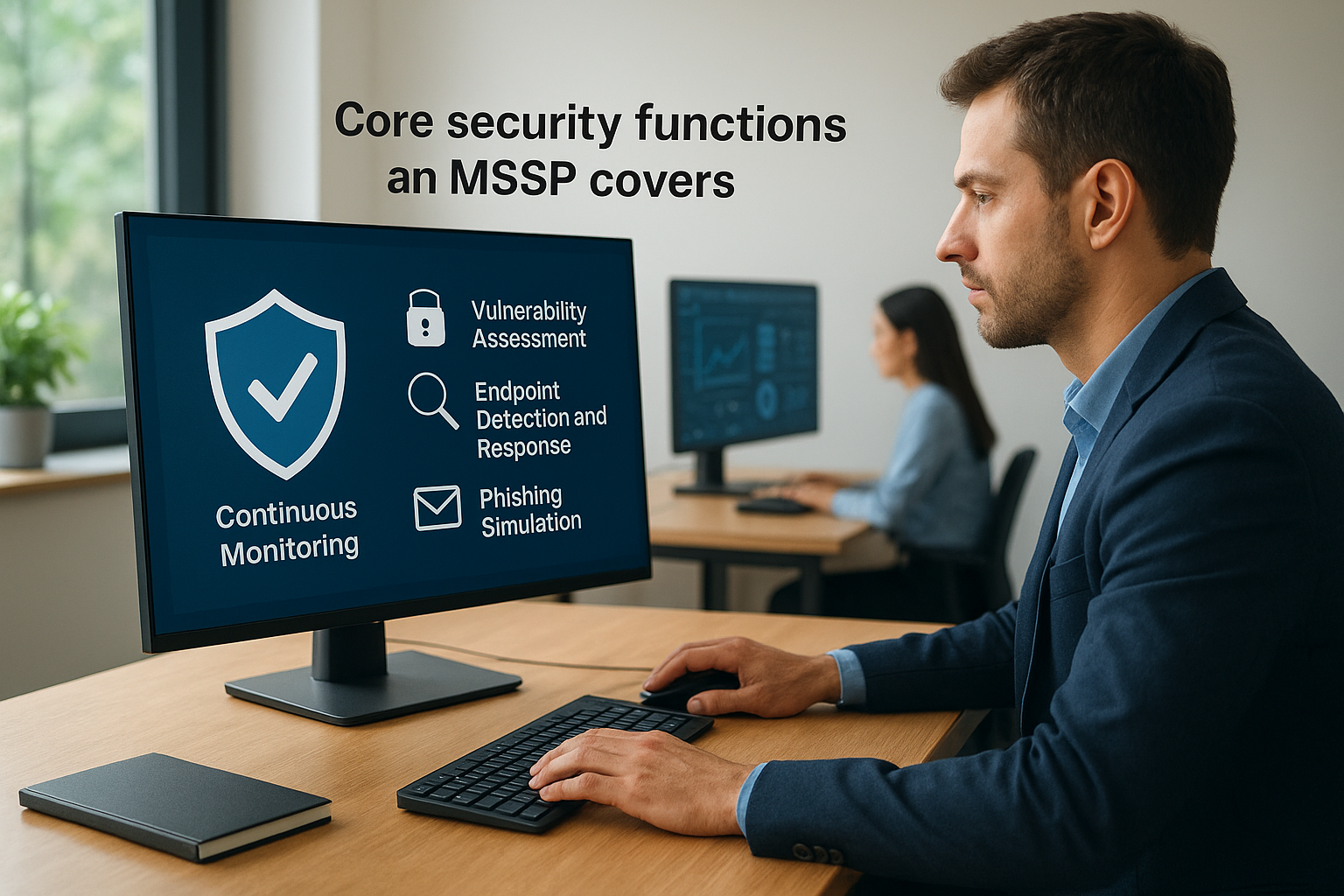
Other standard functions include:
- Endpoint detection and response (EDR): identifies and contains threats at the device level
- Dark web surveillance: alerts you if your credentials or data appear in criminal marketplaces
- Phishing simulation: tests whether your staff can spot malicious emails before they click
- Security Operations Centre (SOC): a dedicated team that investigates alerts and coordinates your response
The more services you consolidate under one provider, the fewer gaps exist between tools that would otherwise operate in isolation.
Incident response and business continuity
Managed security does not stop at detection. Incident response covers what happens once a threat is confirmed, including containment, investigation, and recovery. This structured process replaces the reactive, panic-driven decisions that often make a breach significantly worse.
Business continuity and disaster recovery planning ensure your organisation can keep operating even when systems are compromised. These are not optional extras – they determine whether a breach costs you days or months of disruption, and a capable MSSP builds both into your overall security arrangement from the start.
How managed security works day to day
Understanding what managed security is in abstract terms is one thing; seeing how it operates day to day is another. Your MSSP does not simply install software and step back. Active, structured engagement is built into the service from the start, and what that looks like will vary depending on your environment, industry, and risk profile. The process covers everything from continuous monitoring through to structured review cycles with your team.
Monitoring and alerting
Your MSSP’s SOC team watches your systems continuously, typically 24 hours a day, seven days a week. Automated detection tools generate alerts when activity deviates from established baselines, whether that is an unusual login at 3 am or a large data transfer heading to an unfamiliar destination. Analysts then review and triage each alert, separating genuine threats from false positives so your team is contacted only when something actually requires attention.
The value here is not just detection speed – it is the human judgement applied to every alert before it reaches you.
Reporting and reviews
Ongoing communication forms a core part of the arrangement. Regular reports keep you informed about your environment’s security posture, covering identified vulnerabilities, detected threats, and actions taken in response. Most MSSPs also schedule periodic review meetings to walk you through findings, discuss changes to your risk profile, and adjust the service as your business grows or shifts.
Coordination with your internal team
Managed security works alongside your existing IT staff rather than replacing them. Clear escalation paths define who does what when an incident occurs, removing confusion under pressure. Your provider handles the specialist security work, while your internal team focuses on day-to-day IT operations, with both teams communicating consistently to ensure nothing is overlooked.
Managed security terms people mix up
The language around what is managed security can get confusing quickly. Vendors use overlapping terminology, and buyers sometimes sign contracts without fully understanding what category of service they are purchasing. Getting these terms straight saves you from costly misaligned expectations before you commit to any provider.
MSS, MSSP, and MDR
Managed Security Services (MSS) refers to the range of outsourced security functions themselves, such as monitoring, vulnerability management, and incident response. An MSSP (Managed Security Service Provider) is the company that delivers those services. The distinction matters because not all MSSPs offer the same scope – some focus narrowly on monitoring, while others manage your full security environment.

Managed Detection and Response (MDR) is a more specific offering that combines threat detection with active response capabilities. Where an MSSP might alert your team and leave the response to you, an MDR provider steps in directly to contain and investigate threats. Both models have legitimate uses, but your choice depends on how much internal capacity you have to act on alerts promptly.
If a provider uses MDR and MSSP interchangeably without explaining the difference, that is worth pressing on before you sign anything.
SOC vs NOC
A Security Operations Centre (SOC) focuses specifically on identifying and responding to security threats. A Network Operations Centre (NOC) focuses on keeping your network available and performing well. The two functions are related but distinctly different in purpose and staffing.
Some providers operate both, while others offer only one. If your managed security contract references a SOC, check what analyst coverage looks like, including whether it runs 24/7 and whether your alerts get reviewed by qualified security specialists rather than general network engineers. The quality of that team directly determines how effective your protection actually is in practice.
How to choose the right managed security partner.
Knowing what managed security is only half the work. The other half is finding a provider who actually delivers it well. Not every MSSP is built the same, and the differences between a capable partner and an inadequate one become painfully clear the moment you face a real incident.
Look beyond the service list.
Most MSSPs publish a similar list of services. What separates a capable provider is the depth behind that list – the quality of their analysts, the maturity of their processes, and whether their tooling genuinely fits your environment. Ask specifically about analyst qualifications and SOC coverage hours before committing. A provider whose monitoring stops at 5 pm on a Friday is not protecting you when attackers know businesses are most vulnerable outside standard working hours.
Check their track record with similar organisations
Experience with businesses of your size and sector matters significantly. A provider who primarily serves enterprise clients may not have the processes or pricing structures suited to an SMB. Ask for case studies or references from organisations comparable to yours, and look for evidence of ISO 27001 expertise if compliance is part of your requirement. That certification work requires specialised knowledge that general IT providers lack.
The right question is not “can they do this?” – it is “have they done this for organisations like ours?”
Understand what happens during an incident
The real test of any managed security partner is their incident response capability. Clarify exactly what your provider does when a threat is confirmed – who contacts you, how quickly, and what actions they take without waiting for your instruction. Vague answers here are a warning sign. A reliable partner has a documented, rehearsed process that you can review before you need it, not one assembled on the spot when something goes wrong.
A clear way to get started
Understanding what managed security is provides a solid foundation, but the next step is to assess where your own organisation actually stands. Most businesses discover gaps they didn’t know existed once they examine their current security posture honestly. That audit is the fastest way to understand what you need before comparing providers.
TrustedIA has delivered managed security and IT services to UK businesses for over 30 years. Our solution-agnostic approach means we recommend what genuinely fits your environment, not what suits a vendor relationship. Whether you need continuous monitoring, incident response support, ISO 27001 guidance, or a full managed security arrangement, we build the service around your specific risk profile and operational requirements.
If you’re ready to understand your current exposure and explore what proper protection looks like in practice, speak to the TrustedIA team today.