Cyber attacks against UK organisations are growing in both frequency and sophistication. Ransomware groups, nation-state actors, and opportunistic criminals don’t announce themselves, they probe, adapt, and exploit gaps before most security teams even notice. That’s where threat intelligence services come in. Rather than waiting for an alert after something has gone wrong, these services give your organisation the context and foresight to act before threats materialise.
But not all providers offer the same depth of coverage. Some focus on tactical indicators of compromise, others on strategic geopolitical risk, and a few deliver fully managed intelligence programmes tailored to your sector and threat profile. Choosing the right service depends on what your organisation actually needs, and how much internal resource you can realistically dedicate to acting on the intelligence you receive.
At TrustedIA, we help businesses across the UK strengthen their security posture through managed services, including SOC operations, dark web surveillance, and vulnerability assessments. We built this guide to help you compare eight threat intelligence services worth considering, covering what each one does well, where they differ, and how to match a provider to your organisation’s risk profile and goals.
1. TrustedIA managed threat intelligence services
TrustedIA delivers fully managed threat intelligence services built specifically for UK organisations that lack the internal headcount to run a dedicated intelligence programme. Rather than handing you a raw data feed, the team contextualises every finding against your specific environment and translates it into something your security team can act on without spending hours decoding alerts.

What you get day to day
Your daily experience centres on continuous monitoring across dark web forums, threat actor communities, and open-source intelligence sources. You receive prioritised alerts with context attached, not just raw indicators, so your team spends less time interpreting data and more time responding to the threats that actually matter to your organisation.
Intelligence types covered
TrustedIA covers tactical, operational, and strategic intelligence within a single managed service. This includes dark web surveillance for leaked credentials and exposed data, phishing simulation and threat detection, vulnerability intelligence mapped to your specific assets, and SOC-driven analysis of active campaigns targeting your sector or supply chain.
Integrations and workflow fit
The service is built to work around your existing toolset rather than requiring a wholesale platform change. TrustedIA takes a solution-agnostic approach, which means they connect intelligence outputs into the security tools you already run and build workflows that match how your team operates, rather than adding friction to your processes.
This approach makes intelligence immediately operational, removing the gap between identifying a threat and being able to respond to it.
Best for
TrustedIA fits SMBs and mid-market organisations across the UK that want enterprise-grade intelligence coverage without the cost of building an in-house team. It also suits businesses working toward ISO 27001 certification, where documented threat monitoring forms a core component of the required control framework.
Pricing and contracting approach
TrustedIA operates on managed service contracts rather than per-seat or per-feed pricing. This gives you predictable monthly costs tied to coverage scope rather than usage spikes. Pricing is discussed directly with the team based on your organisation’s size, risk profile, and requirements.
Trade-offs to plan around
Because TrustedIA delivers a managed service, you depend on their analyst team rather than building internal intelligence capability in parallel. If your longer-term goal is to develop a fully in-house SOC with proprietary tooling, you should discuss a transition roadmap with the team from the outset.
2. Bridewell cyber threat intelligence services
Bridewell is a UK-focused managed security services provider that has built a solid reputation delivering structured threat intelligence services to regulated industries, including financial services, critical national infrastructure, and aviation. Their intelligence practice sits within a broader security operations capability, giving clients access to analyst-driven insights rather than raw data feeds.
What you get day to day
Their UK-based Security Operations Centre monitors threats around the clock on your behalf. You receive contextualised alerts and threat briefings drawn from a combination of commercial intelligence feeds, open-source monitoring, and dark web visibility.
Intelligence types covered
The service covers tactical indicators of compromise alongside operational intelligence on active threat actor campaigns. Bridewell also provides strategic intelligence reporting relevant to regulated sectors, helping you understand risks at the organisational and industry level.
Their sector-specific focus means the intelligence you receive is more immediately relevant to your actual risk environment.
Integrations and workflow fit
Bridewell integrates intelligence outputs into SIEM platforms and existing security tooling, reducing the manual effort your team needs to process findings. Their SOC-led approach means analyst context accompanies every alert, rather than leaving your team to interpret raw data alone.
Best for
Bridewell suits larger organisations and regulated businesses operating in sectors such as finance, government, and critical infrastructure, where compliance and sector-specific threat coverage carry significant weight.
Pricing and contracting approach
Bridewell works on managed service agreements with pricing structured around your coverage requirements. Exact figures require direct engagement with their sales team.
Trade-offs to plan around
Bridewell’s strength in enterprise and regulated environments can make the service feel oversized for smaller organisations, which may find both the scope and pricing a less natural fit.
3. IBM X-Force Threat Intelligence Services
IBM X-Force is one of the most recognisable names in global threat intelligence services, backed by decades of security research and a sensor network monitoring threats across more than 130 countries. The service draws on billions of data points collected daily to give organisations a broad view of the current threat landscape.
What you get day to day
Your team gains access to the X-Force Exchange platform, a cloud-based intelligence hub that combines IBM’s proprietary research with community-sourced threat data. You receive continuous feeds of indicators of compromise, threat actor profiles, and vulnerability intelligence updated in near real time.
Intelligence types covered
IBM X-Force covers tactical indicators such as malicious IPs, URLs, and file hashes alongside deeper operational intelligence on active campaigns and adversary tooling. Their research team also produces strategic threat reports on emerging global trends and nation-state activity.
The breadth of IBM’s global sensor network means their intelligence reflects threats across industries and geographies rather than a narrow slice of the landscape.
Integrations and workflow fit
X-Force integrates natively with IBM QRadar and supports STIX/TAXII standards, making it compatible with many third-party SIEMs and security platforms. If your team already runs IBM security tooling, the integration overhead is minimal.
Best for
IBM X-Force suits larger enterprises with in-house security teams capable of consuming and operationalising high volumes of threat data across a global footprint.
Pricing and contracting approach
IBM offers subscription-based licensing through its X-Force Exchange platform, with enterprise agreements available for organisations that need deeper integration and dedicated analyst support.
Trade-offs to plan around
The platform is built for large-scale enterprise environments, and smaller UK organisations may find the depth and complexity exceeds what their team can realistically action without dedicated intelligence analysts already in place.
4. Microsoft Defender Threat Intelligence and TIP
Microsoft Defender Threat Intelligence, formerly known as RiskIQ, gives organisations access to one of the largest proprietary internet datasets in the industry. The platform maps the internet continuously, tracking infrastructure used by threat actors and correlating it against your exposure across Microsoft’s ecosystem to surface relevant risks before they reach your environment.
What you get day to day
Your team works directly within the Microsoft Defender portal, where threat intelligence feeds surface alongside alerts and incidents already generated by your Microsoft security stack. You receive prioritised threat actor profiles, attack surface data, and indicator enrichment without switching between separate tools or platforms.
Intelligence types covered
Microsoft covers tactical indicators such as IPs, domains, and certificates linked to known threat actor infrastructure, as well as vulnerability intelligence and strategic reporting on active campaigns. Their data set is particularly strong for tracking adversary infrastructure changes over time.
The scale of Microsoft’s internet scanning means their indicator coverage frequently surfaces threats before they appear in smaller commercial feeds.
Integrations and workflow fit
The platform connects natively with Microsoft Sentinel, Defender XDR, and the broader Microsoft security suite, making integration straightforward if your organisation already runs these tools. Third-party integration is supported via API and STIX/TAXII outputs for teams using non-Microsoft SIEMs.
Best for
This service suits Microsoft-heavy environments where your security team wants intelligence embedded directly into existing workflows rather than managing a separate threat intelligence services platform alongside their current tooling.
Pricing and contracting approach
Microsoft Defender Threat Intelligence is available through Microsoft 365 Defender licensing tiers, with premium features accessible via Microsoft Security add-on subscriptions negotiated through your Microsoft agreement or partner.
Trade-offs to plan around
If your organisation runs a mixed or non-Microsoft environment, the native integration advantage largely disappears and the platform becomes harder to justify against dedicated intelligence providers with broader tooling compatibility.
5. Recorded Future and CrowdStrike Falcon Intelligence
Both Recorded Future and CrowdStrike Falcon Intelligence sit at the high end of the threat intelligence services market, offering deep adversary intelligence with a strong emphasis on predictive and contextual analysis rather than reactive indicator feeds.
What you get day to day
Recorded Future surfaces structured intelligence on threat actors, vulnerabilities, and geopolitical risks through its platform, combining machine learning with analyst reporting. CrowdStrike Falcon Intelligence delivers actor-attributed threat reporting tied directly to CrowdStrike’s endpoint telemetry, giving your team a clear picture of who is targeting your sector and how.
The actor attribution capability in CrowdStrike Falcon Intelligence is particularly valuable for organisations that need to understand adversary intent, not just indicators.
Intelligence types covered
Together, these platforms cover strategic, operational, and tactical intelligence at significant depth. Recorded Future excels at vulnerability intelligence and third-party risk monitoring, while CrowdStrike focuses on campaign-level adversary behaviour and malware analysis tied to real-world incident data.
Integrations and workflow fit
Both platforms support SIEM and SOAR integrations through APIs and STIX/TAXII outputs. CrowdStrike connects tightly with its own endpoint and XDR platform, offering the strongest value to existing CrowdStrike customers.
Best for
These services suit larger enterprises and mature security teams with dedicated analysts capable of consuming detailed intelligence reporting and translating findings into operational decisions.
Pricing and contracting approach
Both operate on enterprise subscription models, with pricing negotiated based on modules selected and organisational scale. Neither publishes standard pricing publicly.
Trade-offs to plan around
The depth of both platforms assumes your team has sufficient analyst capacity to act on the intelligence delivered, which makes them a weaker fit for organisations without dedicated security personnel.
6. Lookout threat intelligence services
Lookout takes a distinct angle on threat intelligence services compared to most providers on this list. Rather than leading with network or endpoint telemetry, its intelligence capability centres on mobile security data, drawing on one of the largest mobile datasets in the industry to surface threats that other platforms frequently miss.
What you get day to day
Your team receives continuous intelligence on mobile-targeted threats, including phishing campaigns delivered via SMS and messaging apps, malicious applications, and device vulnerabilities. The platform surfaces findings in a centralised dashboard with prioritised alerts and contextual risk scoring to help you focus on what matters most.
Intelligence types covered
Coverage spans tactical indicators tied to mobile threat vectors alongside operational intelligence on phishing infrastructure and mobile malware campaigns. Their dataset covers hundreds of millions of devices, giving visibility into emerging mobile threats before they appear in traditional intelligence feeds.
This mobile-first depth makes Lookout a strong complement to providers that focus primarily on network and endpoint telemetry.
Integrations and workflow fit
The platform connects with SIEM tools and cloud security platforms through API-based integrations, making it straightforward to fold mobile threat data into your existing security workflows without significant additional overhead.
Best for
Lookout suits organisations with a significant mobile workforce, particularly in sectors such as financial services and healthcare where mobile devices handle sensitive data regularly.
Pricing and contracting approach
Pricing follows a subscription model based on the number of devices covered and modules selected. You need to contact their sales team directly for specific figures.
Trade-offs to plan around
The mobile-centric focus means intelligence coverage is narrower than generalist providers. If mobile endpoints represent a small part of your attack surface, the platform may not deliver sufficient breadth to justify it as a standalone solution.
7. Flashpoint Ignite and SOCRadar
Flashpoint Ignite and SOCRadar both target organisations that need deep visibility into threat actor communities, dark web activity, and digital risk exposure. While they approach the problem from slightly different angles, both platforms position themselves as intelligence-led threat intelligence services built for security teams that want actionable context rather than raw data.
What you get day to day
Flashpoint Ignite gives your analysts access to curated finished intelligence drawn from illicit forums, chat platforms, and closed communities, alongside a searchable archive of historical threat actor activity. SOCRadar delivers continuous digital risk monitoring, covering your brand, exposed assets, and supply chain threats through a centralised dashboard with daily prioritised alerts.
The combination of Flashpoint’s deep web access and SOCRadar’s attack surface monitoring fills coverage gaps that most traditional security tools leave open.
Intelligence types covered
Both platforms cover tactical and operational intelligence, including compromised credential monitoring, dark web mentions, and active campaign tracking. Flashpoint leans heavily into threat actor profiling and geopolitical risk, while SOCRadar emphasises external attack surface intelligence and third-party risk exposure.
Integrations and workflow fit
Both tools support API-based integration with major SIEM and SOAR platforms, allowing you to push intelligence directly into your existing workflows without significant configuration overhead.
Best for
These platforms suit mid-market and enterprise teams that need strong dark web and digital risk coverage alongside traditional network and endpoint intelligence sources.
Pricing and contracting approach
Both operate on subscription models with pricing available on request based on your coverage scope and team size.
Trade-offs to plan around
Neither platform replaces a broader managed security service, so organisations without in-house analysts may struggle to act on the volume of intelligence delivered without additional support.
Where to go from here
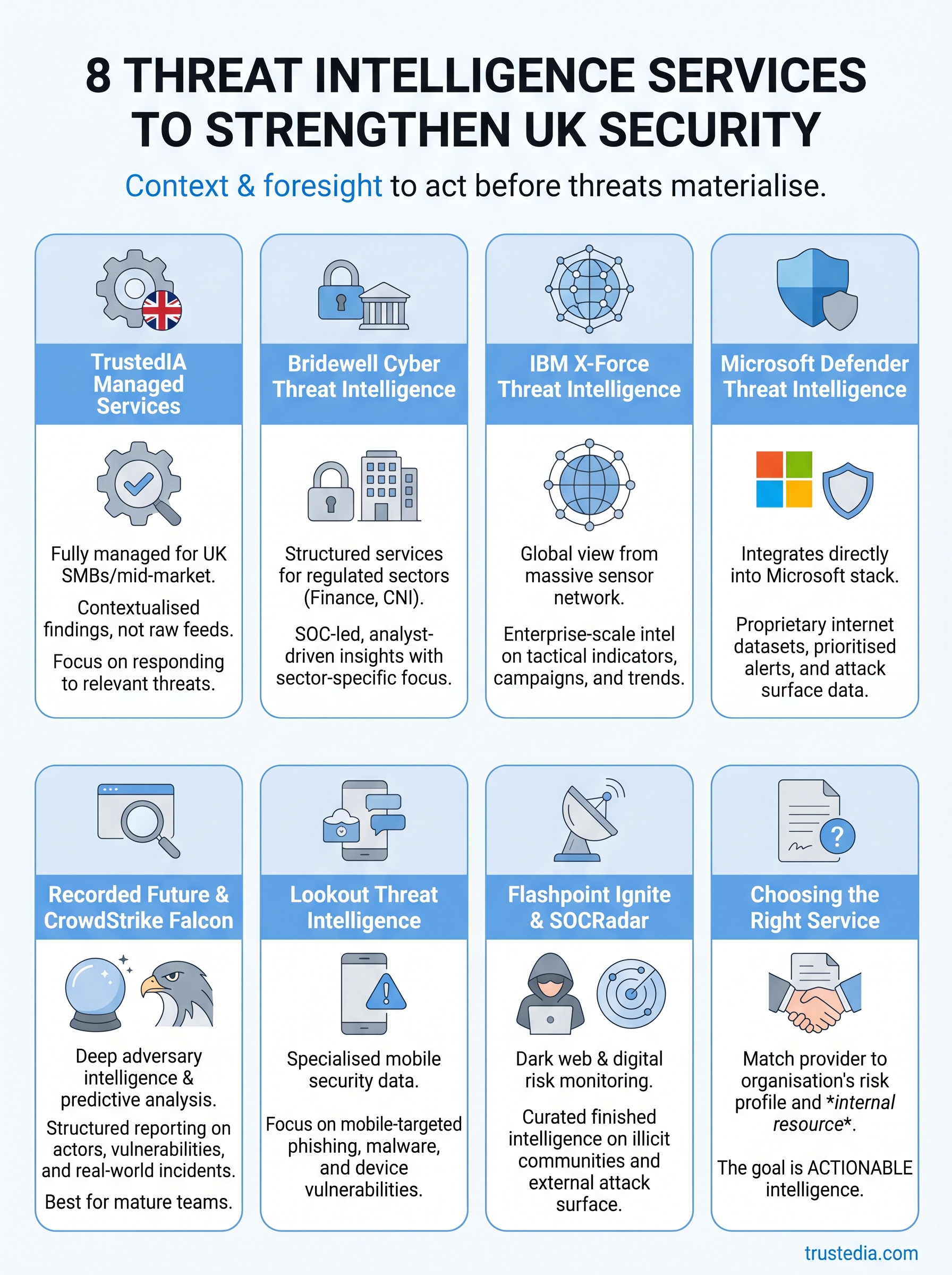
Every provider on this list approaches threat intelligence services from a different angle, and the right choice depends on what your organisation can realistically act on. If you run a large enterprise with dedicated analysts and existing vendor relationships, platforms like Recorded Future, CrowdStrike, or Microsoft Defender will likely suit your workflow. If your team is smaller and you need intelligence that arrives with context already applied, a fully managed service will give you more value than a raw data platform that sits unused.
The biggest risk most UK organisations face is not a lack of intelligence, but a lack of time and resource to do anything meaningful with it. That’s exactly the gap a managed service is designed to close. If you want to understand how managed threat intelligence could work within your specific security environment, speak to the TrustedIA team to explore what coverage looks like for your organisation.