
Most cyber attacks don’t start with a hacker breaking through a firewall. They start with someone clicking a link in an email, reusing a weak password, or opening a file they shouldn’t have. The importance of cyber security awareness cannot be overstated because the majority of breaches trace back to human error, not technical failure. For any business serious about protecting its data, training employees to spot threats is no longer optional.
Phishing emails are getting harder to distinguish from legitimate messages. Social engineering tactics are more targeted than ever. Without the right knowledge, even well-meaning staff can hand over credentials, expose sensitive records, or trigger ransomware that brings operations to a halt. The real risk sits between the keyboard and the chair, and closing that gap requires consistent education, not just better software. It’s a problem that affects organisations of every size, from small teams to large enterprises.
At TrustedIA, we work with businesses across the UK to build stronger cyber security postures, and that always includes the human element. From phishing simulations to cyber training programmes, we’ve seen first-hand how awareness turns employees from a vulnerability into a genuine line of defence. This article breaks down exactly why cyber security awareness matters, what threats your people need to recognise, and the practical steps you can take to reduce risk across your organisation.
Why cyber security awareness matters at work
When your employees understand how attackers operate, they make better decisions under pressure and catch threats before they become serious incidents. The importance of cyber security awareness in a workplace context goes far beyond a one-off IT briefing. It shapes the daily habits of every person who touches a company device, inbox, or system. Businesses that invest in this consistently see measurable reductions in security incidents, not because they’ve installed better software, but because their people are better informed.
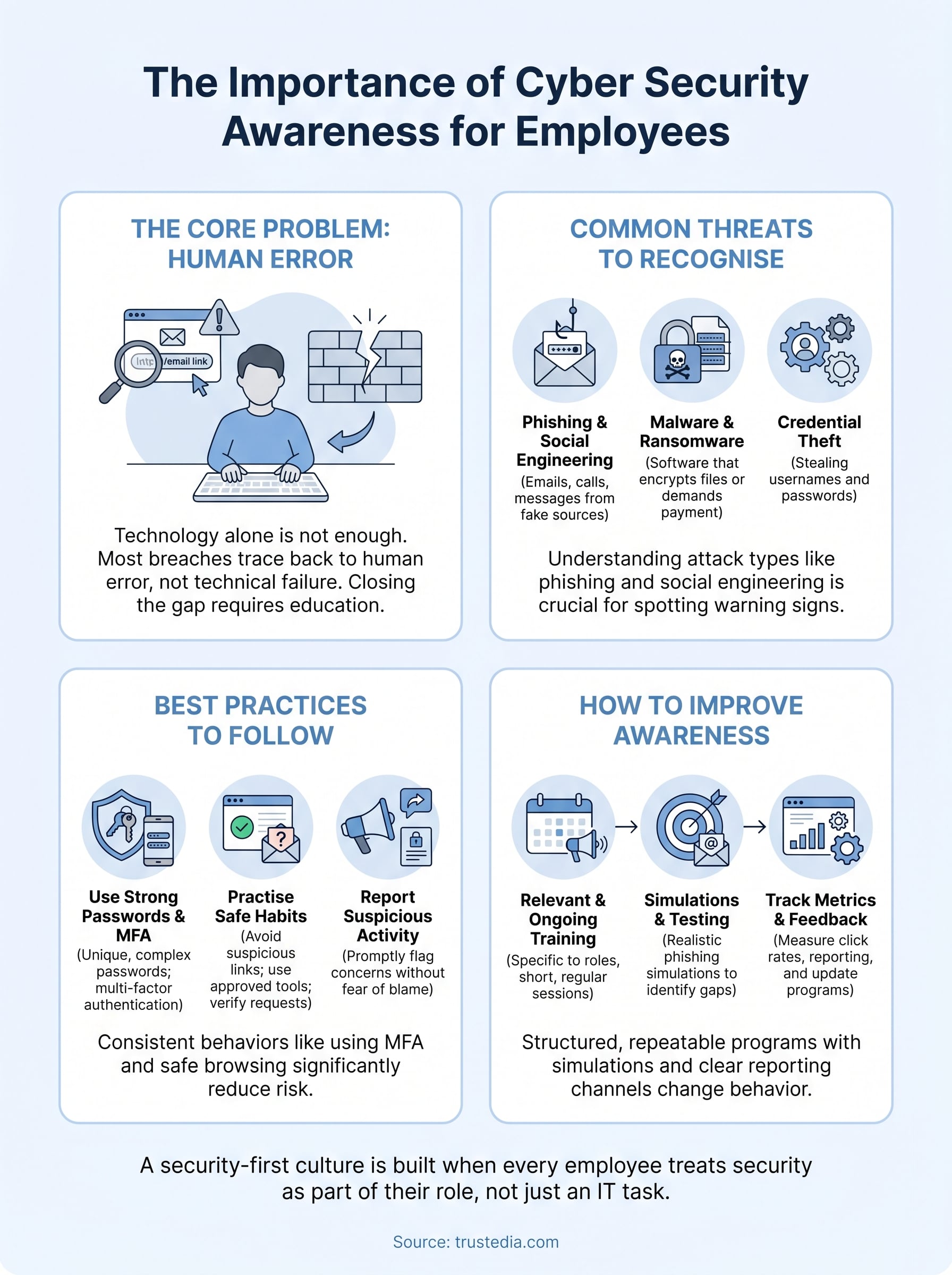
Human error drives most incidents
The numbers are hard to ignore. Research from IBM’s Cost of a Data Breach Report consistently shows that human error contributes to a significant proportion of security breaches worldwide. Employees don’t make these mistakes out of carelessness; they make them because no one has clearly shown them what to look for. A convincing phishing email, a spoofed sender address, or an urgent-sounding request for login credentials can catch almost anyone off guard without proper training.
The weakest point in any security system is rarely the technology; it’s the person who hasn’t been given the tools to recognise a threat.
Your organisation could have enterprise-grade firewalls and endpoint protection in place, but if a staff member hands over their credentials in response to a fake IT support request, none of that infrastructure matters. Awareness training closes the gap that technical controls cannot reach.
Regulatory pressure is growing
Businesses operating in the UK face increasing obligations around data protection and cyber security standards. The UK GDPR requires organisations to implement appropriate technical and organisational measures to protect personal data, and that explicitly includes training the people who handle it. If a breach occurs and your team was never trained to manage sensitive information securely, your organisation faces significant regulatory exposure, including potential fines from the Information Commissioner’s Office.
For businesses working toward or maintaining ISO 27001 certification, employee awareness is a formal requirement, not an optional extra. Clause 7.3 of the standard requires that personnel are aware of the information security policy, their role in maintaining it, and the consequences of falling short. Awareness is built directly into the framework.
Awareness builds a security-first culture
Technical controls and policies alone do not create a secure organisation. What reduces risk over the long term is a workplace where every employee treats security as part of their own role, not something they leave to the IT team. When staff feel confident identifying suspicious activity and reporting it without fear of blame, your organisation gains an early warning system that no software can fully replicate.
Achieving that culture requires consistency rather than a one-time onboarding exercise. When your people see that leadership takes cyber security seriously and acts on it, they follow that lead. The result is a workforce that actively protects your business rather than inadvertently exposing it.
Common threats employees must recognise
Understanding specific attack types is what makes awareness training genuinely useful. Without knowing what a threat looks like in practice, employees cannot act on general advice about staying safe. The importance of cyber security awareness lies partly in giving people a concrete picture of the tactics attackers use day to day, so they can spot warning signs before any damage is done.
Phishing and social engineering
Phishing remains the most common way attackers gain initial access to business systems. Attackers send emails that appear to come from trusted sources (a bank, a supplier, or even a senior colleague) and prompt the recipient to click a link, enter credentials, or open an attachment. Spear phishing takes this further by targeting specific individuals with personalised details gathered from social media or company websites, making the message far harder to dismiss at a glance.

If an email creates urgency, requests login details, or asks you to bypass a normal process, treat it as suspicious until you can verify it through a separate channel.
Social engineering extends beyond email. Vishing (voice phishing) involves attackers calling employees and posing as IT support or a trusted authority. Smishing uses text messages to deliver malicious links. Both rely on the same psychological levers: urgency, authority, and the fear of consequences for not complying quickly enough.
Malware, ransomware, and credential theft
Ransomware has caused significant operational disruption to UK businesses in recent years. It typically arrives through a phishing link or an infected attachment, then encrypts files and demands payment for their return. Even organisations with backups face downtime and potential data exposure while they work through recovery.
Credential theft is equally damaging and often less visible. Attackers use fake login pages or keyloggers to capture usernames and passwords, then access systems quietly over time. Employees who reuse the same password across multiple accounts dramatically increase the risk of a single breach spreading across the entire organisation.
Best practices every employee should follow
Knowing what threats look like is only half the picture. The importance of cyber security awareness also lies in translating that knowledge into daily habits that reduce the chance of an attack succeeding. Simple, consistent behaviours across your entire workforce create a meaningful reduction in risk that no single piece of technology can match on its own.
Use strong passwords and enable multi-factor authentication
Every account your employees use should have a unique, complex password that isn’t shared with any other service. Password reuse is one of the most common ways attackers move from one compromised account into others. A password manager makes this practical for staff who wouldn’t otherwise remember dozens of different credentials.
Multi-factor authentication (MFA) is one of the most effective controls available. Even if an attacker obtains a password, MFA stops them from accessing the account without a second verification step.
Beyond passwords, your team should enable MFA on every system that supports it, starting with email accounts and remote access tools, which attackers target most frequently.
Practise safe browsing and email habits
Your employees should avoid clicking links or downloading attachments from unexpected emails, even when the sender appears familiar. Verifying requests through a separate channel (such as calling the sender directly) takes seconds and can prevent a serious incident. The same applies to any email that creates urgency or asks staff to bypass a normal approval process.
Outside of email, staff should only use company-approved applications and storage services rather than personal tools that sit outside your security controls. Connecting to public Wi-Fi without a VPN exposes business data in transit, so employees working remotely need clear guidance on what is and isn’t acceptable.
Report anything that looks suspicious
Your organisation needs employees to report incidents promptly, not hide them out of embarrassment. A culture where staff feel safe raising concerns early gives your security team the chance to contain a threat before it spreads. Make sure everyone knows who to contact and how, so reporting never feels complicated or unclear.
How to run effective awareness training
Knowing the importance of cyber security awareness is one thing; delivering training that actually changes behaviour is another. A single annual presentation rarely moves the needle. What works is a structured, repeatable programme that connects to the real situations your employees face every day, delivered in formats that hold attention rather than burn it.
Make training relevant and ongoing
Generic training that covers every conceivable threat in a two-hour session tends to be forgotten within days. Your employees retain information far better when it’s specific to their role and delivered in short, regular intervals throughout the year. A finance team member needs to understand invoice fraud and business email compromise. A customer-facing employee needs to recognise social engineering over the phone. Tailoring the content to the audience makes it land.
The most effective training doesn’t just inform; it changes what your employees do when they face a real decision under pressure.
Keep sessions short and focused, ideally no longer than 15 to 20 minutes per topic. Spreading training across the year keeps security front of mind rather than treating it as an annual tick-box exercise.
Use simulations to test real behaviour
Reading about phishing and recognising it in your inbox are two different skills. Phishing simulations send realistic but controlled fake emails to your employees, then track who clicks, who reports, and who ignores them. The results tell you exactly where your training gaps sit and which teams or individuals need more support, without waiting for a real attack to reveal the problem.
Simulations work best when they’re followed immediately by targeted feedback. An employee who clicks a simulated phishing link should see a brief explanation of what gave it away and what to do differently next time. That moment of learning, directly after a near-miss, is far more effective than any classroom module. Pair simulations with clear reporting channels so employees build the habit of flagging suspicious messages rather than just deleting them.
How to measure and improve awareness
Running training is only valuable if you can tell whether it’s working. The importance of cyber security awareness lies not just in delivering content to your employees, but in tracking whether that content actually changes how they behave day to day. Without clear measurement, you risk spending time and budget on programmes that have little real impact on your organisation’s exposure to cyber threats.
Track metrics that reflect behaviour
The most useful metrics focus on what your employees do, not just what they’ve completed or watched. Phishing simulation click rates show how many staff fell for a test email compared to previous rounds. Reporting rates (the percentage of employees who flag a suspicious message rather than ignore or delete it) indicate whether your people have both the knowledge and the confidence to act on it. Over time, you want click rates falling and reporting rates rising.
If your reporting rate stays low, the issue often isn’t knowledge; it’s that employees don’t feel safe raising concerns or don’t know who to contact.
Measure these figures by team and by time period so you can identify where gaps are concentrated and whether specific training interventions have made a measurable difference. A single organisation-wide average masks the real picture and makes it harder to direct resources where they’re needed most.
Review and update your programme regularly
Cyber threats evolve, and your training must keep pace with them. Schedule a formal review of your awareness programme at least every six months to assess whether the content still reflects the threats your employees are most likely to face. New attack techniques, changes to your business operations, and results from recent simulations should all influence what you cover in the next cycle.
Collect direct feedback from employees after each training session. Short surveys asking what was useful, what was unclear, and what situations they’d like guidance on give you a practical basis for improvement. Combining that feedback with your simulation data and incident logs builds a clear, ongoing picture of where your programme is working and where it still needs attention.
Final thoughts
The importance of cyber security awareness comes down to one straightforward truth: your technology can only protect you as far as your people will let it. Every firewall, endpoint tool, and access control becomes less effective the moment an employee clicks the wrong link or shares credentials with the wrong person. Building genuine awareness across your workforce reduces that risk in a way that no single product can replace.
Your training programme does not need to be complex to be effective. Short, regular sessions, realistic phishing simulations, clear reporting channels, and consistent measurement will move your organisation in the right direction faster than any annual presentation. The goal is a team that treats security as part of their everyday role, not an afterthought.
If you want expert support putting this into practice, TrustedIA’s cyber training and managed security services give your business the structure and guidance to build lasting awareness across every level of your organisation.



