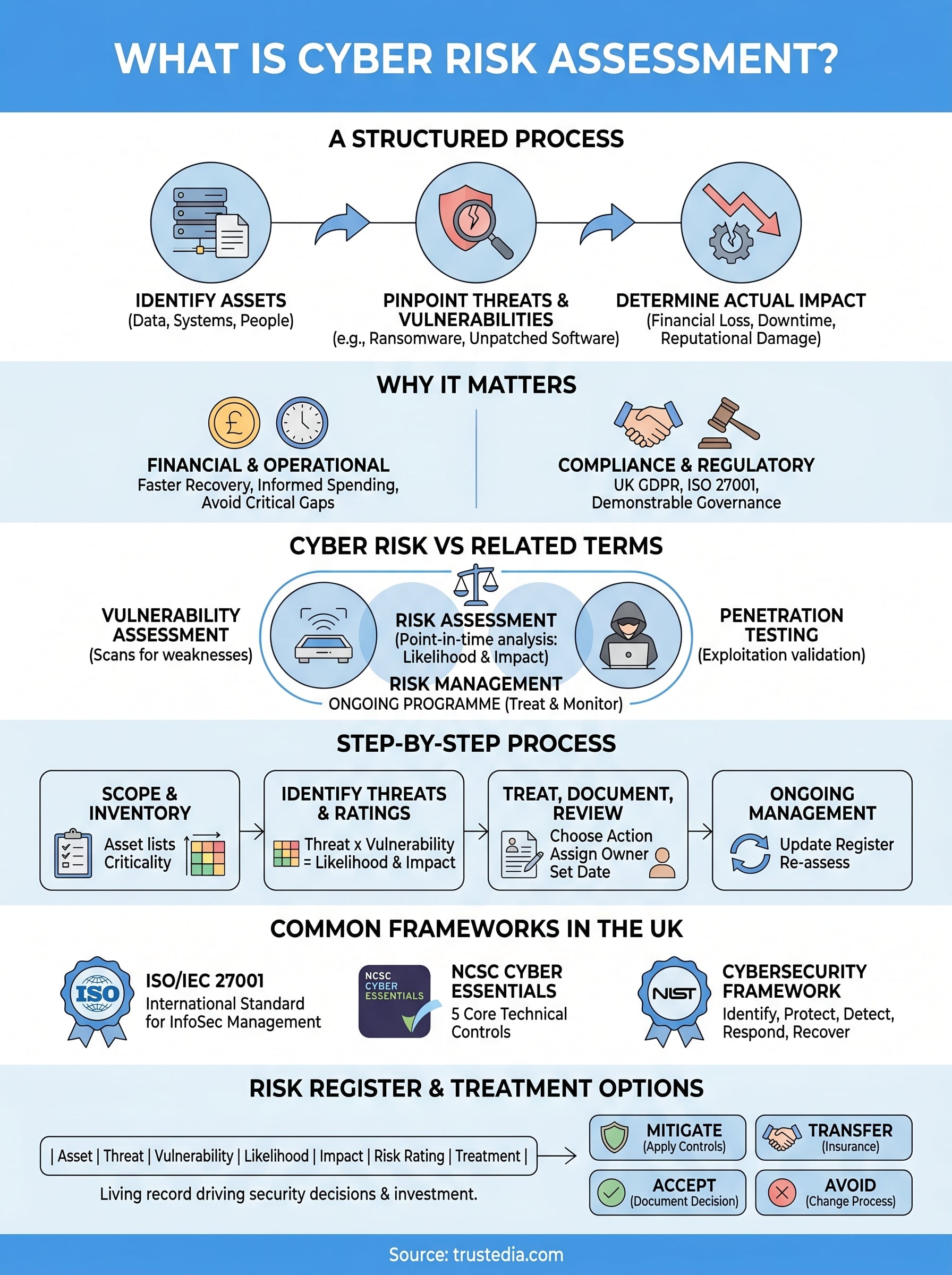
Every organisation holds data that someone else wants, customer records, financial information, intellectual property, operational systems. A cyber risk assessment is the structured process of identifying those assets, pinpointing the threats and vulnerabilities that could compromise them, and determining what the actual impact would be if something went wrong. It’s not a theoretical exercise. It’s how you make informed decisions about where to spend your security budget and which risks genuinely need your attention.
Without one, you’re guessing. You might over-invest in areas that pose little real danger while leaving critical gaps wide open. A proper assessment gives you a clear picture of your exposure and a rational basis for action, whether that means patching a system, tightening access controls, or accepting a risk you’ve consciously evaluated. It also forms the backbone of compliance frameworks like ISO 27001, where risk assessment isn’t optional but foundational.
At TrustedIA, we’ve spent over 30 years helping businesses across the UK understand and manage their cyber risk, from initial posture assessments using our internally developed CRAFT tooling, through to full ISO 27001 implementation and certification. This article breaks down what a cyber risk assessment actually involves, walks through each step of the process, and includes practical examples so you can see how it works in real operational contexts. Whether you’re building a programme from scratch or refining an existing one, this guide gives you a solid foundation to work from.
Why cyber risk assessments matter
Understanding what is cyber risk assessment is one thing. Knowing why it belongs at the centre of your security programme is another. Businesses across the UK face an active and evolving threat environment, and the organisations that manage incidents well are almost always the ones that did the groundwork beforehand. A risk assessment tells you where your actual exposure sits, not where you assume it does, which makes a real difference when you’re allocating limited resources against a wide range of potential threats.
The financial and operational consequences of unmanaged risk
When a cyber incident hits an organisation that hasn’t assessed its risks, the damage spreads far beyond the initial breach. Systems go down without a clear recovery path, sensitive data gets exposed with no prior classification or ownership assigned, and the business spends the first critical hours just trying to work out what happened. The average cost of a data breach for UK businesses runs into tens of thousands of pounds, and for many SMBs, a serious incident without a recovery plan can end normal operations entirely.
Organisations that complete regular risk assessments recover from incidents faster because they already know which systems are critical, where their data lives, and what their acceptable downtime looks like.
Reputational damage is harder to quantify but equally real. Customers, partners, and suppliers lose confidence in businesses that appear unprepared. Demonstrating that you’ve assessed and managed your risk proactively is a signal that you take their data seriously, and that carries weight with clients both before and after an incident occurs.
Compliance and regulatory expectations
If your organisation handles personal data, you’re already operating within the scope of UK GDPR, which expects you to take a risk-based approach to data protection. That means identifying what could go wrong with the personal data you hold, assessing the likelihood and impact, and acting accordingly. A cyber risk assessment gives you the structured evidence to show that you’ve done this work, rather than simply asserting that your security is adequate.
ISO 27001, the internationally recognised standard for information security management, goes further. It requires a formal risk assessment and treatment process as part of certification. Many organisations pursue ISO 27001 not just for the certificate but because the discipline it imposes produces measurably better security outcomes. The risk assessment is where that discipline begins.
A risk-based approach shapes better security decisions
Without a risk assessment, security spending tends to follow industry trends or vendor recommendations rather than the actual threat profile of your organisation. You might invest in tools that don’t address your most significant vulnerabilities, or apply uniform controls across systems that carry very different levels of risk. That approach is an inefficient use of budget and, more importantly, it leaves real and identifiable gaps in your defences.
A completed risk assessment gives you a prioritised view of what matters most. You can direct your budget, your team’s attention, and your technical controls toward the areas that carry genuine risk, and you can document your reasoning so that decisions are defensible to leadership, auditors, and insurers alike. That clarity is what separates organisations that manage their security strategically from those that react to problems as they arise.
Cyber risk assessment vs related terms
Before you can use a cyber risk assessment effectively, you need to know what it is and what it isn’t. Several terms get used interchangeably in this space, but they describe distinct activities with different scopes. Conflating them leads to gaps in your security programme, because you might think you’ve covered your risk exposure when you’ve only addressed part of it.
Risk assessment vs risk management
A risk assessment is a point-in-time analysis that identifies, analyses, and evaluates your risks. Risk management is the broader, ongoing programme that uses the assessment as its input. Think of the assessment as the diagnostic stage: it tells you what risks exist and how significant they are. Risk management then covers how you treat those risks, whether through mitigation, transfer, acceptance, or avoidance, and how you monitor them over time.
If you run a risk assessment but never act on it or revisit it, you have a document, not a programme.
When people ask what is cyber risk assessment, they’re often actually describing both concepts at once. It helps to keep them separate so you can plan the work properly, because the assessment feeds the risk register, and the risk register drives your ongoing decisions.
Risk assessment vs vulnerability assessment
A vulnerability assessment scans your technical environment for known weaknesses, such as unpatched software, misconfigured systems, or exposed ports. It’s an important input to a cyber risk assessment, but it only covers one dimension. A full risk assessment also factors in the likelihood of exploitation, the value of the affected assets, and the potential business impact, none of which a vulnerability scan can tell you on its own.
You can run a vulnerability assessment weekly and still have significant unmanaged risk if you’re not connecting those findings to the broader context of your organisation’s operations and data.
Risk assessment vs penetration testing
Penetration testing goes a step further than vulnerability assessment by actively attempting to exploit weaknesses in a controlled way, simulating what an attacker would actually do. It’s a useful validation tool, but it’s not a substitute for a risk assessment. Pen testing tells you whether a vulnerability is exploitable; a risk assessment tells you whether that vulnerability poses an acceptable or unacceptable level of risk given your specific environment, assets, and business context. Both have their place, but they answer different questions.
The core components of cyber risk
To understand what is cyber risk assessment in practice, you need a clear grip on the building blocks it uses. Every risk is a combination of specific factors, and knowing what those factors are helps you structure your thinking and avoid leaving out elements that could distort your overall picture. A risk isn’t simply "we might get hacked"; it’s a precise statement about what could happen, to what, under what conditions, and with what consequences.
Assets and what you’re protecting
An asset is anything your organisation depends on to operate or anything that holds value that could be harmed. That includes obvious targets like databases and servers, but also less obvious ones like staff credentials, physical access systems, third-party integrations, and contractual information. Before you can assess risk, you need an asset inventory that captures what you actually have and how critical each asset is to your business operations.
Your assets don’t carry equal weight. A customer-facing payment system carries far more risk exposure than an internal document archive. Categorising your assets by criticality and data sensitivity gives you a logical starting point for deciding where your risk assessment effort should focus first.
Threats, vulnerabilities, and likelihood
A threat is any potential event or action that could cause harm to an asset, whether that’s a ransomware group, a phishing campaign, a disgruntled employee, or a misconfigured cloud bucket. A vulnerability is the weakness that a threat can exploit, such as an unpatched operating system, a weak password policy, or the absence of multi-factor authentication. Likelihood estimates how probable it is that a specific threat will exploit a given vulnerability in your environment, taking into account your industry, your existing controls, and the current threat landscape.

Neither threats nor vulnerabilities alone constitute a risk: risk exists where a credible threat meets an exploitable weakness, and your assessment needs to capture both sides of that equation.
Impact and consequence
Impact measures what your organisation would actually lose if a risk materialised. That includes direct financial costs, operational downtime, data loss, regulatory penalties, and reputational damage. Some impacts are measurable in pounds and hours; others, like the erosion of customer trust, take longer to quantify but are no less significant.
Mapping impact against likelihood gives you a risk rating for each identified risk, which becomes the basis for deciding which risks need immediate treatment and which can be accepted or monitored.
Step-by-step cyber risk assessment process
Understanding what is cyber risk assessment conceptually is only the starting point. You need a repeatable, structured process that produces actionable results rather than a document that sits on a shelf. The steps below give you that structure, and each one builds logically on the last.
Define scope and build your asset inventory
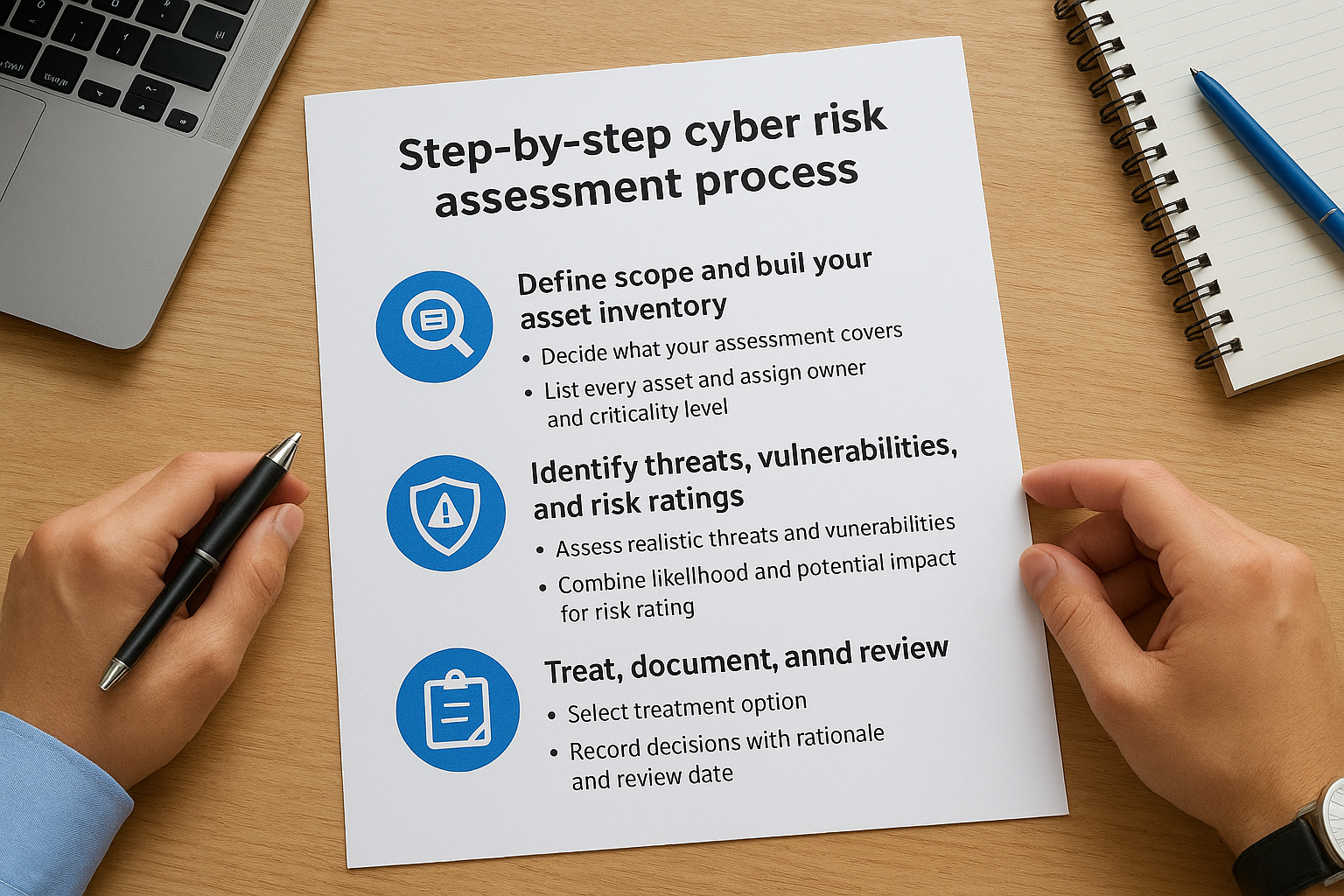
Before you assess anything, decide what your assessment covers: your full organisation, a specific system, a business unit, or a defined data set. A clear scope keeps the work manageable and ensures your findings sit within agreed, documented boundaries. Once your scope is set, list every asset it contains, including systems, data stores, applications, infrastructure, and third-party dependencies, and assign an owner and criticality level to each.
Assets typically fall into three broad categories:
- Primary assets: the information and processes your business depends on directly
- Supporting assets: the systems, hardware, and software those processes run on
- Human assets: the people with access, knowledge, or responsibility for those systems
Identify threats, vulnerabilities, and risk ratings
For each asset, work through the realistic threats it faces and the vulnerabilities a threat could exploit. Use sector-relevant threat intelligence, previous incident data, and vulnerability scan outputs to ground your analysis in real scenarios rather than theoretical ones.
This is the step where many organisations underinvest their time, and it most directly determines whether your risk ratings reflect your actual exposure.
Once you’ve mapped threats and vulnerabilities, combine them with an assessment of likelihood and potential impact to produce a risk rating. A simple matrix that scores each dimension from one to five gives you a structured, repeatable method for comparing risks and identifying which ones exceed your acceptable threshold.
Treat, document, and review
For every risk that exceeds your threshold, select a treatment option based on the nature of the risk and your capacity to act on it. Your four standard treatment choices are:
- Mitigate: apply controls to reduce likelihood or impact
- Transfer: use cyber insurance or contractual arrangements to shift the risk
- Accept: document the decision with full awareness of the consequences
- Avoid: change the activity or process that creates the risk
Record each decision with the rationale, the responsible owner, and a target review date. Treatment without documentation leaves you unable to demonstrate your decisions to auditors, insurers, or senior leadership. The record also gives you a clear baseline for your next assessment cycle.
Common frameworks and standards in the UK
When you’re building or formalising a cyber risk assessment process, aligning your approach with a recognised framework gives your work structure, credibility, and a clear benchmark against which to measure progress. Several frameworks are relevant to UK organisations, and understanding what each one demands helps you decide which one fits your operational context and compliance requirements most closely.
ISO/IEC 27001
ISO 27001 is the most widely recognised framework for information security management, and it sits at the centre of what is cyber risk assessment for organisations pursuing formal certification. The standard requires you to establish a formal risk assessment methodology, document your risk criteria, and produce a Statement of Applicability that maps your identified risks to selected controls. This is not a one-time audit; it is a continuous cycle of assessment, treatment, and review.
Achieving ISO 27001 certification signals to clients, partners, and regulators that your organisation manages information security systematically rather than reactively. For UK businesses operating in regulated sectors or tendering for public contracts, certification increasingly functions as a baseline expectation rather than simply a differentiator.
NCSC Cyber Essentials
The National Cyber Security Centre Cyber Essentials scheme provides a lighter-touch baseline focused on five technical controls: firewalls, secure configuration, user access control, malware protection, and patch management. It won’t replace a full risk assessment, but it gives smaller organisations a practical starting point for reducing their most common attack vectors.
Cyber Essentials certification is required for UK government contracts involving personal data or certain sensitive information, which makes it a commercial necessity for many businesses, not just a best practice.
Cyber Essentials Plus adds an independent technical verification layer to the same controls, providing stronger external assurance for organisations that need to demonstrate their security posture to clients or procurement teams.
NIST Cybersecurity Framework
Many UK organisations also reference the NIST Cybersecurity Framework, which organises security activity across five core functions that mirror the risk management lifecycle closely. It provides practical language for communicating security posture to non-technical leadership and board members, making it a useful complement to ISO 27001 rather than a standalone replacement.
The five functions are:
- Identify: understand your assets, risks, and governance
- Protect: implement safeguards for critical services
- Detect: develop capabilities to identify security events
- Respond: take action when an incident is detected
- Recover: restore capabilities and services after an incident
Practical examples and risk statements
One of the most useful ways to understand what is cyber risk assessment in practice is to see how risks get written as formal statements. A risk statement turns a vague concern into a precise, documented finding that captures the asset at risk, the threat, the relevant vulnerability, the likelihood of exploitation, and the potential impact. Without that structure, your assessment produces an unordered list of worries rather than a prioritised basis for decisions.
What a well-formed risk statement looks like
A solid risk statement follows a consistent format so that anyone reading your risk register can understand the risk without needing additional context. The structure should capture what is at risk, what could cause harm, and what the consequences would be if the risk materialised. The table below shows three examples drawn from scenarios UK businesses regularly face.
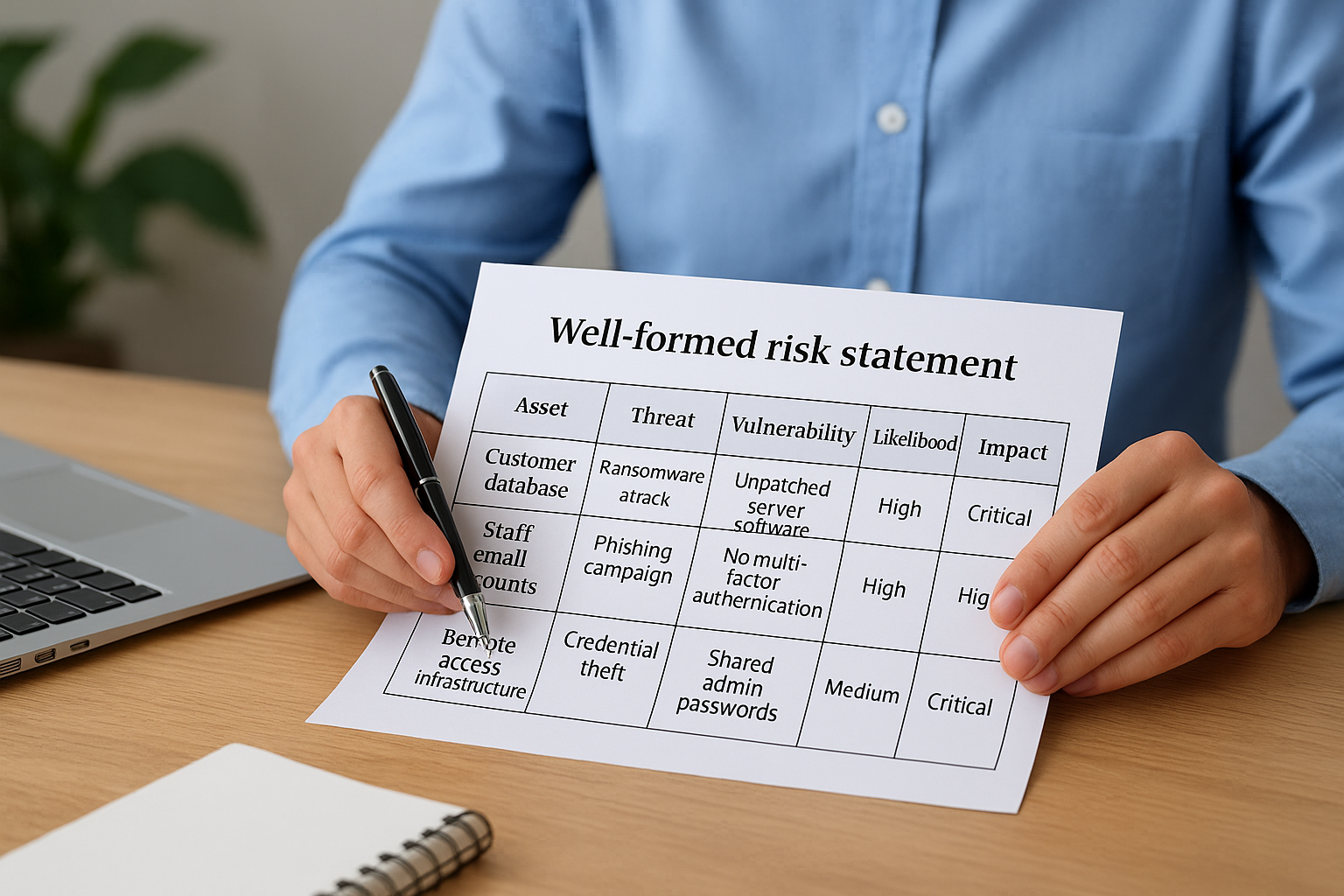
| Asset | Threat | Vulnerability | Likelihood | Impact | Risk Rating |
|---|---|---|---|---|---|
| Customer database | Ransomware attack | Unpatched server software | High | Critical | Very High |
| Staff email accounts | Phishing campaign | No multi-factor authentication | High | High | High |
| Remote access infrastructure | Credential theft | Shared admin passwords | Medium | Critical | High |
Each row gives the risk owner everything they need to decide whether and how quickly to act. You can see immediately that the unpatched server and the absence of MFA are not abstract concerns but specific, traceable findings that require a named owner and a treatment plan attached to them.
Translating risk ratings into treatment decisions
The risk rating is only useful if it connects directly to a treatment decision and a responsible person.
Once you have your risk ratings, your next step is to measure each one against your documented risk appetite, the threshold your organisation has agreed it can accept. Risks that exceed that threshold need an assigned treatment. For the examples above, deploying MFA across all email accounts is a straightforward mitigation that significantly reduces one of the most common attack vectors in the UK threat landscape. Patching the server addresses another. Replacing shared admin passwords with individual privileged accounts removes a third. Each treatment links back to the original risk statement, so your register stays coherent and your decisions remain auditable as your environment changes over time.
Common mistakes and how to avoid them
Even organisations that understand what is cyber risk assessment in theory often undermine their own efforts through avoidable process errors. Knowing where these mistakes tend to occur means you can structure your assessment to prevent them from the start, rather than discovering the gaps after an incident has already exposed them.
Treating the assessment as a one-time task
Many organisations complete a risk assessment, file the document, and move on. That approach produces a snapshot that becomes outdated almost immediately. Your threat environment changes, your systems change, your staff change, and any of those shifts can introduce new risks that your original assessment never captured.
A risk assessment that never gets revisited gives you a false sense of security, which is more dangerous than having no assessment at all.
Build a defined review cycle into your programme from the outset, whether that’s annually, after a significant change to your infrastructure, or following a security incident. The review doesn’t need to rebuild the entire assessment from scratch; it needs to challenge your existing findings against your current environment and update the risk register accordingly.
Scoping too broadly or too narrowly
Setting the wrong scope is one of the most common reasons assessments fail to produce useful, actionable output. Too narrow, and you miss the connections between systems that create compound risk. Too broad, and the work becomes unmanageable, which leads to shallow analysis that misses the specific vulnerabilities that actually matter.
Define your scope clearly at the start, tied to a specific system, business process, or data classification rather than a vague organisational boundary. If your full environment is genuinely large, break it into discrete assessment cycles so each one receives the depth of attention it needs.
Failing to assign clear ownership
A risk finding without a named owner is a finding that won’t get treated. You can produce a thorough, well-structured assessment and still see no improvement if nobody holds responsibility for acting on the results. Each risk in your register needs a specific person accountable for treatment, a timeline, and a defined outcome.
Ownership also matters for ongoing monitoring. When your environment changes, the person responsible for a given risk area is best placed to flag whether the original assessment still holds or whether you need to revisit your rating and treatment plan.
Making it ongoing with a risk register
A completed risk assessment answers the question of what is cyber risk assessment in practice, but the real value comes from what happens after you finish it. Your findings should feed directly into a live risk register, a structured document that records every identified risk, its rating, its owner, the chosen treatment, and the current status of that treatment. Without a register, your assessment produces findings that have nowhere to go, and individual risks lose their connection to the decisions made about them over time.
What a risk register contains and how to maintain it
Your risk register is the operational home of your risk programme. Each entry should capture the asset affected, the threat and vulnerability involved, the likelihood and impact scores, the risk rating, the assigned owner, the treatment decision, and the target review date. That structure means anyone looking at the register can understand the full picture of a risk without needing to dig through a separate assessment document.
Treat your risk register as a living record, not an archive. It should reflect your current exposure, not the state of your organisation when you first built it.
Maintaining the register means revisiting entries when your environment changes, not just at your scheduled annual review. When you onboard a new system, change a third-party supplier, or expand your remote working capabilities, check whether any existing risk entries need updating and whether the change introduces risks that aren’t captured yet. Assign that review responsibility to the same person who owns the relevant risk so it becomes part of their normal operational accountability rather than a separate task that falls through the gaps.
Connecting the register to your wider security programme
Your risk register should inform your security investment decisions, your policy updates, and your incident response priorities. When leadership asks why a particular control is in place or why a system is being patched ahead of schedule, your register gives you a direct, documented answer. It also provides auditors and insurers with a clear trail showing that your organisation identifies, evaluates, and acts on risk systematically.
Reviewing and updating the register on a defined cycle, whether quarterly or after any significant change, keeps your risk programme grounded in reality rather than a point-in-time snapshot that becomes less accurate with every week that passes.
Next steps for your organisation
Now that you understand what is cyber risk assessment and how each component connects, the practical next step is to start building your own process. Begin with your asset inventory: even a basic list of your critical systems and the data they hold gives you a foundation to work from. From there, identify the realistic threats those assets face and work through the likelihood and impact scoring that turns observations into actionable risk ratings.
If your organisation lacks the internal resource or expertise to run this process confidently, working with a specialist removes the guesswork and ensures your assessment meets the requirements of frameworks like ISO 27001 or Cyber Essentials. TrustedIA has helped UK businesses of all sizes build structured, defensible risk programmes from the ground up, using our own CRAFT tooling to assess your security posture quickly and accurately. To find out how we can support your organisation, get in touch with the TrustedIA team today.